
On April 13, 2023, the FTC announced notices of penalty offenses sent to approximately 670 companies marketing OTC drugs, homeopathic products, dietary supplements and functional foods. The notices warned that companies could face civil penalties of up to $50,120 per violation for unsubstantiated claims. Health claims need competent and reliable scientific evidence, and claims to treat serious disease need well-controlled human clinical trials. For IV wellness clinics, the lesson is to describe drips accurately and avoid unsupported promises.
IV wellness marketing has long leaned on bold language. Drip menus promise immunity, energy, detox, beauty and recovery, often with names that suggest more than the evidence supports. That language can work in the short term, but it also creates risk, and it can make a careful clinic sound like every other one on the block. In 2023, the FTC sent a broad reminder that health claims need real evidence behind them.
On April 13, 2023, the FTC announced it had sent notices of penalty offenses to approximately 670 companies marketing over-the-counter drugs, homeopathic products, dietary supplements and functional foods. IV clinics were not the target group, but the principles in those notices describe exactly how regulators view health claims.
This retrospective covers what happened and what it means for IV wellness clinics today. It connects to our coverage of the 2025 Texas IV therapy law, the 2024 TikTok law and the 2023 FTC Endorsement Guides update.
What actually happened in 2023
April 13: the notices. The FTC announced notices of penalty offenses sent to approximately 670 companies marketing OTC drugs, homeopathic products, dietary supplements or functional foods.
The penalties. The FTC said the notices allow it to seek civil penalties of up to $50,120 per violation against a company that engages in conduct it knows has been found unlawful in prior administrative orders.
The evidence standard. The notices listed unlawful practices including lacking competent and reliable scientific evidence for health or safety claims, and lacking at least one well-controlled human clinical trial for claims that a product cures, mitigates or treats a serious disease. Misrepresenting the level of substantiation or claiming something is “clinically proven” without basis was also listed.
Endorsements too. Recipients also received a notice about endorsements and testimonials, including misrepresenting that endorsers’ experiences are typical.
No implication of wrongdoing. The FTC said inclusion on the list did not suggest any recipient had engaged in deceptive or unfair conduct. It pointed recipients to its Health Products Compliance Guidance, issued in December 2022. The vote was 3-1.
Why it mattered for IV wellness clinics
IV clinics sell services rather than packaged products, but their marketing makes the same kinds of objective health claims. “Boosts immunity.” “Flushes toxins.” “Cures hangovers.” “Clinically proven to increase energy.” Each of those is a claim that, under FTC principles, needs evidence appropriate to what it says.
The notices also made clear that the FTC’s principles apply to any marketer making efficacy claims, not only to the companies that received letters. The Health Products Compliance Guidance explicitly addresses health-related claims broadly, and it is a useful reference for clinic copy.
IV wellness also attracts attention from state regulators and medical boards, which oversee who can order and administer infusions. Marketing that overstates benefits can draw scrutiny from more than one direction, and complaints from a single unhappy client can start that process.
What typical agencies did
Many agencies kept writing drip menus the same way: benefit-heavy names, broad promises and testimonials presented as typical results. Social content leaned on before-and-after energy claims and celebrity associations.
The better approach was a claims review: list every claim on the website, menus, ads and social posts, then decide which ones the clinic can support and rewrite the rest. Clinics that did this often found the rewritten copy read as more premium, because confident, specific language sounds more credible than a list of promises.
What it means for an IV wellness clinic today
These steps help an IV clinic market confidently without overstating what it offers.
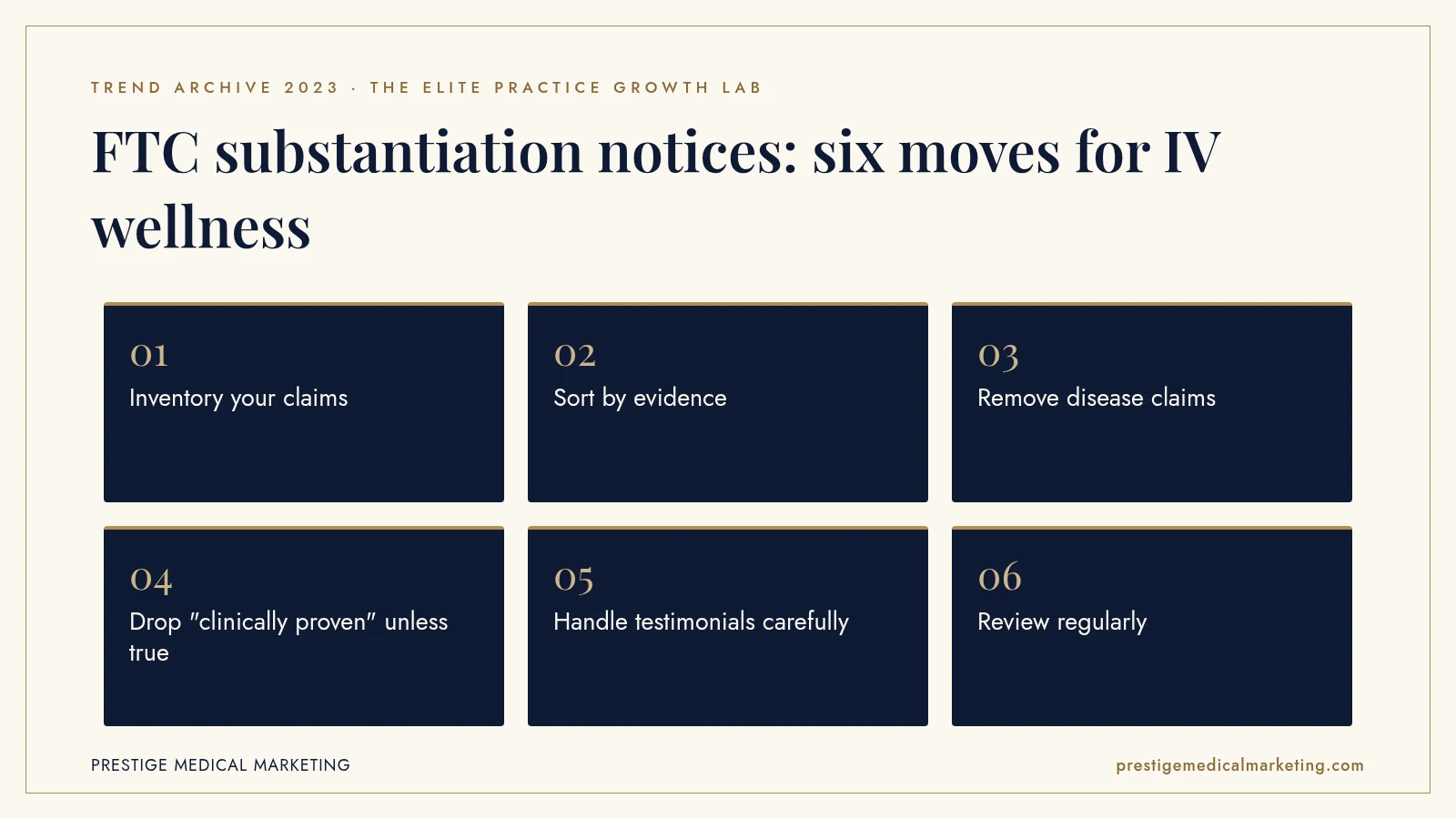
1. Inventory your claims
List every health claim across the website, menus, ads, social posts and printed materials. Include drip names, since a name can itself be a claim. Do not forget old articles, landing pages from past promotions and pinned social content.
2. Sort by evidence
For each claim, ask what evidence supports it. Clinical oversight should help judge whether the evidence matches the claim’s strength. A claim supported only by general nutrition facts should be phrased far more modestly than one backed by human trials of the specific treatment.
3. Remove disease claims
Claims to cure, treat or prevent disease need rigorous evidence. Most wellness drips should not make them, and words like “treats,” “prevents” and “cures” are worth searching for and removing.
4. Drop “clinically proven” unless true
Do not imply proof that does not exist. Describe ingredients and what is known accurately. Citing a study about an ingredient taken by mouth does not prove the same benefit from an infusion, and the copy should not suggest it does.
5. Handle testimonials carefully
Do not present individual experiences as typical, and disclose any material connections with endorsers. That includes staff, friends of the owner and anyone who received a free or discounted service.
6. Review regularly
New menu items, promotions and social posts should go through the same review before launch. Seasonal campaigns, such as cold-season or holiday recovery promotions, are where risky claims tend to creep back in.

Writing a drip menu that holds up
A strong drip menu can be both accurate and appealing. Lead with what is in the bag: fluids, vitamins, minerals or other ingredients, with amounts where appropriate. Explain who the service is designed for and what the process involves, including the screening and clinical oversight. Describe expected experiences in modest, honest language, and note that results vary.
Names can still have personality without implying medical outcomes. “The Recovery Drip” invites a question; “The Immunity Cure” makes a claim. The difference matters far more than it first appears. Our IV therapy marketing guide includes examples of menu structures that convert without overpromising.
Detox and immunity language
Two of the most common wellness claims deserve particular care. “Detox” claims suggest the body is removing specific toxins because of the service, which is rarely supported for IV vitamin therapy. “Immunity” claims suggest protection against illness, which edges toward disease prevention.
Clinics that want to talk about these themes can do so honestly by describing ingredients and their known roles in general terms, without promising specific health outcomes. When in doubt, a medical director and qualified counsel should review the wording.
Social media and influencer content
Much IV clinic marketing happens on Instagram and TikTok, often through influencers or patient content. Claims made in those posts are still the clinic’s advertising when the clinic directs or pays for them. The FTC’s endorsement principles, updated in June 2023, require clear disclosure of material connections and prohibit using endorsements to make claims the clinic could not make directly.
That means influencer briefs should include claim guidance, and clinics should review content before it goes live. We cover the endorsement side in our Endorsement Guides retrospective.
What builds demand instead
IV clinics that win long term usually compete on experience and trust rather than promises. A beautiful, calm space, clear pricing, visible clinical oversight, transparent screening and excellent reviews give people reasons to book that do not depend on bold health claims.
Local search visibility matters too. People searching for IV therapy nearby compare Google Business Profiles, reviews and websites. A clinic that looks professional and explains its services clearly converts those searches. Our Google Business Profile guide applies directly.
Pricing, memberships and promotions
Claims are not limited to health benefits. Pricing language, membership terms and promotions are also advertising, and they need to be accurate. “Starting at” prices should reflect real options. Membership benefits and cancellation terms should be clear before someone signs up. Limited-time offers should actually be limited.
IV clinics that rely on memberships benefit from making terms easy to understand and easy to exit. That reduces complaints and chargebacks and builds the kind of trust that keeps members longer. We cover membership terms in more detail in our 2025 click-to-cancel retrospective.
Who reviews the copy
A practical question for many clinics is who should approve marketing claims. The answer is usually a small team: the medical director or supervising clinician for clinical accuracy, the owner for brand and business fit, and qualified counsel for higher-risk claims or new campaigns. The marketing partner should flag questionable claims rather than wait to be told.
A simple shared document listing approved claims, prohibited phrases and required disclosures saves time. New staff, influencers and agencies can work from it, and the clinic avoids reinventing decisions with every post. It also creates a record showing the clinic took claims seriously.
The website as the source of truth
Ads, social posts and influencer content are short by nature. The website is where a clinic can explain services fully: ingredients, process, screening, who is a good candidate, who is not, pricing and what to expect. When short-form content points back to a clear, accurate website, the overall marketing is easier to defend and more persuasive.
A well-built service page also helps search visibility. Search engines and AI assistants increasingly reward pages that answer questions directly and accurately. Thin pages packed with benefit claims do poorly on both counts. Our custom website service builds service pages that work for patients, search and compliance at once.
Before-and-after content and reviews
IV clinics often share patient stories about energy, recovery or skin. Real reviews are valuable, but a clinic should not cherry-pick or edit them into health claims it could not make itself. Featuring a review that says a drip “cured my migraines” turns that review into the clinic’s claim. Thank reviewers, share general experience-focused feedback and leave dramatic health outcomes out of advertising. Our guide to reputation and premium pricing shows how reviews support pricing without crossing that line.
Mobile IV and event services
Many IV businesses offer mobile or event services, marketed heavily on social media with lifestyle imagery. The same claim principles apply, and mobile services face extra questions about screening, supervision and safety. Marketing should describe how screening works and who provides care, rather than presenting IV therapy as a casual add-on to a party.
What 2023 does not tell us
The notices went to product marketers, and the FTC did not announce actions against IV clinics as part of this effort. We do not know how the FTC would evaluate any particular drip claim, and state rules differ. What 2023 does show is the documented evidence standard the agency applies to health claims, which is a sound guide for any clinic.
The premium practice advantage
Premium IV clinics market with precision rather than hype. Visit our IV wellness marketing service, our services, who we help and our approach to Google Maps and AI search visibility. Our team works from Austin with practices nationwide.
The bottom line
The 2023 FTC notices restated a simple, durable principle: health claims need evidence. IV wellness clinics that describe their services accurately and compete on experience and trust build a brand that lasts.
Check if your market is open. We take one practice per specialty per market. Request a market check or call (716) 400-0084.
Frequently asked questions
What did the FTC send in April 2023?
Notices of penalty offenses to approximately 670 companies involved in marketing OTC drugs, homeopathic products, dietary supplements or functional foods, warning about unsubstantiated product claims.
How large could the penalties be?
The FTC said notices of penalty offenses allow it to seek civil penalties of up to $50,120 per violation against companies that engage in conduct found unlawful in prior administrative orders.
What evidence does the FTC expect for health claims?
Competent and reliable scientific evidence for health or safety claims, and at least one well-controlled human clinical trial for claims that a product cures, mitigates or treats a serious disease.
Did being on the list mean a company broke the law?
No. The FTC said inclusion on the list did not in any way suggest that a recipient had engaged in deceptive or unfair conduct.
Does this apply to IV wellness clinics?
The notices went to product marketers, but the FTC's substantiation principles apply to anyone making objective health claims in advertising, including service providers. Get legal advice on specific claims.
How should IV clinics describe their drips?
Describe ingredients, the process and what is known accurately, avoid disease and cure claims, avoid implying proof that does not exist and have clinical oversight review the copy.