
On April 24, 2024, the Protecting Americans from Foreign Adversary Controlled Applications Act became law. It required TikTok's owner, ByteDance, to divest TikTok's U.S. operations or face a ban from U.S. app stores and hosting services, with a deadline of January 19, 2025. The Supreme Court upheld the law in January 2025, and a U.S. joint venture deal closed in January 2026. For IV and wellness clinics, the episode showed the risk of depending on a single platform for new clients.
For many IV hydration and wellness clinics, TikTok became one of the fastest ways to reach new clients. Short videos about recovery drips, immune support or a behind-the-scenes look at a lounge could reach thousands of local viewers. Some clinics built much of their new client flow on the platform.
In 2024, Congress put that flow at risk. A new federal law gave TikTok’s owner a deadline to sell the app’s U.S. operations or face a ban. For months, business owners watched headlines about lawsuits, court arguments and deadlines, unsure whether a key marketing channel would survive.
This retrospective covers what happened, why it mattered for IV and wellness clinics and how to reduce platform risk today. For our broader approach, see IV therapy marketing.
What actually happened in 2024
The law. On April 24, 2024, the foreign aid package that included the TikTok provisions became law. The Protecting Americans from Foreign Adversary Controlled Applications Act required ByteDance to divest TikTok’s U.S. operations or face restrictions.
The deadline. The law set a deadline of January 19, 2025. After that, app stores and internet hosting services would be barred from distributing, maintaining or updating TikTok in the United States unless a qualifying divestiture occurred. The law allowed a possible extension under certain conditions.
The challenge. TikTok, ByteDance and a group of creators challenged the law in court. A federal appeals court upheld it in December 2024, and the Supreme Court agreed to hear the case on an expedited basis.
The ruling. On January 17, 2025, the Supreme Court upheld the law. TikTok briefly went offline for U.S. users that weekend, then restored service, and enforcement was delayed by executive action while a deal was negotiated.
The outcome. In January 2026, CNN reported that a deal had closed creating a U.S. joint venture to run TikTok in the United States. We cover the 2025 blackout in our retrospective on TikTok going dark.
Why it mattered for IV and wellness clinics
IV and wellness clinics are a natural fit for short video. Services are easy to show, the lounge environment is visual and many clients are younger adults who spend time on TikTok. A single video could fill a weekend of appointments. For some clinics, TikTok was not one channel among many. It was the main source of new clients.
The 2024 law exposed that dependency. A clinic could have thousands of followers, a library of popular videos and a steady stream of messages, and none of it was guaranteed. If the app disappeared, the followers, the videos and the message history would be out of reach. Clinics that had not collected contact information or built other channels faced a real risk.
The uncertainty itself was costly. Owners had to decide whether to keep investing in TikTok content, shift budget elsewhere or wait. Those decisions were made without knowing how the story would end.
What typical agencies did
Many agencies kept producing TikTok content without discussing the risk. Some told clients the ban would never happen. Others panicked and moved budget abruptly to other platforms, losing momentum.
A common gap was the lack of a capture strategy. Agencies measured views and followers but rarely helped clinics turn TikTok viewers into contacts the clinic owned, such as booked clients, email subscribers or text opt-ins.
Few agencies used the moment to build the foundation that would protect a clinic regardless of the outcome.
What it means for an IV or wellness clinic today
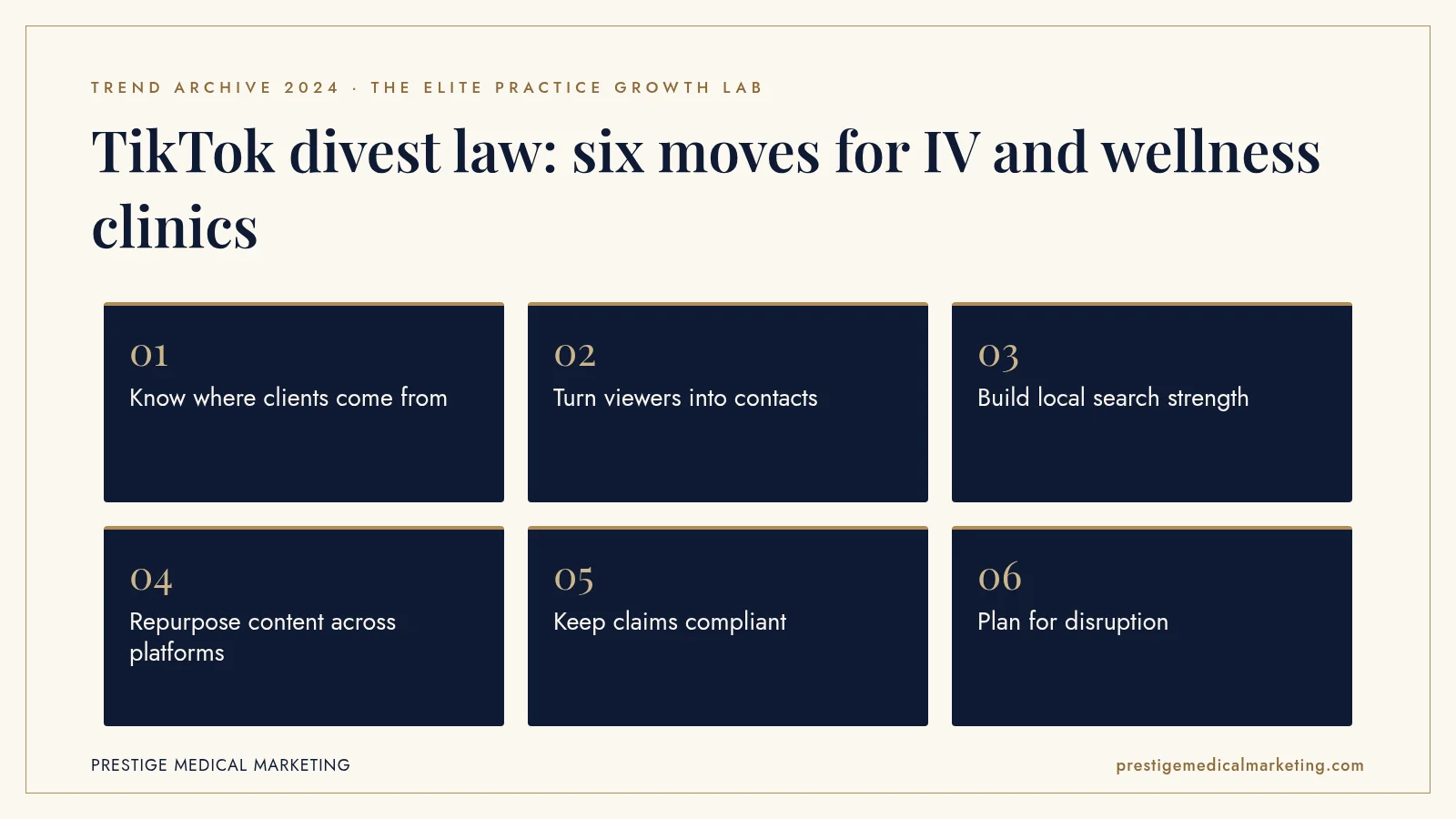
Use platforms for reach and own the relationship. Here is how we approach it.
1. Know where clients come from
Ask every new client how they found you and record it. Without this, you cannot see how dependent you are on one platform.
2. Turn viewers into contacts
Give social viewers a reason to book, join an email list or opt in to texts, with proper consent. Contacts you own survive platform changes.
3. Build local search strength
A complete Google Business Profile, steady reviews and clear service pages bring clients who are ready to book, independent of any social app.
4. Repurpose content across platforms
Short videos can run on Instagram, YouTube Shorts and your website. Spreading content reduces dependence on a single feed.
5. Keep claims compliant
Wellness content attracts scrutiny. Avoid disease claims and exaggerated benefits, and follow advertising rules on every platform.
6. Plan for disruption
Write down what you would do if a major platform went away tomorrow. A simple plan prevents panic decisions.
Borrowed reach versus owned relationships
Followers feel like an asset, but they are a relationship mediated by a platform. The platform decides who sees a post, whether an account stays active and whether the app is available at all. When the platform changes, the relationship changes with it.
Owned relationships are different. A client’s phone number, email address and booking history belong to the clinic’s systems, with the client’s permission. A clinic can reach those clients regardless of what happens to any app. That is why the most resilient wellness clinics treat social media as the top of a funnel, not the whole funnel.
Building owned relationships takes deliberate effort. Offer something worth signing up for, such as early access to new services, membership information or seasonal offers. Make sign-up easy at booking and checkout. Then send messages people actually want, not constant promotions.
Content that works across platforms
The kinds of videos that perform well for IV clinics, such as a quick explanation of what is in a drip, a tour of the lounge, a nurse answering a common question or a look at the booking process, are not unique to TikTok. They work on Instagram reels, YouTube Shorts and a clinic’s website.
Planning content for multiple platforms from the start makes the work more efficient. Film once, edit for each format and post widely. Track which platforms bring bookings, not just views. Over time, the clinic learns where its clients actually come from and can invest accordingly. Our notes on Instagram changes cover the reels side of this.
Compliance for wellness content
IV and wellness clinics operate in a space where claims matter. Content that suggests a drip treats or cures a disease, or that promises specific health outcomes, can draw attention from regulators and platforms and can mislead clients. Medical oversight, screening and qualified staff should be clear in the content, not hidden.
State rules also matter. Some states have tightened oversight of IV therapy businesses, as covered in our retrospective on the Texas IV therapy law. Content that shows proper screening, licensed clinicians and safety practices can be both compliant and reassuring to clients.
Local search as the steady channel
Social media is excellent for awareness. Local search is where many clients go when they are ready to act. Someone who saw a video about recovery drips may later search for IV therapy near them, look at reviews and book. If the clinic is not visible in that search, the awareness from social media can benefit a competitor.
A strong local presence means a complete and accurate Google Business Profile, regular reviews, clear service and pricing pages, fast mobile pages and easy online booking. These assets keep working regardless of what happens on any social platform. They also tend to bring clients with clear intent.
Communicating with clients during uncertainty
When a platform is in the news, clients notice. Some will ask whether they can still find the clinic, follow updates or redeem offers they saw on the app. A clinic that answers clearly looks prepared and professional.
A simple message works best: where clients can follow the clinic, how to book directly and how to get updates by email or text. Post it on the platform while it is available, and repeat it on the website and in the booking confirmation. Clients who receive that message before any disruption are much easier to keep.
The same approach applies to any platform change, from a policy update that limits certain content to an account suspension caused by an automated review. Having a direct line to clients turns a potential crisis into an inconvenience.
A platform dependency check
A quick exercise shows how exposed a clinic is. Pull the last three months of new client records and group them by how each person found the clinic. If one social platform accounts for most new clients, the clinic is concentrated. If new clients come from a mix of search, referrals, social and returning clients, the clinic is more resilient.
Next, count the contacts the clinic can reach directly: clients with valid email addresses or text opt-ins, and past clients who could be invited back. Compare that number with the clinic’s social following. A large following with a small contact list is a warning sign. The goal over the next year is to grow the contact list steadily from every channel.
Finally, check whether the clinic’s best content lives anywhere besides the platform. If the most popular videos exist only inside one app, download the originals, store them safely and publish them on the website and other channels. Content is an asset only when the clinic can still use it after a platform changes.
Memberships and repeat visits
Many IV and wellness clinics offer memberships or packages. Those programs are another form of owned relationship. A member who visits monthly has a direct connection to the clinic that does not depend on any feed. Clear membership pages, simple sign-up and good service at every visit turn one-time visitors from social media into long-term clients.
What 2024 does not tell us
The 2024 law created uncertainty that lasted well beyond the year, and we do not have reliable data on how many wellness clinics lost or shifted business because of it. Ownership, policies and features of TikTok in the United States may continue to change, so check current news before making decisions. What 2024 does show is that a clinic’s access to its audience on any platform can change because of events completely outside its control.
The premium practice advantage
A premium IV and wellness clinic is known for safe, comfortable, well-run care. That reputation lives in reviews, client relationships and local search, not in one app’s algorithm.
That is how we approach wellness marketing: social discovery that feeds owned channels, backed by Google Maps and AI search visibility and a booking path you control. See our services and who we help, including IV and wellness clinics. Our team works from Austin with practices nationwide.
The bottom line
The April 2024 TikTok law gave ByteDance a deadline to divest or face a U.S. ban, a law the Supreme Court later upheld. For IV and wellness clinics, the lasting lesson was about dependency. Use social platforms for reach, but build owned relationships, local search strength and a direct booking path that no single platform can take away.
Check if your market is open. We take one practice per specialty per market. Request a market check or call (716) 400-0084.
Frequently asked questions
What did the 2024 TikTok law require?
The Protecting Americans from Foreign Adversary Controlled Applications Act required ByteDance to divest TikTok's U.S. operations by January 19, 2025, or app stores and hosting providers would be barred from distributing and supporting the app in the United States.
When was it signed?
It was signed on April 24, 2024, as part of a larger foreign aid package passed by Congress.
Did the Supreme Court rule on it?
Yes. On January 17, 2025, the Supreme Court upheld the law. TikTok briefly went offline in the United States that weekend before service was restored and enforcement was delayed by executive action.
How was it resolved?
In January 2026, a deal closed creating a U.S. joint venture to operate TikTok in the United States, with ByteDance keeping a minority stake according to news reports. Check current news for the latest status.
Why does this matter for an IV or wellness clinic?
Many wellness clinics used TikTok for discovery. The law showed that a clinic's audience on any platform can be disrupted by events it cannot control, so owned channels and local search matter.
Should a clinic stop using TikTok?
Not necessarily. TikTok can still be valuable. The lesson is to use it for discovery while building a website, Google presence, reviews and an email or text list that the clinic owns.