
Apple previewed Mail Privacy Protection on June 7, 2021 and released it with iOS 15 on September 20, 2021. The feature stops senders from using invisible pixels to learn when a user opens an email and masks the user's IP address. Because opens from Apple Mail users who turned it on could no longer be measured reliably, open rates became inflated and less meaningful. IV wellness clinics learned to judge email by clicks, bookings, rebookings and membership retention instead.
Email has always suited IV wellness clinics. The relationship is repeat by nature: a client books a hydration drip before a trip, a recovery session after an event or a monthly membership visit. Between visits, a short email about a new formulation, an opening on Saturday morning or a membership renewal reminder keeps the clinic top of mind. For years, the first number many clinics checked after a send was the open rate.
In 2021, Apple made that number far less reliable. Mail Privacy Protection, part of iOS 15, was designed to stop senders from learning when someone opened a message. For a clinic that judged subject lines, send times and even whole campaigns by opens, it removed a familiar compass.
This retrospective covers what Apple actually announced and released in 2021, why IV wellness clinics felt it and what a clinic should measure today. For the later chapters of email and privacy changes, see our look at iOS 17 Link Tracking Protection in 2023 and the 2024 Gmail and Yahoo sender requirements.
What actually happened in 2021
June 7: the preview. At its developer conference, Apple previewed new privacy protections in iOS 15, iPadOS 15 and macOS Monterey. In the Mail app, Apple said, Mail Privacy Protection stops senders from using invisible pixels to collect information about the user, helps prevent senders from knowing when a user opens an email, and masks the user’s IP address so it cannot be linked to other online activity or used to determine location.
September 20: the release. Apple announced that iOS 15 was available as a free software update. From that point, Apple Mail users on updated devices could turn on Mail Privacy Protection.
The mechanics. Most email platforms measured opens by embedding a tiny invisible image in each message. When the image loaded, the platform recorded an open, often with a time and approximate location. Mail Privacy Protection changed when and how that content loaded for users who turned it on, so the image could load without the person ever reading the message.
Other privacy changes the same year. The same June announcement included Hide My Email, which lets users share random forwarding addresses, and stronger Intelligent Tracking Prevention in Safari that hides IP addresses from known trackers. Together they signaled that Apple would keep reducing what senders and advertisers could learn about individual users.
Why it mattered for IV wellness clinics
IV wellness is a frequency business. Its economics depend on clients returning, whether through memberships, packages or simple rebooking. Email is one of the main ways clinics encourage that, and open rates had become a quick shorthand for whether the audience was paying attention.
After Mail Privacy Protection, a clinic might see open rates jump without any change in client behavior. A subject line test could declare a winner based on opens that did not reflect reading. Send-time optimization based on when people opened became guesswork for a large share of the list. Automated sequences that branched on whether someone opened, such as sending a reminder to non-openers, started treating many readers and non-readers alike.
The clinics that noticed this early stopped arguing about opens and started looking at what clients actually did: clicked to book, booked, came in, renewed.
What typical agencies did
Many email reports kept leading with open rate long after it stopped meaning much. Some agencies celebrated higher opens as evidence that content was improving. Others filtered out Apple opens in ways that were not always transparent, which made comparisons with earlier periods unreliable.
A few reacted by sending more often, assuming that more sends would make up for weaker signals. For a premium wellness brand, that approach tends to increase unsubscribes and erode the sense that each message is worth reading.
The better approach was to change the scoreboard. That meant tying email to bookings, defining success as appointments and renewals, and testing subject lines and offers based on clicks and conversions instead of opens.
What it means for an IV wellness clinic today
Open rates are still reported, but they are best treated as a rough health check. These habits make email measurable again.
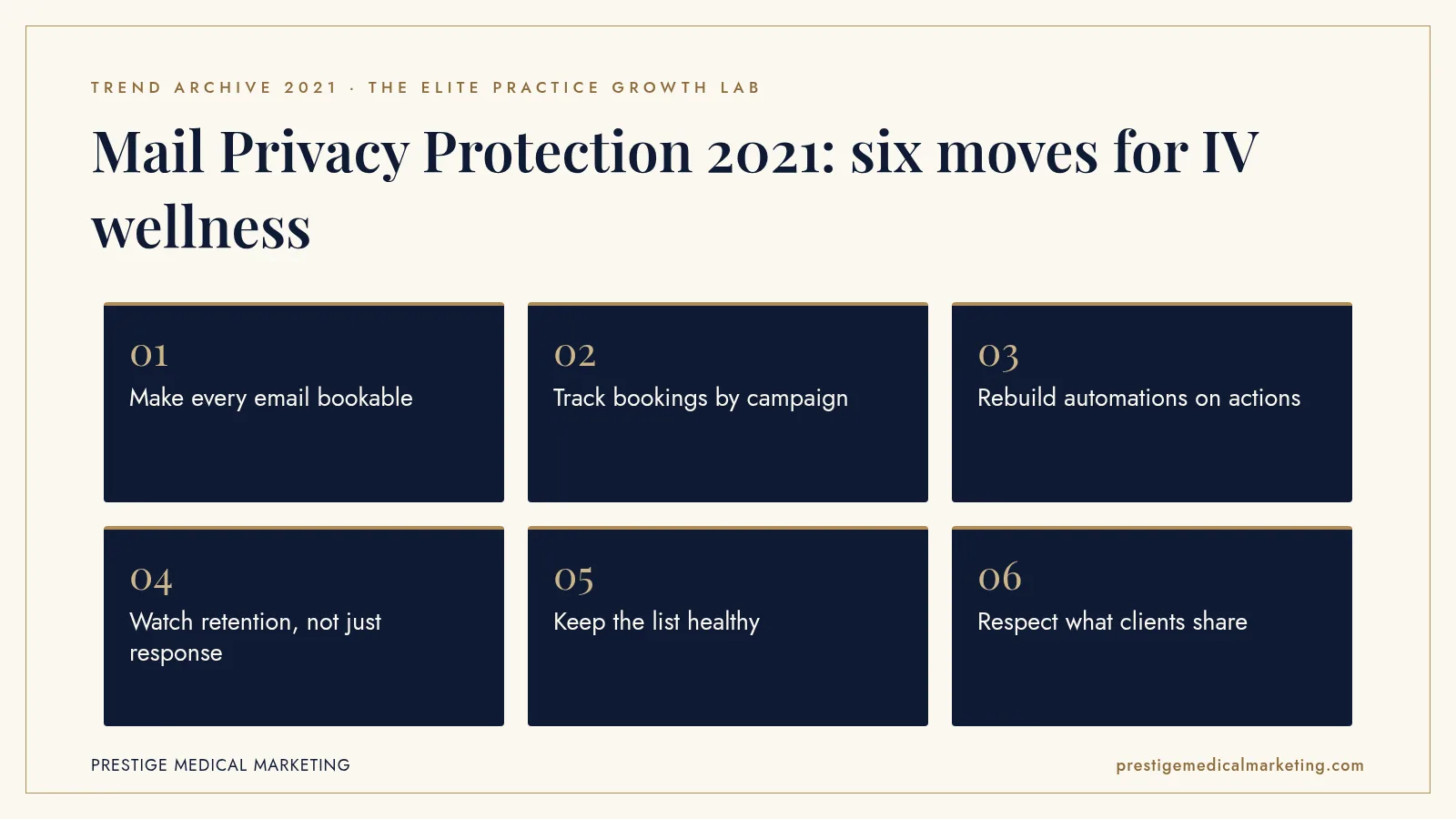
1. Make every email bookable
Each send should have one clear action, usually a link to book or to manage a membership. That action is measurable in a way opens no longer are.
2. Track bookings by campaign
Use consistent link tagging and your booking system’s reporting to see which emails produced appointments, not just visits.
3. Rebuild automations on actions
Branch sequences on clicks, bookings and visits instead of opens. A client who booked does not need the reminder; one who did not might.
4. Watch retention, not just response
Membership renewals, rebooking intervals and lapsed-client reactivation show whether email is doing its real job.
5. Keep the list healthy
Remove addresses that have not clicked or booked in a long time, and make unsubscribing easy. Healthy lists reach inboxes more reliably.
6. Respect what clients share
Do not put health details in subject lines or previews, and be careful about what personal information flows into email platforms and integrations.
What good wellness email looks like
The best wellness emails read like a note from the clinic rather than a flyer. They are short, specific and useful: a new weekend opening, a reminder that a membership visit is available this month, a clear explanation of a seasonal service, or a practical note about hydration before a long flight. They say who the clinical team is and avoid promising outcomes that IV therapy cannot guarantee.
Accuracy matters in wellness marketing. Claims about immunity, energy, detox or recovery should be careful and supportable. An email that overpromises may get a click, but it undermines trust with clients and can attract regulatory attention. Language that describes what a service involves and who it may suit, with a clear invitation to ask questions, serves a premium brand better.
Design should work on a phone first. Most wellness clients read email on mobile, so a single column, a readable font, one primary button and a booking page that loads quickly matter more than elaborate graphics.
Memberships and the long view
For clinics with memberships, email is less about promotion and more about service. Welcome sequences that explain how to use a membership, reminders before credits expire and simple ways to pause or change plans help members get value, which supports retention. These messages are judged by whether members keep coming and keep renewing.
That long view also guards against a common trap. A promotional blast can produce a short burst of bookings while quietly increasing unsubscribes and spam complaints. Over a year, a calm, useful cadence that keeps the list engaged usually produces more visits than aggressive promotion.
Clinics that also send text messages should apply the same thinking. Each channel should have a clear purpose, a reasonable frequency and an easy way to opt out, and messages should never include sensitive health details.
Reading the numbers honestly
A practical email report for an IV wellness clinic might show sends, clicks, bookings attributed to each campaign, revenue from those bookings where available, unsubscribes and complaints. Over time it should show membership retention and rebooking intervals for clients who receive email compared with the clinic’s overall base. Opens can sit at the bottom as context, clearly labeled as inflated by privacy features.
That kind of report makes decisions easier. If a monthly educational email produces steady bookings with few unsubscribes, keep it. If a discount-heavy campaign produces bookings but high churn later, reconsider it. The numbers that matter are the ones tied to clients walking through the door.
A note on list growth
Mail Privacy Protection also changed how clinics should think about growing a list. Because opens no longer prove attention, a large list of disengaged addresses can look healthy while doing little. A smaller list of clients who have visited, joined a membership or asked a specific question is usually worth more than a long list gathered through giveaways.
The cleanest way to grow a wellness list is to ask at natural moments: when a client books online, at check-in with clear consent, or when someone requests information about a membership. Each subscriber should know what they will receive and how often. That clarity sets expectations, reduces unsubscribes and keeps complaints low, which in turn helps messages reach inboxes.
It also helps to segment by relationship rather than by guesswork. Members, recent first-time clients and lapsed clients need different messages. A first-time client might get a short note explaining what to expect next time and how memberships work. A lapsed client might get a simple invitation back with current hours. A member might simply get a reminder that a visit is available this month. Each segment is measured by whether it produces the visit it was designed for.
Testing without opens
Subject line testing still has value, but the winner should be judged on clicks and bookings. With a modest list, differences may be small, so it helps to test bigger ideas, such as a practical note versus a promotional offer, and to repeat a test before drawing conclusions. A calm, honest subject line that tells the reader what is inside usually serves a premium clinic better than clever wording. The clinics that thrive treat email as a relationship, measured by visits and loyalty rather than by a single number on a dashboard. Honest measurement, applied consistently over months, tells a far clearer story than any single campaign. Keep it simple.
What 2021 does not tell us
Apple did not publish how many users turned on Mail Privacy Protection, and email providers reported different estimates depending on their audiences. We do not have reliable public data on how IV wellness clinics as a group were affected, and the impact depended on how many clients used Apple Mail. What 2021 established clearly is that open tracking could no longer be trusted as a measure of attention, and that the direction of travel was toward less visibility into individual behavior.
The premium practice advantage
A premium IV wellness clinic has what makes email worth reading: a clinical team clients trust, a calm experience and services worth returning for. The work is measuring email by visits and renewals. See our IV wellness services, our IV therapy marketing guide, our booking engine, our full services, who we help and how we approach Google Maps and AI search visibility. Our team works from Austin with practices nationwide.
The bottom line
Apple’s Mail Privacy Protection, released with iOS 15 in September 2021, made email open rates unreliable. For IV wellness clinics, the lasting lesson was to measure email by clicks, bookings, rebookings and membership retention, and to write messages useful enough that clients act on them.
Check if your market is open. We take one practice per specialty per market. Request a market check or call (716) 400-0084.
Frequently asked questions
When did Mail Privacy Protection launch?
Apple announced it on June 7, 2021 alongside other iOS 15 privacy features, and iOS 15 became available on September 20, 2021.
What does Mail Privacy Protection do?
Apple says it stops senders from using invisible pixels to collect information about the user, helps prevent senders from knowing when a message is opened and masks the user's IP address.
Why did open rates become unreliable?
Open tracking relies on an invisible image loading when a message is opened. With Mail Privacy Protection turned on, that signal no longer reflected whether a person actually read the email, so reported opens could be inflated.
Does it affect clicks?
Mail Privacy Protection was designed around open tracking and IP addresses. Clicks on links still require a person to act, which is why clicks and downstream bookings became more useful measures.
Why does this matter for IV wellness clinics?
Many IV wellness clinics rely on email for memberships, rebooking reminders and seasonal offers. Decisions based on open rates, such as subject line tests or send-time choices, became less trustworthy.
What should a clinic measure now?
Measure clicks, appointments booked from each email, membership renewals, rebooking rates and unsubscribes, and compare them over time rather than relying on opens.