
On June 5, 2023, Apple announced Link Tracking Protection for iOS 17, iPadOS 17 and macOS Sonoma. It removes extra information that some websites add to URLs to track users across sites from links shared in Messages and Mail and from links in Safari Private Browsing, while keeping links working. Users can also extend Safari's advanced tracking protection to all browsing. For IV wellness clinics, it meant some ad clicks would be harder to attribute, and that reliable measurement should rest on first-party, privacy-conscious data.
IV wellness clinics often grow through paid social and search ads. A promotion for a hydration drip or a membership offer goes out, people click, and the clinic wants to know which ads produced bookings. For years, much of that measurement relied on identifiers added to links that let ad platforms connect a click to a later action, sometimes days or weeks later.
In 2023, Apple took another step to limit that kind of tracking. It announced that iOS 17 would strip user-tracking information from certain links. For clinics, the change was a reminder that measurement built on following individuals across the web was becoming less reliable, and that privacy-respecting alternatives were worth building.
This retrospective covers what Apple announced and what it means today. It connects to our coverage of the FTC’s 2023 substantiation notices, the 2025 Texas IV therapy law and Chrome cookies and HIPAA tracking in 2025.
What actually happened in 2023
June 5: the announcement. Apple announced new privacy and security features, including Link Tracking Protection in Messages, Mail and Safari Private Browsing.
What it does. Apple said some websites add extra information to their URLs to track users across other websites, and that this information would be removed from links users share in Messages and Mail, with links still working as expected. The same information would also be removed from links in Safari Private Browsing.
Broader option. MacRumors reported that the feature, which Apple calls Advanced Tracking and Fingerprinting Protection in Safari settings, could also be enabled for all browsing, and that it arrived with iOS 17, iPadOS 17 and macOS Sonoma.
Part of a pattern. The change followed earlier Apple privacy measures and arrived the same summer the FTC and HHS warned health providers about online tracking technologies.
Why it mattered for IV wellness clinics
IV wellness clinics often run promotions through Instagram, Facebook and Google ads, and many share links by text and email. When identifiers are removed from links shared in Messages or Mail, or opened in Private Browsing, ad platforms may not be able to connect those clicks to later bookings. Reports in ad dashboards can become less complete, especially for promotions that spread by text or email between friends.
That does not mean ads stopped working, or that clinics should abandon paid social. It means platform reports may undercount results, and clinics that relied only on those reports could misjudge which campaigns perform.
The change also underlined a privacy point. Wellness services can reveal sensitive health information, and the same summer the FTC and HHS warned providers about sharing that data with tracking tools. Apple’s change pointed in the same direction, and clinics that aligned with it reduced both legal and reputational risk.
What typical agencies did
Many agencies treated the change as a technical obstacle and looked for workarounds, such as renaming parameters or adding more tracking scripts. Others ignored it and kept reporting platform numbers as if they were complete, which left clinic owners making budget decisions on partial information.
The better approach accepted that individual-level tracking was shrinking and built measurement around what the clinic itself knows: bookings, calls, memberships and where patients say they heard about the clinic. It was simpler, more private and more accurate about what actually grew the business.
What it means for an IV wellness clinic today
These steps build measurement that holds up as privacy protections grow.
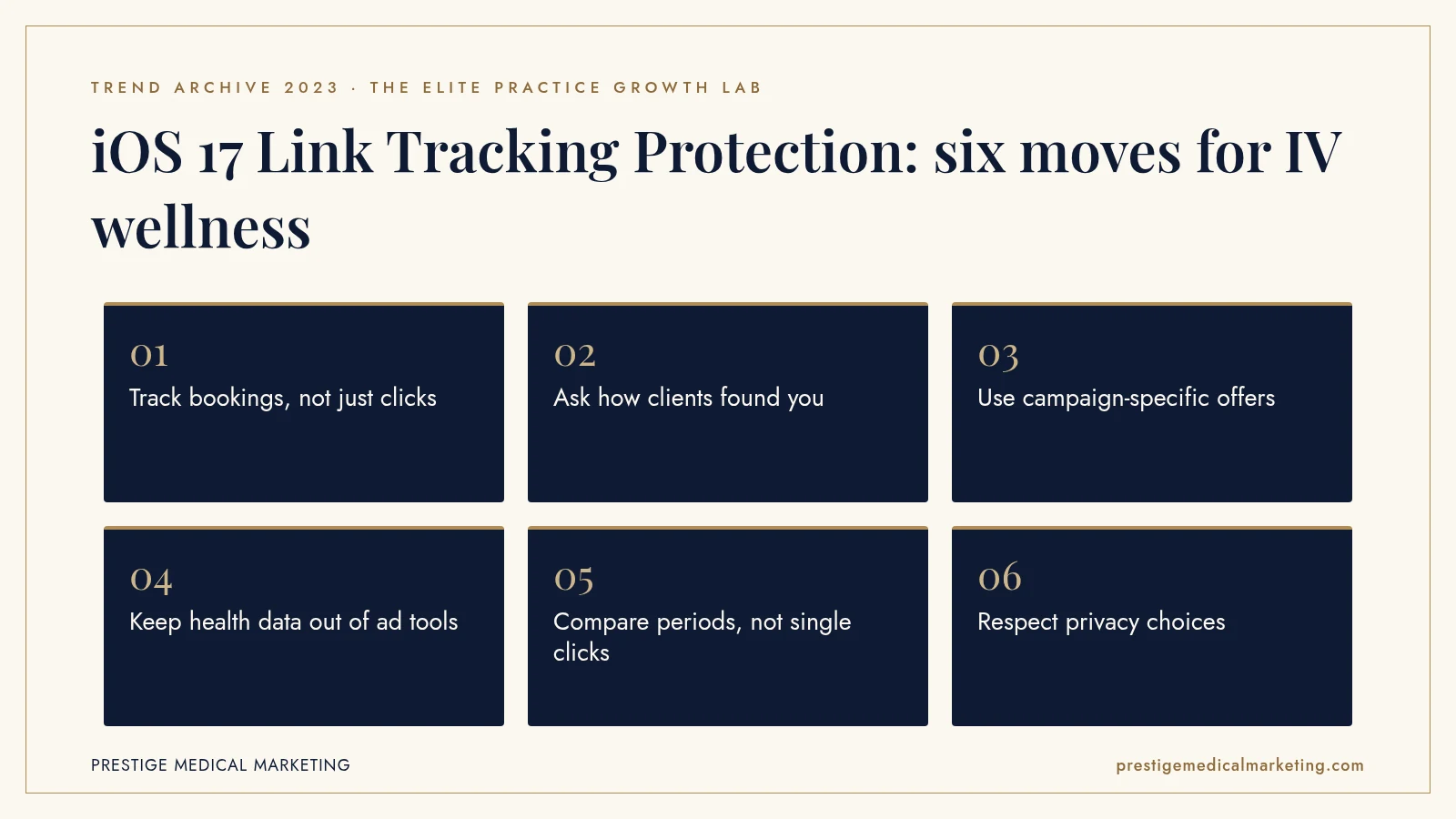
1. Track bookings, not just clicks
Measure booked appointments and revenue in the scheduling system, not only clicks and platform conversions. The scheduling system knows who actually came in, what they purchased and whether they returned. That is the most reliable record of growth a clinic has, and it is unaffected by changes to links or browsers.
2. Ask how clients found you
Add a simple source question to booking and intake, such as “How did you hear about us?” with a short list of options. Self-reported sources are imperfect and incomplete, but they capture word of mouth, social discovery and referrals that no tracking tool sees. Reviewed monthly, they reveal patterns quickly.
3. Use campaign-specific offers
Distinct offers or landing pages per campaign make attribution easier without tracking individuals. A specific membership offer for one campaign, or a dedicated page for a seasonal promotion, shows which message drove interest. Keep offers accurate and consistent with advertising rules.
4. Keep health data out of ad tools
Review pixels and tags on booking and intake pages. Information about which drip a person books, or the health goals they enter, can reveal health details. Keep advertising tags off those pages, configure any analytics carefully and get qualified advice on what applies to the clinic.
5. Compare periods, not single clicks
Judge campaigns by changes in total bookings over time. When a campaign runs, compare new client bookings with similar periods before and after. This simple approach often tells a clinic more about real impact than click-level reports.
6. Respect privacy choices
Do not try to defeat browser or device protections. Workarounds tend to break as platforms update, and they undermine the trust that wellness clients place in a clinic. Measurement that works with privacy is far more durable.

The privacy context of 2023
Apple’s announcement came in a year of heightened attention to health data online. In July 2023, the FTC and HHS sent letters to roughly 130 hospital systems and telehealth providers warning about tracking technologies, as we cover in our tracking letters retrospective. The FTC’s GoodRx and BetterHelp actions showed that sharing health information with advertising platforms could lead to enforcement.
IV wellness clinics sit in a gray area for some rules, but patients do not see the distinction. They expect wellness and health information to stay private. Apple’s change was another signal that the market was moving toward privacy, and that clinics should move with it.
Building first-party relationships
When third-party tracking weakens, the relationships a clinic owns become more valuable. An email list of clients who opted in, a membership program and a loyal client base that books directly are assets no browser change can take away. They also provide the clearest view of what is working, because every booking, renewal and referral is recorded in systems the clinic controls.
Clinics should invite clients to join a list with a clear, genuine reason, such as early access to appointments or seasonal offers, and send messages people actually want. Consent, easy unsubscribes and respect for frequency keep those lists healthy. Our coverage of the 2024 Gmail and Yahoo sender requirements explains how to keep email deliverable.
Memberships as a measurement advantage
Many IV wellness clinics offer memberships. Beyond predictable revenue, memberships make growth easier to measure. The clinic can see how many members it adds each month, how long they stay and which offers or channels brought them in. Those numbers rest entirely on the clinic’s own records.
Membership terms should be clear, with honest descriptions of what is included and how to cancel. Our coverage of the 2025 click-to-cancel ruling discusses why clear cancellation remains good practice.
A simple measurement stack
IV wellness clinics do not need complex tools to measure well. A practical stack has four parts: the scheduling system as the record of bookings and revenue, call tracking that records the source of phone inquiries without capturing health details, a self-reported source question at booking and privacy-conscious website analytics configured to avoid sensitive data. Reviewed together each month, these sources answer the questions that matter. Which channels bring new clients? Which offers convert? How many first-time clients return? None of those answers depend on identifiers that browsers may strip. Our booking engine service and guide to predictability and scaling cover how to set this up.
Text and email promotions
Text messages and emails are common channels for IV wellness promotions, and they are exactly where Link Tracking Protection applies to shared links. A client who forwards a promotion to a friend by text may send a link without its tracking details. That is not a problem to solve with tricks. It is a reason to use simple, privacy-friendly signals: a short offer code mentioned at booking, a dedicated landing page or a question at check-in. Those signals show whether a campaign drove interest without following anyone across the web. Messages should also be sent only to clients who opted in, with clear ways to stop receiving them.
Reading platform reports wisely
Ad platforms still provide useful and timely data, and many now use statistical modeling to estimate conversions they cannot observe directly. Clinics should read those reports as estimates, not exact counts. When platform numbers and booking records disagree, the booking records are the better guide to business results.
A monthly review that places platform reports next to booking data, self-reported sources and revenue gives a balanced view. Over time, the clinic learns how each platform’s reports relate to real outcomes and can budget accordingly. A platform that consistently overstates results deserves less weight, and one that understates them may deserve more investment than its dashboard suggests.
Search and local visibility as stable channels
Not every channel depends on link tracking. Clients who find a clinic through Google Maps, search results or a recommendation often book directly or call. A strong Google Business Profile, clear website and steady reviews produce bookings that are easy to see in the clinic’s own systems. Our IV therapy marketing guide covers how to balance paid and organic channels.
AI assistants increasingly answer local questions too. Clear, accurate information about services, hours and pricing helps those tools recommend the clinic. Our guide to getting recommended by AI explains the approach.
What 2023 does not tell us
Apple did not publish data on how many links were affected in practice, and we do not have reliable figures on how the change affected attribution for wellness clinics. Ad platforms have also changed their measurement tools since 2023, and the exact parameters affected have not been fully documented by Apple. Clinics should test their own links rather than rely on assumptions. What 2023 does show is Apple’s documented change and the direction of travel toward less cross-site tracking.
The premium practice advantage
Premium IV wellness clinics measure what matters and protect client trust while they do it. Visit our IV wellness marketing service, our services, who we help and our approach to Google Maps and AI search visibility. Our team works from Austin with practices nationwide.
The bottom line
Apple’s 2023 Link Tracking Protection made some ad clicks harder to trace. IV wellness clinics that measure bookings, respect privacy and keep health data out of ad tools have a clearer view of growth than any platform report can give. That clarity supports better budget decisions and builds the kind of trust that keeps clients coming back.
Check if your market is open. We take one practice per specialty per market. Request a market check or call (716) 400-0084.
Frequently asked questions
What is Link Tracking Protection?
It is an Apple privacy feature announced on June 5, 2023, that removes extra tracking information from URLs in links shared through Messages and Mail and in Safari Private Browsing.
Do links still work after tracking information is removed?
Yes. Apple said the links will still work as expected.
Which devices were affected?
The feature arrived with iOS 17, iPadOS 17 and macOS Sonoma.
Can users extend it to all Safari browsing?
MacRumors reported that users can enable Advanced Tracking and Fingerprinting Protection for all browsing in Safari's advanced settings.
How does this affect IV wellness clinic marketing?
Some ad clicks may lose click identifiers, making platform attribution less complete. Clinics should rely more on first-party measurement such as bookings, calls and simple source questions.
Should clinics try to work around it?
No. Clinics should respect user privacy choices, keep health data out of ad platforms and build measurement that does not depend on tracking individuals across sites.