
On July 8, 2025, the Eighth Circuit Court of Appeals vacated the FTC's amended Negative Option Rule, known as click-to-cancel, finding the FTC skipped a required preliminary regulatory analysis. But the federal ROSCA law and state auto-renewal laws still apply, California's amended auto-renewal law took effect July 1, 2025, and the FTC announced a $2.5 billion Amazon settlement over subscription practices in September. Membership practices should still make sign-up terms clear and cancellation easy.
Memberships became one of the most important business models for private practices over the last several years. Med spas sell monthly treatment memberships. Longevity and concierge clinics sell annual programs. Weight loss, IV and wellness practices sell recurring plans. Recurring revenue makes a practice steadier, more valuable and easier to plan.
It also brings the practice into the world of subscription law. In 2025, that world went through a dramatic year: a sweeping federal rule nearly took effect, then a court struck it down, then the FTC used older laws to win one of its largest settlements ever over subscription practices.
This retrospective explains what happened, what still applies and why the smartest membership practices treat easy cancellation as a selling point.
What actually happened in 2025
The rule. In late 2024, the FTC finalized amendments to its Negative Option Rule, which became widely known as the click-to-cancel rule. It would have required businesses to obtain clear consent to recurring charges, disclose key terms and make cancelling at least as easy as signing up. Most of its requirements were scheduled to take effect in 2025, and the FTC pushed the main compliance date to July 14, 2025.
July 1: California moves first. Amendments to California’s automatic renewal law, AB 2863, took effect on July 1, 2025. They added requirements around express consent, annual reminders and the ability to cancel online for subscriptions consumers can sign up for online. California’s rules apply to businesses serving California consumers, regardless of the federal rule.
July 8: the rule is vacated. Days before the federal compliance date, the U.S. Court of Appeals for the Eighth Circuit vacated the rule in Custom Communications v. FTC. The court held the FTC had failed to conduct a required preliminary regulatory analysis after an administrative law judge found the rule’s annual economic effect would exceed $100 million. Reuters reported the decision the same day.
September 25: enforcement anyway. Less than three months later, the FTC announced a $2.5 billion settlement with Amazon over Prime enrollment and cancellation practices, including a $1 billion civil penalty and $1.5 billion in consumer refunds. That case was brought under the FTC Act and the Restore Online Shoppers’ Confidence Act, known as ROSCA, laws that were not affected by the court’s decision.
Why the vacated rule did not end the risk
Many business owners read the July headlines and concluded that subscription rules were gone. They were not. Three layers of law remained.
ROSCA. This federal law, in place since 2010, requires clear disclosure of material terms, express informed consent before charging and simple mechanisms to stop recurring charges for online subscriptions. The Amazon settlement showed how seriously the FTC still enforces it.
State automatic renewal laws. Many states have their own laws covering consent, disclosure, reminders and cancellation. California’s 2025 amendments are among the strictest, and several other states have updated their laws in recent years.
Consumer protection generally. State attorneys general and the FTC can act against unfair or deceptive practices, and patients can complain to state medical boards and review sites. A membership that feels like a trap creates risk well beyond any single rule.
Why this matters for practices
Practice memberships often involve recurring card charges set up online or at the front desk. Depending on the structure and the patient’s state, they may fall under these laws. Even where the legal fit is uncertain, the reputational stakes are clear: an unhappy member who cannot cancel easily is one of the most likely sources of a one-star review.
For longevity, concierge and wellness practices that sell higher-priced memberships, the stakes are higher still. These patients are often professionals who expect clear terms and respond badly to friction.
What typical agencies did
Membership marketing in the aesthetic and wellness world has often borrowed tactics from consumer subscription businesses: buried terms, pre-checked boxes, cancellation only by phone during business hours, and long minimum commitments disclosed in small print. Some agencies treated the July decision as permission to keep doing that.
That is a short-term view. Hard-to-cancel memberships may slightly improve retention numbers, but they damage reviews, referrals and trust, and they create legal exposure under the laws that remained. We do not build memberships that way.
What it means for a membership practice today
This is marketing guidance, not legal advice. Have counsel review your membership terms for every state you serve.
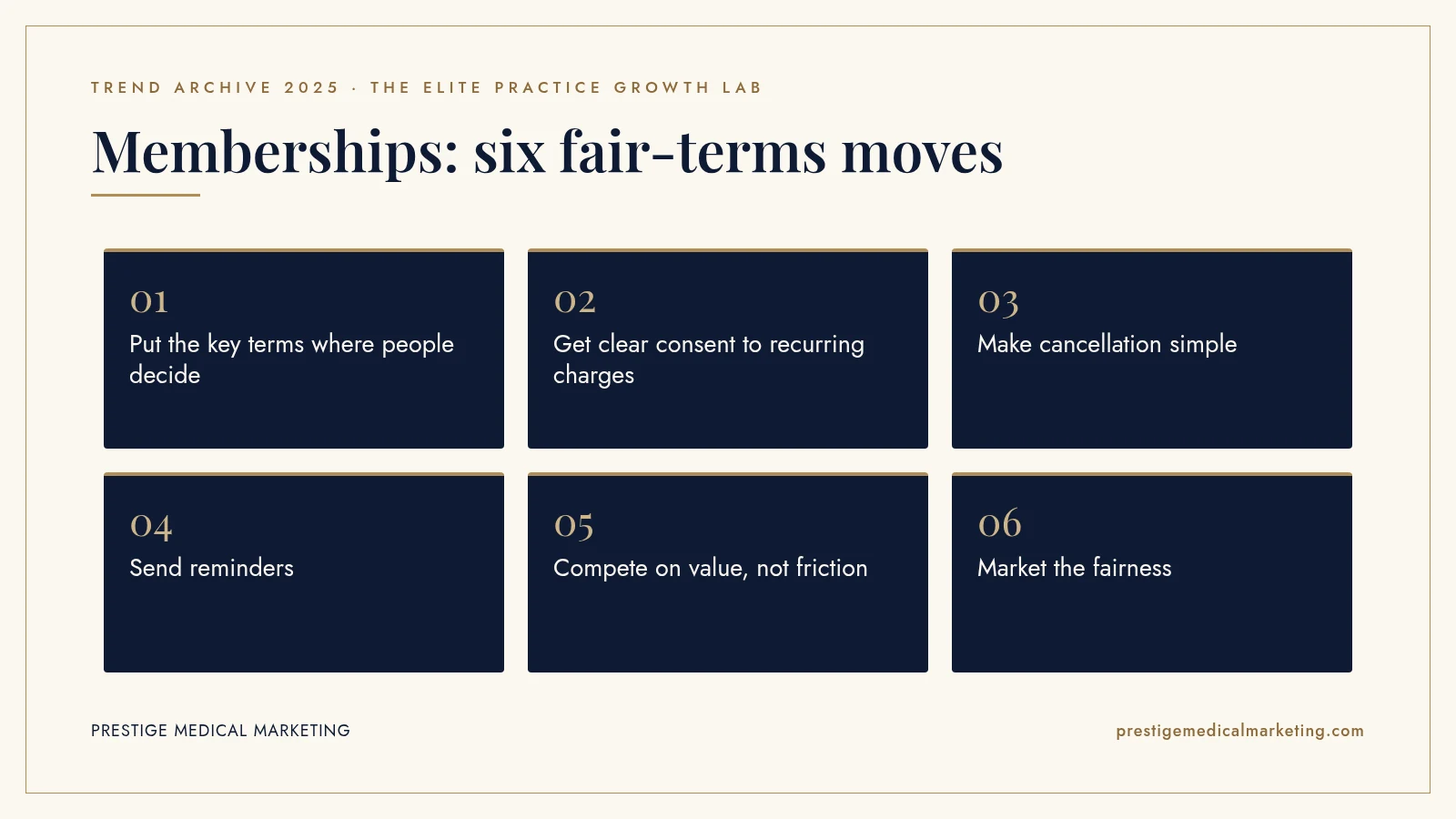
1. Put the key terms where people decide
Price, billing frequency, minimum term if any, what is included, how unused benefits work and how to cancel should appear clearly next to the sign-up button or on the agreement the patient signs at the front desk. No fine print surprises.
2. Get clear consent to recurring charges
Ask for express consent to the recurring charge, separately from other terms where your counsel advises it. Send a confirmation that restates the terms and explains how to cancel.
3. Make cancellation simple
If members can join online, let them cancel online. If they join in person, give them a simple way to cancel by email or online, not only by phone during limited hours. Confirm cancellations in writing.
4. Send reminders
Before annual renewals or after free or discounted introductory periods, send a clear reminder. Several state laws require it, and it prevents the angry “I did not know I was still being charged” call.
5. Compete on value, not friction
The best retention strategy is a membership worth keeping: real savings, priority booking, member events, personalized plans and providers who know the member. Our playbook on reputation and premium pricing explains why that kind of value supports higher prices.
6. Market the fairness
“Cancel anytime online” or “no long-term contract” can be powerful lines in your marketing, if they are true. They reduce the risk a new member feels, which can increase sign-ups more than any discount.

Designing a membership people want to keep
For a longevity or concierge practice, here is what a well-designed membership offer often includes. Your exact structure will differ, and it should be reviewed by counsel.
A clear core. What the member gets every month or year: visits, testing, consultations, treatments or credits, described in plain language.
Real access. Priority scheduling, direct messaging with the care team through a secure channel, or longer appointments. Access is often what members value most.
Progress you can see. Regular reviews of results, plans and goals, so members feel the value instead of just paying for it.
Honest exits. A simple cancellation path and a respectful offboarding conversation. Members who leave on good terms often come back and still refer friends.
Membership pages built this way do more than comply. They sell. A prospective member who sees exactly what they get and how easy it is to leave feels confident joining today. For longevity practices, our longevity clinic marketing guide covers how to present programs and memberships.
A membership page checklist
Use this list to review the page or agreement where patients join your membership. It is a marketing checklist, not a legal one, but it covers what most patients look for before they commit.
- The monthly or annual price, shown clearly, with the billing date explained.
- Any minimum commitment, stated plainly near the price.
- What is included each period, and what happens to unused benefits.
- How and when members can pause, change or cancel, in one or two sentences.
- Who to contact with questions, with a real response time.
- Examples of who the membership is right for, and who it may not suit.
- A consent checkbox or signature for the recurring charge that is not pre-checked.
- A confirmation message or email that restates all of the above.
Every item on this list also answers a buying objection. Clear terms are not a cost of doing business. They are part of the sales page.
Front desk scripts matter too
Many practice memberships are sold in person, at checkout or after a consultation. That makes the front desk part of compliance and part of the brand. Train your team to explain the price, the billing schedule, any commitment and how to cancel, every time, in the same plain words. Give them a one-page summary to hand to the patient.
When a member asks to cancel, the response should be warm and simple: confirm the request, explain the final charge date if any, and ask one optional question about why they are leaving. A brief offer to pause or switch plans can be fine if it is genuine and easy to decline. A required retention call or a series of hoops is not.
Members remember how leaving felt. Many come back later, and many refer friends, if the exit was respectful.
How to measure membership marketing
Track four numbers each month: new members, cancellations, average months retained and revenue per member. Then add one more: the reason members give when they leave. If most leave because they moved or their goals changed, your offer is working. If they leave because they did not use the benefits or did not see value, you have a product problem that no amount of cancellation friction will fix.
Practices that track these numbers make better decisions about pricing, benefits and marketing spend. Practices that track only sign-ups tend to over-discount to grow, then lose members just as quickly. Our guide to predictability and scaling shows how recurring revenue fits a practice growth plan.
What 2025 does not tell us
The FTC could attempt a new rulemaking, and state laws continue to change. The vacated rule’s history also does not tell you exactly how ROSCA or a given state law applies to your membership structure, which depends on details like how members sign up and where they live. That is a question for counsel. What 2025 made clear is that regulators were still willing to act on subscription practices, with or without the new rule.
The premium practice advantage
Discount memberships compete on price and often rely on friction to hold members. Premium memberships compete on value, access and relationship, and they can afford to make leaving easy. That confidence is itself a marketing message: we are good enough that you will want to stay.
That is how we approach membership marketing for longevity and wellness clinics and other private practices we work with: clear offers, honest terms, strong retention and fast follow-up through our patient booking engine. Our team works from Austin with practices nationwide, one per specialty per market.
The bottom line
In 2025, the FTC’s click-to-cancel rule was vacated on July 8, days before its main compliance date. But California’s stricter auto-renewal amendments took effect on July 1, ROSCA stayed in force and the FTC announced a $2.5 billion subscription settlement in September. Membership practices that make terms clear and cancellation easy reduce risk and sell more memberships. The rule died. The principle did not.
Check if your market is open. We take one practice per specialty per market. Request a market check or call (716) 400-0084.
Put this playbook to work: see how it applies to the Prestige System for medical practice marketing.
Frequently asked questions
What was the FTC click-to-cancel rule?
It was the FTC's amended Negative Option Rule, finalized in 2024, which would have required businesses to make cancelling a subscription at least as easy as signing up, get clear consent to recurring charges and disclose key terms. Most of its requirements were set to take effect in 2025.
Why was the click-to-cancel rule vacated?
On July 8, 2025, the U.S. Court of Appeals for the Eighth Circuit vacated the rule in Custom Communications v. FTC. The court held the FTC failed to conduct a required preliminary regulatory analysis, after an administrative law judge found the rule's annual economic effect would exceed $100 million.
Does that mean membership practices can make cancellation hard?
No. The federal Restore Online Shoppers' Confidence Act still applies to online subscriptions, and many states have their own automatic renewal laws. In September 2025, the FTC announced a $2.5 billion settlement with Amazon over Prime enrollment and cancellation practices under existing law.
What changed in California in 2025?
Amendments to California's automatic renewal law, AB 2863, took effect July 1, 2025. They added requirements around consent, annual reminders and cancellation, including allowing online cancellation for subscriptions consumers can sign up for online. Practices with California patients should review their terms with counsel.
Do medical memberships count as subscriptions?
Many practice memberships involve recurring charges, which can bring them within subscription and auto-renewal laws depending on how they are structured and where patients live. The details depend on your structure and state, so ask counsel to review your terms.
How does easy cancellation help marketing?
It lowers the risk patients feel when joining, which can increase sign-ups. It also prevents complaints and negative reviews from members who feel trapped. A membership people stay in because they value it is worth more than one they stay in because leaving is hard.