
On May 7, 2025, Apple's Eddy Cue testified that Google searches in Safari fell in April 2025 for the first time in 22 years, and he linked the dip to AI tools. Google said its overall queries were still growing. For longevity clinics, whose patients tend to be early adopters of new technology, the lesson is to build visibility in both Google and AI assistants, and to own the patient relationship directly.
Every so often, a single sentence in a courtroom tells you more about where marketing is heading than a year of conference keynotes. On May 7, 2025, one of those sentences came from Eddy Cue, Apple’s senior vice president of services.
Testifying in the federal antitrust case against Google, Cue said that Google searches in Safari had fallen the previous month. “That has never happened in 22 years,” he said. He tied the dip to the growing use of AI tools.
For most private practices, that was an interesting headline. For longevity and anti-aging clinics, it deserved more attention. The patients those clinics serve tend to be affluent, health-literate and early to new technology. When a broad shift shows up in national data, it usually shows up first and fastest among people like them.
This retrospective covers what was actually said, what Google said back, what the court did later that year, and what it means for a longevity clinic owner today.
What actually happened in 2025
May 7, 2025: the testimony. As The Verge reported, Cue said Google searches in Safari declined in April 2025 for the first time ever. He linked the decline to AI tools such as ChatGPT, Perplexity and others, and said Apple was considering adding AI search options to Safari.
Google’s response. The same day, Google published a statement saying it continued to see overall query growth in Search, including total queries from Apple’s devices and platforms. In other words, Google did not dispute that something changed in Safari, but said its total search usage was still growing across the ways people reach it.
September 2, 2025: the remedies ruling. Later in the year, Judge Amit Mehta issued his remedies decision in the case. Reuters reported that Google would keep Chrome and Android and could keep paying for default placement, but would be barred from exclusive contracts and required to share certain search data with qualified competitors. The Department of Justice’s announcement laid out the remedies in detail.
The AI side kept growing. Through 2025, ChatGPT went from about 700 million weekly users in August to 800 million by October. Google answered with its own AI features: AI Overviews passed 2 billion monthly users, and AI Mode reached every U.S. user in May.
How to read the Safari moment honestly
It would be easy to turn this into “Google is dying.” That is not what the evidence says. Safari is one access point. Google said overall queries grew. People reach Google through Chrome, the Google app, Android, voice and Lens. A dip in one channel in one month is a signal, not a collapse.
But signals matter in marketing. For two decades, Google search was so dominant that most practices built their entire patient acquisition strategy on it: rank, buy ads, wait for the phone to ring. The Safari moment was a public, sworn statement that the habit was starting to shift. When habits shift, the businesses that adjust early get the advantage, and the ones that wait pay more to catch up.
Why longevity clinics should pay closer attention
Longevity medicine is a research-heavy purchase. Patients compare advanced lab panels, hormone optimization, metabolic programs, body composition scans, peptide questions and concierge membership models. Many of them are paying out of pocket, often for a membership, and they want to understand exactly what they are buying.
That kind of research is precisely what AI assistants are good at. A patient can ask an assistant to explain the difference between standard and advanced lipid testing, what a VO2 max test measures, or what questions to ask before joining a concierge longevity program, and get a clear answer in seconds. Then they ask who offers it near them.
Longevity patients also tend to be heavy users of new tools. They wear trackers, read research summaries and follow health podcasts. It is reasonable to expect them to adopt AI research earlier than the average patient, though no public study we know of has measured that for longevity specifically. We are drawing an inference, and you should test it in your own intake data.
What typical agencies got wrong
Most agencies serving longevity clinics in 2025 did one of two things. Some ignored the shift and kept selling the same search package: keywords, backlinks and monthly rankings. Others swung hard toward hype, selling longevity clinics flashy social content full of bold health claims to chase attention.
The first group missed the change in how patients research. The second group created risk. Longevity marketing lives close to health claims, and regulators spent 2025 paying more attention to health advertising, not less. Bold promises about reversing aging or adding years to life are the kind of claims that can bring trouble and erode trust with exactly the skeptical, educated patient a premium clinic wants.
The average SEO firm sells a channel. A longevity clinic needs a reputation that travels across every channel a patient might use.
What it means for a longevity clinic today
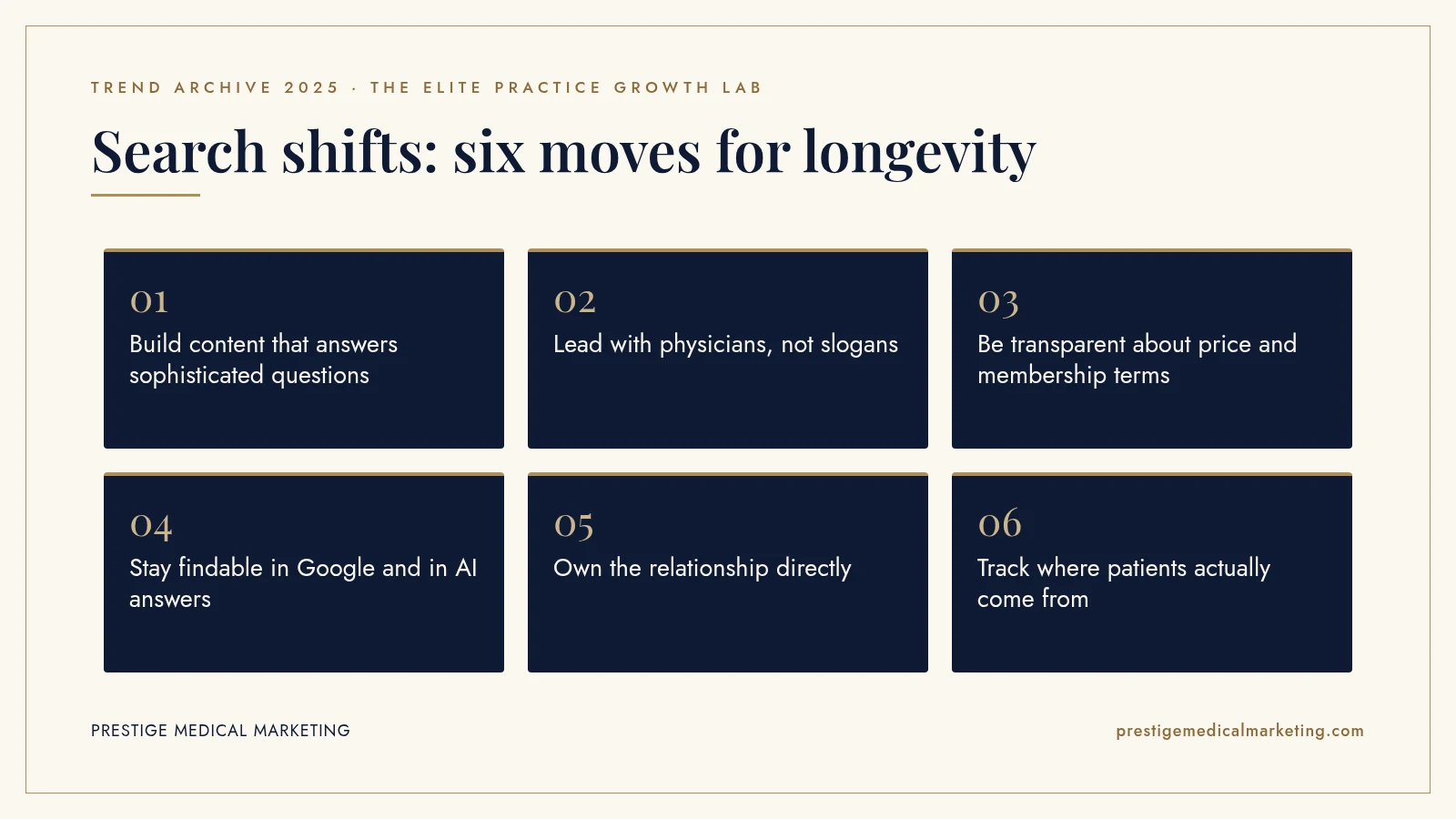
1. Build content that answers sophisticated questions
Your patients ask better questions than most. Answer them: what each test measures and why you use it, how you build a plan from results, how often you retest, what is evidence-based and what is still emerging. Our longevity clinic marketing guide covers the page structure we use.
2. Lead with physicians, not slogans
Name your medical director and clinicians. Show their training and focus. Longevity patients are buying judgment. A clinic that hides its doctors behind a brand looks like every other wellness startup.
3. Be transparent about price and membership terms
Patients who research with AI tools will often ask about cost. Clinics that publish clear pricing or at least clear pricing ranges, and explain membership terms plainly, are easier to recommend. Make cancellation terms clear and fair, too. Our retrospective on membership rules covers why that matters.
4. Stay findable in Google and in AI answers
Your Google Business Profile, website structure and reviews still matter most. Then make sure AI tools can find and understand you: consistent information everywhere, clean structured data and credible mentions. See our guide on how to get your practice recommended by AI.
5. Own the relationship directly
The real lesson of the Safari moment is about dependence. If one company’s search box controls whether patients find you, your business sits on someone else’s foundation. Build channels you own: an email list of patients and prospects, a membership program with a clear value, educational events, and referral relationships with other physicians.
6. Track where patients actually come from
Ask every new patient how they found you, and add AI assistants as an option. Check your analytics for referral traffic from AI tools. You do not need perfect attribution. You need to see the trend early.

Health claims and the trust premium
There is a reason we keep returning to honesty. Longevity is a field where the science is moving, and a lot of marketing runs ahead of it. Patients know that. The best-informed ones, the ones who can afford a premium membership, are the most allergic to hype.
That creates an opportunity. A clinic that explains what it knows, what it does not know yet, and how it decides, stands out sharply against a market full of miracle language. AI assistants also tend to summarize the cautious, mainstream view of a topic. Content that aligns with credible evidence is more likely to fit into those answers than content that contradicts it.
This is also where your physicians’ voice matters most. A short, plain-language note from your medical director on how the clinic decides which tests and treatments to offer can do more for trust than a page of marketing copy. It tells patients there is a thinking person behind the program, not a sales funnel.
What a balanced patient acquisition mix looks like
Diversifying does not mean spreading a budget thin across every new platform. For a longevity clinic, it usually means four layers working together.
Search and maps. Your Google Business Profile, your website and your reviews remain the foundation. They catch patients who already know what they want and are looking for where to get it.
AI visibility. The same foundation, made easy for assistants to understand: consistent facts, physician bios, clear program pages and credible third-party mentions. It costs little extra if the foundation is done right.
Owned audience. An email list fed by useful education, such as a short monthly note from your medical director on what your clinic is seeing and recommending. People who are not ready for a membership today may be ready in six months, and you want to be the clinic they already know.
Relationships. Referral partnerships with primary care physicians, concierge practices, executive health programs, trainers and nutrition professionals. These relationships do not depend on any search engine at all.
A clinic with all four layers does not need to guess how search will look in two years. It will be visible wherever patients end up looking, and it will have direct relationships that no algorithm change can take away. That stability is worth more than any single ranking.
Start with whichever layer is weakest today, and build from there.
A note on timing
The Safari decline was reported for one month. Nobody outside Apple and Google knows exactly how the trend developed after that, and we will not pretend to. What we do know is that AI assistants kept growing through the rest of 2025, Google kept moving AI answers closer to the top of its results, and a federal court opened the door to more competition in search distribution.
None of that requires a longevity clinic to rebuild its marketing overnight. It does argue for diversifying now, while it is cheap, instead of later, when every competitor is trying to do the same thing.
The premium clinic’s advantage
Every shift in how people search rewards the businesses with something real to say. A longevity clinic with experienced physicians, a thoughtful program and transparent terms has plenty to say. The work is saying it clearly in the places patients now look.
That is how we build longevity and wellness clinic marketing: physician-led content, strong local and AI visibility, clear membership offers and fast follow-up. Our team works from Austin with clinics nationwide, one per specialty per market. See how it fits into the Prestige System for medical practice marketing.
The bottom line
In April 2025, Safari searches fell for the first time in 22 years, and Apple tied it to AI. Google said it was still growing overall, and a federal court later reshaped how search defaults can be bought. For longevity clinics, the takeaway is not panic. It is preparation: be findable everywhere your sophisticated patients research, keep your claims honest, and own the relationship once they find you.
Check if your market is open. We take one practice per specialty per market. Request a market check or call (716) 400-0084.
Put this playbook to work: see how it applies to med spa marketing and plastic surgery marketing.
Frequently asked questions
Did Google searches really decline in 2025?
Apple's Eddy Cue testified on May 7, 2025 that searches in Safari, Apple's browser, declined in April 2025 for the first time in 22 years. Google responded that it continued to see overall query growth in Search, including from Apple devices. Both statements can be true: one channel dipped while total usage grew.
Why would a longevity clinic care about Safari search numbers?
Because it was a rare public data point showing that the way people search was starting to change, and the change was linked to AI tools. Longevity patients often research deeply and try new tools early. A shift that shows up in broad data tends to show up sooner in that audience.
What did the court decide in the Google search antitrust case?
On September 2, 2025, Judge Amit Mehta ruled that Google would not have to sell Chrome or Android, but barred exclusive distribution contracts and required Google to share certain search data with qualified competitors. Google can still pay to be a default, but not on an exclusive basis.
Should a longevity clinic stop investing in Google?
No. Google remains the largest source of search for most practices. The point is to stop depending on a single channel. Build strong pages that work in Google and in AI assistants, and build direct channels like email and membership programs that you own.
What kind of content works for longevity patients?
Clear, honest explanations of what you test, what you treat, what the evidence supports, what it costs and who it is for. Longevity patients are skeptical of hype. Plain language, named physicians and transparent pricing earn more trust than bold claims.
How do I know if AI tools are sending patients to my clinic?
Ask new patients how they found you and include AI assistants as an option on intake forms. In your analytics, check referral traffic from AI tools such as ChatGPT and Perplexity. The numbers may be small, but they show direction.