
On October 13, 2021, the FTC announced it had sent a Notice of Penalty Offenses concerning endorsements and testimonials to more than 700 companies, warning that they could face civil penalties of up to $43,792 per violation if they used endorsements in ways found deceptive in prior FTC cases. The listed practices included misrepresenting that endorsers' experiences were typical. For weight loss clinics, the lesson was to use only genuine, accurately presented testimonials with clear context that results vary.
Weight loss marketing has always run on stories. A patient who lost weight and regained confidence is a powerful message, and clinics have used testimonials, transformation photos and success stories for decades. Those stories can be genuine and helpful. They can also mislead, especially when an exceptional result is presented as what everyone can expect.
On October 13, 2021, the FTC sent a strong reminder about where the line sits. The agency announced it had sent a Notice of Penalty Offenses about endorsements and testimonials to more than 700 companies, warning that deceptive use of endorsements could bring significant civil penalties. For weight loss clinics, the notice described practices that were common in their industry.
This retrospective explains what the FTC did, why it mattered for weight loss clinics and what responsible testimonial use looks like today. It is educational, not legal advice. For related chapters, see our pieces on the 2023 update to the FTC Endorsement Guides, the 2024 fake review rule and the 2023 substantiation notices.
What actually happened in 2021
October 13: the notices. The FTC announced that it had sent a Notice of Penalty Offenses to more than 700 companies, placing them on notice that they could incur civil penalties of up to $43,792 per violation if they used endorsements in ways that ran counter to prior FTC administrative cases.
The practices. The FTC said the notice outlined practices it had found unfair or deceptive in prior cases, including falsely claiming an endorsement by a third party, misrepresenting whether an endorser is an actual, current or recent user, using an endorsement to make deceptive performance claims, failing to disclose an unexpected material connection with an endorser and misrepresenting that endorsers’ experiences represent consumers’ typical or ordinary experience.
No presumption of wrongdoing. The FTC stated that a recipient’s presence on the list did not in any way suggest that it had engaged in deceptive or unfair conduct.
The message. Samuel Levine, Director of the FTC’s Bureau of Consumer Protection, said fake reviews and other deceptive endorsements cheat consumers and undercut honest businesses, and that advertisers would pay a price for those practices. The Commission vote was 5-0.
Why it mattered for weight loss clinics
Every practice the notice listed has a familiar weight loss version. A transformation story presented as typical when it was exceptional. A testimonial from a patient who received free services without disclosure. A review written by someone who never completed the program. A claim about results that relies on one patient’s story rather than evidence.
The notice did not create new law. It reminded companies of existing law and signaled that the FTC intended to use civil penalties as a deterrent. For weight loss clinics, that raised the stakes on marketing practices many had taken for granted.
It also reinforced something good clinics already knew. Honest testimonials, presented with context, build trust that lasts. Misleading ones create unrealistic expectations, disappointed patients and reputational risk.
What typical agencies did
Many agencies kept doing what had always worked: the most dramatic transformations front and center, short quotes stripped of context and fine print that few people read. Some offered discounts or free services in exchange for reviews without considering disclosure.
A smaller group took the notice as a prompt to audit their clients’ marketing. They reviewed testimonials, checked consent and disclosure, added clear context about variability and removed claims they could not support.
That audit approach protected clinics and improved their marketing at the same time, because patients increasingly distrusted results that looked too good to be true.
What it means for a weight loss clinic today
Endorsement rules have continued to develop since 2021. These habits keep testimonials honest and effective.
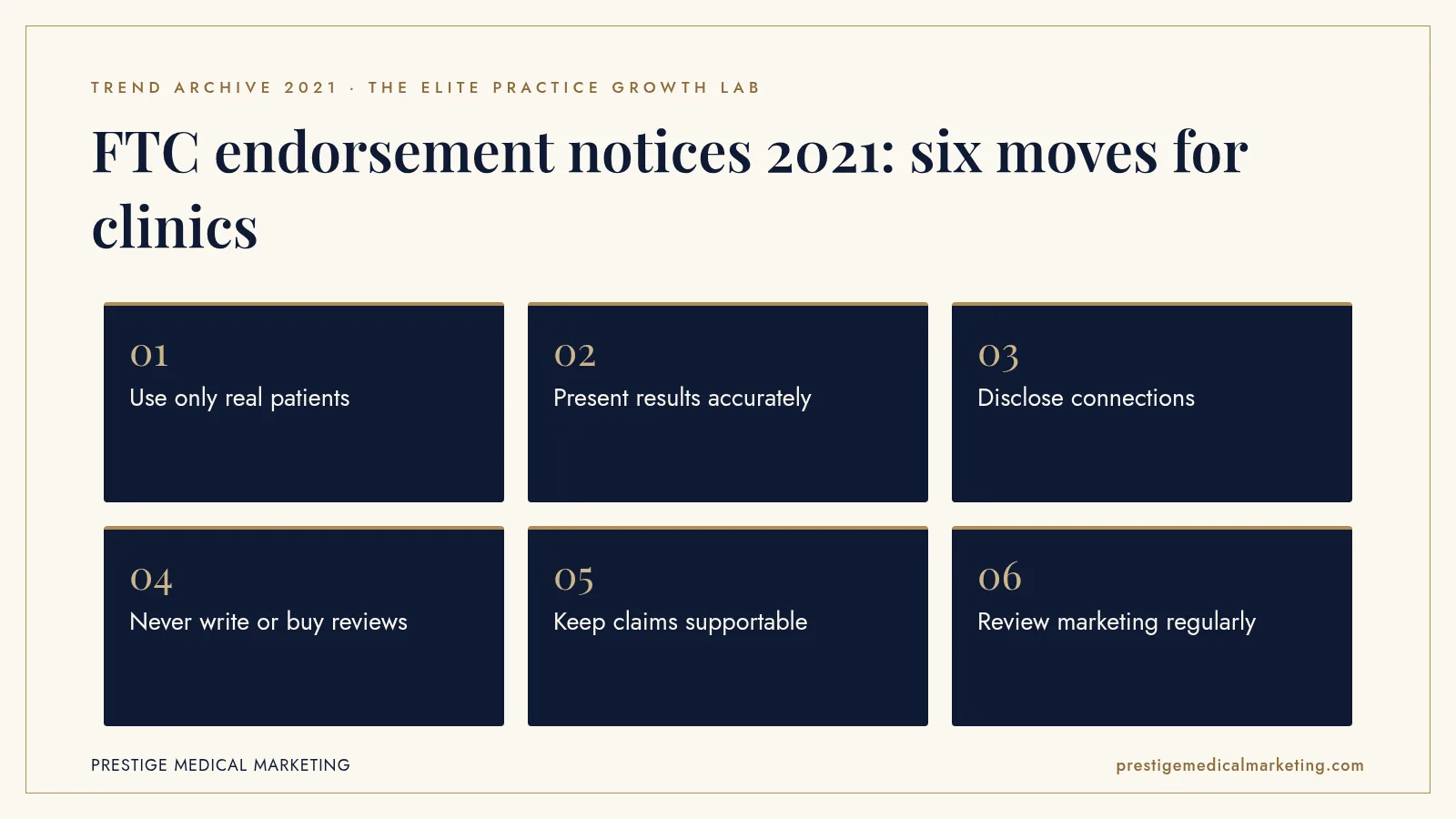
1. Use only real patients
Every testimonial should come from an actual patient, with written consent for how it will be used.
2. Present results accurately
Do not imply that an exceptional result is typical unless you can substantiate that claim.
3. Disclose connections
If a patient received free or discounted care, or has another relationship with the clinic, disclose it clearly.
4. Never write or buy reviews
Do not create reviews, pay for them or ask staff and family to post them.
5. Keep claims supportable
Any statement about how much weight patients lose or how quickly must be supported by evidence, not stories.
6. Review marketing regularly
Audit website content, ads and social posts at least once a year with appropriate advisers.

The problem with typical results
The most common weight loss testimonial issue is implied typicality. A clinic features its most successful patient, and a prospective patient assumes that result is what to expect. A tiny disclaimer saying results may vary does not necessarily fix that impression. The safer approach is to present results in a way that reflects reality, explain that outcomes differ based on many factors and avoid building the entire marketing message around exceptional cases.
That honesty also helps the clinic. Patients who arrive with realistic expectations are more likely to be satisfied with their progress and to share positive experiences.
Before-and-after photos
Transformation photos are a form of endorsement. They should be genuine, consented, unaltered and accompanied by appropriate context, such as the timeframe and the fact that results vary. Lighting, posture and clothing differences can exaggerate changes, so consistency matters. Clinics should also consider whether photos create unrealistic expectations, even when they are technically accurate.
Reviews on third-party platforms
Online reviews are endorsements too. Clinics may ask patients for reviews, but they should ask everyone, not only those likely to be positive, and should never offer incentives tied to the content of a review. Responding to reviews should protect patient privacy and never confirm that a reviewer is a patient or discuss treatment details.
Influencers and partnerships
Some weight loss clinics work with local influencers or community figures. Any material connection, including free services, payment or discounts, must be clearly disclosed in the content itself. The clinic is responsible for making sure partners understand and follow the rules, and for monitoring what is posted.
Medication-related testimonials
As GLP-1 medications became central to weight management, testimonials increasingly referenced specific drugs. That added complexity, because statements about prescription medications must be accurate and balanced. Clinics should be especially cautious about testimonials that suggest a medication works the same way for everyone or downplay side effects.
Building a culture of honest marketing
Compliance is easier when honesty is a shared value. When the clinical team, front desk and marketing partners all understand why testimonials must be accurate and disclosed, fewer problems slip through. A short written policy on testimonials, reviews and endorsements, reviewed by advisers and shared with everyone involved, sets clear expectations. New staff and new agencies should receive it on day one, and it should be revisited whenever the rules change or the clinic adds a new marketing channel, so that good intentions stay connected to current requirements.
Collecting testimonials the right way
Good testimonials start with a good process. Clinics can ask patients at natural milestones whether they would be willing to share their experience, explain exactly how the story would be used and get written consent that covers each channel. Patients should be free to decline without any effect on their care, and they should be able to withdraw consent later. Recording the date, the context and any relationship with the clinic makes it easy to add accurate disclosures and to retire stories that are no longer representative.
That kind of process protects patients and the clinic, and it tends to produce more authentic stories, because patients who choose to share do so on their own terms.
Why penalty offense notices carry weight
Ordinarily, a first violation of the FTC Act may not result in civil penalties on its own. The Notice of Penalty Offenses changed that calculation for recipients. As the FTC explained, the notice allows the agency to seek civil penalties against a company that engages in conduct it knows has been found unlawful in a previous FTC administrative order. By putting companies on notice, the FTC removed the argument that they did not know the practices were unlawful.
For businesses that were not on the list, the notice still served as a clear statement of what the agency considered deceptive. The practices it described were not obscure technicalities. They were common marketing habits, and the FTC was signaling that it intended to treat them seriously.
Testimonials on the website
A weight loss clinic’s website is often where testimonials live longest. A success story posted years ago may still sit on the homepage, even if the patient’s experience is no longer representative or the program has changed. Clinics should review website testimonials periodically, confirm that consent is still valid, update context where needed and remove stories that no longer reflect the clinic’s current approach.
The way testimonials are framed matters too. A page titled real results that shows only the most dramatic cases sends a different message from a page that shares a range of patient experiences, explains the factors that affect outcomes and invites prospective patients to discuss their own goals.
Video testimonials and social clips
Short video testimonials became more popular as social platforms leaned into video. The same principles apply. A patient speaking on camera is still an endorsement, and editing can change meaning. Clips should not be cut in ways that exaggerate results, and any material connection should be disclosed within the video or post itself, where viewers will see it. Honesty is the most durable marketing advantage. Always.
What 2021 does not tell us
The October 2021 notices did not tell us how many recipients would change their practices, how often the FTC would pursue penalties or how individual medical practices would be treated. Endorsement guidance and review rules developed further in the following years. There is no reliable public data on how weight loss clinics as a group responded. What 2021 does show is that the FTC was determined to deter deceptive endorsements, and that clinics using only genuine, accurately presented testimonials were on solid ground.
The premium practice advantage
A premium weight loss clinic does not need exaggerated stories. Its reputation rests on careful care and honest communication, and its testimonials can reflect that. See our weight loss services, our weight loss clinic marketing guide, our reputation and premium pricing work and our full services. Our team works from Austin with practices nationwide.
The bottom line
When the FTC sent endorsement penalty notices to more than 700 companies in October 2021, it put a spotlight on testimonials, reviews and results claims. For weight loss clinics, the lasting lesson was simple: use real patients, present their experiences honestly, disclose connections, never fabricate reviews and let a reputation for honest care do the persuading.
Check if your market is open. We take one practice per specialty per market. Request a market check or call (716) 400-0084.
Put this playbook to work: see how it applies to med spa marketing and plastic surgery marketing.
Frequently asked questions
What did the FTC do in October 2021?
It sent a Notice of Penalty Offenses about deceptive endorsements and testimonials to more than 700 companies, announced on October 13, 2021.
What penalties did the notice describe?
The FTC said recipients could incur civil penalties of up to $43,792 per violation if they used endorsements in ways that ran counter to prior FTC administrative cases.
Which practices did the notice cover?
Examples included falsely claiming a third-party endorsement, misrepresenting whether an endorser is an actual, current or recent user, using endorsements to make deceptive performance claims, failing to disclose an unexpected material connection and misrepresenting that endorsers' experiences are typical.
Did receiving the notice mean a company had done something wrong?
No. The FTC said a recipient's presence on the list did not in any way suggest that it had engaged in deceptive or unfair conduct.
Why does this matter for weight loss clinics?
Weight loss marketing often relies on testimonials and results stories, which are exactly the kinds of endorsements the notice addressed.
How should a clinic use testimonials today?
Use real patients with written consent, present their experience accurately, avoid implying typical results unless substantiated, disclose any material connection and never write or buy reviews.