
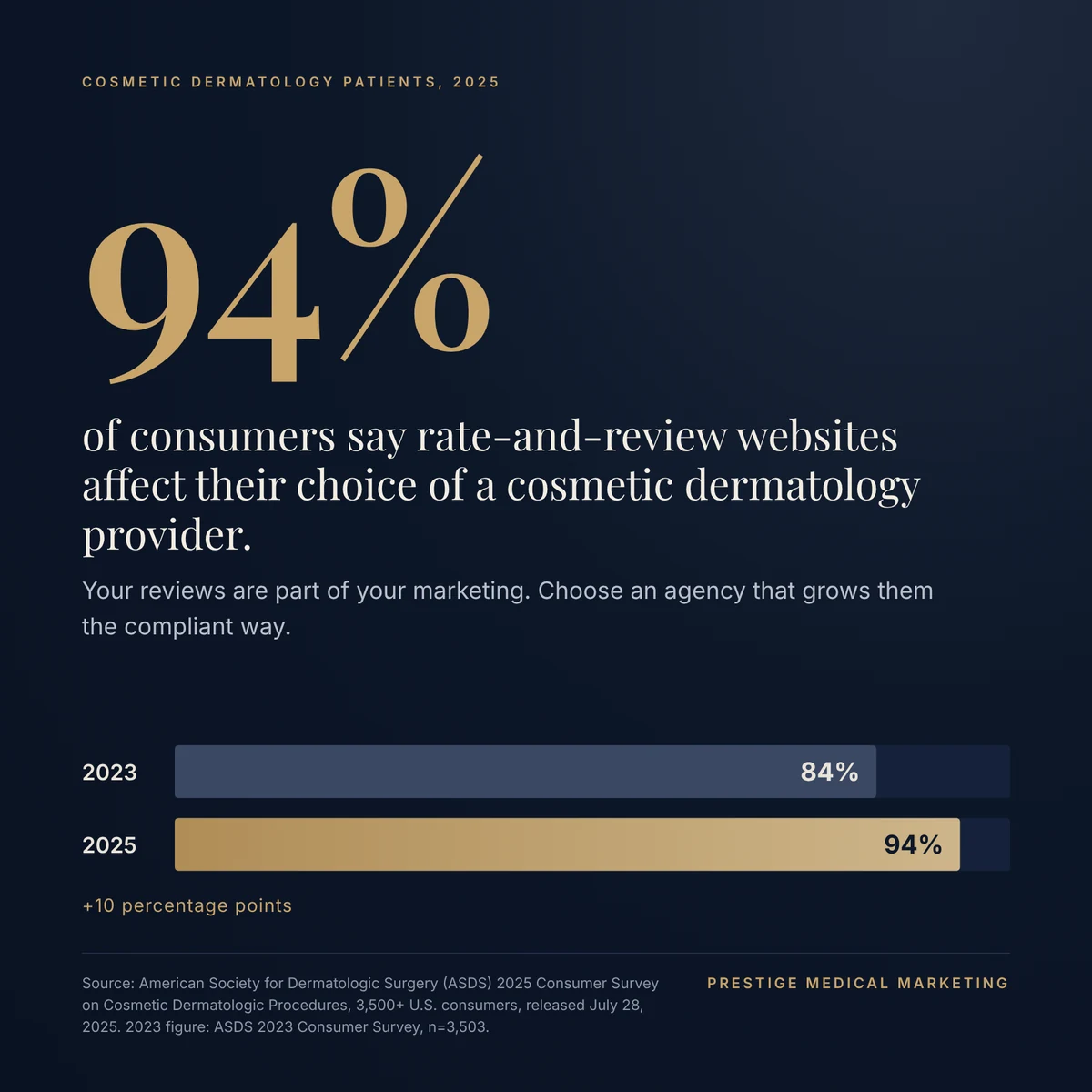
To choose a dermatology marketing agency, pick the one that plans your medical and cosmetic patients separately, protects your reviews and your license, keeps every account in your name and reports on booked consultations. Reviews matter more than ever: 94% of cosmetic dermatology consumers say rate-and-review websites affect their choice of provider, up from 84% in 2023 (ASDS 2025 and 2023 Consumer Surveys).
94% of cosmetic dermatology consumers say rate-and-review websites affect their decision when they choose a provider. That figure comes from the American Society for Dermatologic Surgery (ASDS) 2025 Consumer Survey on Cosmetic Dermatologic Procedures, which polled more than 3,500 consumers nationwide and was released July 28, 2025. In the society’s 2023 survey (n=3,503), the same answer was 84%. Ten points in two years.
So here is the direct answer. To choose a dermatology marketing agency, pick the one that understands both sides of your practice, medical and cosmetic, protects your reviews and your license, keeps every account in your name and reports on booked consultations instead of clicks. This guide gives you the questions to ask, the red flags, the in-house option, what drives cost, a realistic timeline and the compliance rules your agency has to know cold.
It is written for owners of private dermatology and cosmetic dermatology practices. If you want the general version for any specialty, read our medical marketing agency checklist. This one goes deeper on what is different about dermatology.
Why a dermatology practice needs a different kind of agency
You run two businesses under one roof, and they market in opposite ways. A generalist agency treats them as one. That is where the money leaks.
- Medical dermatology (skin checks, acne, eczema, psoriasis) is a fast decision. Patients want someone nearby, in network and available soon. Google Maps, reviews and same-week openings win it.
- Cosmetic dermatology (injectables, lasers, peels, body contouring) is a slow, cash-pay decision. Patients compare providers for weeks. Credentials, reviews, results galleries and how you answer questions win it.
An agency that pushes both through one “book now” funnel underperforms on at least one side. Usually it is the cosmetic side, which is the side most owners want to grow. A good agency asks about your service mix before it pitches anything: what share of revenue is cosmetic, which treatments carry the best margin and how many cosmetic consults you can actually handle each week.
What dermatology patients check before they book in 2026
Patients vet you online before they ever call, and the bar keeps rising. Here is what the most recent surveys say:
- 94% of cosmetic dermatology consumers say rate-and-review websites affect their choice of provider, up from 84% in 2023 (ASDS consumer surveys, 2025 and 2023).
- Nearly half say a provider’s social media presence affects whether they book, and 74% follow their provider on social media (ASDS 2025).
- 55% of U.S. adults have canceled or avoided booking a provider because of online reviews, up from 40% in 2025 (rater8 2026 Patient Choice Report, April 2026, n=992).
- 75% will not book with a provider rated below 4.0 stars. 44% will not book below 4.5 (rater8 2026).
- 66% say the way a provider responds to reviews influences their trust, up from 42% (rater8 2026).
- 47% have used AI to research or find a healthcare provider, up from 31% (rater8 2026).

The ASDS survey also found that board certification in a related specialty, a physician referral and licensure rank among the strongest influences on who patients choose. Cost (24%) and pain (14%) were the top hesitations about a cosmetic procedure. Read that as a marketing brief: prove your credentials, earn real reviews, answer the cost and comfort questions in plain English and be easy to find when someone asks an AI assistant who to see.
What should a dermatology marketing agency do for you?
A dermatology marketing agency should bring you more of the right patients and prove it with booked consultations. In practice that covers:
- Google Business Profile and Maps for every location and provider. See our dermatology Business Profile guide.
- A page for each treatment you want more of, with your medical team approving every clinical claim.
- A steady, compliant review system that asks every patient and replies without breaking privacy rules.
- AI search visibility so ChatGPT, Gemini and Google’s AI answers can verify your practice. See how to get your practice recommended by AI and Google AI Mode for dermatology practices.
- Paid search and social that follow health advertising policies, when paid makes sense.
- Call handling and booking, because more visibility into missed calls is just a more expensive way to lose patients.
- Reporting that splits medical and cosmetic, and shows new-patient revenue against spend.
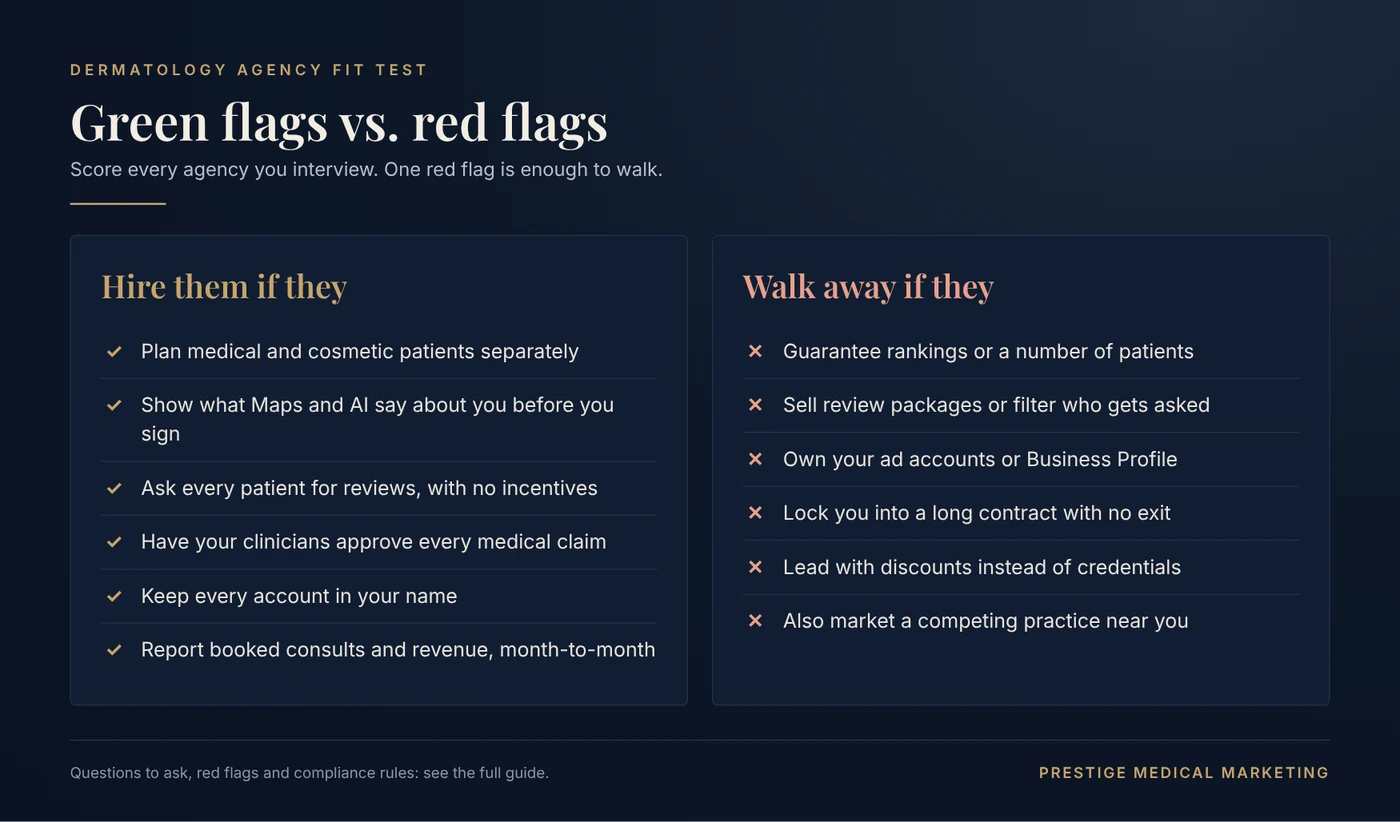
12 questions to ask a dermatology marketing agency
Ask these on the first call. A strong agency answers with specifics. A weak one answers with adjectives.
- “How would you market our medical side differently from our cosmetic side?” Listen for two plans, not one.
- “Which of our treatments would you grow first, and why?” The answer should be about margin and capacity, not what is easiest to rank.
- “What do Google Maps and the AI assistants say about us today?” A good agency shows you before you sign.
- “How do you get reviews without breaking FTC or Google rules?” The right answer: ask every patient, no incentives, no filtering.
- “How do you reply to reviews without confirming someone is a patient?” They should know this cold.
- “Who approves the medical claims on our site and in our ads?” Your clinicians should. Always.
- “How do you handle before-and-after photos?” Listen for patient consent, honest typical results and no editing.
- “Will you sign a Business Associate Agreement if you touch patient information?” If they hesitate, walk.
- “Who owns the website, ad accounts, Business Profile and data?” You do. In your name, from day one.
- “Do you work with other dermatology practices in our market?” If yes, ask how they decide who gets the top spot.
- “What will you report every month?” Booked consults and new-patient revenue, split medical and cosmetic.
- “What is the contract term, and what happens if we leave?” Month-to-month is the confident answer.
Red flags that should end the conversation
Walk away if you hear any of these.
- Guaranteed rankings or a guaranteed number of patients. Nobody controls Google or AI answers. A guarantee is a sales tactic.
- Review “packages,” review gating or rewards for reviews. That puts your practice at risk with the FTC and with Google.
- Ad accounts or your Business Profile in the agency’s name. That is a hostage situation, not a partnership.
- Long lock-in contracts with no performance exit.
- Cookie-cutter templates built for a plumber with your logo on top.
- Discount-led promotions as the main growth plan. Deal shoppers rarely become loyal cosmetic patients.
- Reports full of impressions and clicks with no line for booked consultations.
- They market a competing dermatology practice down the street.
In-house marketer or dermatology marketing agency?
Hire in-house when you have one or two channels and someone to manage them. Hire an agency when you need the full system and senior strategy without building a department.
- In-house works for daily social posting, front desk review requests and patient communication. One good coordinator can own that.
- An agency works when you need search, Maps, AI visibility, ads, web and reporting to work together. One person rarely masters all of them.
- Most growing practices land on a hybrid: an in-house coordinator for content and patient touchpoints, and an agency for the visibility engine and the math.
For the full side-by-side, read medical marketing companies vs. in-house. If you are weighing a consultant instead, see healthcare marketing consultant vs. agency.
How much does a dermatology marketing agency cost?
Cost depends on scope, not on a price list. Be wary of anyone who quotes a number before they understand your practice. These are the factors that move the fee:
- Number of locations and providers. Each one needs its own profile, pages and reviews.
- Number of treatments you want to grow. Five priority treatments take less work than twenty.
- How competitive your market is for the treatments you care about.
- How much cleanup the foundation needs: old listings, a slow website, duplicate profiles.
- Whether paid ads are included, and whether ad spend is separate from the management fee.
- Medical review of content and how quickly your team can approve it.
- Call handling, booking and follow-up, if they are part of the plan.
Compare proposals on expected cost per booked consultation, not the monthly fee. A cheaper agency that books no one costs more than you think.
How long until a dermatology marketing agency shows results?
Expect early fixes in weeks, steady gains over months and honest reporting every month. The exact pace depends on your market and how much needs fixing.
- First weeks: Business Profile cleanup, listing fixes, tracking, call handling and review requests. These can move quickly.
- First few months: treatment pages, review growth and AI visibility start to build. Paid campaigns, if used, can bring calls sooner.
- Six months and beyond: compounding visibility in Maps and AI answers, plus a clearer picture of cost per booked patient by treatment.
Many practices plan around their own calendar too. Laser and resurfacing pushes often land in fall and winter, when patients spend less time in the sun, and event-driven injectable demand tends to build before the holidays. A good agency builds the plan around your calendar, not a generic one.
The compliance rules your dermatology agency must know
Your agency writes in your name, so its mistakes land on your license. These are the rules a dermatology marketer should be able to explain without looking them up:
FTC rules on reviews and testimonials
- The FTC’s rule on consumer reviews and testimonials (16 CFR Part 465, effective October 21, 2024) bans fake reviews and buying reviews on the condition that they are positive. Our FTC review rule guide covers what it means for a practice.
- The FTC’s Endorsement Guides (16 CFR 255.2) say that if a testimonial implies results patients can generally expect, you need proof that those results are typical. Otherwise you must clearly disclose what patients can generally expect. “Results not typical” alone does not cover you. That applies to before-and-after photos too.
- The FTC’s Health Products Compliance Guidance says health claims need competent and reliable scientific evidence. No “erases wrinkles forever.”
Professional and state medical board rules
- The American Academy of Dermatology’s Code of Medical Ethics for Dermatologists says a dermatologist should not publicize themselves in an untruthful, fraudulent, misleading or deceptive way, and it endorses the AMA’s policy on advertising. The AMA Code of Medical Ethics on advertising and publicity allows physician advertising as long as it is not false, misleading or deceptive.
- State medical boards set their own advertising rules. In Texas, for example, 22 TAC §164.4 lets a physician advertise “board certified” only for certification by an American Board of Medical Specialties member board, the AOA Bureau of Osteopathic Specialists, the American Board of Oral and Maxillofacial Surgery or a board the Texas Medical Board has approved. Your agency should check your state’s rules before it writes a credential claim.
Privacy and ad platform rules
- Never confirm someone is a patient in a review reply. HHS settled with a New Jersey practice for $30,000 in 2023 after it disclosed patient information in replies to Google reviews.
- If your agency handles patient information, it should sign a Business Associate Agreement under HIPAA.
- Google limits how health information can be used in ad targeting. Read Google’s personalized advertising policy and expect your agency to know it.
We are not your lawyer, and nothing here is legal advice. But the right agency builds these rules into the work so you never have to clean up after it.
Mistakes dermatology owners make when hiring an agency
- Hiring on price instead of cost per booked patient.
- Hiring for one channel (ads, or social) when the leak is the Business Profile, reviews or the phone.
- Letting the agency own the accounts. You lose years of history if you part ways.
- Skipping clinical review to move faster. Speed is not worth a board complaint.
- Chasing traffic for treatments you do not want to perform.
- Hiring before fixing capacity. If your cosmetic schedule is already booked out, fix scheduling first.
How Prestige Medical Marketing does dermatology marketing the right way
Most agencies sell activity and send a PDF. We sell booked patients and show the math. Here is how we work with dermatology practices:
- Market Check first. We show you what Google Maps and the AI assistants say about your practice today, and who they name instead.
- Two patient paths. Medical and cosmetic get their own pages, campaigns and reporting.
- Your clinicians approve every medical claim.
- Reviews the compliant way: ask every patient, no incentives, privacy-safe replies.
- You own everything: domain, website, Business Profile, data and ad accounts.
- Month-to-month. We earn the next month or we lose it.
- One dermatology practice per market. We never market your direct competitor in your area.
We work with private practices nationwide from our Austin, Texas headquarters. See our dermatology marketing service, The Prestige System, our dermatology marketing playbook and every practice type we help, including med spas.
What You Get
- A Market Check of your Google Maps and AI visibility before you commit
- Separate growth plans for your medical and cosmetic patients
- Business Profile, treatment pages and AI search visibility built to be verified
- A compliant review system with privacy-safe replies
- Clinician-approved claims on every page and ad
- Monthly reporting on booked consults and new-patient revenue
- Every account in your name, month-to-month
Results You Can Expect
- First weeksA clean, accurate Business Profile, fixed listings, working call tracking and review requests going out.
- Over monthsMore visibility in Maps and AI answers for the treatments you chose, and a growing base of real reviews.
- Every monthA plain-English report on booked consultations and revenue, split medical and cosmetic.
What we will not promise: a set number of patients or a #1 ranking. Nobody honest can. You can leave any month.
Questions first? Call (716) 400-0084
Want to know how your dermatology practice looks to patients right now? Book a free Practice Growth Call or call (716) 400-0084. We will show you where you stand in Google Maps and the AI answers, and what to fix first.
Frequently asked questions
How do I choose a dermatology marketing agency?
Choose the agency that plans your medical and cosmetic patients separately, shows you what Google Maps and AI tools say about your practice before you sign, earns reviews without incentives, has your clinicians approve every medical claim, keeps every account in your name and reports on booked consultations and new-patient revenue.
How important are online reviews for a dermatology practice?
Very. In the American Society for Dermatologic Surgery 2025 Consumer Survey (3,500+ U.S. consumers, released July 28, 2025), 94% said rate-and-review websites affect their choice of a cosmetic dermatology provider, up from 84% in the 2023 survey. The rater8 2026 Patient Choice Report found 75% of U.S. adults will not book with a provider rated below 4.0 stars.
What questions should I ask a dermatology marketing agency?
Ask how they would market your medical side differently from your cosmetic side, what Google Maps and AI tools say about you today, how they get reviews without breaking FTC or Google rules, who approves medical claims, whether they will sign a Business Associate Agreement, who owns the accounts, what they report monthly and what the contract term is.
What are the red flags when hiring a dermatology marketing agency?
Guaranteed rankings or patient numbers, review packages or review gating, ad accounts or a Business Profile held in the agency's name, long lock-in contracts, discount-led growth plans, reports with no booked consultations and an agency that also markets a competing practice in your area.
Should a dermatology practice hire in-house or use an agency?
Hire in-house for one or two channels such as social posting and patient communication. Use an agency when you need search, Google Maps, AI visibility, ads, website and reporting working together. Many growing practices use a hybrid: an in-house coordinator plus an agency for the visibility system.
How much does a dermatology marketing agency cost?
It depends on scope: the number of locations and providers, how many treatments you want to grow, how competitive your market is, how much cleanup your listings and website need, whether paid ads are included and whether call handling and booking are part of the plan. Compare proposals on expected cost per booked consultation, not the monthly fee.
How long does it take a dermatology marketing agency to show results?
Business Profile, listing, tracking and review fixes can show up within weeks. Treatment pages, review growth and AI visibility usually build over several months, depending on your market. Nobody honest can guarantee a number-one ranking or a set number of patients, so judge progress monthly on calls and booked consultations.
Can a dermatologist advertise as board certified?
Only within the rules of their state medical board. In Texas, for example, 22 TAC 164.4 allows the term only for certification by an American Board of Medical Specialties member board, the AOA Bureau of Osteopathic Specialists, the American Board of Oral and Maxillofacial Surgery or a board approved by the Texas Medical Board. Your agency should check your state's rules before writing credential claims.
Are before-and-after photos allowed in dermatology marketing?
They can be used with patient consent, but the FTC's Endorsement Guides (16 CFR 255.2) say that if a testimonial implies typical results you need proof those results are typical, or you must clearly disclose what patients can generally expect. Photos should be unedited, and state board and platform rules also apply.