
A healthcare marketing consultant diagnoses and advises; a healthcare marketing agency builds and runs the work. Hire a consultant when you have people doing the work but no clear plan. Hire an agency when nobody owns execution. Most private practices need both functions, so the best fit is often a strategy-led agency that diagnoses, executes and reports on booked consults under one owner.
Most practice owners who search for a healthcare marketing consultant are not short on advice. They have a folder full of it. What they are short on is booked consults. Before you hire anyone, know which problem you are paying to solve, because the wrong hire burns six months and a lot of trust.
This guide gives you the plain difference between a healthcare marketing consultant and a healthcare marketing agency, when each one is the right call, how each one charges, the questions that expose a weak fit and a scorecard you can fill out in ten minutes. It is written for private practices: med spas, plastic and cosmetic surgery, dermatology, medical weight loss, longevity, men’s health and functional medicine. Not hospital systems.
Healthcare marketing consultant vs. agency: the short answer
A healthcare marketing consultant diagnoses and advises. A healthcare marketing agency builds and runs the work. Hire a consultant when you do not know what is broken and have people to fix it. Hire an agency when you know what needs doing and nobody has the hours to do it. Most private practices need both jobs done, by one team that is accountable for booked patients.
The trouble starts when the two jobs get split. The consultant writes a smart plan. The agency executes its own version. Nobody owns the gap between them, and the practice owner ends up refereeing. That gap is where most marketing budgets go to die.
What a healthcare marketing consultant does
A healthcare marketing consultant audits your marketing, finds the bottleneck and hands you a prioritized plan. The deliverable is decisions, not campaigns. A good one leaves you clearer than they found you and does not need to stay forever.
Typical consultant work for a private practice:
- Marketing audit. Website, Google Business Profile, reviews, ads, tracking and how calls and forms get handled.
- Positioning. Which treatments to lead with, which patients to chase and why someone should pick you over the practice two miles away.
- Budget and channel plan. Where the money goes first and what gets cut.
- Vendor oversight. Reviewing your current agency’s work and reports from your side of the table.
- Team coaching. Training the front desk on phone scripts, follow-up and consult conversion.
What a consultant usually does not do: write the pages, manage the ads every week, chase the reviews or answer the 7:40 PM inquiry. If a consultant says they do all of that, you are talking to a small agency. Judge them as one.

What a healthcare marketing agency does
A healthcare marketing agency executes: it builds the website, runs local search and ads, produces content and reports results every month. The deliverable is work shipped on a schedule. A good one also brings a point of view on what to do first.
Typical agency work for a private practice:
- Website and treatment pages that answer patient questions and book consults on a phone.
- Google Maps and local search, including your Business Profile, listings, reviews and AI answers in Google, ChatGPT and Gemini.
- Paid search and paid social for treatments with real demand.
- Response and booking systems, so calls and forms turn into appointments instead of voicemails.
- Reporting on calls, booked consults and cost per booked patient.
Where agencies fall short: many sell a channel and call it strategy. If every problem an agency diagnoses happens to be solved by the service it sells, the diagnosis is a sales pitch.
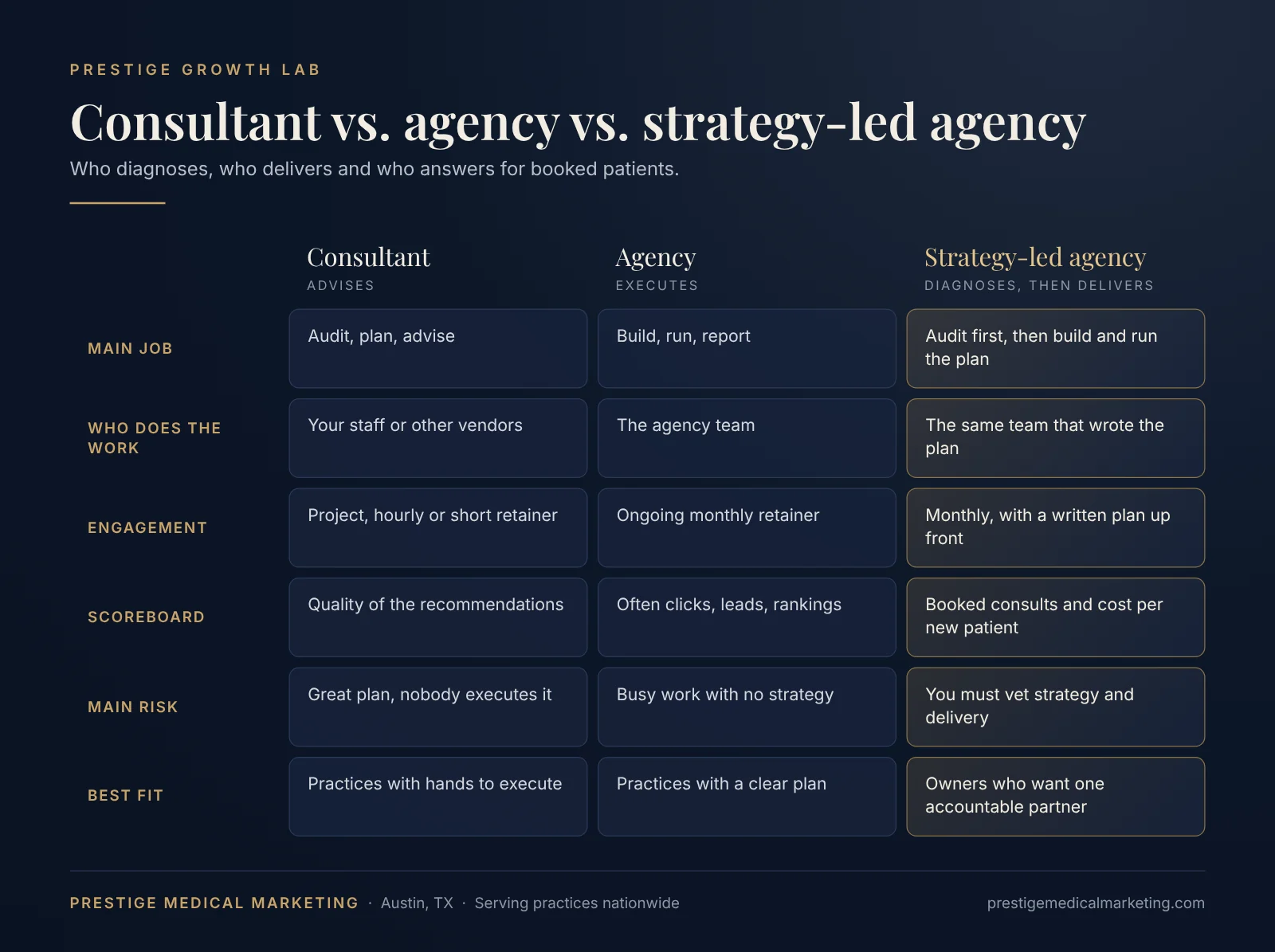
Consultant vs. agency vs. strategy-led agency, side by side
Consultants win on depth and objectivity. Agencies win on capacity and consistency. A strategy-led agency puts the diagnosis and the delivery under one roof, with one owner of the result.
| Question | Healthcare marketing consultant | Healthcare marketing agency | Strategy-led agency |
|---|---|---|---|
| Main job | Diagnose, plan, advise | Build, run, report | Diagnose, then build and run |
| Who does the work | Your team or other vendors | The agency team | The team that wrote the plan |
| Typical engagement | Project, hourly or short retainer | Monthly retainer, ongoing | Monthly, with a written plan up front |
| Accountable for booked patients | Rarely, they advise | Sometimes, often reports clicks and leads | Yes, that is the scoreboard |
| Main risk | Great plan, nobody executes it | Busy work with no strategy | You must vet both skills |
| Best for | Practices with staff to execute | Practices with a clear plan already | Owners who want one accountable partner |
Hire a healthcare marketing consultant when
Hire a consultant when the question is “what should we do?” and you already have hands to do it. Specifically:
- You have an in-house marketer or a capable practice manager who needs direction, not replacement.
- You suspect your current agency is underdelivering and want an outside review before you fire anyone.
- You are opening a new location or service line, such as adding GLP-1 weight loss or a surgical offering, and need a launch plan.
- The problem is narrow: tracking that does not match your booking system, ads nobody can explain, a website that gets traffic and no consults.
Hire a healthcare marketing agency when
Hire an agency when the question is “who is going to do this every week?” Specifically:
- Nobody on staff owns marketing, or the owner-provider is doing it at night.
- The work spans several channels at once: website, Maps, reviews, ads and follow-up.
- You need consistent output for months, not a single fix.
- You want one partner reporting on booked patients instead of four vendors pointing at each other.
Where in-house marketers and fractional CMOs fit
A fractional CMO is a senior consultant on a recurring schedule. An in-house marketer is a full-time employee. Both still need someone to execute the specialist work. A fractional CMO makes sense for a multi-location group that needs leadership but not a full executive salary. An in-house hire makes sense when you have daily work on site, such as content capture, events and front-desk follow-up, and enough budget to back them with tools and vendors. For a single-location practice, one in-house hire rarely covers SEO, ads, web, reviews and tracking well. We broke that trade-off down in medical marketing companies vs. in-house.
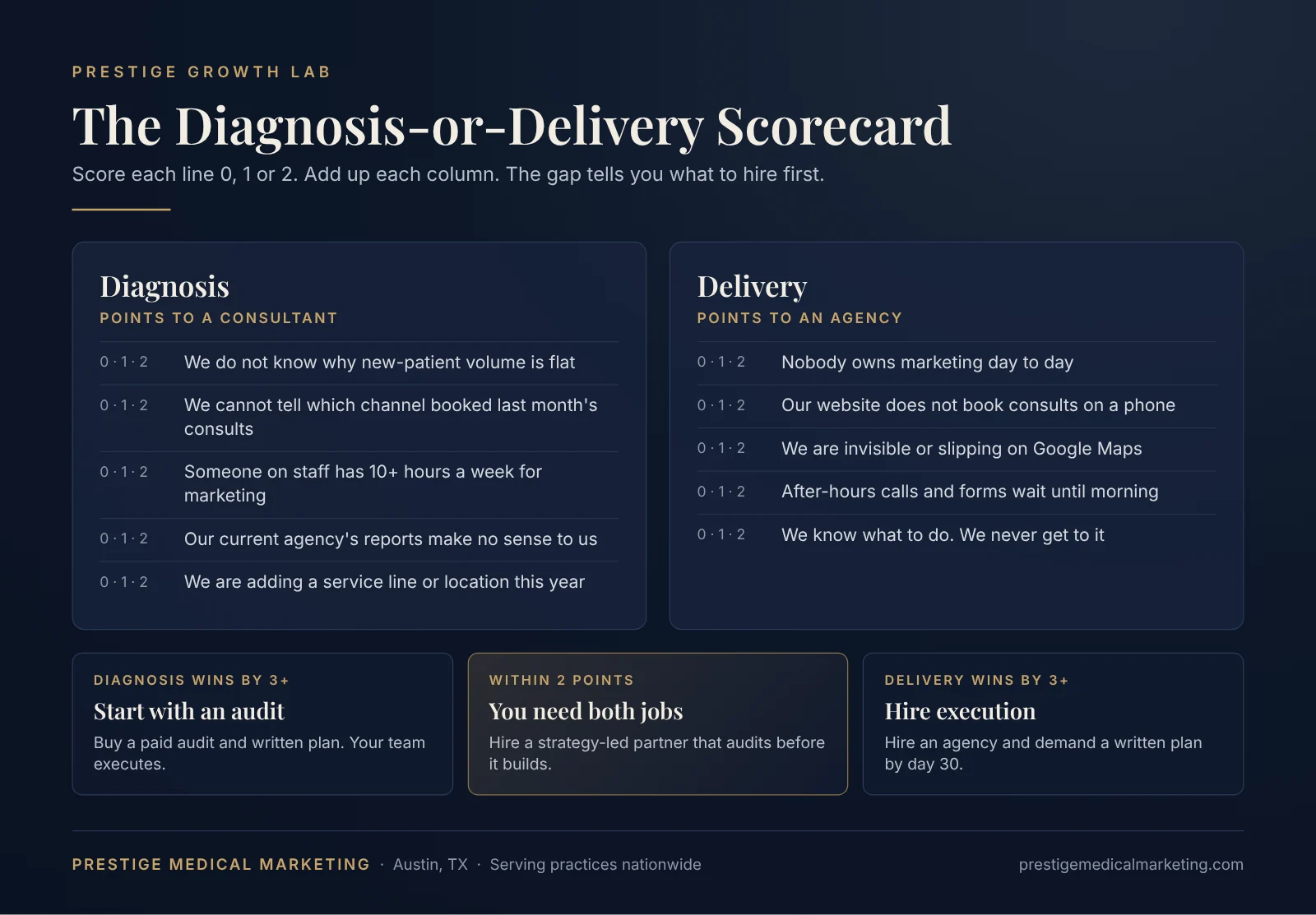
The Diagnosis-or-Delivery Scorecard
Score each statement 0 (not true), 1 (partly) or 2 (true). The higher column tells you what to hire first. Be honest. This takes ten minutes and saves months.
| Statement about your practice today | Points toward | Your score (0-2) |
|---|---|---|
| We do not know why new-patient volume is flat. | Consultant | ___ |
| We cannot tell which channel booked last month’s consults. | Consultant | ___ |
| We have someone on staff with 10+ hours a week for marketing. | Consultant | ___ |
| Our current agency’s reports make no sense to us. | Consultant | ___ |
| We are adding a new service line or location this year. | Consultant | ___ |
| Nobody owns marketing day to day. | Agency | ___ |
| Our website looks dated or does not book consults on a phone. | Agency | ___ |
| We are invisible or slipping on Google Maps for our top treatments. | Agency | ___ |
| Calls and forms after hours go unanswered until morning. | Agency | ___ |
| We already know what to do. We just never get to it. | Agency | ___ |
How to read it: Consultant column higher by 3 or more, start with a paid audit and plan. Agency column higher by 3 or more, hire execution and demand a written plan in the first 30 days. Within 2 points of each other, you need both jobs done, and a strategy-led agency that audits before it builds is usually the cleaner path. High scores in both columns mean you are leaking patients right now. Fix the leaks first.
Using both: where the hand-off breaks
Consultant-plus-agency setups work only when one person owns the scoreboard and the agency agrees to the plan before work starts. Without that, here is what happens. The consultant recommends fixing call handling and tracking first. The agency’s retainer is for ads, so it launches ads. Three months later the consultant blames execution, the agency blames the plan, and you paid both.
If you use both, put three things in writing: one shared definition of a booked consult, one monthly report both parties sign off on, and who has the final call when they disagree. That person should be you or your practice manager, never a vendor.
How healthcare marketing consultants and agencies charge
Consultants usually bill by the project, by the hour or on a short retainer. Agencies usually bill a monthly management fee, sometimes plus a percentage of ad spend. Compare cost per booked patient, not the fee. Prices swing widely by specialty, market size and scope, so ignore any blog that gives you one number for your practice.
- Project fee: a fixed price for an audit, a plan or a defined build. Best for a clear, one-time problem.
- Hourly: flexible for advice, hard to budget. Ask for a cap.
- Retainer: a monthly fee for ongoing work. Demand a defined scope and an end date if it is a consultant.
- Percentage of ad spend: common for paid media. It pays the vendor more when you spend more, so watch who recommends raising budgets.
- Bundled “free” audits: fine as a sales step. Not a strategy.
Keep ad spend separate from management fees on every invoice. If you cannot see both numbers, you cannot judge either one.
What the first 90 days should look like
Whoever you hire, the first 90 days should move from audit to plan to fixes to measured growth, in that order.
- Days 1 to 14: audit and access. Every account confirmed in the practice’s name. Tracking checked. Calls and forms tested, including after hours.
- Days 15 to 30: written plan. The top three bottlenecks, the fix for each, the owner of each and the numbers that will prove it worked.
- Days 31 to 60: plug the leaks. Response speed, Google Business Profile, the treatment pages that matter most and review flow.
- Days 61 to 90: accelerate. Ads or content on the treatments that now convert, with a first honest report on cost per booked consult.
A consultant should hand you that plan by day 30. An agency should hand you the same plan and then do it. If either one starts with “let’s run some ads and see,” walk.
Questions to ask a healthcare marketing consultant or agency
Ask questions that force specifics: who does the work, how results are measured, who owns what and how patient data is handled.
- Which private practices in my specialty have you worked with, and what changed for them?
- Who exactly does the work on my account, and will I talk to them?
- How do you track a phone call or form back to a booked consult?
- What will you report each month, and can I see a real example?
- Who owns the website, domain, Google Business Profile and ad accounts? Google lets a profile have owners and managers, so the practice should hold primary ownership (Google Business Profile Help).
- Will you touch patient information, and if so, will you sign a business associate agreement? HHS explains when a vendor handling protected health information must sign one (HHS business associate FAQs).
- How do you get reviews? Agencies and reputation firms can be liable under the FTC’s reviews and testimonials rule for fake or sentiment-conditioned reviews (FTC).
- What is the contract term, and what do I keep if we part ways?
- Do you work with my direct competitors in this market?
- What would you tell me not to spend money on?
The last question is the best one. A partner who never tells you to spend less is selling, not advising.
Red flags in a healthcare marketing consultant or agency
- Guaranteed rankings. Google says plainly that no one can guarantee a #1 ranking (Google Search Central).
- They own your accounts. If the agency holds your profile, ad account or domain, leaving gets expensive on purpose.
- Reports full of impressions and clicks, with no line for booked consults.
- Every diagnosis matches their product. Ads agency says ads. Web shop says new website.
- Senior people on the sales call, juniors on the account, and you never meet them.
- Review shortcuts. Gated review requests, staff reviews or anything that sounds like buying stars.
- Long lock-in with no exit terms. Good partners earn the next month.
- No clinical sign-off process. Treatment claims should be approved by your medical team before anything goes live.
Why your specialty changes the answer
The consultant-or-agency choice shifts with how patients buy in your specialty.
- Med spas: high volume, repeat visits, fierce local competition. You need constant execution on Maps, reviews and fast booking. Agency work dominates. See med spa marketing.
- Plastic and cosmetic surgery: long, high-value decisions built on surgeon trust and before-and-after proof. Positioning matters as much as traffic, so strategy up front pays off. See plastic surgery marketing.
- Dermatology: two patient paths, medical and cosmetic, that need different pages and offers. See dermatology marketing.
- Medical weight loss: strict ad-platform rules on prescription drugs and claims. You need a partner who knows the rules before launching anything. See medical weight loss marketing.
- Longevity, men’s health and functional medicine: cash-pay, education-heavy, privacy-sensitive. Clear positioning plus discreet, fast follow-up. See longevity, men’s health and functional medicine.

Mistakes practices make when hiring marketing help
- Hiring for the channel they like instead of the bottleneck they have.
- Buying a plan with no budget to execute it. A binder is not a strategy.
- Buying execution with no plan. Activity is not progress.
- Judging SEO in month two and paid ads in week two.
- Letting the vendor define success. You define it: booked consults, show rate and cost per new patient.
- Ignoring the phones. More leads into a front desk that misses calls is a more expensive way to lose patients.
When to switch from a consultant to an agency, or to a new agency
Switch to an agency when the plan is clear and execution keeps slipping. Switch agencies when reports cannot connect spend to booked patients after a full quarter. Signs it is time:
- The consultant’s recommendations from 90 days ago are still sitting in a document.
- Your agency cannot tell you cost per booked consult, or will not.
- You learn about problems from patients before your vendor flags them.
- You are paying two or more vendors who do not talk to each other.
Before you switch, make sure you hold admin access to every account, export your data and keep the old tracking numbers live until the new setup is confirmed. If you are choosing your next partner, use our checklist for choosing a medical marketing agency, and see how the pieces fit together in our guide to medical digital marketing for private practices.
How Prestige Medical Marketing does it: consultant thinking, agency delivery
We built Prestige Medical Marketing for owners who are tired of paying one firm to think and another to do. We audit first, put the plan in writing and then build and run it ourselves. One team. One scoreboard: booked patients.
- Diagnosis before invoices. Every engagement starts with a Market Check and a growth plan built around the patients you want most.
- Your team approves clinical claims. Nothing about a treatment goes live without your medical team’s sign-off.
- You own everything. Website, domain, Google Business Profile, data and ad accounts stay in the practice’s name.
- Month-to-month. We earn the next month or we do not get it.
- One practice per specialty per market. We never market your direct competitor in your area.
- ROI reporting every month: new-patient revenue against spend, and what we change next.
We work with private practices nationwide from our Austin, Texas headquarters. See The Prestige System, every practice type we help and how we work.
Not sure if you need a consultant or an agency? Book a free 15-minute Practice Growth Call or call (716) 400-0084. We will tell you which problem to solve first, and if a short audit is all you need, we will say so.
Frequently asked questions
What is the difference between a healthcare marketing consultant and an agency?
A healthcare marketing consultant diagnoses and advises: audits, strategy, priorities and vendor oversight, while your team or other vendors do the work. A healthcare marketing agency executes: it builds and runs your website, Google Business Profile, search, ads and reporting. Consultants sell judgment; agencies sell delivery.
Should a private practice hire a consultant or an agency?
Hire a consultant when you already have people or vendors doing the work but no clear plan, or when you need an outside audit before you spend more. Hire an agency when nobody owns execution and you need pages built, listings managed, ads run and calls tracked every week. If you need both, hire a strategy-led agency that does the diagnosis and the delivery under one owner.
How much does a healthcare marketing consultant cost compared with an agency?
Consultants usually charge by the hour, by the project or by monthly advisory retainer. Agencies usually charge a monthly management fee, sometimes plus setup and plus your ad spend, which goes to the ad platform. Compare total cost against the value of the booked consults each option produces, not the fee alone.
How long does it take to see results from a healthcare marketing agency?
Fast fixes like call coverage, speed-to-lead and tracking can show up in booked consults within weeks. Google Business Profile and treatment-page work usually builds over two to six months. Anyone who promises a guaranteed number-one ranking is making a promise Google itself says no one can keep.
Does my marketing consultant or agency need to sign a Business Associate Agreement?
If the firm will create, receive, maintain or transmit protected health information on your behalf, such as patient lead data tied to treatments, HIPAA generally requires a Business Associate Agreement. Ask your privacy counsel to confirm what applies to your setup before any patient data changes hands.
Who should own my website, Google Business Profile and ad accounts?
You should. Keep your practice as the owner of the domain, website, Google Business Profile, analytics and ad accounts, and give the consultant or agency manager-level access. If you part ways, you remove their access and keep every asset and its history.
Is a fractional CMO the same as a healthcare marketing consultant?
Close, but not the same. A fractional CMO is a part-time marketing executive who sets strategy and manages the people and vendors doing the work on an ongoing basis. A consultant is usually brought in for a defined diagnosis or project. Neither one replaces the hands that build pages and run campaigns.
Can a practice use a consultant and an agency at the same time?
Yes, as long as one person owns the result. The plan breaks at the hand-off when the consultant sets goals the agency never agreed to and the agency reports numbers the consultant never asked for. Put one scorecard, booked consults and cost per booked consult, in front of both.