
Medical digital marketing is the online system that gets a private practice found, chosen and booked. Build it in order: tracking and call capture first, then Google Maps and local search, then treatment pages that convert, then fast response, then ads, then retention. Measure booked consults and cost per booked consult, not likes or clicks.
Most private practices do not have a marketing problem. They have a sequencing problem. They buy ads before the phones are answered, post on Instagram before Google can find them, and pay for a new website before anyone tracks which pages book consults. Every channel works a little. Together they leak.
This guide lays out what medical digital marketing actually is for a private practice, the channel stack we build in order, the first 90 days step by step and the numbers worth watching. It is the same playbook we run for med spas, plastic surgery, dermatology, weight loss and longevity practices from our Austin, Texas headquarters.
What medical digital marketing means for a private practice
Medical digital marketing is the system that turns online demand into booked consults: search and Maps visibility, AI answers, a website that converts, fast response to every inquiry, paid campaigns and follow-up that brings patients back. The channels are the parts. The system is what you are paying for.
Hospital marketing chases brand awareness across a region. A private practice plays a different game. Your patients are usually local, often paying cash for elective care, and they compare two or three providers before they book. That changes the job:
- The decision is personal. A filler, facelift or GLP-1 program is a trust purchase. Proof and clarity beat clever ads.
- The market is a few miles wide. Google Maps and local search decide who gets the call. National reach is mostly wasted spend.
- The value is long-term. One aesthetic patient who returns for years is worth many first visits. Retention is part of marketing, not an afterthought.
- The rules are stricter. Patient privacy, review rules and ad-platform health policies apply to you in ways they never apply to a restaurant.
The medical digital marketing channel stack, in order
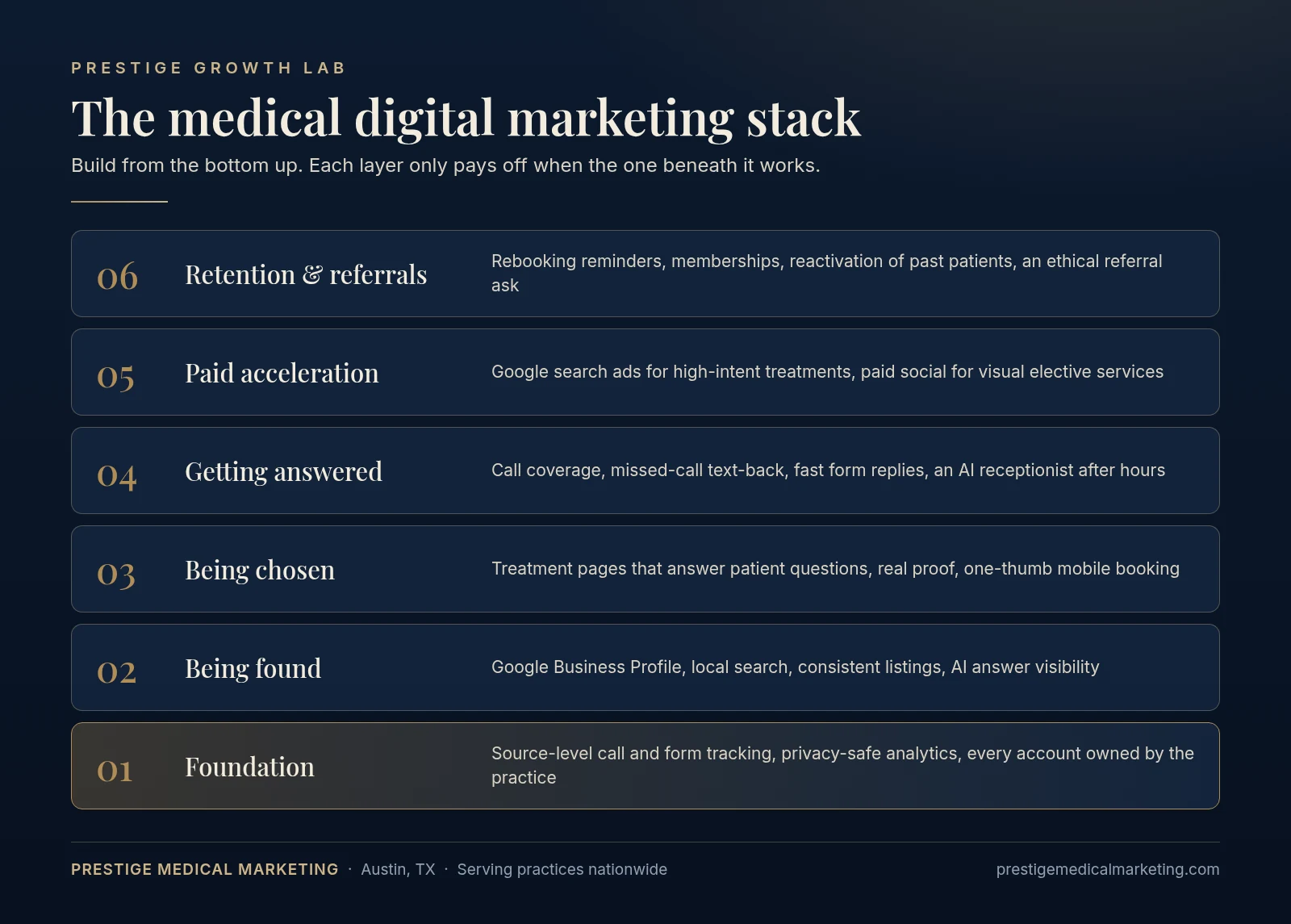
Think of your marketing as six layers. Each layer depends on the one beneath it. Skip a layer and the layers above it underperform, no matter how much you spend on them.
Layer 1: Foundation (tracking, ownership and call capture)
Before any campaign, know where every booked consult came from and own every account it runs through. That means call tracking that records the source, form tracking that does not leak health details, analytics you can read, and your domain, Google Business Profile and ad accounts in the practice’s name. Without this layer, every later decision is a guess.
Layer 2: Being found (Google Maps, local search and AI answers)
Your Google Business Profile is the most valuable free listing you have. Google says local results are based mainly on relevance, distance and prominence (Google Business Profile Help). You control relevance and prominence: accurate categories and services, real photos, steady patient reviews and consistent details everywhere you are listed. The same signals feed AI answers in Google, ChatGPT, Gemini and Perplexity. Google states there are no special requirements to appear in AI Overviews beyond being eligible for normal search (Google Search Central). Anyone selling a secret AI ranking trick is selling a story.
Layer 3: Being chosen (website, treatment pages and proof)
Visibility gets you compared. Your website decides whether you win the comparison. Every high-value treatment deserves its own page that answers the questions patients ask before they book: who it is for, what it feels like, recovery, how results are judged, who performs it and how to book. Add consent-safe before-and-after photos where your specialty allows, provider credentials and a booking path that works on a phone with one thumb.

Layer 4: Getting answered (speed to lead)
The fastest practice to respond usually gets the consult. A patient who reaches voicemail at 6:40 PM often calls the next name on the list. This layer covers phone coverage during and after hours, text-back for missed calls, form replies in minutes rather than hours and an AI receptionist that answers, qualifies and books when your front desk cannot. It is the cheapest growth most practices ignore.
Layer 5: Paid acceleration (Google Ads and social ads)
Ads amplify a system that already converts. They do not fix one that does not. Search ads capture patients actively looking for a treatment in your area. Paid social works for visual, elective services such as injectables, body contouring and aesthetic surgery, where patients need to see the result before they search for it. Both carry health-specific rules, covered below.
Layer 6: Retention and referrals
The cheapest new booking is a returning patient. Rebooking reminders, memberships for repeat treatments, reactivation messages to past patients and a simple, ethical referral ask all compound. Many practices spend heavily to win a first visit and nothing to earn the second.
How to sequence medical digital marketing: the first 90 days
Order matters more than budget. Here is the sequence we use with new practices. Your timeline shifts with your market and starting point, but the order rarely does.
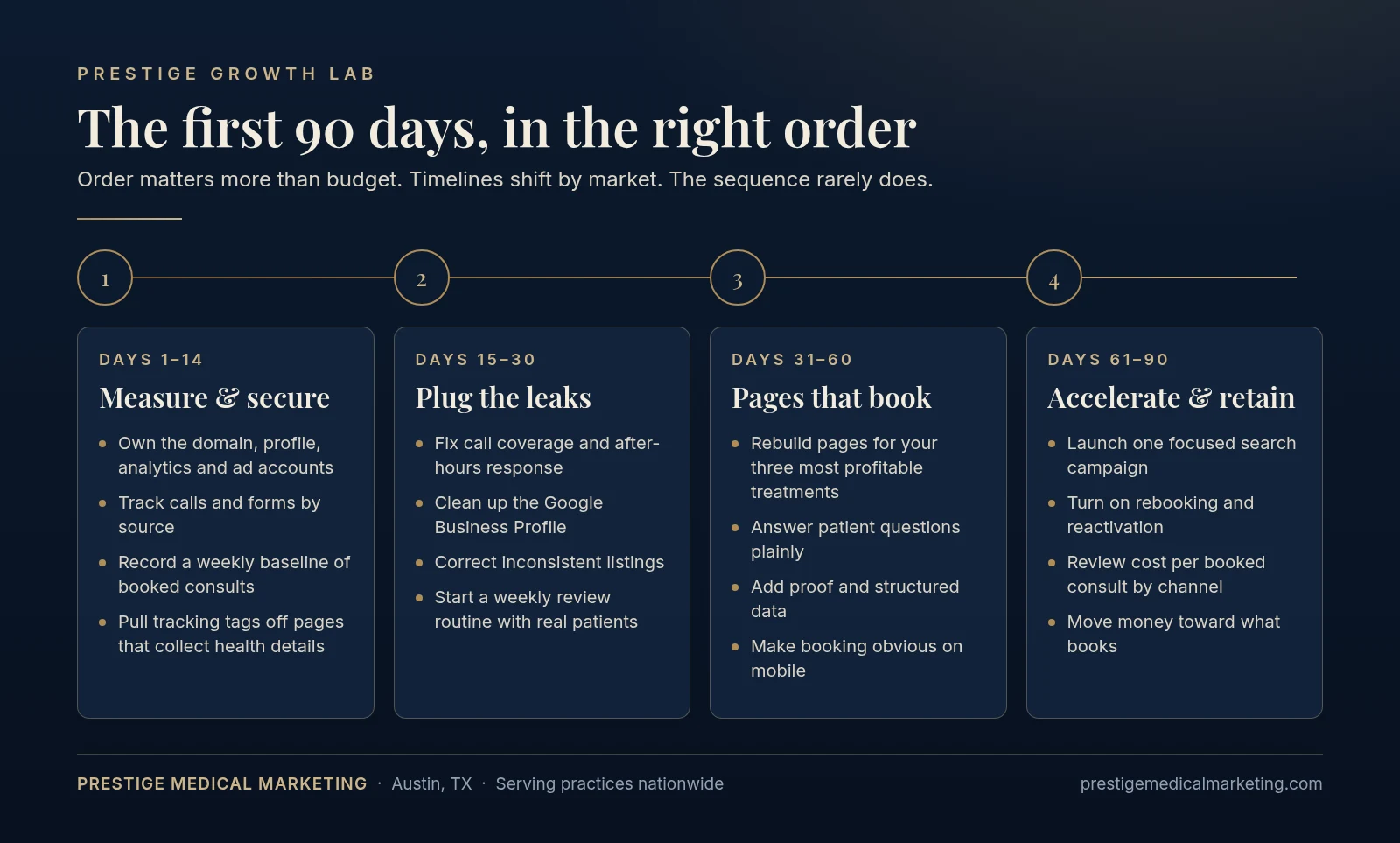
- Days 1 to 14: measure and secure. Confirm the practice owns its domain, profile, analytics and ad accounts. Set up call and form tracking by source. Record a baseline: calls, missed calls, consult requests and booked consults per week. Audit where tracking tags sit and remove them from pages that collect health information.
- Days 15 to 30: plug the leaks. Fix call coverage and after-hours response. Clean up your Google Business Profile: categories, services, hours, photos and booking link. Correct inconsistent listings. Start a weekly review routine with real patients.
- Days 31 to 60: build the pages that book. Rebuild or create pages for your three most profitable treatments. Answer patient questions plainly, add proof and structured data, and make booking obvious. Publish answers to the questions patients ask most, which is also what AI engines quote.
- Days 61 to 90: accelerate and retain. Launch one tightly focused search campaign for your highest-value service with a matching landing page. Turn on rebooking and reactivation for existing patients. Review cost per booked consult by channel and move money toward what books.
By day 90 you should see the system working: fewer missed calls, a cleaner Maps presence, stronger treatment pages and a report that ties marketing to the calendar. Organic search and Maps keep compounding for months after that. Treat anyone who promises page one in 30 days with suspicion.
What makes medical digital marketing different: the rules
General digital marketers learn healthcare rules on your account. These are the four that matter most for a private practice. Your attorney and compliance advisors have the final word. An agency is not a law firm, but a good one raises these issues before you do.
Website tracking and patient privacy
HHS guidance on online tracking technologies explains when analytics and ad pixels can expose protected health information. A federal court vacated one part of that guidance in June 2024, the part about public pages, as HHS notes on the same page. Patient portals, intake forms and booking flows still deserve strict handling. Our rule: no ad pixels on pages where patients log in, book or describe symptoms, and a business associate agreement with any vendor that handles patient data.
Reviews and testimonials
The FTC’s final rule on fake reviews and testimonials bans fake reviews and certain review suppression. Ask every patient, reply to every review, never confirm in a public reply that someone is a patient, and never buy, filter or ghost-write reviews.
Google Ads health policies
Google restricts how healthcare services and medicines are advertised under its Healthcare and medicines policy, and its personalized advertising policy limits targeting based on health. Prescription weight loss and hormone campaigns need particular care.
Meta data limits for health advertisers
Meta prohibits sharing health information through its business tools, including in event names, URLs and audiences (Meta Business Help Center). Since early 2025, Meta has limited lower-funnel conversion events for many advertisers it classifies as health and wellness. Plan your social campaigns and your measurement around that, not around last year’s tactics.
What to measure in medical digital marketing (and what to ignore)
Measure booked patients and what they cost. Everything else is a supporting signal.
Track these every month:
- Booked consults by source. The only number that proves a channel works.
- Cost per booked consult. Compares channels fairly, regardless of click prices.
- Answer rate and missed calls. Shows how much paid and organic demand you are losing at the front desk.
- Time to first response. Fast responses win consults. Slow ones hand them to competitors.
- Consult show rate and conversion to treatment. Separates marketing problems from scheduling and sales problems.
- Patient value over 12 months. Sets how much you can afford to pay for a new patient.
Treat impressions, followers, likes and rankings for vanity keywords as diagnostics, not results. A report full of traffic charts and no booked patients tells you the person reporting is not tracking what matters.

How medical digital marketing changes by specialty
The stack is the same. The emphasis shifts with how your patients decide.
- Med spas: Maps, reviews and treatment pages carry the load. Paid social works for visual treatments. Memberships drive profit. See med spa marketing.
- Plastic and cosmetic surgery: long research cycles, so surgeon credibility, consent-safe galleries and consult pre-qualification matter most. See plastic surgery marketing.
- Medical weight loss: the strictest ad rules of the group. Lead with program, provider oversight and honest expectations, never drug claims. See weight loss clinic marketing.
- Dermatology: two audiences, medical and cosmetic, need two clear paths through one site. See dermatology marketing.
- Longevity and anti-aging: informed, skeptical patients reward depth and clear program explanations. See longevity clinic marketing.
- Men’s health, functional medicine and IV wellness: privacy-first messaging and fast, discreet response win. See men’s health, functional medicine and IV and wellness.
What does medical digital marketing cost?
Cost depends on scope, specialty and how competitive your market is, so compare cost per booked patient, not monthly fees. Four factors drive the number: how many layers need building from scratch, how many treatments and locations you market, the click prices in your specialty and city, and how much content and response work your team can handle itself.
The budget rule we follow: fix the leaks before buying traffic. Answering every call and replying fast usually costs less than buying more clicks, and it makes every dollar of ad spend work harder. Keep ad spend separate from management fees so you can see both. Hold any test for a full quarter before judging it.
The mistakes that drain a practice’s marketing budget
- Ads before answers. Paying for clicks into a phone line nobody picks up after 5 PM.
- Random acts of marketing. A post here, a promotion there, no system connecting them.
- Coupon-driven demand for premium care. Discount traffic fills the book with one-time bargain hunters.
- Renting your assets. An agency that owns your website, profile or ad accounts owns your leverage.
- Template websites. The same site sold to every practice in the country gives patients no reason to choose you.
- Pixels everywhere. Tracking tags on booking and intake pages create privacy risk for little gain.
- Judging SEO in month two. Organic visibility compounds. Quitting early wastes the work already done.
Do it yourself, hire in-house or hire a medical marketing agency?
A practice can run parts of this stack itself, especially reviews and retention. Most struggle to run all six layers well while seeing patients. If you are weighing the options, read medical marketing companies vs. in-house. If you are ready to hire, use our checklist for choosing a medical marketing agency.
How Prestige Medical Marketing runs the stack
Most agencies sell a channel. We build the whole stack, in order, and report on booked patients. That is The Prestige System: Maps and AI search visibility, custom practice websites, AI receptionists and booking systems, run as one system rather than four vendors.
- One practice per specialty per market. We never market your direct competitor in your area.
- You own everything. Domain, website, profile, data and ad accounts stay with the practice.
- Privacy built in. No ad pixels on intake or booking pages, ever.
- Honest timelines. No guaranteed rankings. A clear plan, a 90-day sequence and reporting you can check.
We work with private practices nationwide from Austin, Texas. See every practice type we help or explore Google Maps and AI search for practices.
Want the stack built for your practice? Check if your market is open or call (716) 400-0084. We will show you which layer is leaking first, and we will tell you straight if you are not a fit.
Frequently asked questions
What is medical digital marketing?
Medical digital marketing is the online system a medical practice uses to get found, chosen and booked: Google Business Profile and local search, a website with treatment pages that convert, fast response to calls and forms, paid search and social ads, and retention. It runs under health-specific rules on privacy, reviews and advertising.
Which channel should a practice fix first?
Start with tracking and call capture, then your Google Business Profile. If you cannot see which channel booked a consult, or calls go to voicemail, every dollar you add to ads or social leaks out. Fix the foundation, then get found, then get chosen, then accelerate.
How long does medical digital marketing take to work?
Speed-to-lead fixes and call coverage can lift booked consults within weeks. Google Business Profile and treatment-page improvements usually build over two to six months. Organic search keeps compounding after that. Paid search can produce calls quickly once the pages and phones are ready for them.
Is social media enough to market a medical practice?
No. Social builds familiarity for visual, elective treatments, but most patients still search Google, check Maps and read reviews before they book. A practice that only posts on Instagram is invisible at the moment a patient is ready to choose.
Can a practice use Google Analytics and the Meta Pixel on its website?
Carefully. HHS warns that tracking technologies can disclose protected health information when they collect data on pages tied to a patient's health or appointments. Keep tracking tags off forms and pages that collect health details, review vendor agreements, and get privacy counsel to confirm your setup.
How much should a medical practice spend on digital marketing?
It depends on your specialty, market competition, treatment values, capacity to take new patients and how much of the foundation already works. Set the budget from the value of a booked consult and the number of new patients you can actually serve, then move money toward the channels that book.
Can ChatGPT or Google AI recommend my practice?
Yes, and the inputs are the same ones that win local search: a complete Google Business Profile, consistent listings, steady real reviews and clear pages that answer patient questions directly. Google says there are no special requirements for AI Overviews beyond being eligible to appear in normal search.
Does a medical practice need paid ads?
Not on day one. Ads amplify a system that already converts. Once tracking, call coverage and treatment pages are in place, a focused search campaign for your highest-value service is often the fastest way to add booked consults.