
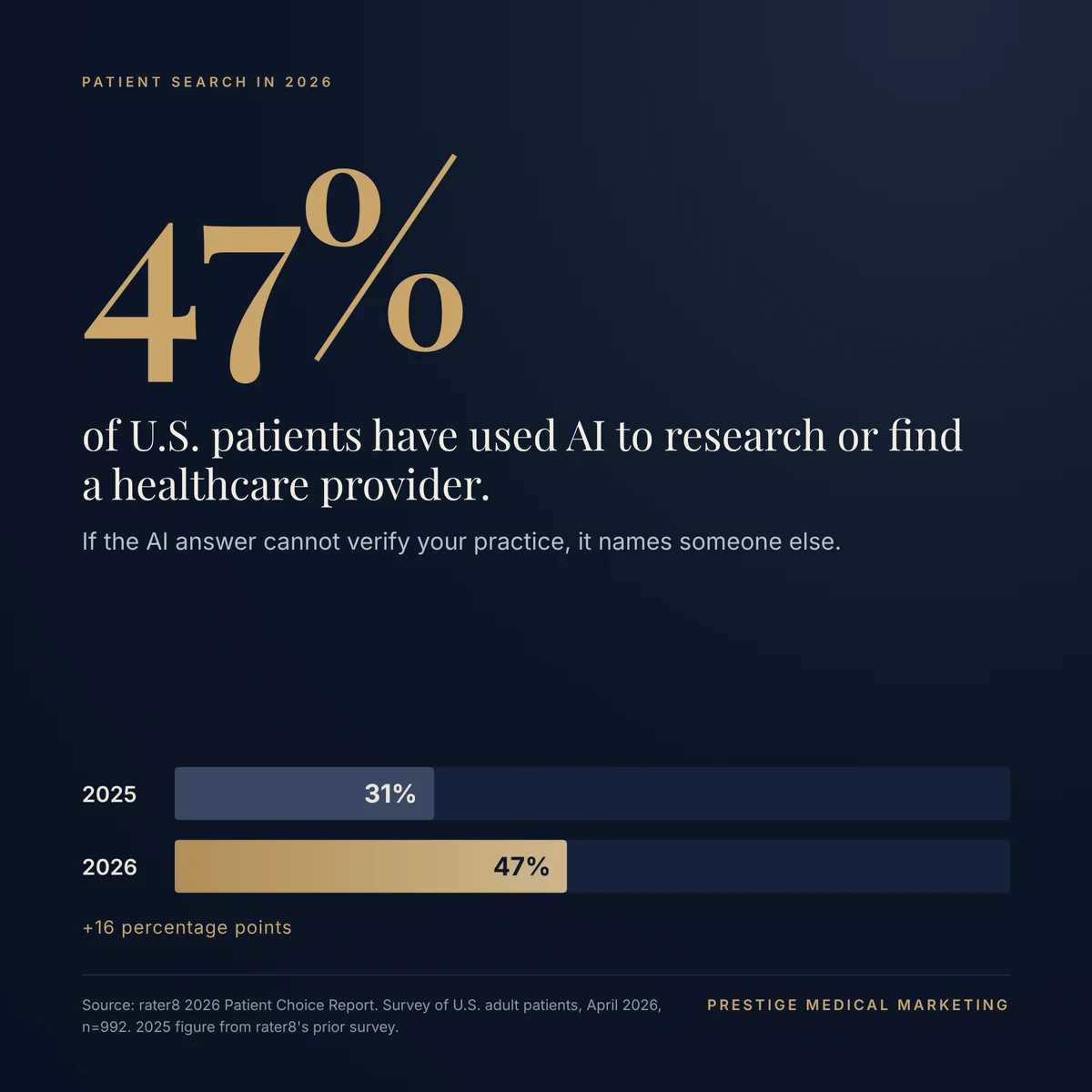
Medical marketing SEO gets a practice found and chosen in Google Search, Google Maps and AI answers. It matters more than ever: 47% of U.S. patients have used an AI tool to research or find a provider, up from 31% in 2025 (rater8 2026 Patient Choice Report). Win it with a complete Business Profile, one page per treatment, steady compliant reviews, consistent listings, clinician-approved content and structured data, measured on booked consults.
47% of U.S. patients have now used an AI tool to research or find a healthcare provider, up from 31% in rater8’s 2025 survey. That is the headline of the rater8 2026 Patient Choice Report (survey of U.S. adult patients, n=992, April 2026). For a private practice, it means the first impression often happens before anyone visits your website. An answer engine reads what the internet says about you, then decides whether your name is in the answer.
Medical marketing SEO is the work that decides that answer. This guide shows what changed, what Google and the AI tools actually read, the steps that put a practice in front of patients who book, what it costs, how long it takes and how to choose the right partner. It is written for private, mostly cash-pay practices: med spas, plastic and cosmetic surgery, dermatology, medical weight loss and longevity clinics.
What is medical marketing SEO?
Medical marketing SEO is the work of getting a medical practice found and chosen in Google Search, Google Maps and AI answers by patients looking for the treatments it offers. It covers four things: your Google Business Profile, your website and treatment pages, your reviews and reputation, and the consistency of your practice details everywhere they appear online.
The goal is not traffic. The goal is booked consultations from patients who fit your practice. A dermatology practice ranking for acne questions it does not want to treat has a traffic problem dressed up as a win.
The 2026 numbers every practice owner should know
Patients now search locally, check ratings hard and lean on AI to make the shortlist. These figures come straight from the rater8 2026 Patient Choice Report (U.S. adult patients, April 2026):
- 47% have used an AI tool to research or find a healthcare provider, up from 31% in 2025 (n=992).
- 55% of patients who searched for a doctor start with some version of “specialty near me” (searchers only, n=714).
- 36% of searchers said AI tools influenced their final choice of doctor, ahead of Google search results at 34% (n=714).
- 37% name the AI Overview as the section of Google they trust most when searching for care. The local map pack: 13%. Ads: 7% (n=992).
- 66% of AI users have run into incorrect provider information from an AI tool, and 60% trusted the AI summary without checking it (AI users only, n=465).
- 75% will not book with a provider rated below 4.0 stars (n=992).
Read that list as a practice owner. Patients start local. AI narrows the field. Star ratings cut anyone below the line. And when the AI gets your hours, address or services wrong, most patients never find out. They just book somewhere else.

What this means for your practice
If an AI tool cannot find clear, consistent, trustworthy information about your practice, it names someone else. There is no ad slot for that answer. You earn it or you do not show up.
Here is the pain we hear from owners every week:
- “We are the best injector in town and ChatGPT names the chain down the street.”
- “Our agency sends a ranking report every month. The phone does not ring more.”
- “Google shows our old hours and a phone number we stopped using two years ago.”
- “We have 40 reviews. The practice that opened last year has 400.”
None of that is a talent problem. It is a visibility system problem, and it is fixable.
Does SEO still matter if patients use AI?
Yes. AI answers are built on the same signals SEO has always worked on. Google says plainly that the best practices for SEO remain relevant for AI Overviews and AI Mode, and that there are no additional requirements or special optimizations needed to appear in them (Google Search Central, AI features and your website). The practice that wins the AI answer is usually the practice with the strongest foundation: an accurate profile, real reviews, clear pages and consistent details.
What changed is the penalty for sloppiness. A blue-link page with a typo still got clicked. An AI answer that cannot verify your details simply leaves you out.
How Google Maps and AI tools decide which practice to name
Google ranks local results mainly on relevance, distance and prominence. That comes from Google’s own guide to local ranking, which also says businesses with complete and accurate information are more likely to show up, and that there is no way to request or pay for a better local ranking.
- Relevance: how well your profile and pages match what the patient asked for. “Lip filler,” “CoolSculpting alternative,” “medical weight loss program” and “Mohs surgery” are different searches with different winners.
- Distance: how close you are to the searcher. You cannot change your address, so you win on the other two.
- Prominence: how well known you are, including links to your site and how many reviews and what ratings you have.
AI assistants pull from the same sources: your website, your Business Profile, review sites, directories and articles that mention you. rater8’s report makes the point directly: practices with consistent, well-distributed information across every listing are more likely to be represented accurately when AI assembles its answers.
Medical practice marketing for local visibility: the six signals that move the needle
Local visibility for a medical practice comes down to six signals. Fix them in this order. This is the core of any medical practice marketing plan built for Maps and AI answers.
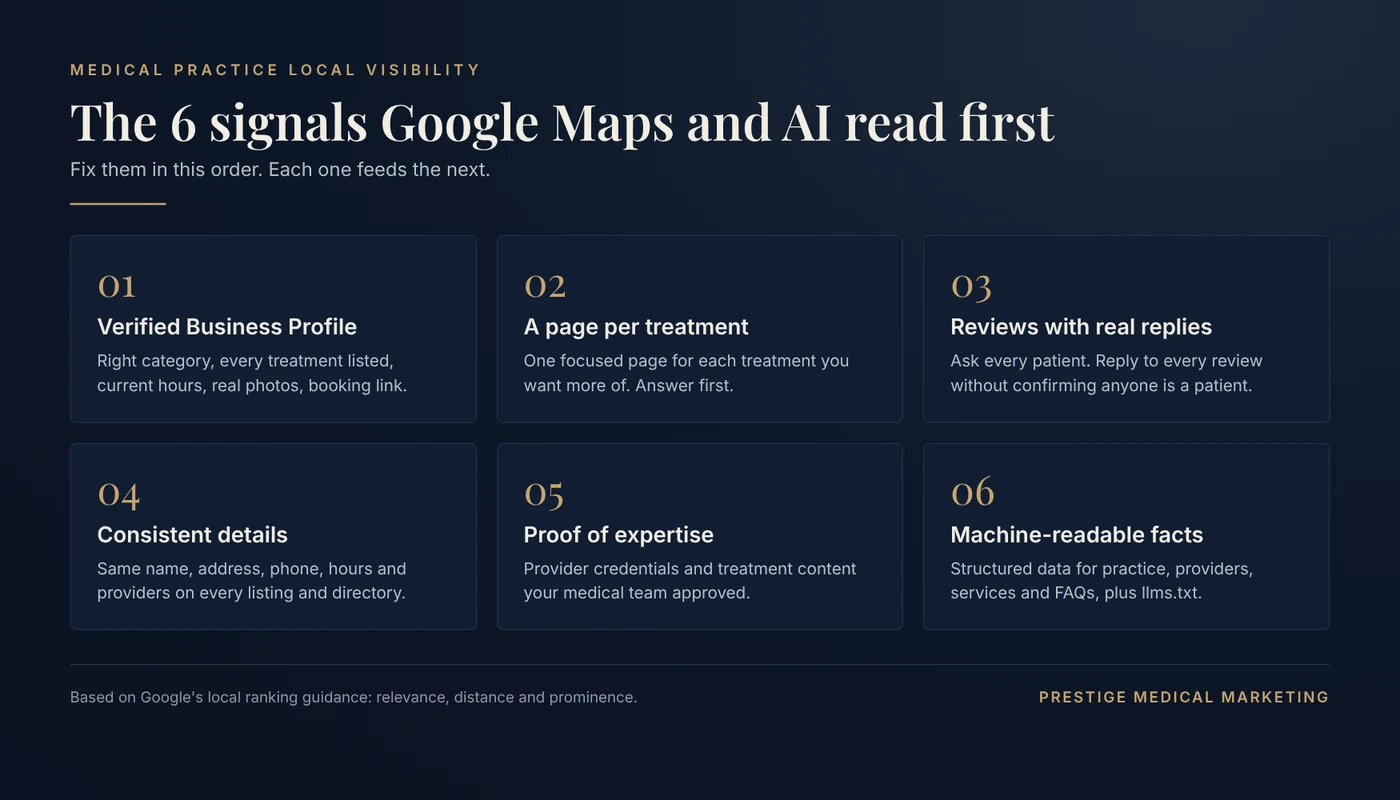
- A complete, verified Google Business Profile. Right primary category, every treatment listed as a service, current hours, real photos of your space and team, booking link and a description written for patients, not for keywords.
- One page per treatment that pays. A single “Services” page ranks for nothing. A plastic surgery practice needs a real page for each procedure it wants to grow. A med spa needs separate pages for injectables, lasers and skin treatments.
- Reviews with steady velocity and real replies. Ask every happy patient, not just a few. Reply to every review without confirming that the person is a patient.
- Consistent details everywhere. Practice name, address, phone, hours and provider names identical across your site, Google, Apple Maps, Bing, Yelp, Healthgrades and the directories in your specialty.
- Proof of expertise. Provider bios with credentials, medically reviewed treatment content and the date it was last reviewed.
- Machine-readable facts. Structured data that labels your practice, providers, services and FAQs, plus an llms.txt file that states the facts in plain text.
Why medical SEO is held to a higher standard
Google treats health content as “Your Money or Your Life” content, where trust carries extra weight. Google’s guidance on creating helpful, reliable, people-first content explains that its systems give more weight to content showing strong experience, expertise, authoritativeness and trust on topics that could affect health. Its Search Quality Rater Guidelines use the same YMYL standard.
In practice, that means anonymous treatment pages written to hit a keyword count lose to pages a clinician can stand behind. Your medical team should approve every clinical claim. Ours does not go live without that sign-off.
The medical marketing SEO process, step by step
A sound medical SEO engagement follows the same five steps: audit, fix the foundation, build the pages, grow the reviews, then measure on booked consults.
Step 1: Audit what Google and AI already say about you
Search your practice and top treatments the way patients do, in Google, Maps and at least two AI assistants. Write down every wrong hour, old phone number, missing service and competitor named instead of you. That list is your starting line.
Step 2: Fix the foundation
Claim and verify every profile, correct every listing, set up call and form tracking in your practice’s name and make sure the site loads fast and books cleanly on a phone.
Step 3: Build the treatment pages patients search for
Each page answers the questions patients ask before they book: who it is for, what happens at the visit, downtime, how to choose a provider and what it costs or what drives the cost. Answer first, then explain.
Step 4: Grow reviews the right way
Build a simple system that asks every patient after the visit. The rater8 report found 68% of patients would likely leave a review if their doctor asked (n=992). Most practices never ask.
Step 5: Measure what matters
Report on calls, booked consultations, show rate and cost per booked patient. Rankings are a leading indicator, not the scoreboard.
How long does medical SEO take?
Profile and listing fixes can show up within weeks. Treatment pages and review growth usually build over several months. Speed depends on how competitive your market is, how many treatments you target and how much is broken at the start. A med spa in a dense metro competing on injectables is a longer climb than a longevity clinic with few direct competitors. Google itself tells business owners that no one can guarantee a number-one ranking (Google Search Central, Do you need an SEO?). Judge progress by quarter, not by week.
How much does medical marketing SEO cost?
Cost is driven by scope, not by a magic monthly number. The factors that move the price:
- How many treatments and locations need pages and profiles.
- How much cleanup the foundation needs: duplicate listings, a slow site, broken tracking.
- How competitive your specialty is in your market.
- Whether content is medically reviewed and written by people who understand your specialty.
- Whether the engagement includes review systems, call handling and booking, or only rankings.
Compare proposals on cost per booked consultation, not on the monthly fee. A cheap plan that delivers clicks and no consults is the most expensive line on your P&L.
In-house, DIY or a medical marketing SEO company?
DIY works for the basics. Specialists win when the market is competitive or nobody owns the work every week. Google notes that a small local business can do much of the work itself. The trouble is time. Your practice manager is also running the front desk, the schedule and payroll.
- DIY fits a new practice in a quiet market with an owner who will keep the profile, reviews and pages current.
- In-house fits a larger practice that can hire a marketer with real local SEO and healthcare compliance experience.
- A specialist medical marketing company fits practices that want the whole system built and run, from profile and pages to reviews, AI visibility and call handling, with one team accountable for booked patients.
For a deeper comparison, read medical marketing companies vs. in-house teams.
How to choose a medical practice marketing company for local visibility
Choose the firm that can show you what Google and AI say about you today, explain exactly what it will change and report on booked patients. Ask these questions on the first call:
- What do Google Maps and the AI assistants say about my practice right now, and what is wrong?
- Who owns my Business Profile, website, tracking and ad accounts? (The right answer: you do.)
- Who approves clinical claims before a page goes live?
- How do you get reviews without incentives or filtering out unhappy patients?
- Will you sign a Business Associate Agreement if you handle patient information?
- Do you work with my direct competitors in my market?
- What will you report every month, and is booked consults on it?
Walk away from anyone who guarantees a number-one spot, claims a “special relationship” with Google or buys reviews. Google’s own hiring guide lists the first two as warning signs. Our full checklist for choosing a medical marketing agency goes further.
Reviews and compliance: where practices get burned
Fake reviews, paid reviews and careless replies are now legal risks, not just bad form.
- The FTC’s rule on consumer reviews and testimonials (16 CFR Part 465, effective October 21, 2024) bans creating or buying fake reviews, paying for reviews conditioned on positive sentiment and certain review suppression practices (Federal Register).
- Google’s review policy bans offering incentives for reviews and selectively soliciting positive reviews, the practice often called review gating (Google Maps user contributed content policy).
- HIPAA applies to review replies. In 2023, HHS’s Office for Civil Rights settled with a New Jersey psychiatric practice for $30,000 after it disclosed patient information in responses to negative Google reviews (HHS). Reply warmly, never confirm someone is a patient and take details offline.
- Tracking pixels need care. HHS guidance on online tracking technologies still applies to logged-in pages, booking tools and patient portals, even after a federal court vacated part of it in June 2024 for public pages (HHS bulletin). Have your privacy counsel review your setup.
This is marketing guidance, not legal advice. Your counsel has the final word.
How medical SEO differs by specialty
The system is the same. The searches, the proof and the compliance lines change by specialty.
- Med spas: win treatment-level searches like lip filler, laser hair removal and medical-grade facials, and compete on trust, not discounts. See med spa SEO and our med spa marketing approach.
- Plastic and cosmetic surgery: procedure pages, surgeon credentials and careful before-and-after use carry the weight. See plastic surgery SEO and plastic surgery marketing.
- Dermatology: keep medical and cosmetic patient paths separate so each lands on the right page. See dermatology marketing and our dermatology Business Profile guide.
- Medical weight loss: market the physician-led program, not a drug name, and keep claims accurate. See weight loss clinic marketing.
- Longevity and anti-aging: patients research hard and compare programs. Clear explanations and provider credibility win. See longevity clinic marketing.
Mistakes that keep practices invisible
- Chasing rankings for words that do not book. Rank for treatments you want more of.
- Letting the agency own your Business Profile. If you part ways, you lose the history.
- Ignoring AI answers because “that is not where our patients are.” 47% of patients say otherwise.
- Asking only happy patients for reviews. It breaks Google’s policy and it is the fastest way to lose the profile.
- Treatment pages with no medical review and no named provider.
- Winning the search and losing the call. More visibility into a front desk that misses calls is a more expensive way to lose patients.
How Prestige Medical Marketing does medical SEO the right way
Most agencies sell rankings and send a PDF. We sell booked patients and show the math. Here is how we work:
- Market Check first. We show you what Google Maps and the AI assistants say about your practice today and who they name instead.
- The full system, not one channel. Business Profile, treatment pages, reviews, structured data, llms.txt and AI visibility, connected to call handling and booking. See Google Maps and AI search for medical practices and how to get your practice recommended by AI.
- Your medical team approves every clinical claim.
- You own everything: domain, website, Business Profile, data and ad accounts.
- Month-to-month. We earn the next month or we lose it.
- One practice per specialty per market. We never market your direct competitor in your area.
- ROI reporting every month: new-patient revenue against spend.
We work with private practices nationwide from our Austin, Texas headquarters. See The Prestige System and every practice type we help.
Want to know what AI says about your practice right now? Book a free Practice Growth Call or call (716) 400-0084. We will show you where you stand in Google Maps and the AI answers, and what to fix first.
Frequently asked questions
What is medical marketing SEO?
Medical marketing SEO is the work of getting a medical practice found and chosen in Google Search, Google Maps and AI answers by patients looking for its treatments. It covers the Google Business Profile, treatment pages, reviews, consistent listings and structured data, and it should be measured on booked consultations, not traffic.
How many patients use AI to find a doctor?
According to the rater8 2026 Patient Choice Report, 47% of U.S. adult patients have used an AI tool to research or find a healthcare provider, up from 31% in rater8's 2025 survey. The 2026 survey was fielded in April 2026 with a clean sample of 992 patients.
Does SEO still matter now that patients use ChatGPT and AI Overviews?
Yes. Google says SEO best practices remain relevant for AI Overviews and AI Mode and that no special optimizations are required to appear in them. AI assistants pull from your website, Business Profile, reviews and listings, so the same foundation that wins Google Maps wins AI answers.
How does Google decide which medical practices show up on Google Maps?
Google says local results are based mainly on relevance, distance and prominence. Complete and accurate Business Profile information, reviews and ratings, and links to your site all play a part. Google also says there is no way to pay for a better local ranking.
How long does medical SEO take to work?
Profile and listing fixes can show up within weeks. Treatment pages and review growth usually build over several months, depending on how competitive your specialty is in your market and how much needs fixing. No one can guarantee a number-one ranking, so judge progress quarter by quarter on calls and booked consults.
How much does medical marketing SEO cost?
Cost depends on scope: the number of treatments and locations, how much cleanup the foundation needs, how competitive your market is, whether content is medically reviewed and whether reviews, call handling and booking are included. Compare proposals on cost per booked consultation rather than the monthly fee.
Can a medical practice offer incentives for Google reviews?
No. Google's policy bans incentives for reviews and selectively asking only happy patients, and the FTC's rule on consumer reviews (16 CFR Part 465, effective October 21, 2024) bans fake reviews and reviews bought on the condition that they are positive. Ask every patient, with no reward attached.
How should a practice respond to negative reviews without violating HIPAA?
Reply politely without confirming the person is a patient or mentioning any visit or treatment details, and invite them to contact the office directly. HHS settled with a New Jersey practice for $30,000 in 2023 after it disclosed patient information in replies to Google reviews.
What should I look for in a medical practice marketing company?
Look for a firm that shows you what Google Maps and AI tools say about your practice today, keeps every account in your name, has clinicians approve medical claims, earns reviews without incentives, signs a Business Associate Agreement when needed, avoids your direct competitors and reports on booked consults.