
Google announced AI Max for Search campaigns on May 6, 2025, rolling out globally in beta later that month. It combines search term matching beyond your keywords, generated ad text and final URL expansion. Google said advertisers typically saw 14% more conversions or conversion value at similar cost efficiency. For private practices, the key is control: review generated text for healthcare policy and accuracy, restrict landing pages, exclude irrelevant queries and judge results by booked, qualified patients rather than raw conversions.
Search ads have long been one of the most dependable ways for private practices to reach patients who are ready to book. Someone searching “lip filler near me” or “medical weight loss consultation” is close to a decision. Practices that controlled their keywords, ad wording and landing pages tightly could buy those clicks profitably.
In 2025, Google pushed hard toward automation in Search ads. Its biggest move was AI Max for Search campaigns, a one-click suite that hands Google more control over which searches trigger your ads, what the ads say and where they send people.
This retrospective covers what AI Max does, why it matters for practices and how to use it without losing control of quality or compliance.
What actually happened in 2025
The launch. On May 6, 2025, Google introduced AI Max for Search campaigns, rolling out to all advertisers globally in beta starting later that month. Google described it as a one-click suite of targeting and creative enhancements.
The features. According to Google, AI Max includes search term matching, which expands beyond existing keywords using broad match and keywordless technology; text customization, which generates new headlines and descriptions based on your landing page, ads and keywords; and final URL expansion, which sends users to the pages Google considers most relevant. It also added controls such as brand controls and locations of interest at the ad group level.
Google’s claims. Google said advertisers that activate AI Max typically see 14% more conversions or conversion value at a similar CPA or ROAS, and that campaigns still mostly using exact and phrase keywords see a typical uplift of 27%. These are Google’s own figures, based on its internal data, and individual results vary.
Google’s help center page on AI Max explains settings and controls in more detail.
Why this mattered for private practices
For an online retailer, more conversions at the same cost is a clear win. For a practice, it is more complicated, for three reasons.
Patient quality. A practice’s goal is not form fills. It is booked, qualified patients who show up and choose treatment. Expanding to new search terms can bring more inquiries, but some may be from people looking for something you do not offer, at prices you do not charge or in areas you do not serve.
Ad wording. Healthcare advertising is regulated. Google’s healthcare and medicines policies restrict certain products, services and claims, and advertising law prohibits misleading health claims. Generated headlines that promise results or describe treatments loosely could create problems. Our retrospective on the FDA’s 2025 drug ad crackdown shows how seriously regulators took misleading health marketing that year.
Landing pages. Practices often keep carefully designed landing pages for ads. Letting Google pick any page on the site can send paid traffic to articles, team pages or older content that does not convert.
What typical agencies did
Some agencies switched on every automated feature as soon as it appeared, partly because Google recommended it and partly because it reduced their workload. Reports then showed more conversions and lower cost per conversion, which looked like success, even when many of those conversions were low-quality calls and form fills.
Other agencies refused automation entirely and kept managing tightly controlled keyword lists, missing legitimate opportunities as search behavior changed.
We take a test-and-verify approach. Automation can find patients that tight keyword lists miss. But we judge it on booked, qualified patients and revenue, and we keep control of what ads say and where they send people. Our view on measurement is laid out in our predictability and scaling guide.
What it means for a practice today
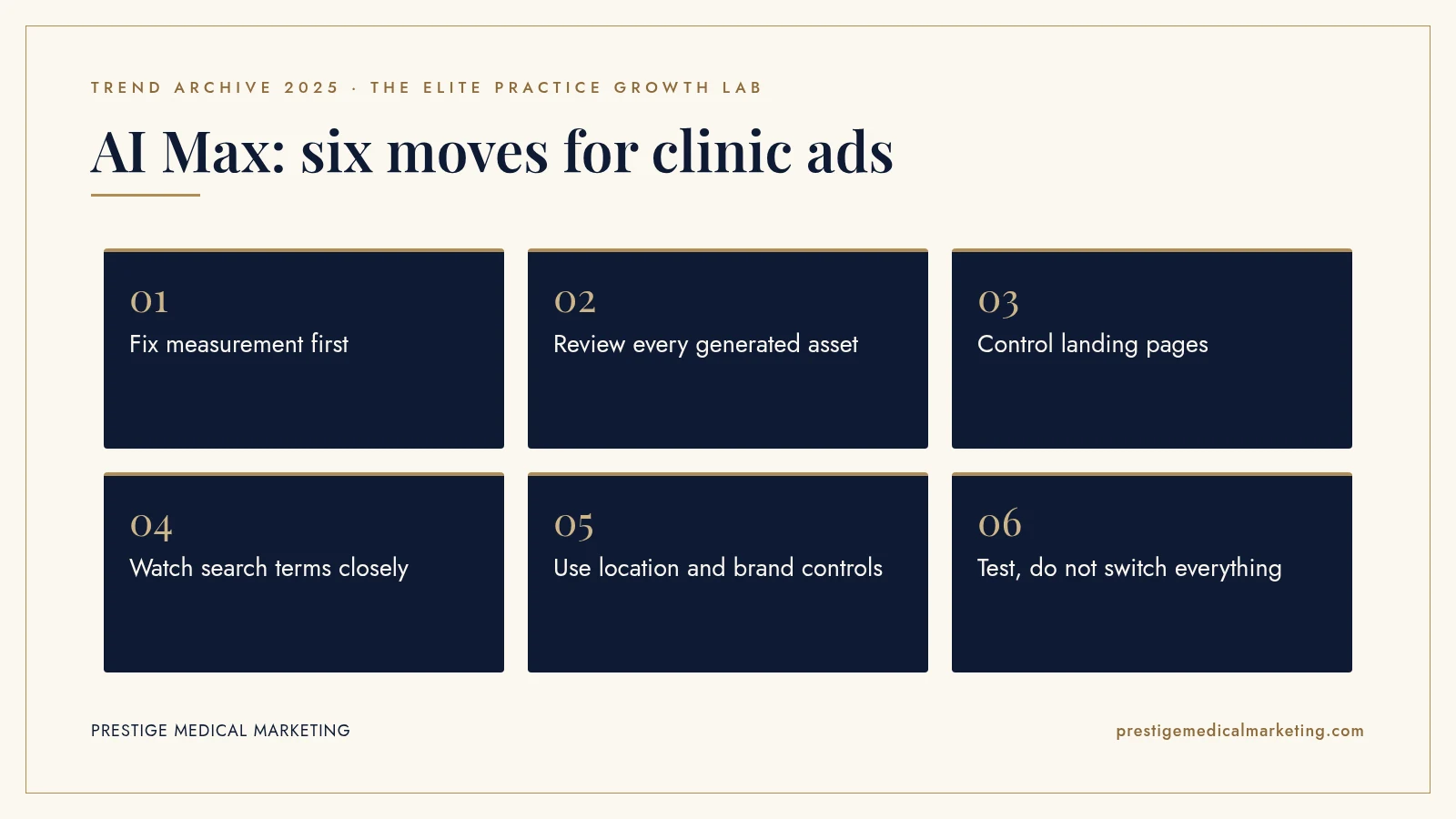
1. Fix measurement first
Before testing AI Max, make sure you can see which ad clicks become booked consultations and patients. If Google optimizes toward any form fill or any call, it will find more of those, qualified or not. Connect your conversion goals to what actually matters, while respecting health privacy limits on what you share with ad platforms. Our retrospective on tracking and HIPAA in 2025 explains those limits.
2. Review every generated asset
If you use text customization, review every headline and description Google generates. Remove anything that promises results, overstates outcomes, mentions prescription drugs in ways your policy status does not allow or does not match your services and prices.
3. Control landing pages
Use URL exclusions to keep ads away from articles, careers pages and other pages that are not meant for paid traffic, or turn off final URL expansion and use dedicated landing pages.
4. Watch search terms closely
Review search term reports weekly during a test. Add negative keywords for irrelevant searches, such as services you do not offer, cheap or free searches if you are a premium practice and job searches.
5. Use location and brand controls
Make sure campaigns target the areas you actually serve. Use brand controls if you want to avoid appearing on competitors’ brand searches or want to focus on specific terms.
6. Test, do not switch everything
Run AI Max on one campaign, compare it against your existing campaigns over a meaningful period and judge it on cost per booked patient. Expand only if it performs.

Where AI Max may help practices most
Patients describe what they want in many different ways: “fix sun spots on face,” “best place for laser hair removal,” “lose weight with doctor help.” Tight keyword lists miss many of those. AI Max’s search term matching can find those patients, which may help practices with a broad range of services, such as med spas, dermatology practices and weight loss clinics.
It may help less for very specific services where you already know the exact terms patients use, or in markets where your service area is small and wasted clicks are expensive.
Specialty-specific cautions
Weight loss clinics. Ads mentioning prescription drugs face specific restrictions, and some may require certification. Generated text that names medications could trigger disapprovals or create compliance problems. Review especially carefully. Our weight loss clinic marketing work is built around these rules.
IV and wellness clinics. Avoid generated claims about curing or treating conditions that you cannot support. Keep ads focused on services, experience and access.
Med spas and plastic surgery. Watch for generated text that promises specific outcomes or uses before-and-after language loosely. Keep ads accurate and aligned with your premium positioning. See our med spa marketing approach.
Men’s health and hormone therapy. These categories involve sensitive topics and regulated products. Check policies and review every asset.
The bigger picture: paid and organic together
AI Max is part of a broader shift in which Google uses AI to match ads with intent, including ads appearing in and around AI Overviews and AI Mode. As our retrospective on AI Overviews and the med spa click explains, organic clicks became harder to win in 2025. That made paid search more important for many practices, and more competitive.
The practices in the strongest position combine both: organic visibility through a strong Google Business Profile, reviews and content, and paid search that is carefully controlled and measured. Each supports the other, and neither depends entirely on Google’s automation.
A sample test plan
Weeks one and two. Confirm conversion tracking reflects booked consultations, not just clicks to call. Choose one campaign with steady volume. Record its baseline: cost per lead, lead-to-booking rate, show rate and cost per booked patient.
Weeks three to eight. Enable AI Max on that campaign with landing page exclusions in place. Review search terms and generated assets every week. Add negatives and remove weak or risky text as you go. Do not change budgets, bidding or other settings at the same time, or you will not know what caused any change.
Week nine. Compare results with the baseline and with similar campaigns that did not use AI Max. Look closely at patient quality, not only at volume. Ask your front desk whether the inquiries felt any different. Then decide whether to keep, adjust or roll back. Write down what you learned, including which search terms brought good patients and which generated headlines you rejected and why. That record makes the next test faster and keeps your team, and any future ads partner, from repeating the same mistakes. Small, careful tests compound over time into an ads account that reliably produces the patients your practice wants.
Calls and follow-up decide the outcome
Any ad change only works if your practice handles the inquiries it creates. If AI Max brings more calls but half go to voicemail, the extra spend is wasted. Before scaling any campaign, make sure calls are answered quickly, forms get replies within minutes during business hours and every inquiry is tracked to an outcome. Our guide on what missed calls cost medical practices shows how much revenue leaks at this stage, and it is often more than any ad setting could recover.
What to ask your ads manager
If someone else runs your Google Ads, ask a few direct questions. Is AI Max turned on in any of our campaigns, and when was it enabled? Which features are active: search term matching, text customization, final URL expansion? Who reviews the generated headlines and descriptions, and how often? Which pages can our ads send people to? What does our cost per booked consultation look like before and after the change, not just our cost per conversion? What are the top search terms from the last month, and which did we exclude?
Clear, specific answers backed by real reports are a good sign. Vague references to “the algorithm” are not.
What 2025 does not tell us
Google’s 14% and 27% figures come from its own data across advertisers and do not tell us how practices specifically performed. We do not have reliable public data on AI Max results for medical or aesthetic practices. Features, policies and controls may have changed since 2025. Results depend heavily on each account’s setup, measurement and market.
The premium practice advantage
Typical agencies let automation run and report on whatever it optimizes. Premium practices insist on control over what their ads say, where they send people and which patients they attract, and they measure success in booked patients and revenue. That discipline turns tools like AI Max into an advantage rather than a cost.
That is how we run paid search as part of our growth services, with fast follow-up through our booking engine so paid inquiries become appointments. Our team works from Austin with practices nationwide.
The bottom line
Google’s AI Max for Search campaigns, introduced on May 6, 2025, automates query matching, ad text and landing pages. Google says it typically lifts conversions. For practices, the value depends on control and measurement: review every generated asset against healthcare policies, restrict landing pages, watch search terms and judge results by booked, qualified patients.
Check if your market is open. We take one practice per specialty per market. Request a market check or call (716) 400-0084.
Frequently asked questions
What is AI Max for Search campaigns?
It is a set of features Google introduced on May 6, 2025 for Search campaigns. It includes search term matching that expands beyond your keywords, text customization that generates headlines and descriptions, and final URL expansion that sends people to the pages Google considers most relevant.
Did Google say AI Max improves results?
Google said advertisers that activate AI Max typically see 14% more conversions or conversion value at a similar CPA or ROAS, and 27% for campaigns still mostly using exact and phrase match keywords. These are Google's own figures, and results vary by account.
Is AI Max safe for medical and aesthetic practices?
It can be used, but generated ad text and expanded landing pages need careful review. Healthcare ads are subject to Google's healthcare and medicines policies and to advertising laws. Review every generated asset and control which pages ads can send people to.
Can AI Max send ads to the wrong pages?
Final URL expansion lets Google choose landing pages on your site. Without controls, it could send traffic to pages you did not intend, such as articles or careers pages. Use URL exclusions or turn off the feature if that is a concern.
How should a practice measure AI Max results?
Measure booked consultations, show rates and revenue from new patients, not just form fills or calls. A rise in conversions that are not qualified patients is not a real improvement.
Should a practice turn on AI Max?
Test it deliberately. Run it on a defined campaign, review search terms and generated text closely and compare patient quality and cost against your existing approach before expanding.