
On December 14, 2022, Google began rolling out its December 2022 link spam update, which used SpamBrain, its AI-based spam-prevention system, to detect sites buying links and sites used to pass outgoing links, and to neutralize the credit those links passed. Google's status dashboard shows the rollout completed on January 12, 2023. For IV and wellness clinics, it meant purchased or manipulative links could simply stop counting, so authority had to be earned through genuine local relationships and useful content.
IV and wellness clinics compete in crowded local markets. Many new clinics open each year, and many of them hear the same pitch from SEO vendors: more backlinks will lift rankings. Packages promising dozens or hundreds of links each month have been sold to clinics for years.
In December 2022, Google made clear how it viewed that approach. Its link spam update used SpamBrain, an AI-based system, to detect sites buying links and sites used to pass links, and to neutralize the credit those links had been providing. Clinics that relied on purchased links could see the value of that investment disappear.
This retrospective covers what Google announced in 2022 and what it means for an IV and wellness clinic today. For related chapters, see Google’s continuous scroll on desktop in 2022, the helpful content update of August 2022 and the core updates of 2022.
What actually happened in 2022
The announcement. On December 14, 2022, Google announced the December 2022 link spam update, saying it was leveraging SpamBrain to neutralize the impact of unnatural links on search results.
SpamBrain. Google described SpamBrain as its AI-based spam-prevention system and said it could now detect both sites buying links and sites used for the purpose of passing outgoing links.
Neutralizing credit. Google said rankings may change as spammy links are neutralized and any credit passed by those unnatural links is lost. The update applied to all languages.
The definition. Google restated that links obtained primarily for artificial manipulation of Search rankings are link spam, and that its algorithms and manual actions aim to nullify those links at scale.
The rollout. Google said it would take about two weeks. Its Search Status Dashboard shows it ran from December 14, 2022, and was complete as of January 12, 2023.
Why it mattered for IV and wellness clinics
Many IV and wellness clinics are young businesses in competitive markets, and they want results quickly. Link packages appeal because they promise measurable activity. The December 2022 update showed that activity is not the same as value. If Google’s systems identify links as purchased or manipulative, they may simply stop counting, and the money spent produces nothing.
The update did not necessarily mean penalties for every clinic with questionable links. Google’s emphasis was on neutralizing credit. But for a clinic whose rankings depended on that credit, losing it could feel the same as a penalty: visibility drops, and calls follow.
It also arrived in a year when Google repeatedly emphasized helpful, people-first content. Together, those messages pointed in the same direction: earn visibility by being genuinely useful and genuinely referenced, not by manufacturing signals.
What typical agencies did
Some agencies continued selling monthly link packages, often built on networks of low-quality sites, guest posts on unrelated blogs or directories that existed only to sell placements. Reports showed rising link counts while the links themselves were worthless or harmful.
Others overreacted, disavowing large numbers of links without evidence of a problem and creating new risks.
The careful approach stopped buying links, focused on real local relationships and useful content, reviewed link profiles calmly and used tools such as disavow only when there was a clear reason.
What it means for an IV and wellness clinic today
Google’s spam systems have continued to evolve since 2022. These principles still apply.
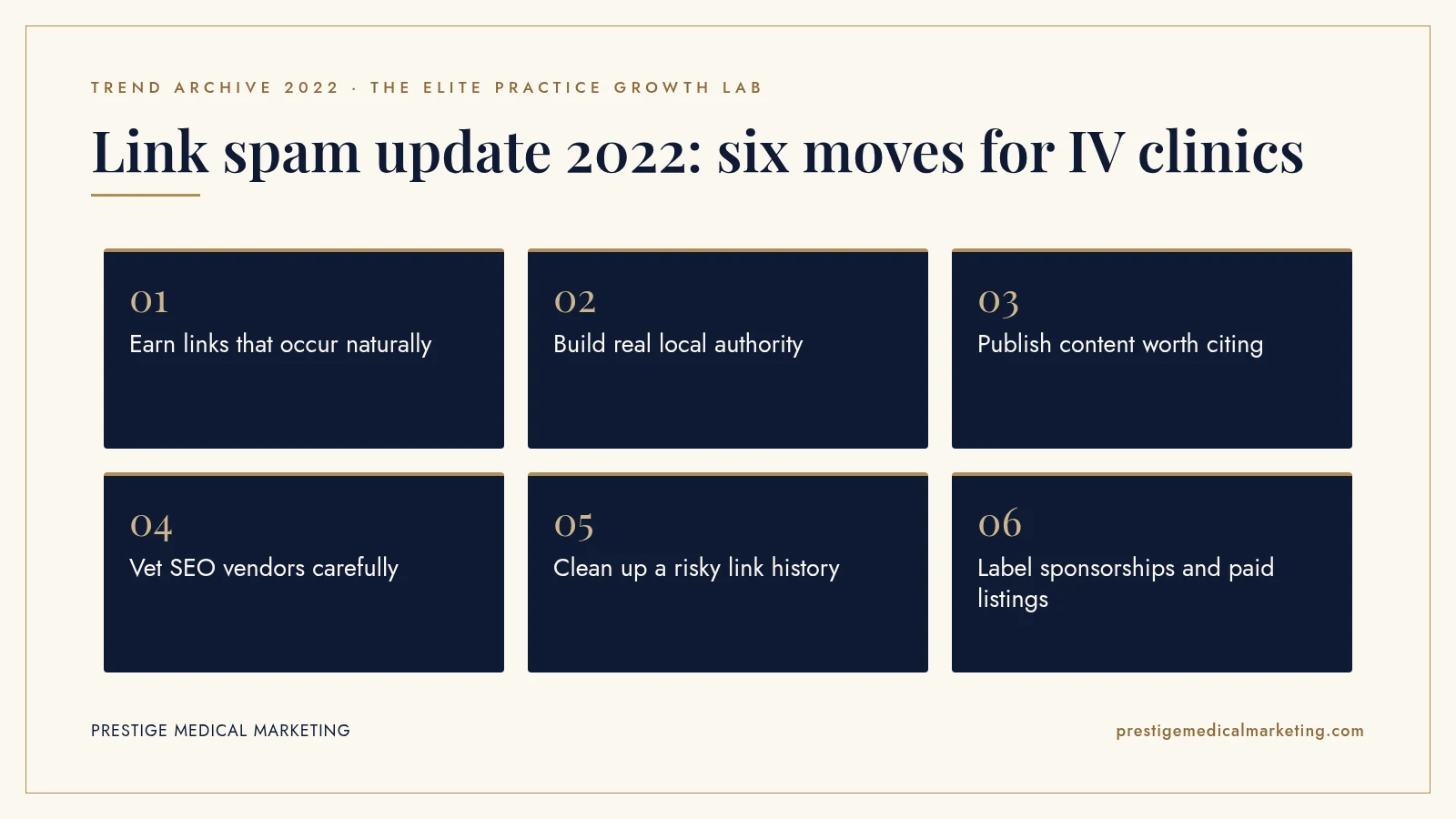
1. Don’t buy links
Treat link packages and paid placements meant to pass ranking credit as wasted money or worse.
2. Build local relationships
Partner with gyms, event organizers and local businesses in ways that genuinely serve clients.
3. Create reference content
Publish clear, accurate resources others want to cite.
4. Qualify paid placements
Use appropriate link attributes on sponsorships and paid listings.
5. Review vendors
Ask any SEO provider exactly how they earn links.
6. Measure outcomes
Judge SEO by calls and bookings, not by link counts.

What a natural link looks like
A natural link exists because someone found the clinic genuinely worth referencing. A local running club links to the clinic that sponsors its race and provides hydration education. A wellness publication cites the clinic’s medical director on a safety topic. A partner business lists the clinic as a trusted referral. Each link reflects a real relationship or real expertise.
Manipulative links look different. They come from sites with no connection to the clinic or its community, often with keyword-stuffed anchor text, placed on pages written only to host links. They appear in bulk and follow patterns that systems like SpamBrain are designed to recognize.
For a clinic, the test is simple: would this link exist if search engines did not? If the answer is no, it is unlikely to provide lasting value.
Local authority for IV and wellness clinics
IV and wellness clinics have natural opportunities to earn local recognition. They support athletes, event organizers, corporate wellness programs and community health initiatives. Each of those relationships can include a genuine mention or link when the partnership is real and visible.
Local media is another avenue. Clinics with a qualified medical director who can speak accurately about hydration, recovery or safety can become a resource for local reporters, especially when the topic is in the news. That kind of coverage builds trust with patients as well as search engines.
Chambers of commerce, local business associations and reputable health directories also provide legitimate listings. These links are modest individually, but they confirm the clinic’s real presence in its community.
Content worth citing
Useful content attracts links on its own. For an IV and wellness clinic, that might mean a clear explanation of what IV therapy can and cannot do, a guide to what happens at a first visit, or a medically reviewed article on safety considerations. Content that is accurate, balanced and specific earns citations from others writing on the same subjects.
Content that overpromises, such as claims that IV therapy cures fatigue, boosts immunity dramatically or detoxifies the body, is less likely to be cited by reputable sources and can create regulatory and trust problems. The same discipline that keeps marketing honest also makes content more referenceable.
Medical review strengthens both. A page reviewed by the clinic’s medical director, with a visible review date, signals that the clinic takes accuracy seriously.
Evaluating SEO vendors
Clinics often hire SEO help without knowing how links are being built. After December 2022, that question became essential. A clinic should ask any vendor where links come from, whether any are paid, how they are placed and what happens if Google discounts them.
Warning signs include guaranteed link counts, guaranteed rankings, reluctance to share link sources and links from sites unrelated to health, wellness or the local area. A reputable vendor explains its approach openly and ties its work to outcomes such as calls, bookings and visibility for meaningful searches.
It also helps to ask for a sample of recent links and to visit those pages. If they are thin articles on sites with no real audience, written mainly to host links, they are unlikely to help and may simply be ignored. Good links come from pages real people read.
Clinics should also ensure they own their website, analytics and Search Console access, so they can review what has been done and change vendors without losing history.
Cleaning up an old link profile
Some clinics inherit link profiles built by previous vendors. The December 2022 update made those profiles a concern. The first step is a calm review. Google’s systems are designed to ignore many low-quality links, so not every questionable link requires action.
Where a clinic has clear evidence of paid link schemes or has received a manual action, Google provides a process for addressing it, including removal requests and, when appropriate, the disavow tool. Disavowing indiscriminately can remove links that help, so it should be done carefully and with a clear rationale.
Going forward, the most effective cleanup is to stop adding manipulative links and to start earning genuine ones. Over time, real relationships and useful content outweigh a legacy of poor links.
Questions clients and owners ask
Clinic owners often ask whether they need links at all. Links remain one of many signals search engines use, but for a local clinic, the basics usually matter more: an accurate Google Business Profile, consistent listings, strong reviews, a fast and clear website and content that answers the questions clients ask. Earned local links reinforce those foundations rather than replacing them.
Owners also ask how quickly honest link building works. It is slower than buying links, and that is the point. A partnership with a local event, a quote in a regional publication or a listing with a reputable association each takes effort, and each is difficult for competitors to copy. Over a year or two, those relationships compound in a way purchased links do not.
Finally, owners ask how to tell if their rankings are at risk. Sudden drops after a spam update, a manual action notice in Search Console or a link profile dominated by unrelated sites are signals worth investigating with a qualified professional.
Sponsorships and paid listings
Not every paid relationship is a problem. IV and wellness clinics often sponsor local events, pay for listings in reputable directories or advertise in community publications. These are legitimate marketing activities. The issue is whether a paid link is designed to pass ranking credit.
Google’s guidance asks that paid or sponsored links be qualified with appropriate attributes, such as rel=”sponsored”, so they do not pass ranking signals. Clinics cannot always control how another site codes a link, but they can avoid deals whose main purpose is a followed link and ask partners to label sponsorships appropriately.
The value of a sponsorship should come from the audience and the relationship, not from the link. A well-chosen local event puts the clinic in front of people who might become clients, and that is worth paying for on its own terms.
What 2022 does not tell us
The December 2022 update showed that Google could detect and neutralize link schemes at scale. It did not reveal exactly how SpamBrain identifies links, how much weight links carry relative to other signals or how future updates would change. Google has continued to update its spam policies and systems since. Clinics should focus on principles rather than trying to reverse-engineer any single update.
The premium practice advantage
A premium IV and wellness clinic earns visibility through genuine expertise and real community relationships. See our IV and wellness services, our guide to IV therapy marketing, our approach to predictability and scaling, our full services, who we help and how we approach Google Maps and AI search visibility. Our team works from Austin with practices nationwide.
The bottom line
In December 2022, Google used SpamBrain to neutralize unnatural links. For IV and wellness clinics, the lesson was to stop buying links, build real local relationships and create content worth citing.
Check if your market is open. We take one practice per specialty per market. Request a market check or call (716) 400-0084.
Frequently asked questions
What was the December 2022 link spam update?
A Google update, announced December 14, 2022, that used SpamBrain to detect sites buying links and sites used to pass outgoing links, and to neutralize the impact of those unnatural links on search results.
What is SpamBrain?
Google describes SpamBrain as its AI-based spam-prevention system. With this update, Google said it could detect both link buying and sites used to pass links.
How long did the rollout take?
Google said it would take about two weeks. Its Search Status Dashboard shows the update ran from December 14, 2022, to January 12, 2023.
What happened to sites with unnatural links?
Google said rankings may change as spammy links are neutralized and any credit passed by those links is lost.
Does Google consider all paid links spam?
Google says links obtained primarily for artificial manipulation of rankings are link spam. Paid placements should be qualified with appropriate link attributes rather than passing ranking credit.
How should an IV and wellness clinic earn links?
Through genuine local relationships, community involvement, partnerships, earned media and useful content, rather than buying links or joining link schemes.