
According to the FDA, Wegovy (semaglutide), approved for chronic weight management in June 2021, was added to FDA's drug shortage list on March 31, 2022, and Ozempic was added on August 23, 2022. The FDA declared the semaglutide shortage resolved on February 21, 2025, with limited transition periods for compounders. For weight loss clinics, the shortage showed the risk of marketing built around a single scarce product and the importance of accurate, compliant claims about compounded alternatives.
Demand can outrun supply in any market, but rarely as dramatically as it did for semaglutide. Wegovy, approved for chronic weight management in June 2021, quickly drew more interest than its manufacturer could meet. By the spring of 2022, the FDA had added it to the national drug shortage list. Later that year, Ozempic, the same molecule approved for type 2 diabetes, joined it.
For weight loss clinics, the shortage was not a footnote. It shaped which patients could start or continue treatment, opened the door to widespread compounding and changed how many clinics marketed themselves. It lasted far longer than most expected, until February 2025.
This retrospective covers what the FDA recorded in 2022, how the shortage unfolded and what it means for a weight loss clinic today. For related chapters, see Mounjaro’s 2022 approval, the FDA’s 2023 compounded semaglutide warning, the tirzepatide shortage resolution in 2024 and the end of the GLP-1 shortage in 2025.
What actually happened in 2022
March 31: Wegovy. According to the FDA’s 2025 declaratory order, Wegovy was added to FDA’s drug shortage list on March 31, 2022. Wegovy had been approved in June 2021.
August 23: Ozempic. The same order says Ozempic, approved in December 2017 for type 2 diabetes, was added to the shortage list on August 23, 2022.
Why the list mattered. Federal law requires the FDA to maintain an up-to-date list of drugs in shortage, defined as a period when demand or projected demand exceeds supply. Some statutory limits on compounding copies of approved drugs depend on whether a drug appears on that list.
Compounding expands. While semaglutide was in shortage, compounded versions became widely available. The FDA later noted that compounded drugs have not undergone FDA premarket review for safety, effectiveness or quality.
How it ended. On February 21, 2025, the FDA declared the semaglutide shortage resolved, concluding that Novo Nordisk’s supply was meeting or exceeding demand. It described transition periods for compounders ending April 22, 2025, under section 503A and May 22, 2025, under section 503B.
Why it mattered for weight loss clinics
A shortage creates two kinds of pressure. Patients who are already on treatment worry about continuity. Prospective patients hear that a drug is hard to get and become more eager to find it. Both pressures land on clinics.
Clinics responded in very different ways. Some paused new starts for scarce medications and focused on comprehensive programs. Some turned to compounded semaglutide and marketed it heavily, sometimes with claims that blurred the line between compounded and approved products. Some built their entire brand around access to a drug during a shortage.
When the shortage ended, the consequences of those choices became clear. Clinics whose marketing depended on compounded semaglutide faced a sudden change in what they could offer. Clinics built on a broader medical program adapted more easily.
What typical agencies did
Many agencies treated the shortage as a marketing opportunity. They ran ads emphasizing availability, low prices and fast access, often naming brand drugs while delivering compounded versions. Some landing pages called compounded products generic versions of brand drugs, which is not accurate. Some implied FDA approval where none existed.
These campaigns could generate many leads quickly. They also created regulatory exposure, platform policy problems and a brand identity tied to a product that could change at any moment.
The careful approach kept the clinic’s message centered on evaluation, individualized care and support, described any compounded medications accurately and avoided promises about access or supply.
What it means for a weight loss clinic today
Supply, policy and enforcement have all changed since 2022. These principles remain sound. Confirm specifics with counsel.
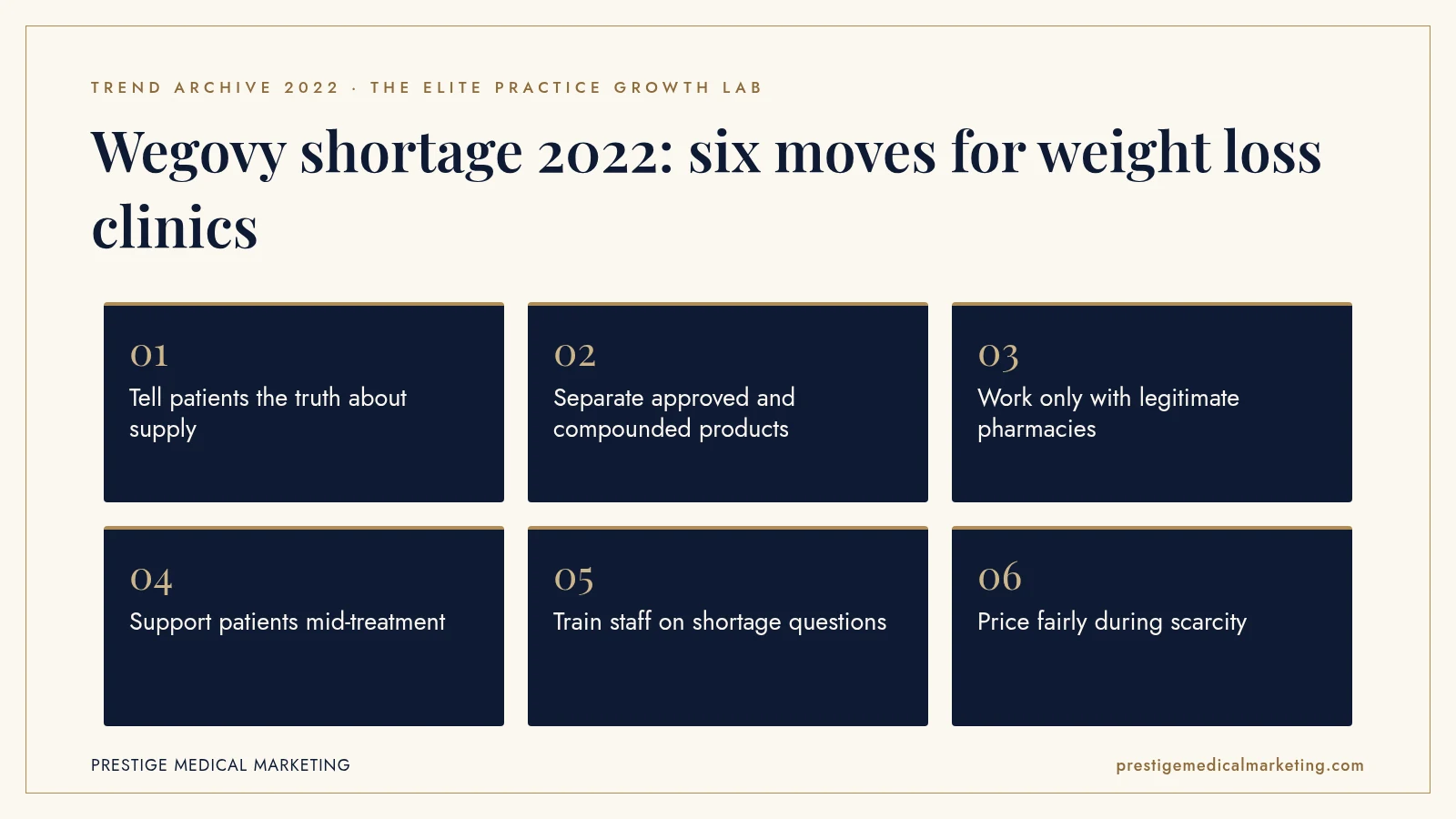
1. Don’t build a brand on one product
Market the clinic’s expertise and program, not a single medication that could become scarce or restricted.
2. Describe compounded drugs accurately
Never call compounded drugs generic or FDA approved. Explain what they are, plainly.
3. Don’t use brand names for compounded products
Using a brand drug’s name to market a compounded product can mislead patients and raise legal issues.
4. Plan for continuity
Have a clinical plan for patients if a medication becomes unavailable or changes form.
5. Avoid scarcity marketing
Do not create urgency around supply. It pressures patients and ages badly.
6. Keep claims current
Review website and ad content whenever supply, policy or approvals change.

How a shortage changes the conversation
During a shortage, the first question many prospective patients ask is whether a clinic can get the drug. That framing turns a medical decision into a procurement problem. Clinics that accepted the framing found themselves competing with every pharmacy, telehealth company and med spa offering access.
Clinics that reframed the conversation did better over time. They explained that medication is one part of a weight management plan, that a clinician would evaluate whether it was appropriate and that the clinic would support patients whether or not a particular drug was available. That message was less exciting than guaranteed access, but it was durable and honest, and it attracted patients looking for long-term care.
Compounding and the line between products
Compounding has a legitimate role in medicine, including during shortages. But compounded drugs are not the same as approved drugs. They are prepared by pharmacies or outsourcing facilities, have not undergone FDA premarket review for safety, effectiveness or quality, and may differ in formulation. The FDA raised concerns about some compounded semaglutide products, including those using salt forms, in warnings after 2022.
For marketing, the key is accuracy. A patient deserves to know whether they are receiving an approved product or a compounded one, what that means and why the clinic chose it. Hiding that distinction, or blurring it with brand names, damages trust when patients learn the truth.
Clear disclosure also protects the clinic. Patients who understood from the beginning that they were receiving a compounded medication are less likely to feel misled if supply or rules change. Their trust rests on the clinic’s honesty rather than on the product itself.
Search behavior during the shortage
A shortage changes what people search for. Instead of researching weight management in general, many searched for specific drug names combined with words about availability, price or location. Clinics competing for those searches were drawn toward content and ads built around access to a particular product.
That content aged quickly. Pages promising availability became inaccurate when supply shifted. Pages naming brand drugs while offering compounded versions became risky as regulators and platforms paid closer attention. Many clinics later had to rewrite or remove large parts of their websites.
Content built around the clinic’s medical approach did not have that problem. Pages explaining how the clinic evaluates patients, what a weight management program includes, how medications fit into care and what support patients receive stayed accurate regardless of supply. They also matched how search engines and AI assistants increasingly evaluate health content, rewarding clear, expert, people-first information over pages written to capture a trending query.
The practical lesson is to separate evergreen pages from time-sensitive ones. A clinic can publish a dated update about medication availability when needed, and archive or revise it as conditions change, while keeping its core service pages focused on care that does not depend on any single product.
Working with pharmacies responsibly
Clinics that prescribed compounded medications during the shortage relied on pharmacies and outsourcing facilities whose quality varied. Choosing those partners was a clinical and reputational decision, not just a purchasing one. Clinics that asked about licensing, sourcing of ingredients, quality testing and adverse event reporting were better positioned than those that chose on price alone.
That diligence also supports marketing honesty. A clinic that knows exactly where its medications come from can describe them accurately, answer patient questions with confidence and adjust quickly when rules change.
The patient on treatment
Shortages often hit current patients hardest. A person who has started a medication and seen progress may face interruptions, dose changes or a switch to another product. Each change requires clinical judgment and clear communication.
Clinics that communicated early and proactively, explaining what was happening, what options existed and how the care team would manage the transition, preserved trust. Clinics that went quiet or simply told patients to try elsewhere lost them. That experience shaped reviews and referrals long after the shortage itself.
A simple communication plan helps. When a medication’s availability changes, the clinic can send current patients a clear message explaining the situation, offer a consultation to discuss options and make sure staff answer questions consistently. Patients rarely expect a clinic to control national supply. They do expect it to keep them informed and to put their care first.
Staff training for shortage questions
Front desk and care coordination staff answered most shortage questions in 2022, often without clear guidance. A short, clinician-approved set of answers helps: what the clinic currently offers, how a clinician decides on treatment, what happens if a medication is unavailable and how patients will be kept informed. Reviewing those answers whenever conditions change keeps them accurate. Staff should avoid promising availability or comparing products in ways only a clinician should.
Pricing during scarcity
Shortages invite pricing decisions that look different in hindsight. Some clinics raised prices sharply when a medication was scarce, while others advertised unusually low prices for compounded alternatives to win volume. Both strategies tied the clinic’s reputation to a temporary market condition.
A steadier approach prices the program, not the product. When a clinic charges clearly for evaluation, follow-up and support, with medication costs explained separately and honestly, patients can see what they are paying for. Price changes tied to supply then become a transparent conversation instead of a surprise, and the clinic’s value does not collapse when the market for one drug shifts.
What 2022 does not tell us
The shortage list records when drugs were in shortage; it does not tell us how many patients were affected, how clinics adapted or how compounded products performed. We do not have reliable public data on clinic marketing practices during the shortage. Later warnings, enforcement and the 2025 resolution came after 2022. What 2022 does show is that a sudden surge in demand could leave clinics dependent on supply they did not control.
The premium practice advantage
A premium weight loss clinic builds a brand that outlasts any shortage. See our weight loss services, our weight loss clinic marketing guide, our full services, who we help and how we approach Google Maps and AI search visibility. Our team works from Austin with practices nationwide.
The bottom line
In 2022, Wegovy and then Ozempic entered the FDA shortage list, and the shortage lasted into 2025. For weight loss clinics, the lesson was to build on care rather than access, describe every medication accurately and plan for supply to change.
Check if your market is open. We take one practice per specialty per market. Request a market check or call (716) 400-0084.
Frequently asked questions
When did the semaglutide shortage begin?
FDA says Wegovy was added to its drug shortage list on March 31, 2022, and Ozempic on August 23, 2022.
When did it end?
FDA declared the semaglutide injection shortage resolved in an order dated February 21, 2025, after reviewing data from the manufacturer and other sources.
Why did the shortage matter for compounding?
Federal law generally limits compounding of drugs that are essentially copies of approved products, but some of those limits depend on whether a drug is on FDA's shortage list. The shortage period changed what compounders could do.
What happened to compounders after the shortage ended?
FDA's order described transition periods, until April 22, 2025, for state-licensed pharmacies and physicians compounding under section 503A, and until May 22, 2025, for outsourcing facilities under section 503B.
Are compounded drugs FDA approved?
No. FDA has noted that compounded drugs have not undergone FDA premarket review for safety, effectiveness or quality.
What should clinics take from the shortage?
Build marketing around the clinic's medical program rather than one product, and make only accurate claims about compounded or approved medications.