
Google announced the Ads Transparency Center on March 29, 2023, describing it as a searchable hub of ads served from verified advertisers across Search, YouTube and Display. Users can see the ads an advertiser has run, which ads were shown in a region, the last date an ad ran and its format. For plastic surgery practices, it meant patients, competitors and regulators could review a practice's ad history, raising the importance of accurate, compliant and consistent ad claims.
For years, a plastic surgery practice’s Google ads were mostly visible to the people who happened to see them. Competitors could search and spot some of them, but nobody had a clean, searchable archive of what had run. In March 2023, Google changed that. The Ads Transparency Center made ads from verified advertisers searchable by anyone, with details about where and when they ran.
For plastic surgery, where advertising involves claims about results, safety, credentials and price, that transparency mattered. Every headline, offer and promise became part of an easily reviewed record. Patients researching a surgeon could look up their ads directly. Competitors could study their messaging in detail. Regulators and consumer advocates could see patterns over time.
This retrospective covers what Google launched in 2023 and what it means for plastic surgery advertising today. It connects to our coverage of the FTC’s 2023 substantiation notices and site reputation abuse in 2024.
What actually happened in 2023
March 29: the announcement. Google’s announcement introduced the Ads Transparency Center as a searchable hub of all ads served from verified advertisers, covering Search, YouTube and Display.
What users can see. Google said users could understand the ads an advertiser has run, which ads were shown in a certain region, the last date an ad ran and the ad’s format.
The scale of interest. Google said more than 30 million people interact with its ads transparency and control menus every day.
Built on verification. Google described its global advertiser identity verification program, introduced in 2020, which requires advertisers to verify information about their businesses, where they operate from and what they are selling or promoting.
Connected to My Ad Center. Users can reach the information through the menu next to ads, see whether an advertiser is verified, and like, block or report an ad they believe violates Google’s policies. The Ads Transparency Center rolled out globally over the following weeks.
Why it mattered for plastic surgery practices
Plastic surgery advertising is unusually sensitive. Ads often touch on outcomes, recovery, safety, financing and price, and they reach people making significant decisions about their bodies. Claims that would be harmless in other categories, such as “best results” or “painless recovery,” carry real risk when attached to surgery.
Before the Ads Transparency Center, problematic ads could run and disappear with little public trace. After it, a practice’s ad history became searchable. Patients who saw an aggressive offer could look up what else the practice had promoted. Competitors could note inconsistencies. That raised the cost of careless claims and rewarded practices whose advertising matched their real standards. It also gave careful patients a new research tool at exactly the moment they were deciding whom to trust.
What typical agencies did
Most agencies used the Ads Transparency Center as a competitive research tool, which was perfectly reasonable. Fewer used it to audit their own clients’ ads. Old promotions, outdated pricing and loosely worded claims often stayed live or remained visible in the history.
The better response was to treat the archive as a mirror: if a practice would be uncomfortable seeing an ad quoted back by a patient or a regulator, it should not run. That standard is simple enough for every person who touches the account to apply, from the agency to the practice manager to the surgeon who approves the final wording.
What it means for a plastic surgery practice today
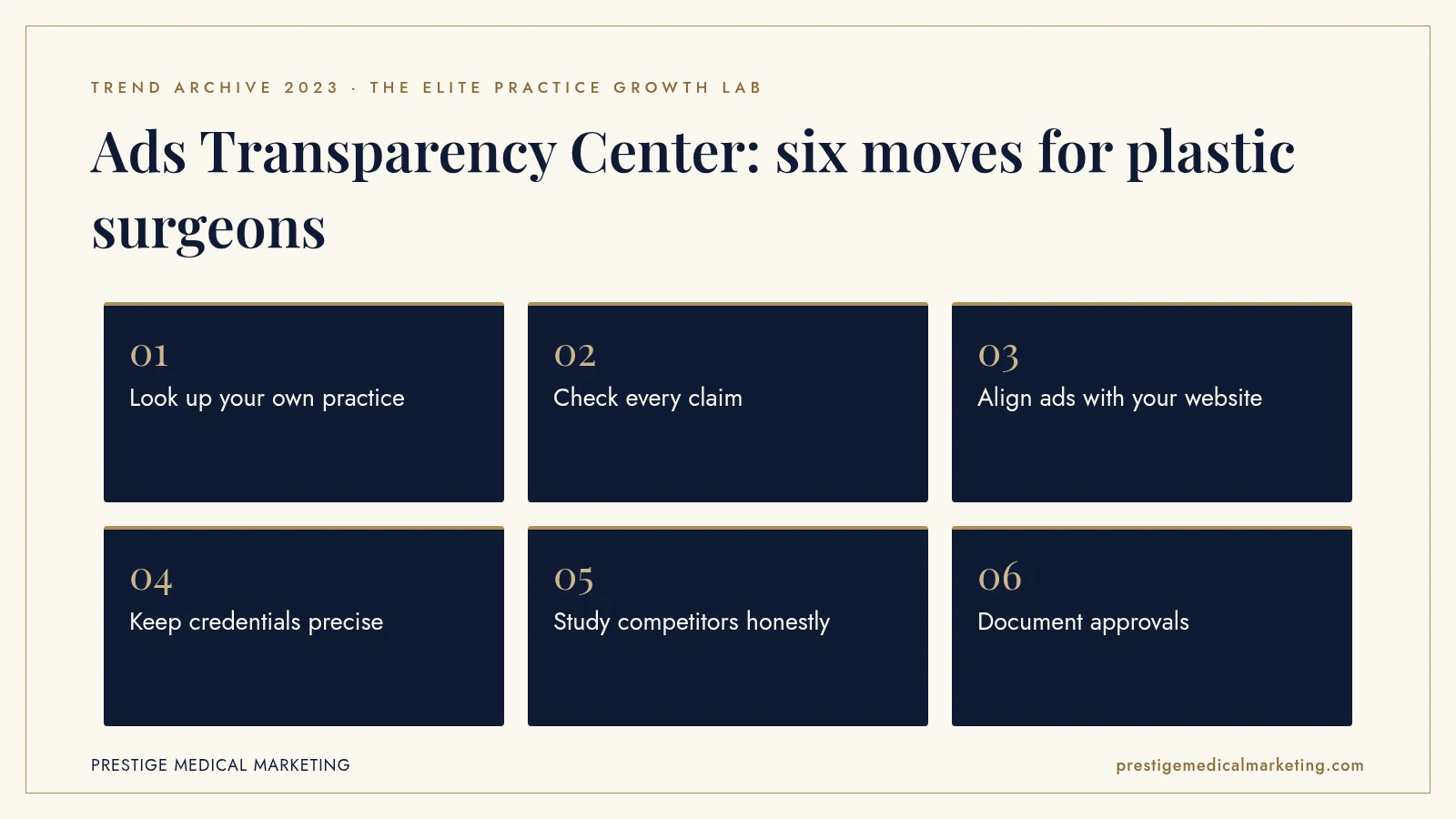
Ads are now public records in practice. These steps keep a practice’s advertising accurate and aligned with its brand.
1. Look up your own practice
Search the Ads Transparency Center for your practice’s advertiser name and review everything shown. Note any ads that are outdated or inconsistent, including ads run by former agencies under your name.
2. Check every claim
Review each ad for claims about results, safety, recovery and price. Make sure each is accurate, substantiated and appropriately qualified. Remove superlatives you cannot support with evidence.
3. Align ads with your website
Offers and claims in ads should match the landing page and your consultation process. Mismatches erode trust and can raise compliance questions about the overall impression.
4. Keep credentials precise
State board certification and credentials exactly as they are, naming the certifying board. Vague credential language invites confusion and, in some states, regulatory attention.
5. Study competitors honestly
Use the tool to understand how others position procedures, then differentiate on your real strengths rather than copying claims. Your surgeon’s experience, your patient care and your results philosophy are harder to copy than an offer.
6. Document approvals
Keep a record of who approved each ad and what evidence supports its claims. That record helps if a platform, patient or regulator ever asks.

The claims that create risk
Certain types of ad language deserve particular care in plastic surgery. Superlatives such as “best surgeon” or “top results” are hard to substantiate. Promises about recovery time, pain or scarring can mislead because outcomes vary between patients. Pricing claims can create problems if the advertised price excludes common costs such as anesthesia or facility fees. And before-and-after imagery in ads may be restricted by platform policies and must reflect real, typical outcomes, not exceptional ones.
The FTC’s approach to health claims, reinforced through its 2023 notices to hundreds of companies, is that objective claims need appropriate evidence. Many state medical boards also regulate physician advertising, including how specialty and board certification are presented. Practices should get qualified legal review of their advertising standards, especially before launching campaigns in new states or for new procedures.
Using the archive for competitive insight
The Ads Transparency Center is also genuinely useful for strategy. A practice can see which procedures competitors promote, how they frame them, which regions they target and how long their ads run. Ads that run for many months are often ones the advertiser considers effective. Patterns across a market, such as which procedures nobody promotes or which cities are crowded with similar offers, can reveal opportunities for a practice willing to position itself differently.
The insight is most valuable when it leads to differentiation. If every competitor in a market leads with discounts, a practice known for surgeon experience and patient care can stand apart by leading with those qualities instead. Copying a competitor’s claims is rarely a winning strategy and can import their risks along with their wording. The goal of competitive research is to find the space where your practice is genuinely different, then say so clearly and accurately.
Consistency across channels
Plastic surgery patients typically encounter a practice in many places: search ads, social content, the practice website, the Google Business Profile, review sites and consultation materials. The Ads Transparency Center made one of those channels easier to audit, but the principle applies to all of them.
When the messaging is consistent, patients build trust as they move from one touchpoint to the next. When an ad promises something the website does not mention or the consultation contradicts, trust erodes quickly. For a high-value elective procedure, that erosion is costly. Our guide to reputation and premium pricing explains why consistency supports value.
Premium positioning in public
A public ad archive rewards practices that advertise like premium brands. Luxury brands rarely discount loudly or make exaggerated promises. They communicate quality, expertise and experience with restraint. For plastic surgery, that means leading with surgeon credentials, the patient experience, the consultation process and the practice environment.
That approach also tends to attract better-fit patients. People drawn by discounts often compare on price alone. People drawn by expertise and care are more likely to value what a premium practice offers and to proceed after consultation. Our plastic surgery SEO guide covers how organic visibility supports the same positioning.
Landing pages are part of the ad
The Ads Transparency Center shows the ad, but patients click through to a landing page, and that page carries just as much weight. A restrained, accurate ad that leads to a landing page full of exaggerated claims has not solved the problem. Regulators and platforms evaluate the overall impression a patient receives, not only the headline.
Strong plastic surgery landing pages share a few qualities. They explain the procedure clearly, including who is a candidate and what recovery generally involves. They introduce the surgeon with accurate credentials. They show real patient reviews and, where policies allow, before-and-after photos with appropriate context. And they make the consultation the clear next step, without pressure tactics or countdown timers.
Those pages also tend to perform better. Patients considering surgery want to feel informed and respected. A page that answers their real questions earns more consultation requests from the right people than one that tries to rush them.
Promotions and financing offers
Promotions are where plastic surgery ads most often drift into risky territory. Seasonal discounts, limited-time offers and financing headlines can all be legitimate, but each needs careful wording. A price in an ad should reflect what a typical patient would actually pay, or clearly state what it includes. A financing offer should be accurate and consistent with the lender’s terms. Urgency claims should be true.
Because the Ads Transparency Center keeps a visible history, a pattern of constant “limited-time” promotions is easy to spot. That pattern can undermine credibility with patients who look closely, and it sits poorly with a premium brand. Many premium practices limit promotions to a few genuine events a year, or avoid price-led advertising altogether.
Building an ad review routine
The simplest protection is a routine. Once a quarter, review every live ad and landing page against a short checklist: accurate credentials, substantiated claims, clear pricing, current offers, consistent messaging and compliant imagery. Retire anything outdated, including old promotions that still appear in rotation. Record who reviewed it and when.
Include the Ads Transparency Center in that review so the practice sees what the public sees. It takes little time, and it turns a potential liability into a regular quality check that protects the brand.
What 2023 does not tell us
Google did not publish data on how often patients use the Ads Transparency Center to research medical advertisers, or whether it changed how practices wrote ads. We have no reliable figures on enforcement outcomes linked to it. What 2023 does show is the documented launch, the information it exposes and the verification program behind it.
The premium practice advantage
Premium plastic surgery practices can let their ad history speak for them. See our plastic surgery services, our full services, who we help and our approach to Google Maps and AI search visibility. Our team works from Austin with practices nationwide.
The bottom line
The Ads Transparency Center made plastic surgery ads searchable in 2023. Practices whose ads are accurate, consistent and premium in tone have nothing to fear from that transparency, and much to gain.
Check if your market is open. We take one practice per specialty per market. Request a market check or call (716) 400-0084.
Frequently asked questions
What is Google's Ads Transparency Center?
A searchable hub Google launched in March 2023 that shows ads from verified advertisers across Search, YouTube and Display, including region, last shown date and format.
Can competitors see a practice's Google ads?
Yes. Anyone can search the Ads Transparency Center by advertiser and see the ads they have run, which makes competitive research easier for everyone.
Does it show ad spend or performance?
Google's announcement describes the ads, the regions where they were shown, the last date shown and the format. It did not describe showing spend, clicks or conversions.
Why does this matter for plastic surgery ads?
Because ad claims become easy to review. Claims about results, safety, pricing or credentials should be accurate and substantiated, since patients and regulators can look them up.
What is advertiser verification?
Google described a global advertiser identity verification program, introduced in 2020, that requires advertisers to verify information about their business and what they promote.
How should a practice use the Ads Transparency Center?
Review your own ads for accuracy and consistency, study how competitors position procedures and use it to spot outdated ads that no longer reflect your offering.