
In March 2024, Google turned off websites made with Google Business Profiles, and visitors were redirected to the business's profile until June 10, 2024, after which the old addresses stopped working. Google Ads campaigns pointing to those sites also stopped running until the link was updated. For chiropractic offices that used these free sites, it meant replacing them with an owned website, updating the profile and ads, and recognizing that a platform-controlled site can disappear on the platform's schedule.
Many small chiropractic offices started online with whatever was free and easy. For some, that meant a website generated from their Google Business Profile. It took minutes to set up, showed hours and contact details and cost nothing. For a busy solo chiropractor, it seemed good enough.
In 2024, Google turned those websites off. Practices that relied on them had a few months to find a replacement before their website links stopped working altogether.
This retrospective covers what changed, why it mattered for chiropractic offices and why owning your web presence matters. For our specialty approach, see chiropractic marketing.
What actually happened in 2024
The feature. Google Business Profiles offered a simple website builder that turned profile information into a basic site, often on a business.site address.
The shutdown. As Search Engine Journal reported, Google said websites made with Business Profiles would be turned off in March 2024, with visitors redirected to the Business Profile instead.
The redirect deadline. The redirect worked until June 10, 2024. After that, Search Engine Roundtable noted that the old site addresses returned errors.
Ads. Google Ads campaigns that pointed to a Business Profile website would stop running from March 1, 2024 until the advertiser updated the destination link.
What stayed. The Business Profile itself continued to work. Only the website feature was discontinued.
Why it mattered for chiropractic offices
Chiropractic is a local, relationship-driven field, and many offices are small. Some relied on a Business Profile website because they had never invested in a full site. When Google turned those sites off, offices faced a short deadline to replace them.
The impact went beyond a missing page. Business cards, directory listings, social profiles and printed materials often pointed to the old address. Ads stopped running until links were updated. Any search visibility the old site had was lost. Offices that missed the change risked sending potential patients to error pages.
More broadly, the shutdown showed how much control a platform has over tools it provides for free. A feature that worked for years could be discontinued on a schedule the practice did not choose.
What typical agencies did
Some agencies scrambled to put up quick replacement sites with little thought to content or conversion. Others moved practices to inexpensive template builders without addressing the underlying problem: the practice still lacked a website designed to explain services, build trust and book appointments.
Some practices received no warning at all because no one was monitoring their online presence. They found out when patients mentioned a broken link.
Few agencies used the moment to build a website that would serve the practice for years.
What it means for a chiropractic office today
An owned website is a core asset. Here is how we approach it.
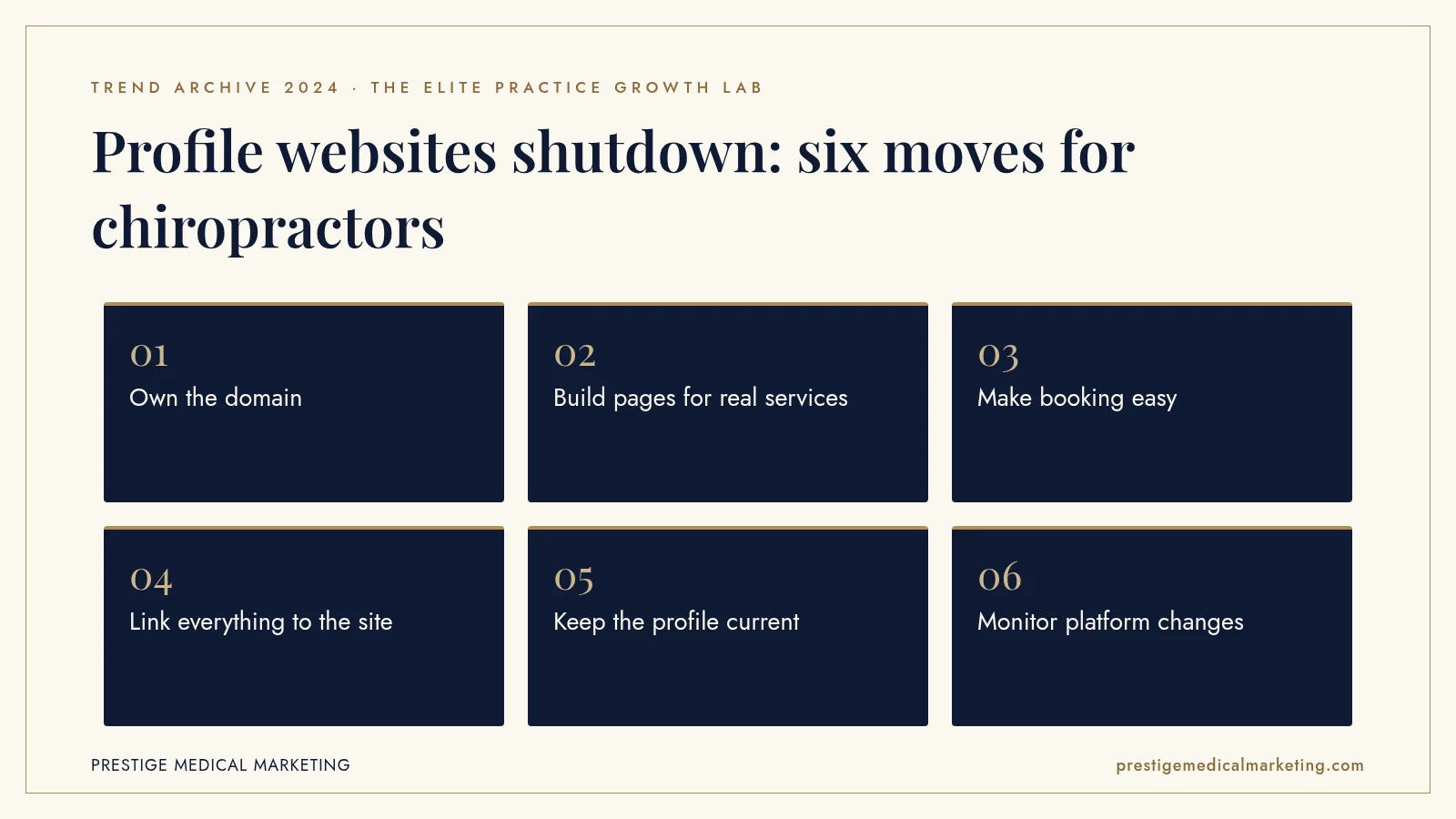
1. Own the domain
Register the practice domain in the practice’s name and keep login details in a secure, shared place.
2. Build pages for real services
Create clear pages for the conditions and services you treat, with plain explanations and what to expect.
3. Make booking easy
Add online scheduling or clear call and request options on every page, especially on mobile.
4. Link everything to the site
Update the Business Profile, ads, directories, social profiles and print materials to point to the owned site.
5. Keep the profile current
Maintain hours, services, photos and reviews on the Business Profile, which still drives local visibility.
6. Monitor platform changes
Assign someone to watch for changes to Google tools the practice uses, so nothing breaks unexpectedly.
Why owning your website matters
A website on a domain the practice controls is the one online asset no platform can switch off. Social networks change algorithms, directories change policies and free tools come and go. The practice website remains, as long as the practice keeps the domain and hosting in good standing.
An owned website also gives the practice control over its story. It can explain the chiropractor’s approach, describe services in detail, share patient education, show real team photos and make booking simple. A Business Profile website could show basic information, but it could not do most of that well. Our custom websites are built around those needs.
Ownership also matters for data. With an owned site, the practice can see which pages patients visit, which services draw interest and how many people book. That information helps guide marketing decisions.
What a chiropractic website should include
Patients looking for a chiropractor usually want answers to a few questions. What do you treat? What happens at the first visit? Do you take my insurance, or what does it cost? Where are you, and when are you open? Can I book online? A good website answers those questions quickly.
Service pages for common concerns, such as back pain, neck pain, headaches or sports injuries, help patients see that the practice can help them. A clear first-visit page reduces anxiety. Pricing or insurance information reduces phone calls. Real photos of the office and team build familiarity. Reviews and testimonials, used within platform and legal rules, provide reassurance.
Speed and mobile usability matter too. Many patients search from their phones, often when they are in pain. A slow or confusing site sends them elsewhere.
The Business Profile still matters
The shutdown did not reduce the importance of the Business Profile. For local searches, the profile is often the first thing patients see. It shows reviews, hours, photos and directions, and it links to the website.
Chiropractic offices should keep their profiles complete and accurate: correct categories, current hours, service descriptions, recent photos and prompt responses to reviews. The profile and website work best together, with the profile drawing patients in and the website helping them decide and book. Our work on chiropractic marketing treats both as one system.
Rented ground and owned ground
The Business Profile website shutdown is one example of a broader pattern. Practices often build important parts of their marketing on platforms they do not control: social media pages, third-party booking tools, directory listings and free website builders. Those tools can be valuable, but they carry risk.
A sensible approach uses platforms for reach while keeping the core on owned ground. The website, the domain, the patient email list and the booking system should be under the practice’s control wherever possible. When a platform changes, the practice adjusts without losing its foundation.
Our pillar on website efficiency explains how an owned site can also save staff time.
Cleaning up old links
Even years later, some practices still have old business.site links scattered around the internet. Directory listings, social bios, email signatures and printed materials may still point to addresses that no longer work. Each broken link is a missed opportunity.
A quick audit helps. Search for the practice name and old address, check major directories and update social profiles. Replace old printed materials when they run out. These small fixes improve patient experience and consistency.
Booking as part of the website
A replacement website is a chance to improve booking. Many chiropractic patients want to schedule quickly, sometimes outside office hours. Online booking, clear appointment types and confirmation messages make that easy. Our booking engine work connects the website, Business Profile and scheduling so patients can book from wherever they find the practice.
Even practices that prefer phone booking can improve the experience with click-to-call buttons, request forms and prompt callbacks. The goal is to make the next step obvious on every page.
Budgeting for a real website
Many practices used the free Business Profile site because budgets were tight. A replacement does not have to be extravagant, but it should be treated as an investment rather than an expense to minimize. A website that explains services clearly, loads quickly and makes booking easy can pay for itself through a modest number of new patients.
Practices should budget for the initial build, hosting, security updates and periodic content updates. A site that is built once and never updated slowly loses value as services, providers and patient expectations change.
Content that helps local patients
A replacement website is also a chance to publish content that helps patients before they book. Short articles on common concerns, such as what to do about lower back pain after lifting, how posture affects neck pain or what to expect from a first adjustment, answer questions patients are already asking. That content builds trust, supports search visibility and gives AI assistants accurate information to reference when people ask for local recommendations.
Content should stay within the scope of chiropractic care and avoid exaggerated claims. Explaining what chiropractic care can help with, when patients should see a physician instead and how the practice coordinates with other providers shows professionalism. Our guide to getting your practice recommended by AI explains why careful, helpful content tends to perform better over time.
Local details matter too. Mentioning the neighborhoods the practice serves, parking and accessibility information, and nearby landmarks helps patients plan a visit. Accurate contact information that matches the Business Profile everywhere it appears supports local search.
A website checklist for chiropractic offices
Every chiropractic website can be reviewed against a short checklist. Is the domain owned by the practice? Do the Business Profile, ads and directories all link to it? Does each main service have its own page? Is there a clear first-visit page? Are insurance and pricing explained? Can patients book or request an appointment from every page on a phone? Do real photos show the office and team? Does the site load quickly on mobile? Is someone responsible for updates and security?
Offices that can answer yes to each question are well protected against the kind of disruption the 2024 shutdown caused, and they are usually better at turning searches into booked visits.
What 2024 does not tell us
Google did not publish how many businesses used Business Profile websites or how many lost traffic when they were turned off. We do not have reliable data on how chiropractic offices specifically were affected. What 2024 does show is that free platform tools can be discontinued, and practices benefit from owning their core web presence.
The premium practice advantage
A premium chiropractic office has a website that reflects its care: clear, fast, helpful and easy to book from. It is owned by the practice and connected to a strong Business Profile.
That is how we build chiropractic marketing: owned websites, booking systems and visibility through Google Maps and AI search. See our services and who we help. Our team works from Austin with practices nationwide.
The bottom line
In 2024, Google turned off websites made with Business Profiles, and old links stopped working after June 10. For chiropractic offices, the lesson was to own the website, keep the Business Profile strong and avoid building core marketing on tools a platform can switch off.
Check if your market is open. We take one practice per specialty per market. Request a market check or call (716) 400-0084.
Frequently asked questions
What did Google shut down in 2024?
Google turned off websites made with Google Business Profiles, the basic sites built from profile information that often used business.site addresses.
When did the sites stop working?
The sites were turned off in March 2024. Visitors were redirected to the Business Profile until June 10, 2024, after which the old addresses returned errors.
What happened to ads linked to those sites?
Search Engine Journal reported that Google Ads campaigns linking to a Business Profile website would stop running from March 1, 2024 until the website link was updated.
Did the Business Profile itself go away?
No. The Business Profile continued to work. Only the separate website feature was discontinued.
What should practices do instead?
Build and own a proper website on a domain the practice controls, link it from the Business Profile and keep both updated.
Why does owning the website matter?
An owned website lets the practice control content, design, booking and tracking, and it cannot be switched off by a platform decision.