
Tirzepatide injection products were on FDA's drug shortage list from December 2022. In October 2024, FDA determined the shortage was resolved, then re-evaluated that decision after litigation and confirmed it on December 19, 2024. FDA gave compounders a transition period, through February 18, 2025 for 503A pharmacies and March 19, 2025 for 503B outsourcing facilities. Weight loss clinics that relied on compounded tirzepatide needed to adjust programs, pricing and marketing. This is marketing guidance, not legal advice.
From late 2022 through most of 2024, the GLP-1 market had an unusual shape. Demand for semaglutide and tirzepatide outpaced supply, both drugs appeared on FDA’s shortage list, and compounded versions filled part of the gap. Many weight loss clinics built programs, pricing and ad campaigns around that situation.
In late 2024, the situation changed for tirzepatide. FDA determined that the tirzepatide shortage was resolved, re-examined that decision after a lawsuit, and confirmed it in December. Compounders were given a transition window into early 2025, and clinics that depended on compounded tirzepatide faced a deadline.
This retrospective covers what happened, why it mattered and how a weight loss clinic should build its marketing now. This is marketing guidance, not legal advice. For the related 2025 developments, see our retrospective on the end of the GLP-1 shortages.
What actually happened in 2024
The shortage. Tirzepatide injection products, sold as Mounjaro and Zepbound, were added to FDA’s drug shortage list in December 2022 as demand surged.
The first decision. In early October 2024, FDA determined that the tirzepatide shortage was resolved and removed it from the shortage list.
The lawsuit. A compounding pharmacy trade group sued, challenging the decision. FDA agreed to re-evaluate, and while it did, said it would not take action against compounders solely for making copies during the review.
The confirmation. On December 19, 2024, FDA issued a declaratory order confirming that the shortage was resolved. FDA’s statement on compounding policies described a transition period: no action for certain violations through February 18, 2025 for 503A pharmacies and physicians, and through March 19, 2025 for 503B outsourcing facilities.
The brand-name shift. In August 2024, Eli Lilly began selling Zepbound single-dose vials through its LillyDirect platform at self-pay prices below its pen prices, adding a lower-cost branded option for some patients.
Why it mattered for weight loss clinics
For many clinics, compounded tirzepatide was the core of the offer. It allowed lower monthly prices than brand-name pens, which made programs accessible to patients without insurance coverage. Ads often led with the drug name and a monthly price. Some clinics described their offer almost entirely in terms of the medication.
When the shortage ended, that model became fragile. Clinics had to decide whether to move patients to brand-name products, change medications, adjust pricing or restructure programs. Each choice affected marketing. Ads built on a drug name and a low price needed to change, and patient communication needed to be careful and accurate.
The deeper issue was positioning. A clinic that marketed itself as a cheap source of a drug was competing on price with every other clinic and telehealth company doing the same. When the price advantage narrowed, it had little else to stand on.
What typical agencies did
Many agencies had built campaigns around medication names, monthly prices and before-and-after imagery. When the regulatory picture shifted, some kept running the same ads until platforms or clinics pulled them. Others switched abruptly to new messaging without a clear plan for existing patients.
A common problem was that ad copy made comparisons that were hard to support, describing compounded products as the same as approved brands. That kind of claim drew increasing scrutiny from regulators and ad platforms.
Few agencies had helped clinics build a program-centered brand that could survive a change in medication supply.
What it means for a weight loss clinic today
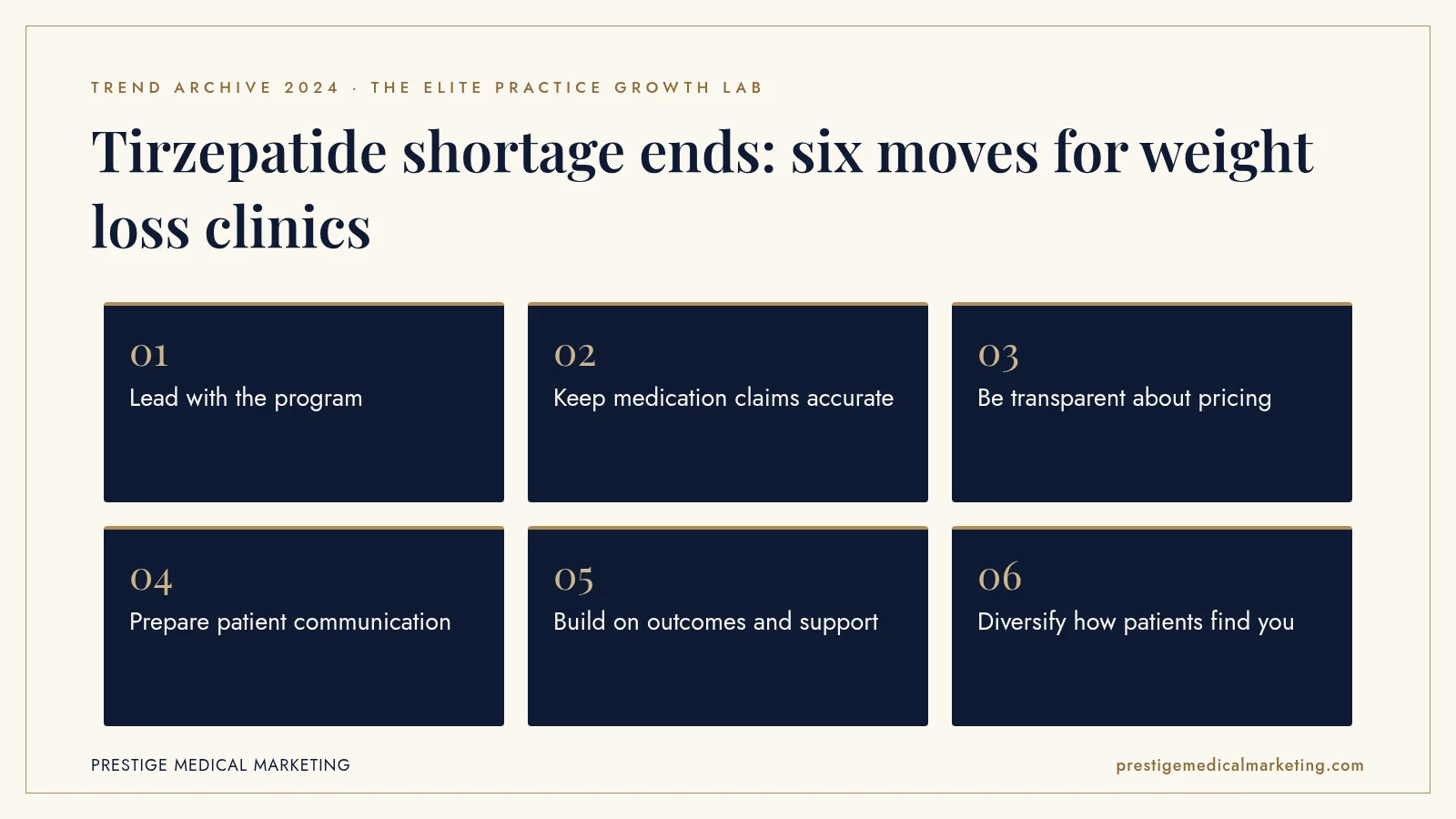
A durable weight loss clinic markets care, not a single product. Here is how we approach it.
1. Lead with the program
Describe medical evaluation, prescribing decisions, nutrition and lifestyle support, follow-up and monitoring. That is the value patients pay a clinic for.
2. Keep medication claims accurate
Describe medications carefully and avoid suggesting compounded products are FDA-approved or identical to brands. Review claims with qualified advisors.
3. Be transparent about pricing
Explain what a program costs, what is included and how medication costs are handled. Clear pricing builds trust when the market is confusing.
4. Prepare patient communication
When supply or regulation changes, tell existing patients what it means for them, what options exist and what happens next, before they hear it elsewhere.
5. Build on outcomes and support
Share how your clinic supports patients over time, with real processes and properly permitted testimonials, without promising specific results.
6. Diversify how patients find you
Do not depend on one ad message. Build local search visibility, reviews and referrals so the clinic is found for its expertise, not one price.

The risk of a drug-first brand
When a clinic’s brand is a drug name and a price, every change in supply, regulation or pricing hits the business directly. A patient who chose the clinic because it was the cheapest source of a medication will leave as soon as a cheaper source appears. There is little loyalty in a price.
A program-first brand behaves differently. Patients who chose a clinic because of its medical oversight, its coaching, its follow-up and the relationship with their provider are more likely to stay when the medication plan changes. The clinic can adjust treatment without losing the reason patients came.
This is especially important for clinics serving self-pay patients. They are paying for an experience and an outcome, and they compare clinics on trust and support as much as on price. See our guide to weight loss clinic marketing for how we position these programs.
How patients experienced the change
For patients, late 2024 and early 2025 could be confusing. News coverage discussed shortages, lawsuits and compounding rules. Social media posts made conflicting claims. Some patients worried that their treatment would stop. Others saw ads promising prices that soon disappeared.
Clinics that communicated early and clearly stood out. A short message explaining what the change meant, what the clinic was doing and what options patients had reduced anxiety and built trust. Clinics that said nothing left patients to fill in the gaps with rumors.
That communication also protected reputation. Patients who feel informed are more likely to leave positive reviews and refer friends. Patients who feel surprised are more likely to complain publicly.
Advertising rules kept tightening
The end of the shortage was one part of a wider tightening around GLP-1 marketing. Ad platforms maintained rules for prescription drug ads, and regulators paid increasing attention to how telehealth companies and clinics promoted weight loss medications. Our retrospective on the 2025 drug ad crackdown covers how that continued.
For clinics, the practical lesson is to build marketing that would still be acceptable under stricter rules. Avoid exaggerated results, avoid unsupported comparisons, include appropriate safety information where required and keep claims tied to what the clinic actually provides.
Pricing pages that hold up
Pricing is where many weight loss clinics feel the most pressure. A clear pricing page can still be competitive without leaning on a drug name. Show what a program includes, such as the initial evaluation, provider visits, lab work if included, coaching and messaging access, and explain how medication costs are handled separately or included.
When medication options or costs change, update the page promptly and date the change. Patients who see a stale price on a website and a different price on the phone lose trust quickly. A pricing page that is accurate and current is one of the simplest ways to show that a clinic is well run.
What the front desk needed to know
Regulatory changes reach patients first through the phone. When the shortage ended, front desk teams fielded questions about whether treatment would continue, whether prices would change and whether the clinic was still allowed to prescribe. Teams without a script improvised, and improvised answers can be inaccurate.
A short internal briefing solves most of this. Explain in plain language what changed, what the clinic is doing, what options exist for patients and which questions should be passed to a provider. Update it as the situation develops. Consistent answers from every staff member show patients that the clinic is in control, even when the market is not.
Reviews and reputation during a transition
Transitions are when reviews turn. A patient who learns about a price increase by surprise, or who cannot get a clear answer about their medication, may post a frustrated review. Several of those in a short period can change how a clinic looks on Google for months.
The best protection is proactive communication and fast follow-up on concerns. When a negative review does appear, respond calmly, avoid any patient health details and invite the person to contact the clinic directly. Prospective patients read responses as closely as reviews. Our reputation and premium pricing guide explains why this matters for self-pay clinics.
Lessons for the next supply change
The tirzepatide transition will not be the last time medication supply, pricing or rules shift under a weight loss clinic. New drugs, new formulations and new pricing programs continue to appear. Each change can make a clinic’s current offer look better or worse overnight.
Clinics can prepare by keeping their marketing modular. Program pages, provider pages and patient education stay stable. Medication-specific details live in a small number of places that are easy to update. Ad campaigns are built so that the medication message can change without rebuilding the whole funnel. When the next change arrives, the clinic edits a few pages and a few ads instead of starting over.
It also helps to keep a simple record of what changed and when. A dated log of pricing, program and messaging changes makes it easier to explain the clinic’s history to patients, staff and advisors, and to see which changes affected bookings.
What 2024 does not tell us
FDA’s decisions settled the shortage status, but they did not settle every question about compounding. Litigation continued, and the rules for compounded GLP-1 products kept developing after 2024. We do not have reliable public data on how many clinics changed their programs or how many patients switched medications during the transition. Check current FDA guidance before making decisions. What 2024 does show is that a business built on a temporary regulatory window needs a plan for when the window closes.
The premium practice advantage
A premium weight loss clinic sells a medically supervised program and a relationship, not a commodity. That positioning survived the end of the shortage far better than price-led offers did.
That is how we market weight loss programs: Google Maps and AI search visibility, clear program pages and careful claims that keep the focus on care. See our services and who we help, including weight loss clinics. Our team works from Austin with practices nationwide.
The bottom line
FDA confirmed in December 2024 that the tirzepatide shortage was resolved and gave compounders a short transition into early 2025. Clinics built around a cheap compounded drug had to rethink their offer. The durable approach is to market the program, keep claims accurate and communicate clearly with patients. This is marketing guidance, not legal advice.
Check if your market is open. We take one practice per specialty per market. Request a market check or call (716) 400-0084.
Frequently asked questions
When did the tirzepatide shortage end?
FDA first determined that the tirzepatide injection shortage was resolved in October 2024. After a lawsuit, FDA re-evaluated the decision and confirmed on December 19, 2024 that the shortage was resolved.
Why did shortage status matter for compounding?
When a drug is on FDA's shortage list, compounders have more room to make copies of it under federal law. When the shortage ends, that room narrows, which affects clinics that relied on compounded versions.
Did FDA give compounders time to adjust?
Yes. FDA said it would not take action for certain violations during a transition period, through February 18, 2025 for state-licensed pharmacies and physicians under section 503A, and through March 19, 2025 for outsourcing facilities under section 503B.
Did the brand-name supply change in 2024?
Yes. In August 2024, Eli Lilly began offering Zepbound single-dose vials through its LillyDirect platform at lower self-pay prices than its pens, which changed the cost comparison for some patients.
What should a weight loss clinic market now?
Market the program, not just a drug. Medical oversight, nutrition support, follow-up and results tracking are what patients pay a clinic for, and they remain valuable regardless of which medication is prescribed.
Can a clinic advertise compounded medication as the same as a brand drug?
Clinics should be careful. Compounded drugs are not FDA-approved, and claims that they are equivalent to approved products can create legal risk. Get qualified advice on drug advertising. This is marketing guidance, not legal advice.