
The CY 2025 Medicare Physician Fee Schedule final rule set the conversion factor at about $32.35, a 2.83% decrease from $33.29 in 2024, with average payment rates reduced 2.93%. The rule also allowed general supervision of physical therapist assistants by PTs in private practice and eased plan-of-care certification. For private PT practices, 2025 reinforced the case for a healthy cash-pay mix, marketed clearly and honestly alongside insurance-based care.
Physical therapy practice owners know the pattern well. Costs rise every year: rent, wages, software, insurance. Medicare payments, which many other payers follow, do not keep up. In 2025, the gap widened again.
The year opened with another reduction to the Medicare physician fee schedule. For private PT practices, it was one more reason to rethink how much of their revenue depended on reimbursement they could not control, and to build services patients choose and pay for themselves.
This retrospective covers what changed in 2025 and how private PT practices can grow a healthy cash-pay business without losing the insurance-based patients they serve.
What actually happened in 2025
The cut. In its CY 2025 physician fee schedule final rule fact sheet, released November 1, 2024 and effective for 2025, CMS said average payment rates would be reduced by 2.93% compared with most of 2024. It estimated the 2025 conversion factor at $32.35, a decrease of $0.94, or 2.83%, from $33.29. CMS attributed the change to the 0% statutory update, the expiration of a temporary 2.93% increase for 2024 and a small adjustment for work relative value units.
The supervision change. The same rule finalized general supervision of physical therapist assistants by PTs in private practice for all applicable physical therapy services. Previously, private practices faced a stricter direct supervision requirement. CMS said the change would give private practices more flexibility and align them with institutional settings.
The paperwork change. CMS also created an exception to the physician or non-physician practitioner signature requirement for initial certification of a therapist’s plan of care, when a written order or referral is on file and the therapist documents that the plan was sent to the physician or practitioner within 30 days of the initial evaluation.
Why this mattered for private PT practices
A 2.83% cut in the conversion factor may not sound dramatic, but it applies to every Medicare visit and arrives on top of years of similar pressure. For practices with a large Medicare population, it translated into real lost revenue at the same time costs were rising.
The supervision and certification changes helped operationally. General supervision of PTAs can make scheduling more flexible and let practices serve more patients with the same team. Easier plan-of-care certification reduces administrative delays. But neither offsets the long-term trend in reimbursement.
That is why so many private PT owners have been building cash-pay services. Not to abandon insurance-based care, but to balance it with services where the practice sets the price and the patient chooses the value.
What typical agencies did
Many PT marketing programs still focus almost entirely on volume: get more referrals, rank for “physical therapy near me” and fill the schedule. That works when every visit is profitable. When reimbursement falls, more volume can mean more work for less margin.
Agencies that do understand cash pay often swing too far the other way, marketing PT like a gym with discount codes and flashy promises. That cheapens the clinical expertise that justifies premium prices.
We position private PT practices as expert clinical teams first, then market specific programs that patients will pay for because of that expertise.
What it means for a PT practice today
This is marketing guidance, not billing or legal advice. Medicare has specific rules about charging beneficiaries, opting out and offering non-covered services. Get qualified advice before changing your payer mix.
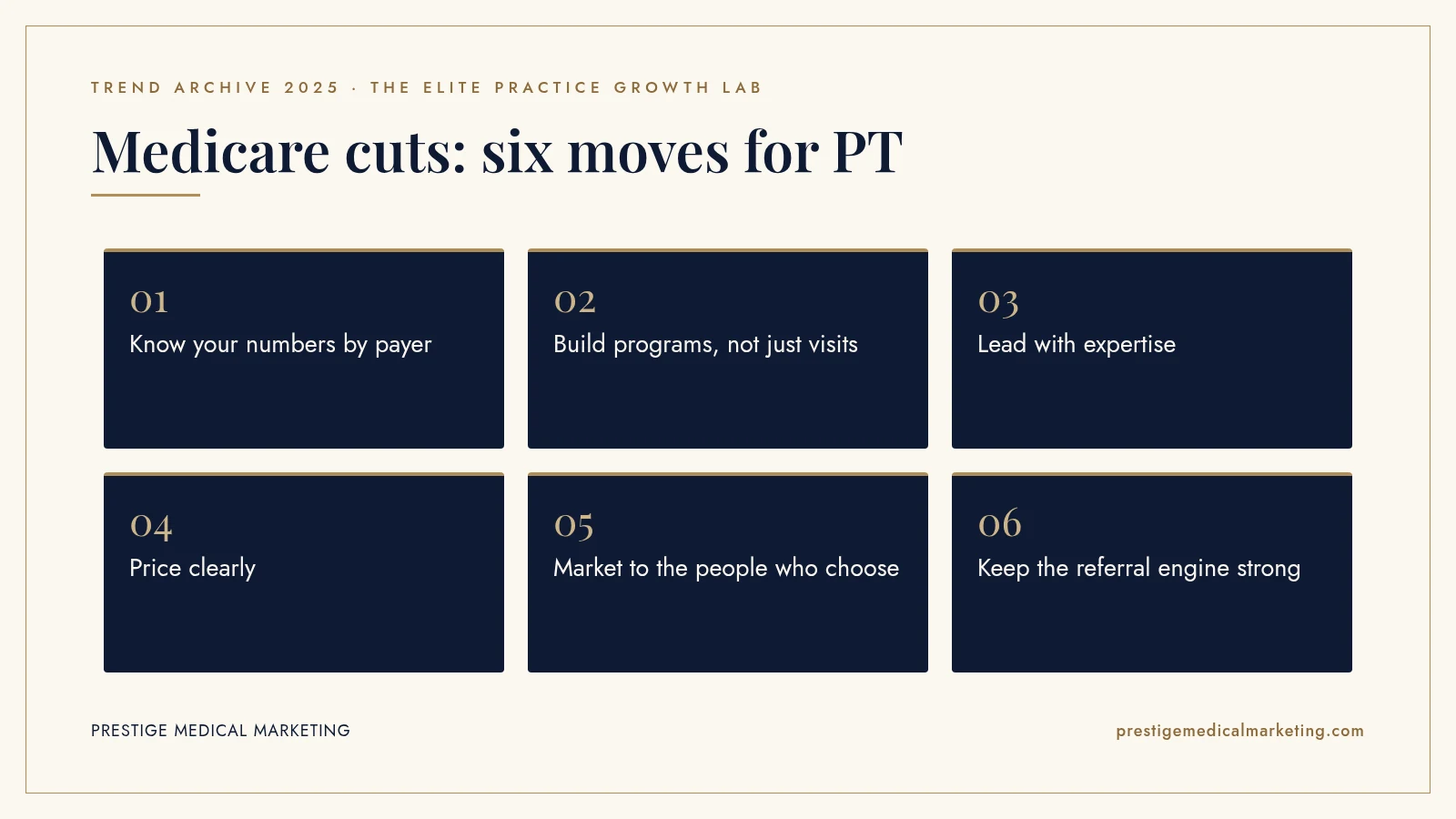
1. Know your numbers by payer
Calculate your real revenue per visit and per episode for each major payer, and compare it with your cost per visit. Many owners discover that some payers barely cover costs. That analysis should guide where you invest marketing.
2. Build programs, not just visits
Cash-pay works best as defined programs with clear outcomes and timelines: a return-to-running program, a golf performance program, a post-rehab strength program, a mobility membership for active adults. Programs are easier to explain, price and market than individual visits.
3. Lead with expertise
Patients who pay out of pocket want to know who is treating them and why that clinician is the right one. Specializations, certifications, sports backgrounds and approach should be front and center on your website and in your marketing.
4. Price clearly
Uncertainty about cost is a major barrier for cash-pay patients. Publish prices or price ranges for your programs and explain what is included. Clear pricing filters out the wrong patients and builds trust with the right ones.
5. Market to the people who choose
Insurance-based PT is often driven by physician referrals. Cash-pay PT is often driven by the patient’s own search and by communities: running clubs, golf clubs, gyms, coaches and personal trainers. Build relationships there and create content that answers their questions.
6. Keep the referral engine strong
Cash-pay growth does not replace physician and surgeon referrals. Keep those relationships healthy with fast scheduling, clear communication and progress updates. Our physical therapy marketing guide covers both channels.

What a strong cash-pay program page looks like
Here is how we structure a page for a cash-pay PT program. The same structure works for performance, wellness and post-rehab programs.
Who it is for. A clear description of the patient: for example, runners returning after injury who want to train without setbacks.
What happens. An initial assessment, a plan and a series of sessions or check-ins, described in plain steps.
Who leads it. The clinician’s background, credentials and why they run this program, with a real photo.
What it costs. The price or price range, what is included and how payment works.
Questions. Honest answers about insurance, timelines, who it is not right for and what results patients can reasonably expect, without guarantees.
How to start. A simple way to book an assessment or a short call, with fast replies.
Pages like this rank for specific searches, convert motivated patients and give your team a consistent way to describe the program. Our custom practice websites are built around this structure.
Visibility for cash-pay PT
Cash-pay patients usually start with a search or a question to an AI assistant: “best physical therapist for runners near me” or “PT for golf back pain.” The practices that show up have specific service pages, strong Google profiles, consistent reviews that mention outcomes and clinicians, and clear location information. Our guides on the Ask Maps local search shift and getting recommended by AI explain how this works.
Reviews deserve special attention. When a cash-pay patient reads reviews, they look for evidence that patients like them got results and felt cared for. Ask every patient for an honest review at the right moment, such as after a milestone in their program. Our retrospective on the FTC’s 2025 review enforcement covers how to do that properly.
Memberships and continuity
Many PT practices have found that the best cash-pay offer is continuity. A patient finishing insurance-covered rehab often wants to keep building strength and avoid reinjury. A monthly membership with periodic sessions, a personalized program and priority scheduling can serve that need well, as long as it is structured properly for your payer contracts and Medicare rules.
Memberships also create predictable revenue that offsets reimbursement swings. Keep terms clear and cancellation easy, as our membership terms retrospective explains, and focus on value that keeps members engaged.
Using the supervision change wisely
General supervision of PTAs gives private practices new flexibility, but it is an operational tool, not a marketing message. Use it to improve access: more appointment times, shorter waits for new patients and smoother scheduling. Then market the result, which is faster access to care with an expert team. Make sure your state practice act and payer contracts allow the arrangements you plan, since CMS rules are only one layer.
Talking about money with patients
Many PT teams are uncomfortable discussing cash-pay options. They worry it sounds like a sales pitch. The fix is a simple, honest script based on the patient’s goals. When a patient nears the end of covered care and says they want to get back to tennis or keep their back strong, the clinician can explain what a continuing program would involve, what it costs and why it might help. No pressure, no discount tricks.
Train the front desk too. They should be able to explain program prices, what insurance does and does not cover, and how to get started, in plain language. Patients appreciate clarity about money, and clarity is what turns interest into a booked assessment. A one-page price sheet at the desk helps everyone say the same thing, every time.
A simple 90-day plan
Month one. Review your payer mix and costs. Choose one cash-pay program that matches your clinicians’ strengths and your community, such as a running, golf or post-rehab strength program. Confirm what your state and payer rules allow.
Month two. Build the program page, set the price, train the team on how to describe it and offer it to current patients who are finishing care. Ask early participants for honest feedback.
Month three. Promote the program locally through partners such as gyms, clubs and coaches, and through your Google profile and website. Track assessments booked, programs started and revenue per participant.
One well-run program often teaches a practice more than a dozen half-launched ideas. Once it works, add the next. Keep the clinical team involved at every step, because the best program ideas usually come from what patients already ask your therapists for, and those therapists will be the ones who make the program worth its price.
What 2025 does not tell us
We do not have reliable public data on how many private PT practices added or expanded cash-pay services in 2025, or how the conversion factor change affected their margins on average. Reimbursement rules continue to change each year, and later rules may have altered the figures in this article. The right payer mix depends on your market, patients and costs, and decisions about Medicare participation need qualified advice.
The premium practice advantage
PT practices that compete only on volume are at the mercy of reimbursement. Practices that build expert programs, price them clearly and deliver a great experience earn revenue they control, while still serving insurance-based patients well. That balance makes the practice more resilient and more rewarding to run.
That is how we approach marketing for physical therapy practices: expert-led positioning, program pages that convert, strong local visibility through our maps and AI search service and fast booking through our booking engine. Our team works from Austin with practices nationwide.
The bottom line
Medicare’s 2025 fee schedule cut the conversion factor 2.83% to about $32.35, while giving private PT practices general supervision of assistants and easier plan-of-care certification. The operational relief helped, but the reimbursement trend did not change. Private PT practices that built clear, expert-led cash-pay programs, marketed honestly and priced transparently, gave themselves a business they control.
Check if your market is open. We take one practice per specialty per market. Request a market check or call (716) 400-0084.
Frequently asked questions
How much did Medicare cut physician fee schedule payments in 2025?
CMS said average payment rates under the physician fee schedule would be reduced by 2.93% in 2025 compared with most of 2024, and estimated the conversion factor at $32.35, a decrease of $0.94 or 2.83% from $33.29 in 2024.
Why did the conversion factor drop?
According to CMS, it reflected the 0% overall update required by statute, the expiration of a temporary 2.93% payment increase for 2024 and a small adjustment for changes in work relative value units.
What changed for physical therapists in private practice in 2025?
CMS finalized general supervision of physical therapist assistants by PTs in private practice for applicable services, replacing the stricter direct supervision requirement. It also created an exception to the physician signature requirement for initial plan-of-care certification when certain conditions are met.
Should a PT practice stop taking Medicare?
That is a business and compliance decision that depends on your market, patients and contracts. Many practices keep Medicare and add cash-pay services. Medicare has specific rules on opting out and on charging beneficiaries for covered services, so get qualified advice before changing anything.
What cash-pay services do PT practices offer?
Common examples include performance and sports programs, wellness and mobility memberships, return-to-sport training, post-rehab strength programs, specialized assessments and services not covered by a patient's plan. What you can offer and how depends on your state practice act and payer rules.
How should a PT practice market cash-pay services?
Explain the outcome patients want, the clinician expertise behind the program, the time and attention they receive and the price, plainly. Patients choosing to pay out of pocket want clarity and a premium experience. Avoid promising specific outcomes.