
Google released broad core updates in June 2021 (June 2 to 12), July 2021 (July 1 to 12) and November 2021 (starting November 17), along with spam updates and a December product reviews update. Core updates reassess content broadly rather than penalizing specific sites. For physical therapy practices, the lasting lesson was to build pages that genuinely help patients understand conditions, treatment and what to expect, and to judge results over months rather than days.
Physical therapy is a search-led specialty. A runner with knee pain, an office worker with a stiff neck or a patient recovering from shoulder surgery often starts with a search: what is causing this, what helps and who nearby treats it. Cash-pay and out-of-network practices in particular rely on being visible in those moments, because they cannot count on an insurer’s directory to send patients their way.
In 2021, Google’s broad core updates made that visibility less predictable. There were three of them, two packed into early summer, alongside spam updates, a link spam update, a product reviews update and the page experience rollout. A practice that ranked well in May could see a different picture by August, and another by December.
This retrospective covers what Google actually released in 2021, why physical therapy practices felt the volatility and what durable visibility looks like today. For the later chapters, see our look at Google’s 2022 core updates, the March 2024 core update and the 2025 Medicare pay cut and cash-pay physical therapy.
What actually happened in 2021
June 2 to 12: the June 2021 core update. Google’s Search status dashboard records the June 2021 core update rolling out from June 2 to June 12. Google said at the time that some of its planned improvements were not ready and would follow in July.
July 1 to 12: the July 2021 core update. The July 2021 core update began on July 1 and was completed on July 12. Coming so soon after June, it meant many sites saw two rounds of movement within six weeks.
Mid-summer: other changes. The page experience update rolled out on mobile from mid-June to early September, and Google announced a link spam update in late July. Spam updates also ran in June. With so many changes overlapping, it was difficult for any site owner to attribute a ranking change to one cause.
November and December. Google’s ranking update history lists a November 2021 spam update beginning November 3, the November 2021 core update beginning November 17 and a December 2021 product reviews update beginning December 1. The November core update arrived just before the holiday season, a timing that drew complaints from retailers.
Why it mattered for physical therapy practices
Physical therapy searches mix two kinds of intent. Some are local and immediate, such as a search for physical therapy nearby. Others are informational, such as searches about a specific injury, exercises or recovery time. Many practices built content to capture the informational searches and convert some of those readers into patients.
Core updates tend to reassess exactly that kind of content. When Google’s systems get better at identifying the most helpful page for a question about a rotator cuff tear or plantar fasciitis, pages that were thin, generic or written mainly to rank can lose ground to pages from hospitals, academic centers, professional associations and clinicians with demonstrated expertise.
For a practice, those shifts showed up as fewer organic visits to condition pages, and sometimes fewer calls. Because the local map results are driven by different factors, some practices saw their map visibility hold steady while their condition pages slipped, which made it important to look at each channel separately.
What typical agencies did
Many agencies treated each update as an emergency. Some rewrote pages in a rush after a drop, which made it impossible to tell whether later movement came from the next update or from the rewrite. Others blamed every change on a single factor, such as links or page speed, and sold a fix for that factor.
Content mills were another common response. Some practices received dozens of short, near-identical posts about conditions, often written without clinical review. That approach was poorly suited to updates designed to reward helpful, reliable content, and it diluted the practice’s site with pages that did not serve patients.
The better approach was patient and evidence-based: wait for the rollout to finish, compare performance before and after, look at which queries and pages changed, study what now ranked and improve the pages that genuinely fell short.
What it means for a physical therapy practice today
Core updates are now a routine part of search. These are the habits that build visibility that lasts.
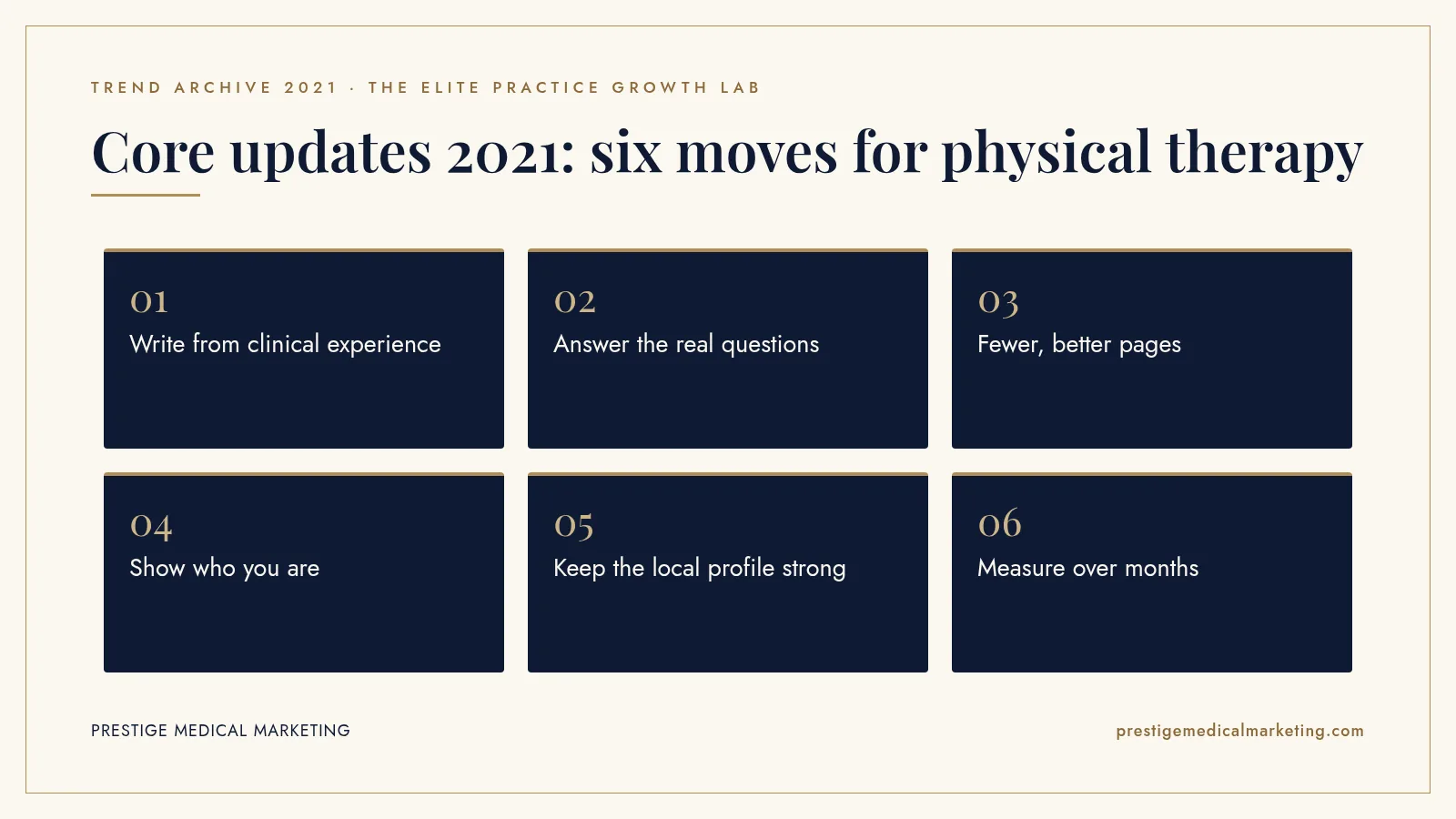
1. Write from clinical experience
Condition and treatment pages should reflect how your therapists actually evaluate and treat patients, reviewed by a licensed clinician and attributed accurately.
2. Answer the real questions
Patients want to know what a first visit involves, how many sessions are typical in general terms, what they can do at home and when to seek other care.
3. Fewer, better pages
One thorough page on a condition you treat often is worth more than several thin pages. Consolidate overlapping content.
4. Show who you are
Therapist bios with credentials, specialties and certifications help patients and reflect the experience Google says it values.
5. Keep the local profile strong
Map visibility depends on relevance, distance and prominence. Accurate categories, hours, services and steady reviews protect a channel that core updates affect differently.
6. Measure over months
Compare traffic, calls and bookings before and after an update finishes, and look at trends across quarters rather than reacting to daily swings.

Cash-pay clarity as content
For cash-pay and out-of-network physical therapy, some of the most useful content has nothing to do with anatomy. Patients want to know how payment works, whether the practice provides documentation for out-of-network reimbursement, how long visits last and why one-on-one care differs from a busy clinic model. Clear, honest answers to those questions help patients decide and set the right expectations.
That content also tends to be distinctive. Many condition pages across the web say similar things, but a practice’s own approach to visit length, therapist continuity and pricing is genuinely unique. Pages that describe it accurately serve patients well and are less likely to be crowded out by large health publishers.
Price communication should be careful and accurate. Where a practice lists prices, they should be current and match what patients are charged. Where it cannot list exact prices, it can explain how fees are set and invite patients to ask.
Separating signal from noise
A ranking report that shows hundreds of keywords moving up and down can be overwhelming. The useful view is narrower. Which pages bring patients, measured by calls, booking requests and new evaluations? How did those pages perform in the weeks after each update finished compared with the weeks before? Did the change come from fewer impressions, lower positions or lower click-through rates?
Search Console provides most of what is needed for that analysis, and a practice’s own booking data shows whether search changes affected the business. Seasonality also matters: physical therapy demand can shift around holidays, sports seasons and the start of the year, so comparing the same period year over year often tells a clearer story than week to week.
When a page did lose ground, the honest question is whether the pages now outranking it are genuinely more helpful. If they are, improving the page or focusing on different topics makes sense. If they are not, patience is often the right call, because later updates frequently move results again.
The broader 2021 picture
The 2021 core updates did not arrive in isolation. Google was also introducing new language understanding systems, adjusting how it handled links and rolling out page experience signals. Taken together, the year showed a search engine steadily getting better at recognizing helpful, trustworthy content and less willing to reward shortcuts. Practices that invested in substance were better placed for the helpful content and experience-focused changes that followed in 2022.
Reviews, referrals and search work together
Organic search rarely works alone for a physical therapy practice. Many patients hear about a practice from a physician, a trainer, a coach or a friend, then search the practice’s name to check it out. In that moment, the practice’s own website, its Google Business Profile and its reviews do the persuading. Core updates have little effect on branded searches, which is one reason referral relationships provide stability when non-branded rankings move.
Building those relationships is part of a resilient marketing plan. Clear communication with referring physicians, useful educational resources for local running clubs or sports teams and a reliable intake process all generate demand that does not depend on Google’s latest assessment of condition pages.
Reviews connect the two. Patients who had a good experience can be invited, consistently and without incentives, to share it. A steady flow of genuine reviews supports map visibility and reassures the patients who arrive from referrals and search alike.
Local visibility supports referrals
Physical therapy depends heavily on physician referrals, but many patients still look up a practice before calling, even after a referral. A clear Business Profile, accurate hours and a website that explains conditions treated, insurance and self-pay options, and how to book helps those patients follow through. Search work supports the referral relationship rather than competing with it. See our maps and AI search work.
Writing about conditions with care
Condition pages should explain how therapy may help, what an evaluation involves and when to see a physician, without promising recovery timelines or outcomes. Written by or reviewed with licensed therapists, that kind of content serves patients well and reflects the experience search systems look for. Over time, a site built on genuine expertise and clear information tends to weather algorithm changes far better than one built on shortcuts, because it is serving patients rather than chasing a formula that Google may revise at any moment. Patience pays off here. Stay the course.
What 2021 does not tell us
Google did not publish which specific changes were included in each core update, and third-party analyses of winners and losers varied widely. We do not have reliable public data showing how physical therapy websites as a group fared in 2021. Because several updates overlapped, attributing any single practice’s movement to one update is often guesswork. What the year does show is that durable visibility came from genuinely helpful content, not from tactics aimed at a single update.
The premium practice advantage
A premium cash-pay physical therapy practice has what core updates reward: experienced clinicians, one-on-one care and a clear method. The work is presenting it honestly and helpfully. See our physical therapy services, our physical therapy marketing guide, our full services, who we help and how we approach Google Maps and AI search visibility. Our team works from Austin with practices nationwide.
The bottom line
Google released core updates in June, July and November 2021, alongside spam, link and product review updates. For physical therapy practices, the lasting lesson was to build clinically grounded, genuinely helpful pages, keep the local profile strong and judge results over months rather than days.
Check if your market is open. We take one practice per specialty per market. Request a market check or call (716) 400-0084.
Frequently asked questions
Which core updates did Google release in 2021?
Google's records show a June 2021 core update from June 2 to 12, a July 2021 core update from July 1 to 12 and a November 2021 core update that began on November 17.
Why were there two core updates in early summer?
Google said some planned improvements were not ready for the June update, so it released them in July instead. The two were effectively one larger set of changes split in two.
Are core updates penalties?
No. Google describes core updates as broad changes to how its systems assess content. Pages can move because other pages are now judged more helpful, not because something is wrong.
Why did physical therapy practices notice them?
Many cash-pay physical therapy practices depend on searches for conditions and local care. Ranking swings in those searches showed up quickly in calls and booking requests.
What other 2021 updates mattered?
Google also released spam updates, including one in November 2021, a link spam update in July and a product reviews update in December, along with the page experience update on mobile.
What should a practice do after a core update?
Avoid hasty changes. Review the pages that moved, compare them honestly with pages that now rank, improve depth, accuracy and clarity where needed and evaluate results over several months.