
On March 2, 2023, the FTC announced a proposed order against BetterHelp, an online counseling service, alleging it shared consumers' email addresses, IP addresses and health questionnaire information with Facebook, Snapchat, Criteo and Pinterest for advertising despite privacy promises. The order required BetterHelp to pay $7.8 million, banned sharing health data for advertising and required affirmative express consent for certain sharing. The FTC finalized the order in July 2023. For behavioral health practices, it showed the risks of ad tracking and lookalike audiences.
Behavioral health marketing carries a particular responsibility. People searching for therapy, psychiatric care or addiction treatment are often in a vulnerable moment, and the fact that they are seeking help is itself sensitive. In 2023, the Federal Trade Commission made that point unmistakably clear through its action against BetterHelp.
The FTC alleged that BetterHelp, an online counseling service, shared consumers’ health information with major advertising platforms after promising to keep it private. The resulting order included a $7.8 million payment and a ban on sharing health data for advertising. For any practice that uses tracking pixels, retargeting or audience matching, the case was a direct warning.
This retrospective covers what happened in 2023 and what it means for behavioral health marketing today. It connects to our coverage of AHA v. Becerra and tracking in 2024, the 2023 FTC and HHS tracking warning letters and the Medicare telehealth lapse in 2025.
What actually happened in 2023
March 2: the proposed order. The FTC announced a proposed order banning BetterHelp from sharing consumers’ health data, including sensitive mental health information, for advertising, and requiring it to pay $7.8 million to settle charges that it revealed sensitive data to third parties after promising privacy.
The allegations. According to the FTC’s complaint, BetterHelp used and revealed consumers’ email addresses, IP addresses and health questionnaire information to Facebook, Snapchat, Criteo and Pinterest for advertising. The FTC said BetterHelp used email addresses and the fact that people had previously been in therapy to have Facebook find similar consumers to target.
Failures of consent and limits. The FTC said BetterHelp did not obtain affirmative express consent before disclosing health data and placed no limits on how third parties could use it, including for their own research and advertising purposes.
The remedies. Beyond the payment, the proposed order banned disclosing health information for advertising, banned sharing personal information with certain third parties for retargeting, required affirmative express consent for certain disclosures, required a comprehensive privacy program, directed third parties to delete the data and limited data retention.
A first. The FTC described it as the first Commission action returning funds to consumers whose health data was compromised. The vote was 4-0, and the order was finalized in July 2023.
Why it mattered for behavioral health practices
Many behavioral health practices, from private therapy groups to psychiatric practices and treatment programs, used the same digital marketing tools BetterHelp did. Meta and other pixels on websites and intake forms. Retargeting audiences built from site visitors. Customer lists uploaded to build lookalike audiences. Conversion tracking that sent form submissions back to ad platforms.
The BetterHelp case showed how those ordinary tools could become a serious problem in a health context. A pixel on an intake questionnaire could transmit sensitive information. A retargeting audience of people who visited a depression treatment page revealed something about those people. An uploaded patient list told an ad platform who was in care.
The case also emphasized privacy promises. BetterHelp’s statements that it would keep data private were central to the FTC’s deception claims. A practice whose privacy policy says one thing while its tracking does another faces similar risk. Many practice privacy policies were copied from templates years ago and never compared with the tools actually running on the website, which makes a mismatch more likely than most owners assume.
What typical agencies did
Many agencies serving behavioral health continued running pixel-based campaigns, retargeting and lookalike audiences as standard practice, sometimes with intake forms connected directly to ad platforms. Few audited what data was flowing where. Some practices did not know their scheduling software or chat widget included tracking of its own, which meant data could leave the site even when the practice had never installed a pixel deliberately.
The better response was an immediate audit: remove ad pixels from sensitive pages and forms, stop uploading patient lists, rebuild conversion tracking without health details and align the privacy policy with actual practice.
What it means for a behavioral health practice today
Responsible marketing is still possible and effective. These steps reduce risk while keeping a practice visible to people who need care.
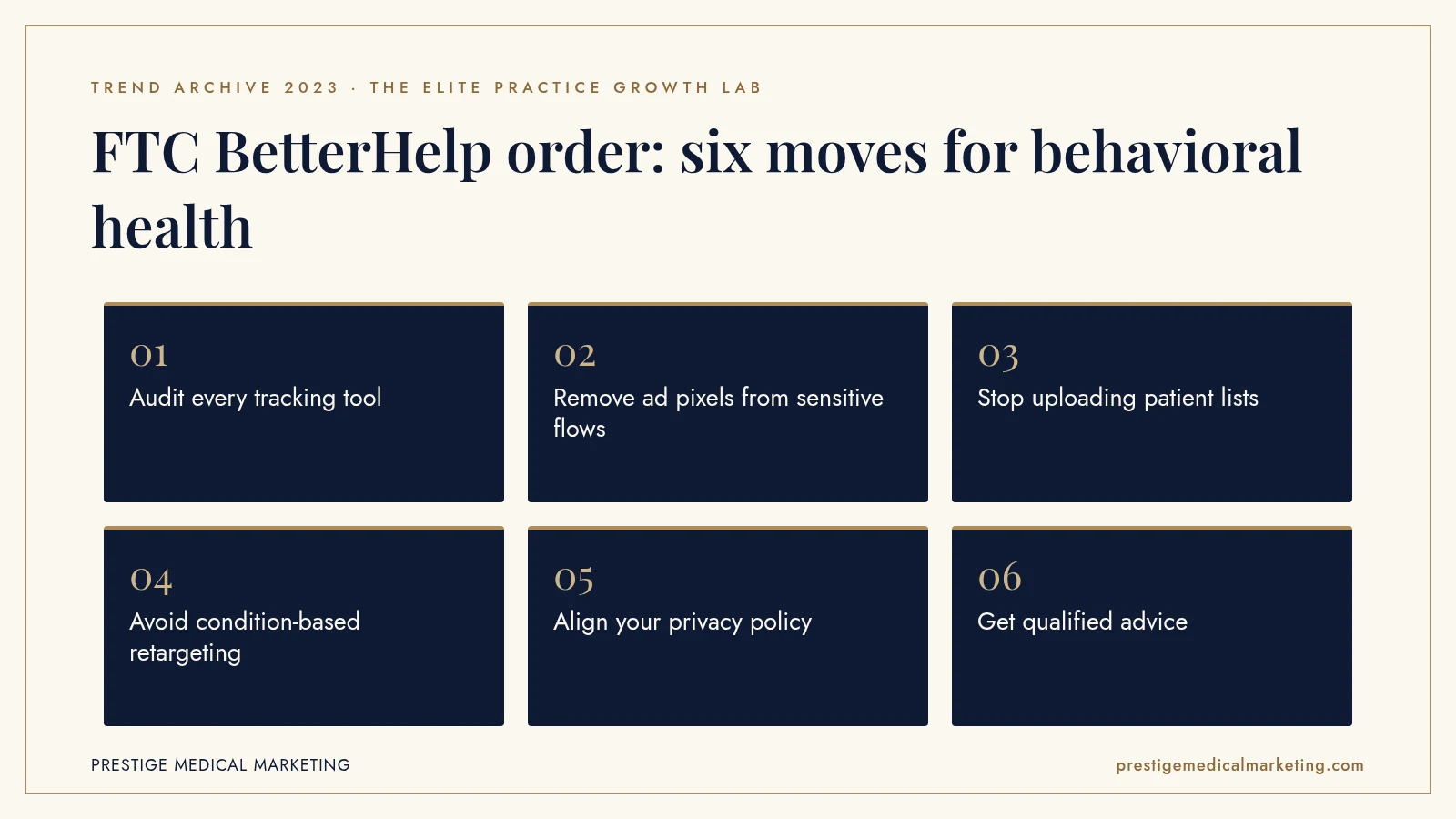
1. Audit every tracking tool
List every pixel, tag and script on the website, especially on service pages, intake forms and scheduling flows. Know what each one collects and where it sends data. Many practices find tags they did not know existed.
2. Remove ad pixels from sensitive flows
Do not run advertising pixels on intake forms, questionnaires or appointment flows. Those are where the most sensitive information appears, and where a single tag can expose it.
3. Stop uploading patient lists
Do not upload patient or inquiry lists to ad platforms for matching or lookalike audiences. Being in care is sensitive, and the BetterHelp case showed how lookalike matching can expose it.
4. Avoid condition-based retargeting
Do not build retargeting audiences based on visits to pages about specific conditions or treatments. Following someone around the web after they read about depression or addiction is both risky and unkind.
5. Align your privacy policy
Make sure the privacy policy accurately describes what the practice collects and shares. Promises must match reality, and the policy should be updated whenever tools change.
6. Get qualified advice
Work with privacy counsel familiar with HIPAA, FTC law and state health privacy laws to review the setup. Several states have added their own consumer health data laws, as we covered in our piece on Washington’s My Health My Data Act.

Marketing that works without sensitive data
Behavioral health practices can grow without sharing health data. The most reliable channels do not depend on it. Organic search brings people who are actively looking for care, and strong service pages written in clear, compassionate language can earn that visibility. A complete, accurate Google Business Profile helps people find local providers. Referral relationships with physicians and other clinicians remain essential, and they depend on reputation rather than data.
Paid search can also work responsibly. Ads can target searches for services in a geographic area without relying on retargeting or uploaded lists. Conversion measurement can count that a consultation request occurred without sending the content of the request to an ad platform. Our guide on getting your practice recommended by AI covers another channel that depends on public information rather than personal data.
Intake forms deserve special attention
The BetterHelp case centered on a health questionnaire, and many behavioral health practices use similar intake forms on their websites. Those forms often ask about symptoms, history, medications and goals, information that is highly sensitive.
The safest approach is to keep detailed clinical intake inside a secure, HIPAA-appropriate system rather than a general website form, and to keep advertising and analytics tags entirely off those pages. A short initial contact form that collects only what is needed to schedule a call, with clinical questions asked later in a secure setting, reduces risk considerably. It also tends to improve conversion, because a short form feels far less daunting to someone taking a first step toward care.
The trust dividend
Privacy is not only a compliance matter in behavioral health. It is part of the care itself, from the very first click. People considering therapy or psychiatric treatment often worry about who will know. A practice that clearly protects privacy, explains its approach in plain language and avoids following visitors around the internet with ads is building trust before the first appointment.
That trust has practical value. People who feel safe are more likely to reach out, more likely to attend and more likely to recommend the practice. In a field where the therapeutic relationship matters, privacy-respecting marketing is aligned with good clinical values.
Platform policies point the same way
Advertising platforms have tightened health-related rules as well. Google’s personalized advertising policies restrict targeting based on sensitive health conditions, and Meta has expanded restrictions on how health-related businesses can use certain data, as we covered in our piece on Meta’s 2025 health ad restrictions.
The direction is consistent across regulators and platforms: health information should not fuel ad targeting. Practices that build their marketing on that assumption avoid repeated rework as rules tighten further, and they are not caught off guard when a platform changes its policies with little notice.
Measuring results without sharing health data
One worry practices raise is that removing pixels and patient lists makes marketing impossible to measure. It does not. A practice can count consultation requests and calls by source using first-party analytics configured carefully, call tracking that records the source of a call without transcribing clinical content and simple intake questions such as “How did you hear about us?”
Those methods answer the business questions that matter: which channels bring people who schedule, how many inquiries become first appointments and where the practice should invest. They do so without telling an advertising platform that a particular person sought mental health care. Our guide to call handling and lead leakage explains how to measure the phone side, which is often the largest share of behavioral health inquiries.
The tradeoff is some loss of automated optimization in ad platforms. For most behavioral health practices, that is a small price compared with the privacy and regulatory risk of the alternative.
Content that earns trust
The most effective behavioral health marketing usually looks more like education than advertising. Clear explanations of what therapy or psychiatric care involves, what a first appointment is like, how insurance or self-pay works and how long people typically wait help someone take a difficult first step.
Provider pages matter too. People want to know who they will talk to: their training, their approach and the issues they focus on. Warm, specific bios often do more for conversion than any campaign, because they help someone picture the first conversation. Pages should avoid promising outcomes, since therapy results vary and claims about cures or guaranteed improvement are inappropriate and risky.
What 2023 does not tell us
The BetterHelp order applied to one company, and the FTC did not publish data on how many behavioral health practices changed their tracking afterward. We also cannot say how specific small-practice setups would be treated, which depends on facts and on HIPAA and state law. What 2023 does show is the FTC’s documented allegations, remedies and stated priority on sensitive health data.
The premium practice advantage
Premium behavioral health practices earn trust through discretion and quality. See our behavioral health services, our full services, who we help and our approach to Google Maps and AI search visibility. Our team works from Austin with practices nationwide.
The bottom line
The FTC’s 2023 BetterHelp order showed that health data shared for advertising carries real consequences. Behavioral health practices that market without sensitive data protect patients, reduce risk and build the trust that brings people into care.
Check if your market is open. We take one practice per specialty per market. Request a market check or call (716) 400-0084.
Frequently asked questions
What did the FTC allege against BetterHelp?
The FTC alleged BetterHelp shared consumers' email addresses, IP addresses and health questionnaire information with Facebook, Snapchat, Criteo and Pinterest for advertising, despite promising to keep that data private.
How much did BetterHelp have to pay?
The proposed order required BetterHelp to pay $7.8 million, which the FTC said would provide partial refunds to consumers. The FTC called it its first action returning funds to consumers whose health data was compromised.
What did the order ban?
It banned BetterHelp from disclosing health information for advertising, banned sharing personal information with certain third parties for retargeting and required affirmative express consent before disclosing personal information to certain third parties.
How did the FTC say BetterHelp used lookalike targeting?
The FTC said BetterHelp used consumers' email addresses and the fact they had been in therapy to have Facebook identify similar consumers for advertising.
Does this apply to small behavioral health practices?
The order applied to BetterHelp, but the FTC's reasoning about health data, privacy promises and advertising applies broadly. Practices should review tracking and ad practices with qualified counsel.
Can behavioral health practices still advertise online?
Yes. The issue is how data is used. Practices can advertise responsibly without sharing patients' health information or identifiers with ad platforms.