
In July 2022, the National Suicide Prevention Lifeline was relaunched as the 988 Suicide & Crisis Lifeline, which people reach by calling or texting 988 or chatting at 988lifeline.org. The old 10-digit number still connects. For private behavioral health practices, it meant updating crisis information on websites, voicemail and after-hours messages so anyone in crisis is directed to 988 or 911, because a private practice is not a crisis service.
Every behavioral health practice serves people who are struggling, and a small number of them may reach out at a moment of crisis. Most private practices are not crisis services. They see patients by appointment, return messages during business hours and rely on emergency and crisis lines for urgent situations. How a practice directs people in those moments is one of the most important things it communicates.
In July 2022, the United States made that easier. The National Suicide Prevention Lifeline was relaunched as the 988 Suicide & Crisis Lifeline, reachable by three digits. Every practice website, voicemail greeting and intake form that mentioned the old number needed an update.
This retrospective covers what changed in 2022 and what it means for a behavioral health practice today. It is about communication, not clinical protocol. For related behavioral health chapters, see the HHS tracking technologies bulletin of 2022, the Meta pixel investigation of 2022 and the FTC’s Kochava location data case.
What actually happened in 2022
The relaunch. According to SAMHSA’s 988 FAQs, the National Suicide Prevention Lifeline, reached at 1-800-273-8255, was relaunched in July 2022 as the 988 Suicide & Crisis Lifeline.
Call, text or chat. SAMHSA describes 988 as a national service offering 24/7 support for mental health, suicide and substance use-related crises. People can call or text 988 or chat online at 988lifeline.org.
The old number still works. SAMHSA states that the 10-digit number remains functional and connects to 988 Lifeline services.
Veterans. Veterans, service members and their families can call 988 and press 1 to reach the Veterans Crisis Line, according to SAMHSA.
Not only suicide. SAMHSA says 988 responds to anyone needing support for suicidal, mental health and substance use crises, and that people can contact 988 about a loved one.
The background. SAMHSA’s 988 overview notes that Congress designated the 988 dialing code in 2020, to be operated through the existing Lifeline.
Why it mattered for behavioral health practices
A private behavioral health practice is usually not equipped to respond to a crisis in real time. Messages may be left after hours, on weekends or while clinicians are in session. A person in crisis who reaches only a voicemail or a contact form needs to be told immediately where to get help.
Before 988, many practice websites listed a 10-digit number that was harder to remember. The launch made it possible to give a simple, consistent instruction everywhere: call or text 988, or call 911 in an emergency. Practices that updated their materials quickly gave people a clearer path. Practices that did not left outdated information in the places people look first.
The launch also raised awareness. As public campaigns promoted 988, more people became familiar with it, and they expected to see it on behavioral health websites.
What typical agencies did
Many agencies building websites for behavioral health practices treated crisis information as an afterthought, placing a small line in the footer or omitting it entirely in favor of booking buttons. Some contact forms promised a quick response without clarifying that the form was not monitored for emergencies.
Others never updated templates after 2022, leaving the old number or no crisis information at all. A few placed crisis messaging in pop-ups that were dismissed and forgotten.
The careful approach treated crisis information as a core element of the site: visible, accurate, consistent across pages, forms and phone messages, and reviewed regularly.
What it means for a behavioral health practice today
These practical steps apply to most private practices. Clinical crisis policies remain a matter for the practice’s clinicians.
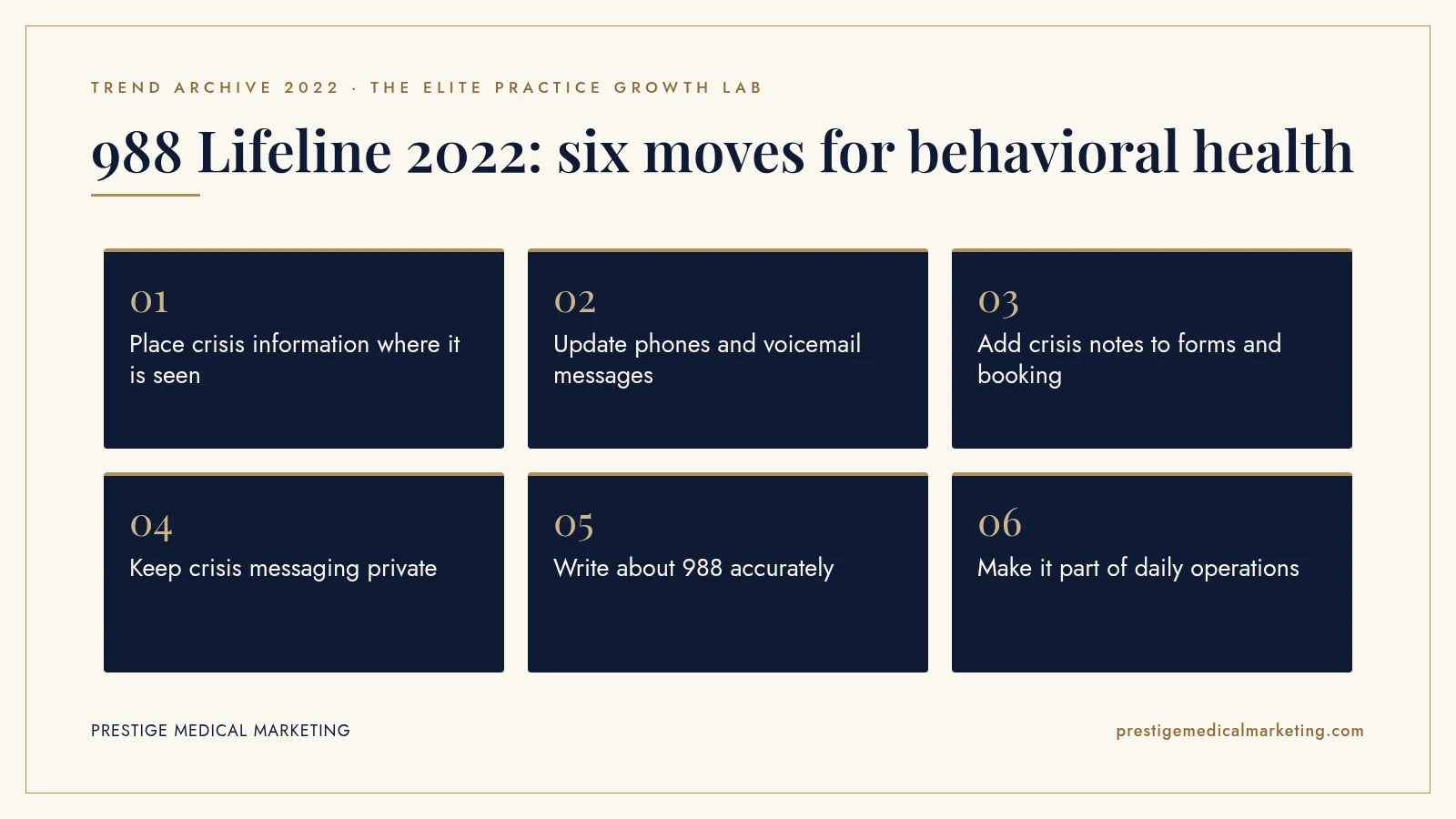
1. Show 988 clearly
Place a short crisis notice in the header, footer or a visible banner, with 988 and 911.
2. Label contact forms
State on every form that it is not monitored for emergencies and that people in crisis should call or text 988.
3. Update voicemail
Begin after-hours messages with crisis instructions before any other options.
4. Update confirmations
Include crisis information in booking confirmations and patient portal messages.
5. Train front desk staff
Give staff a clear script and escalation path for calls that suggest a crisis.
6. Review regularly
Check every page, form and message at least once a year for accuracy.

Where crisis information belongs
People in distress do not read websites carefully. They scan for a phone number or a button. Crisis information should therefore appear where they are most likely to look: near the top of the home page, on the contact page, on every form and in the site footer. It should be written plainly, without clinical jargon, and should not compete with promotional content.
A simple notice works well: if you are in crisis, call or text 988, or call 911 if you are in immediate danger. Making 988 a tappable link on mobile helps people act quickly. The same message should appear in email signatures, appointment reminders and the patient portal.
Practices that serve veterans may also note that veterans can call 988 and press 1. Practices with Spanish-speaking patients can mention that 988 offers services in Spanish, which SAMHSA confirms.
Phones, voicemail and after-hours coverage
The phone is where crisis communication can fail most quietly. A caller who reaches voicemail after hours may hear a long list of options before any guidance on urgent situations. The first thing a behavioral health practice’s after-hours message should say is what to do in a crisis.
Front desk staff need guidance too. They should know how to recognize a call that may involve a crisis, what to say, how to reach a clinician and when to direct the caller to 988 or 911. That guidance should come from the practice’s clinical leadership and be documented so it does not depend on one person’s memory.
Practices that use answering services or call-handling partners should confirm that those partners deliver the same message and know the practice’s escalation process. A call handled well in a crisis matters more than any marketing metric.
Contact forms and online booking
Text and chat deserve the same attention. Practices that offer text reminders or a website chat tool should make sure automated replies include crisis instructions, and that any keywords suggesting distress prompt an immediate pointer to 988 rather than a booking link. Staff who monitor these channels should follow the same escalation guidance as the front desk.
Contact forms and online booking tools are convenient, and they also create a risk. Someone might type a message describing a crisis into a form that no one will see until the next business day. Every form should say clearly that it is not monitored for emergencies, and the confirmation message after submission should repeat the crisis instructions.
Online scheduling systems should do the same. If a scheduling tool lets people describe the reason for a visit, the page should include crisis guidance. Practices may also want their clinical team to decide how staff should respond if a message describing a crisis does arrive, and to document that process.
Privacy and crisis communication
Behavioral health practices handle some of the most sensitive information in healthcare. The same year 988 launched, attention to tracking technologies on healthcare websites grew, culminating in the HHS bulletin of December 2022. Pages and forms that touch crisis topics should be reviewed carefully for third-party tracking, since visiting those pages can reveal sensitive information about a person.
SAMHSA’s FAQs explain that the 988 Lifeline does not require personal information to provide support. Practices can reassure visitors by explaining what happens with information they submit through the practice’s own forms and by limiting what those forms collect.
Writing about 988 responsibly
Some practices write articles explaining what 988 is and how it works. That content can be genuinely helpful, especially for families who want to understand their options. It should rely on official sources such as SAMHSA, link to them and avoid stating details that may change, such as specific menu options, without checking them first.
Content should also avoid implying that the practice itself provides crisis services if it does not. Clear distinctions between ongoing outpatient care, crisis lines and emergency services help people choose the right path at the right moment.
Tone matters as well. Writing about suicide and crisis should follow safe messaging guidance: avoid sensational language, avoid describing methods, emphasize that help is available and include crisis resources on every such page. Clinical leadership should review these pages before they are published and whenever they are updated.
Crisis information in search and AI answers
When someone searches for help with a mental health crisis, search engines typically surface crisis resources prominently. A practice’s role is different. Its pages are found by people looking for ongoing care, and those pages should make the crisis path obvious so that anyone who arrives in distress is redirected immediately.
Clear, consistent crisis notices also help search engines and AI assistants understand what a practice does and does not offer. A page that explains outpatient services and clearly states that the practice is not a crisis service is easier to interpret accurately than one that blurs the two.
Making it part of operations
Crisis communication should not depend on a single website update made in 2022. Practices change phone systems, booking tools and website templates over time, and each change can remove or alter a crisis notice without anyone noticing.
A short annual review helps. Someone checks the website header and footer, every form and confirmation, voicemail and after-hours messages, patient portal messages and email signatures. They confirm the information is current, consistent and visible on mobile. Any new tool added during the year is reviewed before launch.
Ownership matters too. One named person, often the practice manager working with clinical leadership, should be responsible for crisis communication. When responsibility is shared loosely, updates fall through the cracks. A brief checklist kept with the practice’s operating documents makes the review quick and repeatable.
What 2022 does not tell us
The 2022 launch established a simple national number. It did not determine how quickly every region would build local crisis capacity, how wait times would change or how specific menu options would evolve. SAMHSA describes 988 as a first step toward a broader crisis care system. Practices should check official sources periodically rather than assuming details from 2022 remain unchanged.
The premium practice advantage
A premium behavioral health practice earns trust through care in every detail, including the moments that matter most. See our behavioral health services, our approach to call handling, our custom websites, our full services, who we help and how we approach Google Maps and AI search visibility. Our team works from Austin with practices nationwide.
The bottom line
In July 2022, the National Suicide Prevention Lifeline became 988. For behavioral health practices, the lesson was simple: show 988 and 911 clearly on every page, form and message, train staff and review it all regularly.
Check if your market is open. We take one practice per specialty per market. Request a market check or call (716) 400-0084.
Frequently asked questions
What is 988?
The 988 Suicide & Crisis Lifeline is a national service offering 24/7 support for suicidal, mental health and substance use crises by call, text or chat. SAMHSA describes it as available across the United States.
When did 988 launch?
The National Suicide Prevention Lifeline was relaunched as the 988 Suicide & Crisis Lifeline in July 2022.
Does the old Lifeline number still work?
Yes. SAMHSA says the 10-digit number, 1-800-273-8255, remains functional and connects to 988 Lifeline services.
How do veterans reach the Veterans Crisis Line through 988?
SAMHSA says veterans, service members and their families can call 988 and press 1.
Should a private practice list 988 on its website?
Yes. A practice that is not a crisis service should clearly tell visitors in crisis to call or text 988, or call 911 in an emergency.
Should a practice's voicemail mention 988?
Yes. After-hours and voicemail messages should direct callers in crisis to 988 or 911, since messages left with the practice may not be heard until later.