
Medicare telehealth flexibilities lapsed on October 1, 2025 when the federal government shut down. On November 12, 2025, a continuing resolution ended the 42-day shutdown and extended them through January 30, 2026, including the delay of the in-person requirement for Medicare behavioral telehealth. Separately, DEA and HHS extended telemedicine prescribing flexibilities through December 31, 2026. For behavioral health practices, the lesson is to communicate clearly with patients and keep strong in-person and telehealth options.
Few areas of medicine embraced telehealth as fully as behavioral health. Therapy, psychiatry and counseling translate well to video, and for many patients, a session from home removes barriers of travel, time and stigma. For practices, telehealth widened their reach and filled schedules.
But for Medicare patients in particular, telehealth has rested on a series of temporary extensions. In 2025, one of those deadlines arrived at the worst possible moment: the federal government shut down, and several flexibilities lapsed with it.
This retrospective covers what happened, what changed afterward and what behavioral health practices should do about telehealth now.
What actually happened in 2025
October 1: the lapse. Several Medicare telehealth flexibilities, previously extended by Congress, were tied to federal funding deadlines. When funding lapsed on October 1, 2025, they expired. Among them were home as the originating site and the lack of geographic restrictions for non-behavioral visits, audio-only non-behavioral visits, expanded eligible provider types and the delay of the in-person visit requirement for Medicare behavioral telehealth.
November 12: restored. After the Senate passed a continuing resolution on November 10 and the House followed, the President signed it on November 12, 2025, ending a 42-day shutdown. As Telehealth.org reported, the resolution extended the Medicare telehealth flexibilities through January 30, 2026, including the delayed in-person requirement for behavioral telehealth, and coverage indicated that affected claims from October 1 onward were expected to be processed retroactively. CMS published operational updates in its MLN Connects newsletter.
December 31: prescribing extended. Separately, DEA and HHS published a fourth temporary extension of telemedicine flexibilities for prescribing controlled medications. It allows DEA-registered practitioners to prescribe Schedule II to V controlled substances via telemedicine without a prior in-person evaluation from January 1 through December 31, 2026, if the conditions in the rule are met. The DEA announced it the same day.
Why behavioral health felt it most
Behavioral health care depends on continuity. A patient in the middle of therapy or medication management cannot simply pause for six weeks while Congress negotiates. During the lapse, practices serving Medicare patients faced hard choices: switch patients to in-person visits where possible, hold claims and hope for retroactive payment, or pause some services.
The uncertainty mattered as much as the rules. Patients heard about a “telehealth cliff” in the news and called to ask whether their appointments were still on. Practices without a clear message lost trust, and some patients missed care they needed.
For practices that do not bill Medicare, including many cash-pay therapy and psychiatry practices, the direct impact was smaller. But the episode was a reminder that telehealth rules for prescribing, cross-state licensure and payer coverage can change, and that every practice needs a plan for when they do.
What typical agencies did
Much behavioral health marketing in recent years has leaned heavily on convenience: “therapy from your couch,” “get a prescription today,” “no waiting.” Some telehealth brands pushed this to an extreme, and regulators took notice of aggressive mental health prescribing models.
Agencies that built a practice’s entire pitch around telehealth convenience left it exposed whenever the rules shifted. When telehealth access was uncertain, those practices had little else to say.
We take a different view. Telehealth is a strong way to deliver care, but it is not the brand. The brand is your clinicians, your approach and the way your practice treats people.
What it means for a behavioral health practice today
This is marketing and operations guidance, not legal or billing advice. Check current CMS, DEA, state and payer rules before relying on any date.
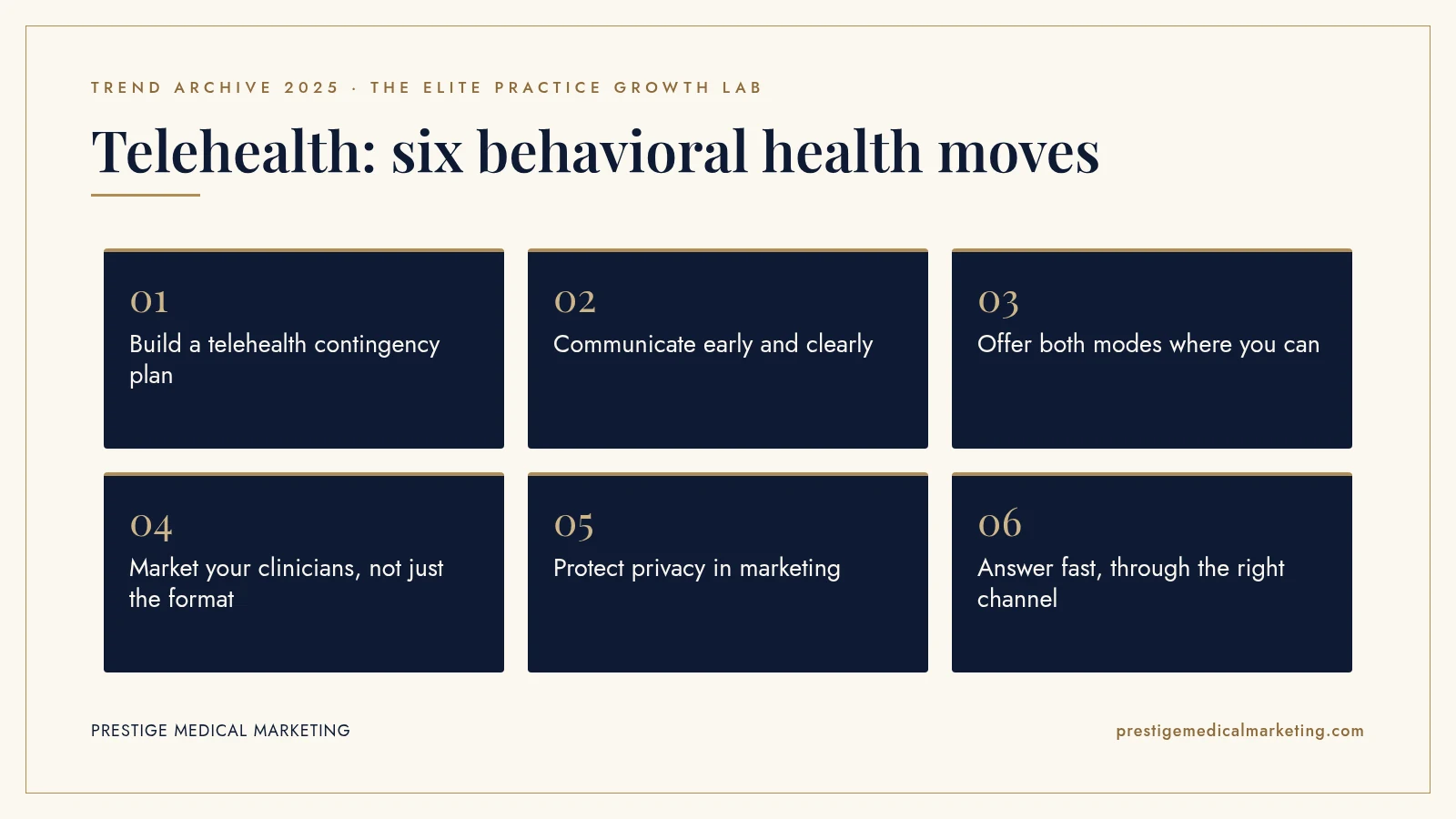
1. Build a telehealth contingency plan
Decide in advance what you will do if a telehealth rule lapses or changes: which patients are affected, who can switch to in-person care, how you will handle claims and how you will communicate. Write it down, so the next deadline is a procedure, not a crisis.
2. Communicate early and clearly
When rules change, tell affected patients before they have to ask. A short, calm message explaining what is changing, what is not and what they should do keeps trust intact. Update your website and train your front desk on the same message.
3. Offer both modes where you can
Practices with a physical location and a telehealth option weathered 2025 best. If you are telehealth-only, consider partnerships or occasional in-person days that let you meet in-person requirements when needed.
4. Market your clinicians, not just the format
Prospective patients choose a therapist or psychiatrist because of fit: training, approach, specialties and personality. Clinician pages with real photos, plain-language descriptions and the issues each clinician focuses on do more for trust than any convenience slogan.
5. Protect privacy in marketing
Behavioral health data is among the most sensitive there is. Avoid ad targeting and tracking that could reveal someone’s mental health condition. Our retrospectives on Meta’s 2025 health data restrictions and 2025’s tracking and privacy changes explain the risks.
6. Answer fast, through the right channel
People often reach out to behavioral health practices at hard moments. A same-day, warm response matters. Make sure your intake process routes inquiries quickly, uses secure channels for any clinical details and provides crisis resources such as the 988 Suicide and Crisis Lifeline on your website. Our guide to call handling and lead leakage covers response systems.

What a strong behavioral health website includes
Here is how we approach a private behavioral health practice website, whether it focuses on therapy, psychiatry or both.
A clear welcome. Who you help, how you work and what the first step looks like, in warm, plain language.
Clinician profiles. Each clinician’s training, approach, focus areas, availability for telehealth or in-person sessions and a real photo.
Services and formats. What you offer, who it is for and whether it is available by telehealth, in person or both.
Fees and insurance. Honest information about cost, insurance participation and superbills where relevant. Uncertainty about cost is one of the biggest barriers to booking.
The first step. A simple way to request a consultation or intake call, with a clear expectation of when someone will respond.
Crisis information. A visible note that the practice is not an emergency service, with crisis resources.
This structure serves patients first, and that is also what serves the practice. Clear, trustworthy sites convert better and are more likely to be surfaced and recommended by search engines and AI assistants. See our guide on getting recommended by AI.
Messages that work during uncertainty
When telehealth rules are in the news, three messages tend to help. First, reassurance: “Your care continues. Here is what is changing and what is not.” Second, options: “If telehealth coverage changes for you, we can see you in person or help you understand your choices.” Third, a contact point: “Questions? Call or message our care team, and we will reply the same day.”
Avoid alarming language or using a policy change as a sales hook. Patients remember which practices helped them through uncertainty and which ones tried to profit from it.
Referral partners are part of resilience
Behavioral health practices often grow through referrals from primary care physicians, other specialists, schools, employers and other therapists. Those relationships matter even more when rules shift, because referral partners need to know whether you can still see their patients and in what format.
Keep a simple list of your referral sources and update them when anything changes: new clinicians, new availability, telehealth or in-person options, insurance changes. A short note from your practice during a policy change positions you as reliable and organized, which is exactly what a referring physician wants.
Make referring easy, too. A dedicated referral page or form, a direct phone line for professionals and a fast confirmation that the referral was received go a long way. Many practices lose referrals simply because the referring office could not reach anyone.
Measuring what matters
Behavioral health practices should measure marketing differently from aesthetic or retail businesses. The goals are access and fit, not volume. Useful numbers include inquiries per month, how quickly each inquiry received a response, how many became intake appointments, how many patients were a good fit for your clinicians and how many continued care past the first few sessions.
Track the source of each new patient, too: search, referrals, insurance directories, AI assistants or word of mouth. That tells you where to invest, and it helps you see quickly if a policy change affects one channel more than others. During the 2025 lapse, for example, practices that tracked telehealth and in-person intake separately could see exactly where demand shifted.
Review these numbers monthly with your clinical lead. Small changes in response time or intake conversion often reveal problems long before they show up in revenue, and they are usually simple to fix once you can see them.
Planning your telehealth mix
Every practice’s ideal balance of telehealth and in-person care is different. Some clinicians and patients strongly prefer one or the other. Review your mix once a year: which services work best in each format, which patients rely on telehealth for access and what would happen to your schedule if telehealth rules for a group of patients changed. That review turns a policy risk into a planning decision.
Include your clinicians in that review. Their preferences, licenses and caseloads shape what is realistic. A plan that the clinical team believes in is far more likely to hold when the next deadline arrives, and patients can feel the difference when everyone gives the same calm answer.
What 2025 does not tell us
We do not have reliable public data on how many behavioral health patients missed care during the lapse or how practices’ revenue changed. Telehealth policy has continued to shift since 2025, and the dates in this article may have been superseded by later legislation or rules. Always check current guidance from CMS, the DEA, your state and your payers. Nothing here is billing or legal advice.
The premium practice advantage
Behavioral health practices that compete on convenience alone are exposed when rules change. Practices that compete on clinician quality, fit and care experience keep their patients through any format shift. Telehealth becomes one more way to deliver excellent care, not the whole proposition.
That is how we approach marketing for behavioral health practices: clinician-first positioning, privacy-safe marketing, websites built for trust and fast, warm follow-up through our booking engine. Our team works from Austin with practices nationwide.
The bottom line
In 2025, Medicare telehealth flexibilities lapsed on October 1 during a 42-day shutdown, then were extended through January 30, 2026 when the government reopened on November 12. DEA and HHS extended telemedicine prescribing flexibilities through 2026. The rules came back, but the lesson stayed: behavioral health practices need a contingency plan, clear patient communication, both in-person and telehealth options and a brand built on clinicians rather than convenience.
Check if your market is open. We take one practice per specialty per market. Request a market check or call (716) 400-0084.
Put this playbook to work: see how it applies to the Prestige System for medical practice marketing.
Frequently asked questions
What happened to Medicare telehealth in October 2025?
Several Medicare telehealth flexibilities that had been extended by Congress expired on October 1, 2025, when a lapse in federal funding began. They included home as the originating site for non-behavioral visits, audio-only non-behavioral visits and the delay of the in-person requirement for behavioral telehealth.
When were the flexibilities restored?
The continuing resolution signed on November 12, 2025, which ended the 42-day shutdown, extended the flexibilities through January 30, 2026. Coverage at the time reported that claims for affected services on or after October 1 were expected to be paid retroactively.
Is behavioral telehealth permanently covered by Medicare?
Congress made home-based behavioral and mental health telehealth a permanent Medicare option in earlier legislation, but tied it to an in-person visit requirement that has been repeatedly delayed. Rules change often, so check current CMS guidance before relying on any date.
What about prescribing controlled substances by telehealth?
On December 31, 2025, DEA and HHS published a fourth temporary extension of telemedicine flexibilities, allowing DEA-registered practitioners to prescribe Schedule II to V controlled substances via telemedicine without a prior in-person evaluation through December 31, 2026, subject to the conditions in the rule.
Should a behavioral health practice keep offering telehealth?
For many practices, yes. Telehealth improves access and continuity. But it should sit alongside in-person options where possible, with clear communication about what coverage and rules apply to each patient. Practices should follow current federal and state rules and payer policies.
How should behavioral health practices market telehealth responsibly?
Describe what you offer, who it suits and how it works, without promising outcomes. Avoid ads or tracking that reveal a person's mental health condition. Respond to inquiries quickly and through secure channels, because people often reach out at difficult moments.