
On February 8, 2024, the FCC released a declaratory ruling confirming that the TCPA's restrictions on "artificial or prerecorded voice" calls cover AI technologies that generate human voices, so such calls require the prior express consent of the person called. For practices, it meant outbound calls using AI voices need the same consent as other robocalls. Answering inbound calls with AI is a different situation, but clear disclosure, consent records and human handoff still matter. This is marketing guidance, not legal advice.
The phone remains one of the most important channels for practices. New patients call to ask questions and book. Existing patients call to reschedule. Practices call patients to confirm appointments, follow up on consultations and reactivate past patients. In 2024, artificial intelligence started to change both sides of that conversation.
AI voice tools became good enough to sound natural, answer common questions and handle simple tasks. That opened useful possibilities for practices struggling with missed calls. It also opened the door to abuse, as scammers used AI voices to make robocalls that sounded like real people.
In February 2024, the Federal Communications Commission responded. It confirmed that existing robocall rules apply to AI-generated voices. This retrospective covers what the FCC decided, why it mattered for practices and how to use AI on the phone responsibly. This is marketing guidance, not legal advice. For the broader picture, see our pillar on call handling and lead leakage.
What actually happened in 2024
The trigger. In January 2024, voters in New Hampshire received robocalls with an AI-generated voice imitating President Biden ahead of the state’s primary. The incident became a widely cited example of AI voice misuse.
The ruling. On February 8, 2024, the FCC released a declaratory ruling confirming that the Telephone Consumer Protection Act’s restrictions on “artificial or prerecorded voice” calls encompass current AI technologies that generate human voices. As a result, such calls require the prior express consent of the called party.
What it covered. The ruling applied existing TCPA rules to a new technology. It did not create a new law. It meant callers could not argue that an AI-generated voice was outside the rules for artificial voices.
A separate consent fight. In late 2023, the FCC had also adopted a rule requiring one-to-one consent for certain lead generation calls. In January 2025, the U.S. Court of Appeals for the Eleventh Circuit vacated that rule. That was a separate issue from the AI voice ruling, but it shows how actively calling rules were changing.
Why it mattered for practices
Practices were among the businesses most interested in AI phone tools. Missed calls are a well-known problem: front desks are busy, calls come in after hours and every unanswered call can mean a lost patient. AI receptionists promised to answer every call, handle common questions and book appointments.
At the same time, some vendors pitched AI for outbound calling: reminder calls, reactivation campaigns and follow-up on leads. The FCC ruling made clear that outbound AI voice calls are treated like other artificial or prerecorded voice calls under the TCPA, with consent requirements. TCPA violations can carry significant statutory damages, and class action lawsuits have been common.
The ruling therefore drew a practical line. Answering a patient who called the practice is different from placing automated calls to patients. Practices needed to understand which side of that line each tool was on.
What typical agencies did
Some agencies and vendors rushed to sell AI calling without discussing consent. They pitched automated reactivation campaigns to entire patient lists or to purchased lead lists, with little attention to whether recipients had agreed to automated calls.
Other agencies avoided AI entirely and left practices with the original problem: missed calls and slow follow-up. Neither approach served practices well.
Some practices also bought AI tools without asking how they handled consent, recordings or data, and only discovered gaps after launch.
The better path was careful: use AI where it clearly helps patients, such as answering inbound calls, and treat outbound automation with the consent discipline the law requires.
What it means for a practice today
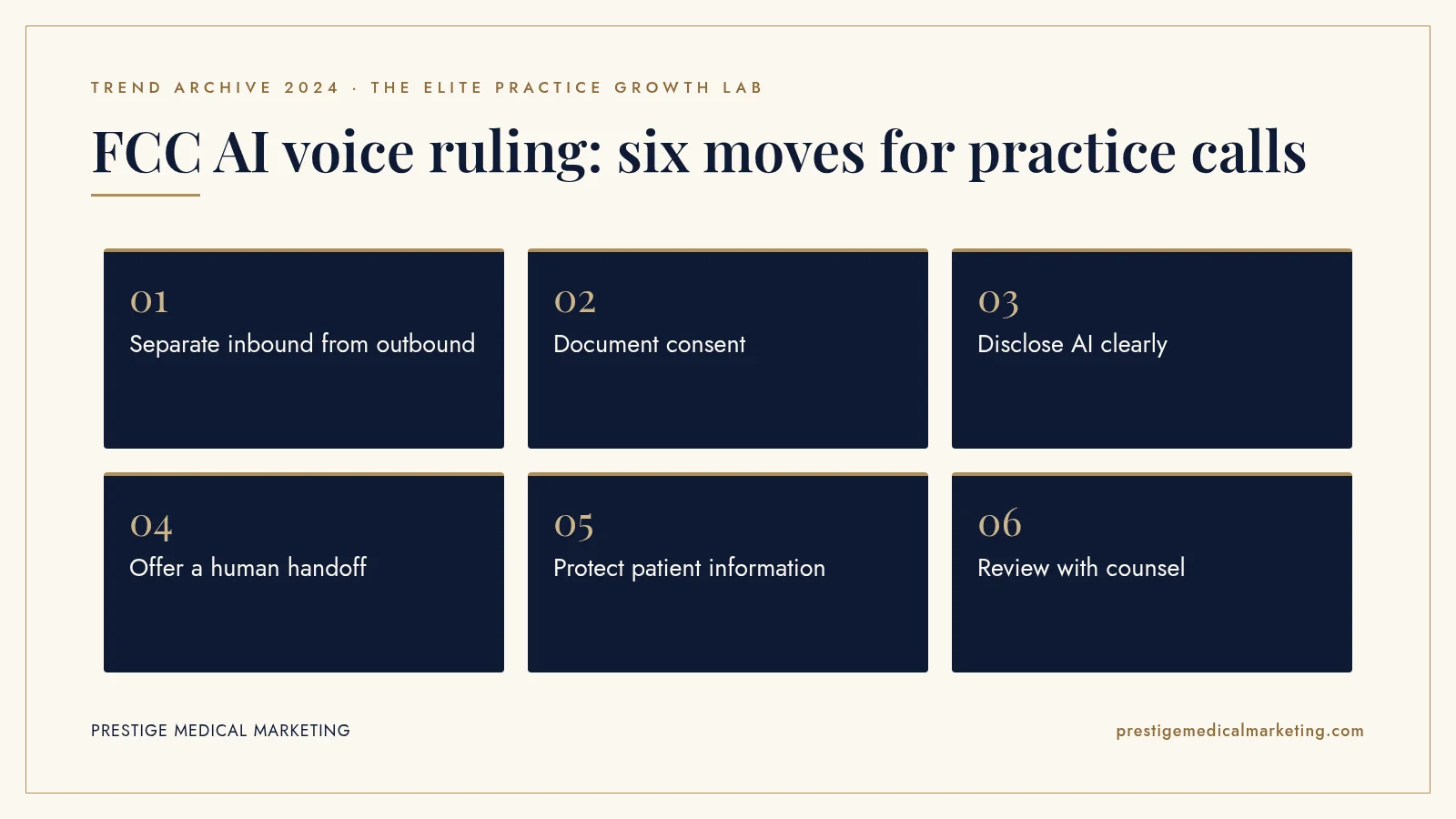
AI can improve the phone experience if it is used responsibly. Here is how we approach it.
1. Separate inbound from outbound
Map every phone tool: which answer patient calls and which place calls. Apply stricter review and consent checks to outbound automation.
2. Document consent
Record when and how patients agreed to receive calls and texts, and for what purpose. Store consent where your systems can check it before calling.
3. Disclose AI clearly
Tell callers when they are speaking with an AI assistant. Transparency builds trust and avoids confusion.
4. Offer a human handoff
Make it easy to reach staff, especially for clinical questions, complaints or sensitive topics. AI should support the team, not trap patients.
5. Protect patient information
Choose vendors that will sign business associate agreements where required, and limit what information AI tools collect and store.
6. Review with counsel
Have counsel review outbound calling programs, scripts and consent language before launch, and again when rules change.

Inbound AI: the stronger use case
For most practices, the clearest value of AI on the phone is answering calls the team cannot reach. A patient calling after hours or during a busy morning can get an answer, book a time or leave details for a callback instead of hearing voicemail. That is a direct improvement in patient experience and in practice revenue. Our guide to what missed calls cost medical practices explains why this matters.
Inbound AI still needs care. The assistant should be accurate, avoid giving medical advice, disclose that it is AI, protect information and hand off to staff for anything it cannot handle well. Calls and transcripts should be reviewed regularly to catch errors and improve responses.
When done well, inbound AI lets staff focus on patients in the office while making sure callers are not ignored.
Outbound automation: proceed carefully
Outbound automation can still be valuable. Appointment reminders, for example, reduce no-shows. But practices should understand the consent requirements and keep records. Calls using artificial or AI-generated voices require prior express consent, and marketing calls may require more.
Practices should also think about patient experience. A reactivation call from an AI voice to someone who has not visited in years may feel intrusive even if it is technically permitted. Text or email messages, sent with consent and clear opt-out options, may be a better fit for some outreach.
Purchased lead lists deserve particular caution. Calling people who never agreed to hear from the practice with automated voices invites legal risk and damages reputation.
Text messaging is part of the picture
The TCPA also covers many automated text messages, and carriers have their own registration and consent requirements for business texting. Practices often use texts for reminders and follow-up because patients prefer them. The same principles apply: get consent, honor opt-outs quickly, keep records and send relevant messages.
AI-written texts raise similar questions. If an AI tool generates or sends messages, the practice is still responsible for consent and content. Human review and clear policies help.
Training staff for the change
Staff should understand how AI fits into the phone workflow. Front desk teams need to know what the AI assistant handles, how handoffs work and how to review AI-captured information. They should also know the practice’s consent policies and when to escalate questions.
When staff trust the system, they use it well. When they do not, they work around it. Involving staff early, reviewing calls together and adjusting scripts based on feedback make adoption smoother.
Measuring the right outcomes
The value of AI on the phone shows up in a few measurable places: fewer missed calls, faster response to new patient inquiries, more booked appointments and fewer no-shows. Practices should track those numbers before and after adding AI so they know whether the tool is helping.
It is just as important to track problems. Review a sample of calls each week for accuracy, tone and correct handoffs. Monitor complaints and opt-out requests. A tool that books more appointments but frustrates patients or creates compliance risk is not a good trade. Our booking engine work connects phone, web and scheduling data so practices can see the full picture.
Choosing an AI phone vendor
The market for AI phone tools grew quickly after 2024, and vendors vary widely. Before choosing one, practices should ask a few practical questions. Does the tool clearly disclose that callers are speaking with an AI assistant? Can it hand calls to staff smoothly, including after hours through a callback queue? Will the vendor sign a business associate agreement where one is required? Where are recordings and transcripts stored, and for how long? Can the practice review every conversation?
Practices should also ask how the vendor handles outbound features. If the tool can place calls or send texts, how does it check consent before doing so? Can outbound features be turned off entirely? A vendor that cannot answer these questions clearly is a risk, regardless of how natural its voice sounds.
Finally, ask about integration. An AI assistant that cannot see the schedule or write appointments into the booking system creates more work for staff, not less. The best results come when the phone assistant, scheduling and patient records work together.
Patient trust on the phone
Patients are increasingly aware of AI voices, and many are wary of them because of scam calls. That wariness is a reason for practices to be especially transparent. A short, friendly disclosure at the start of a call, a clear explanation of what the assistant can help with and an easy option to reach a person make patients more comfortable.
Trust also depends on accuracy. An assistant that gives wrong hours, quotes incorrect prices or mishandles a sensitive question damages trust quickly. Keeping the knowledge base current, limiting the assistant to approved information and reviewing calls regularly protect the patient relationship. The goal is a phone experience patients appreciate, not one they tolerate.
What 2024 does not tell us
The FCC ruling did not answer every question about AI on the phone. It addressed calls using AI-generated voices under existing TCPA rules. It did not set detailed rules for AI receptionists answering inbound calls. Courts and regulators continued to shape calling rules after 2024, including the Eleventh Circuit decision on one-to-one consent. Practices should expect continued change and review their programs regularly.
The premium practice advantage
A premium practice answers the phone. Patients reach a helpful voice, get accurate information and book easily, whether a staff member or an AI assistant answers. Outreach is welcome because it is relevant and consented.
That is how we build AI agents for practices: inbound-first, disclosed, connected to booking and backed by human handoff, alongside a booking engine and call tracking that shows results. See our services and who we help. Our team works from Austin with practices nationwide.
The bottom line
In February 2024, the FCC confirmed that AI-generated voices count as artificial voices under the TCPA, so calls using them require prior express consent. For practices, the lesson was to use AI where it clearly helps patients, especially answering inbound calls, and to treat outbound automation with careful consent and legal review. This is marketing guidance, not legal advice.
Check if your market is open. We take one practice per specialty per market. Request a market check or call (716) 400-0084.
Frequently asked questions
What did the FCC decide in February 2024?
The FCC confirmed that the TCPA's restrictions on calls using an "artificial or prerecorded voice" include current AI technologies that generate human voices. Such calls require the prior express consent of the person called.
Why did the FCC act?
The ruling followed growing concern about AI-generated voice robocalls, including a January 2024 robocall that imitated President Biden's voice ahead of the New Hampshire primary.
Does the ruling ban AI receptionists?
The ruling addresses calls made using artificial or AI-generated voices. Answering inbound calls from patients is a different situation, but practices should still disclose AI use, protect privacy and offer a path to a human.
Can practices use AI voices for reminders?
Outbound AI voice calls fall under the same consent rules as other artificial or prerecorded voice calls. Practices should confirm consent and review the rules with counsel before launching automated calling.
What happened to the FCC one-to-one consent rule?
A separate FCC rule on one-to-one consent for lead generation was vacated by the U.S. Court of Appeals for the Eleventh Circuit in January 2025. The AI voice ruling was a different action.
Is this legal advice?
No. This is marketing guidance, not legal advice. TCPA rules are complex and have significant penalties, so practices should consult qualified counsel about their calling programs.