
Chiropractic marketing works when you win the local map, show patients exactly what you treat, make booking instant and keep patients through their care plan. Build a complete Google Business Profile, earn steady honest reviews, publish condition and service pages, answer every call fast and track each lead to a booked and completed visit.
A patient with a stiff back on Monday morning is not reading ten websites. They open the map, look at the top three practices, check stars and photos and tap call or book. Chiropractic marketing is mostly about winning that short window, then keeping the patient long enough to get the result they came for.
How patients choose a chiropractor
- Proximity and convenience. Close to home or work, with hours that fit.
- Reviews. Recent, specific and plentiful. BrightLocal’s Local Consumer Review Survey tracks how heavily consumers rely on reviews to choose local businesses.
- Clarity. Do you treat their problem? What does the first visit cost? Do you take their insurance?
- Ease. Can they book online right now, or get a human on the phone?
Google says local results depend on relevance, distance and prominence in its guide to improving local ranking. You cannot move your building, but you can control the other two.
Where chiropractic marketing goes wrong, and how we do it instead
They sell gimmicks. We sell clarity.
Spinal screenings at the mall and “free adjustment” coupons bring in bargain hunters who rarely complete a plan of care. We lead with what you treat, how the first visit works and what it costs.
They chase rankings. We chase booked visits.
Ranking for a keyword nobody books from is a vanity metric. We track calls, bookings, shows and completed care plans by source.
They buy reviews. We earn them.
The FTC’s final rule on fake reviews bans fake and incentivized reviews and review suppression. We build a simple system to ask every patient, the honest way.
They use the same template site. We build for your practice.
Cookie-cutter chiropractic sites share the same copy across hundreds of practices. That does nothing for trust or rankings. We write pages around your doctors, your techniques and your community.
They lock you in. We earn your business monthly.
Month-to-month terms, one chiropractic practice per market and monthly ROI reporting on every lead.

Check if your market is open. We partner with one chiropractic practice per market. Request a market check or call (716) 400-0084.
The chiropractic marketing plan, step by step
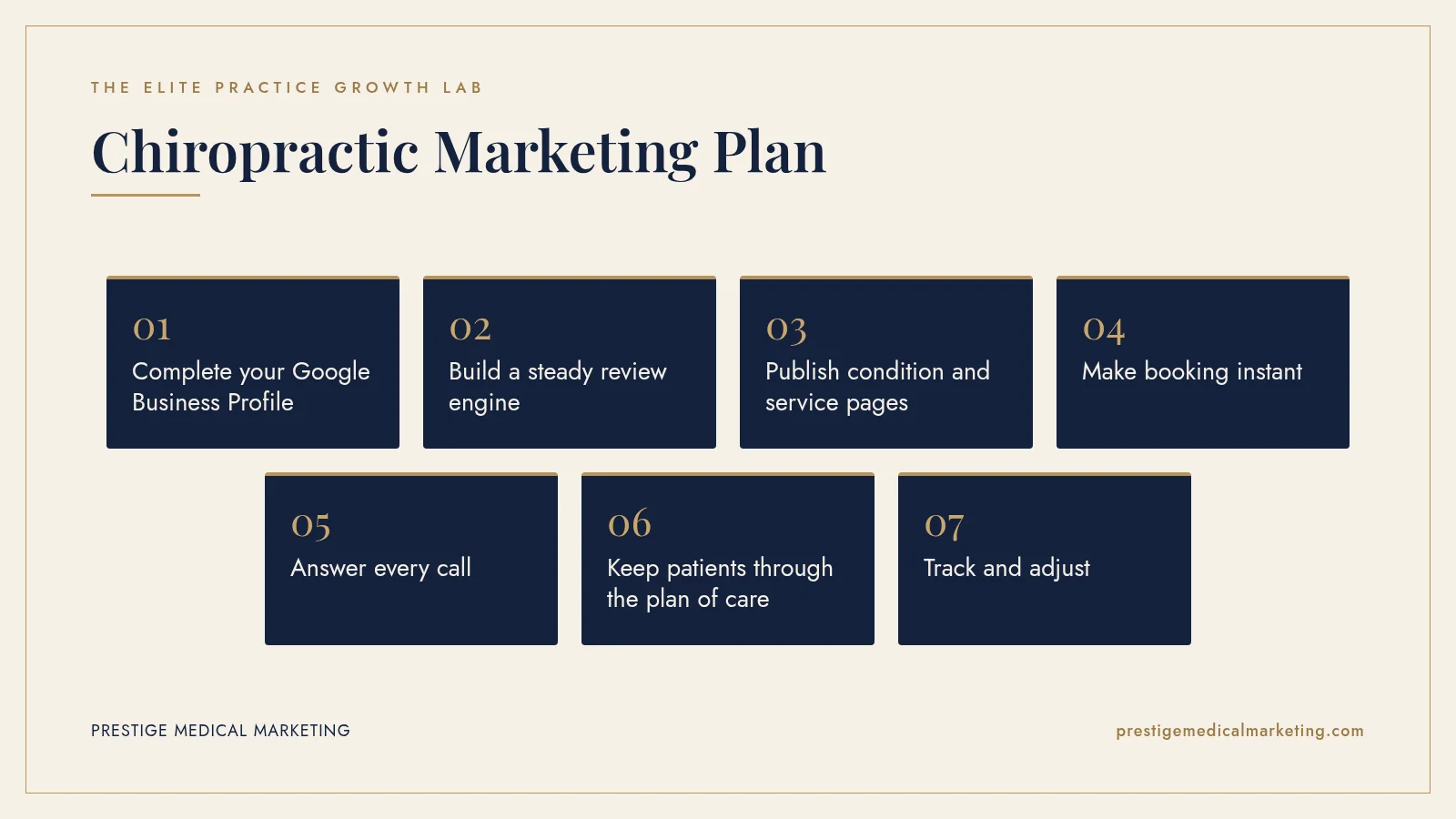
Step 1: Complete your Google Business Profile
Choose the right primary category, add every service, set accurate hours, write a plain description and upload real photos of your team and space every month. Post updates and answer common questions. Keep your name, address and phone identical across every listing.
Step 2: Build a steady review engine
Ask every patient at a natural milestone, send the link by text and reply to every review, good or bad, with care and without sharing health details. Aim for a steady flow each week rather than bursts.
Step 3: Publish condition and service pages
One page each for the problems you see most: low back pain, neck pain, headaches, sciatica, sports injuries, pregnancy care, auto injury care. Explain symptoms, how you evaluate them, what treatment involves and what a typical plan looks like.
Step 4: Make booking instant
Online booking on every page, a clear new patient offer or first-visit price, insurance information and a click-to-call button that rings a trained team member. Speed wins this market.
Step 5: Answer every call
Many new patients call. A missed call during an adjustment is often a lost patient. Use a call plan with backup coverage and text-back for missed calls. Our post on what missed calls cost medical practices shows the math.
Step 6: Keep patients through the plan of care
Explain the plan at the first visit, book ahead, send reminders and reach out after missed appointments. A completed plan is better care and better business. Give patients a simple progress check at key visits, so they see why the plan matters, and offer a maintenance option when active care ends. Patients who understand their plan finish it, and patients who finish it are the ones who refer friends and leave detailed reviews.
Step 7: Track and adjust
Measure new patients, show rate, plan completion and revenue by source every month. Move budget toward what fills the schedule with patients who stay.
Mistakes we fix first
- The wrong primary category. It is the single most important category choice on your profile.
- No photos of the real team. Patients want to see who will treat them.
- One “Services” page for everything. Each condition deserves its own page.
- Booking hidden in the menu. Put it on every screen, especially on mobile.
- Voicemail during peak hours. Patients in pain call the next practice.
- Ignoring negative reviews. A calm, professional reply shows future patients how you treat people.
Paid ads that make sense for chiropractors
Google Ads and Local Services Ads can fill gaps while your organic rankings grow. Keep them tight:
- Target only your real service area, with radius and location settings checked.
- Bid on high-intent searches such as “chiropractor near me,” “back pain chiropractor” and “sciatica treatment [city].”
- Add negative keywords for jobs, schools and free services.
- Send each campaign to a matching landing page with online booking.
- Judge campaigns on cost per booked visit and plan completion, never on clicks.
Community marketing that still works
Chiropractic is a neighborhood business. Partner with local gyms, running clubs, golf and tennis programs, yoga studios, employers and personal trainers. Offer short workshops on posture, desk ergonomics or injury prevention. Bring a simple way to book, collect contact details with consent and follow up within a day. Track every event in the same system as your digital leads, so you know which partnerships bring patients and which only bring foot traffic. Two or three strong partners who refer every month beat a calendar full of events that never convert.
Be clear about insurance, cash pay and care plans
Cost confusion stops more chiropractic bookings than any competitor. Patients want to know three things before they call: whether you take their insurance, what the first visit costs and what a typical plan of care costs over time. Answer all three on your site.
- List the insurance plans you accept, and say plainly if you are out of network.
- Publish the first-visit price, including the exam and any imaging you commonly perform.
- Explain care plans and memberships in simple tiers with what each includes.
- Offer a clear payment option for longer plans.
Practices that explain cost up front spend less time on the phone with poor-fit callers and more time with patients who are ready to start.
Reactivate past patients
Your cheapest new appointment is a past patient who drifted away. Most practices have hundreds of them in the system. Send a short, personal note from the doctor to patients who have not visited in six to twelve months, invite them back for a check-in and make booking one tap. Segment by the reason they first came in, so a past sciatica patient hears about sciatica care, not a generic promotion. Track reactivated patients as their own source in your monthly report.
Content patients actually read
- “What to expect at your first chiropractic visit”
- “How much does a chiropractor cost in [city]”
- “Chiropractor or physical therapist: which do you need?”
- “Is it normal to be sore after an adjustment?”
- Condition guides for each problem you treat
Every article should link to the matching condition page and end with a clear booking option. Clear answers like these also feed AI search; see how Google’s Ask Maps is changing local search.
Website essentials for a chiropractic practice
- A fast, mobile-first homepage with booking above the fold
- Condition and service pages for every core problem
- A first-visit page with price, insurance details and what to bring
- Doctor bios with credentials, techniques and real photos
- Reviews displayed with permission
- Hours, parking and directions that are easy to find
Questions to ask a chiropractic marketing agency
- What will you report each month? New patients, shows and plan completion by source.
- Who owns my website and Google profile? You should, always.
- How do you get reviews? Every patient, no incentives, no screening.
- Do you work with other chiropractors near me? One practice per market protects your strategy.
- What are the terms? Month-to-month.
What good looks like
In ninety days: a complete profile, a working review system, condition pages live, online booking everywhere, a call plan and tracking in place. By month six: stronger map visibility in your service area, more booked visits from search and a clear view of which channels bring patients who complete care. See our chiropractic practice page or our services overview.
Ready to fill the schedule? Check if your market is open or call (716) 400-0084. We’re based in Austin, Texas, and work with practices nationwide.
Put this playbook to work: see how it applies to chiropractic marketing and med spa marketing.
Frequently asked questions
What is the best marketing for a chiropractor?
For most practices, local search delivers the most new patients for the money. A complete Google Business Profile, steady reviews, a fast website with condition pages and online booking, and fast call handling beat almost any paid channel on cost per new patient.
How do chiropractors get more reviews?
Ask every patient at a natural moment, such as when they report feeling better, and send a direct link by text. Never offer rewards for reviews and never ask only happy patients. Steady, honest reviews build more trust than a burst of five-star ratings.
Should a chiropractor run Google Ads?
Ads can work for high-intent searches like "chiropractor near me" and "back pain chiropractor," especially for new practices. Keep campaigns tight to your service area, send clicks to a matching landing page with online booking and track cost per booked visit, not cost per click.
How do chiropractors improve patient retention?
Explain the plan of care clearly at the first visit, book the next appointments before the patient leaves, send reminders and check in after missed visits. Retention is where most practices quietly lose revenue.
Do chiropractors need a blog?
You need useful pages more than a blog. Start with condition pages, service pages and a first-visit page. Add articles that answer common patient questions, such as what to expect after an adjustment.
Is social media worth it for chiropractors?
It helps with community trust and retention more than new patient acquisition. Short videos of your team, your space and patient education work well. Do not expect social posts to replace search.
How long until chiropractic SEO shows results?
Map ranking improvements often show within two to three months of consistent work on the profile, reviews and local pages. Competitive city searches can take six months or more.