
In February 2021, Google Ads began incorporating the behavior of broad match modifier into phrase match. As of July 2021, phrase and broad match modifier keywords share the same updated phrase matching behavior, advertisers can no longer create new broad match modifier keywords, and existing ones behave exactly as phrase match. Google says the new phrase matching is more expansive than the former phrase match and slightly more restrictive than the discontinued broad match modifier.
Every click a private practice buys has a cost, and every irrelevant click is money that could have reached a future patient. For years, many practice ad accounts relied on a keyword setting that offered a balance between reach and control. In 2021, Google retired it.
The setting was called broad match modifier. Its removal did not make headlines outside the advertising world, but it changed how many practice campaigns matched searches, and it pushed advertisers toward a new way of thinking about control.
This retrospective explains what happened in 2021, why it mattered for private practices, how typical agencies reacted and what the change means for an ad account today. For later chapters, see our pieces on the 2022 sunset of expanded text ads and Google AI Max in 2025.
What actually happened in 2021
Google Ads has long offered keyword match types that determine how closely a search must match a keyword for an ad to show. Broad match modifier let advertisers add a plus sign in front of specific words, so ads appeared only on searches that contained those words, in any order, with other words around them. It sat between the wide reach of broad match and the tighter control of phrase and exact match.
According to Google’s help page on the change, Google Ads began incorporating broad match modifier behaviors into phrase match in February 2021. As of July 2021, phrase and broad match modifier keywords share the same updated phrase matching behavior for all languages and show ads on searches that include the meaning of the keyword.
Broad match modifier as a separate matching behavior is no longer available. Google says existing broad match modifier keywords behave exactly as if they were phrase keywords, and advertisers are no longer able to create new ones. Google added that the changes did not affect exact match, broad match or negative keyword match types.
Google described the updated phrase match as combining the control of phrase match with the expanded reach of the discontinued broad match modifier. It said the new behavior is more expansive than the former phrase match and slightly more restrictive than the old broad match modifier.
Why it mattered for private practices
Private practices rarely have unlimited ad budgets. A med spa, a dermatology practice or a men’s health clinic may spend carefully on a handful of services in a defined area. Broad match modifier had become a common way to reach people searching for those services in many phrasings without paying for loosely related searches.
When the behavior moved into phrase match and began matching on meaning rather than exact words, ads could appear on searches that were related but not quite right. A search about a treatment’s side effects, a different service or a do-it-yourself version could look close enough in meaning to trigger an ad. Each of those clicks cost money and rarely produced a consultation, and few owners had time to notice the pattern.
The change also signaled where Google was heading. Matching was moving away from literal words and toward intent, with automation playing a larger role. Practices that understood that direction could adapt their accounts deliberately rather than reactively.
What typical agencies did
Many agencies did nothing. Google said no specific action was required, so some accounts simply carried on, with legacy keywords quietly behaving as phrase match and no one reviewing what searches were now triggering ads.
Others overreacted. They rebuilt accounts around broad match without the conversion tracking or negative keyword discipline needed to keep it focused, which could send budgets toward irrelevant searches.
The more thoughtful response was simple and steady: look at the actual searches, tighten structure, strengthen negative keywords and measure what mattered.
What it means for a practice ad account today
Match types have kept evolving since 2021, but the core habits that protect a practice’s budget are the same.
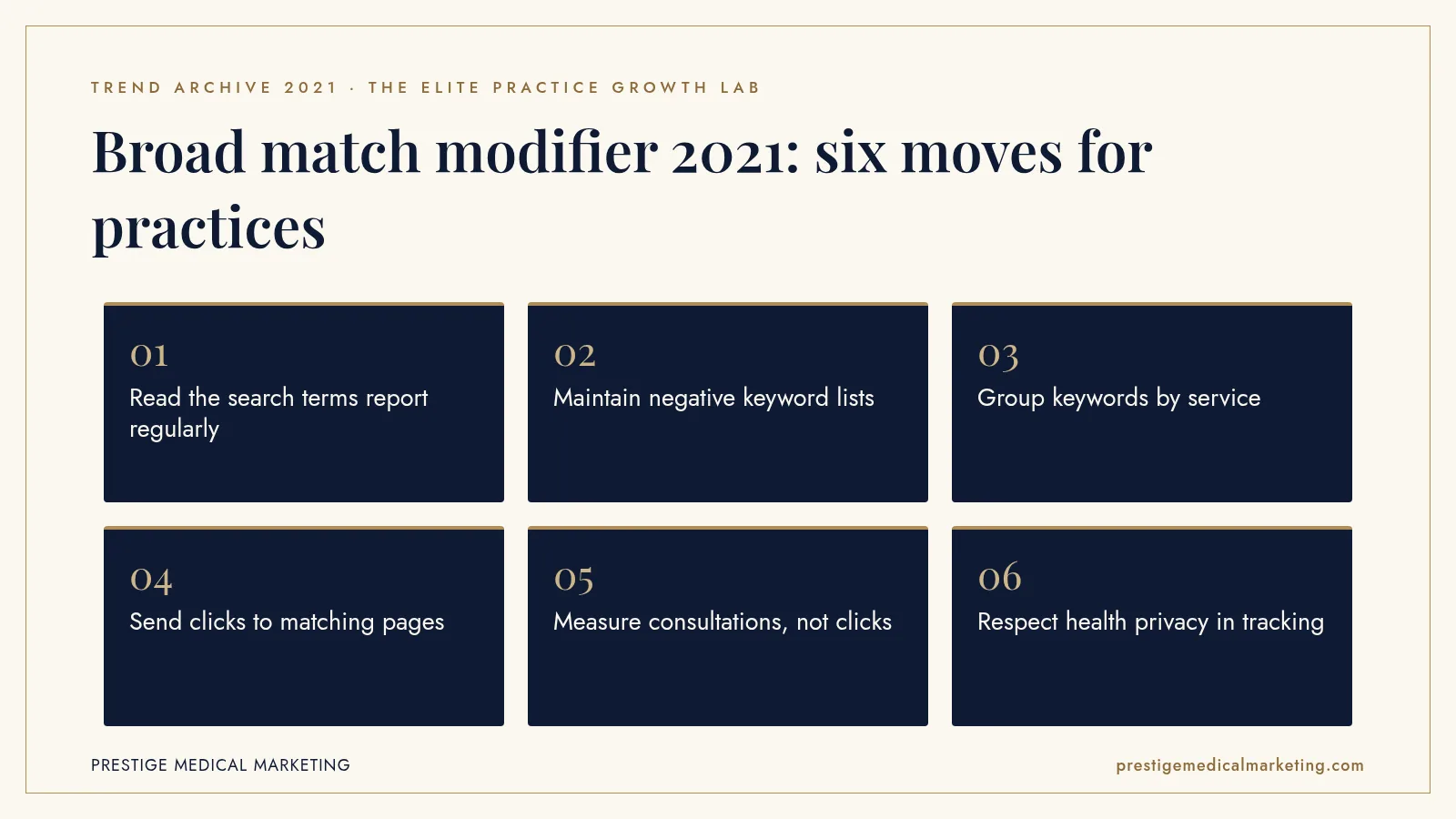
1. Read the search terms report regularly
The search terms report shows what people actually typed before clicking. It is the clearest view of whether matching is working for you.
2. Maintain negative keyword lists
Add terms that signal the wrong intent, such as jobs, training, free or do-it-yourself, so ads stay off searches that will not become patients.
3. Group keywords by service
Tight groups for each treatment or service make ads and landing pages more relevant and make reporting easier to read.
4. Send clicks to matching pages
A search about a specific treatment should land on a page about that treatment, not the home page.
5. Measure consultations, not clicks
Track calls, form submissions and booked appointments so bidding and decisions are based on real outcomes.
6. Respect health privacy in tracking
Keep conversion tracking compliant and avoid sending sensitive health information to advertising platforms.

From words to meaning
The shift in 2021 was part of a broader move from matching words to matching meaning. Google’s current guidance on keyword match types describes broad match as matching searches related to a keyword and notes that Smart Bidding works best with broad match because the wider set of searches allows it to learn. Exact match still offers the tightest control, and Google says identical exact match keywords are prioritized.
For a practice, this means the account must give automation good signals. Accurate conversion data, clear service groupings and strong negative keywords help any match type work better. Without them, automation simply spends faster in directions no one chose.
Why practices are especially sensitive to loose matching
Medical searches often look alike while meaning very different things. A person researching a condition, a student studying a treatment, a job seeker and a ready-to-book patient may all use similar words. Loose matching can blur those groups. A practice selling a premium service also cannot afford to attract people who are only looking for the cheapest option, because those clicks rarely convert and can crowd out the right patients.
That is why reviewing search terms is not a one-time project. It is a weekly habit, especially after any change to match types, bidding or campaign settings.
The landing page carries more weight
As matching loosens, the landing page has to do more of the qualifying. A clear page that names the service, explains who it is for, shows the provider’s credentials and makes the next step obvious helps the right visitor book and the wrong visitor leave quickly. Fast load times, mobile-friendly layouts and an easy booking path make every paid click more valuable. Our custom websites and booking engine are built for exactly that job.
Calls are part of the campaign
Many practice ad clicks become phone calls. If those calls go unanswered or are handled poorly, even well-matched ads waste money. Measuring answered calls and booked consultations, and training the front desk to handle ad-driven calls well, is as important as any keyword setting. See our work on call handling and lead leakage.
Budget discipline in a changing system
Changes like the one in 2021 can move spending patterns without any visible alert. A practice that reviews spend by service, by location and by outcome each month will notice shifts quickly. Setting clear limits for each campaign, and pausing or adjusting campaigns that drift away from booked consultations, keeps the account aligned with the practice’s goals rather than the platform’s defaults.
What to ask your agency
Practice owners do not need to manage keywords themselves, but they should ask a few questions. How often do you review search terms? What did you add to negative keyword lists last month? How do you measure booked consultations from ads? What happens to calls from ads? Clear, specific answers suggest an account that is being actively managed. Vague answers suggest an account running on autopilot. A good partner welcomes these questions, because the answers show the work being done on the practice’s behalf every week.
Location settings deserve the same attention
Keyword matching is only one part of who sees an ad. Location settings decide where those people are. A practice that serves a defined area should check that campaigns target the right places and that the chosen location options reflect people who are actually in or regularly in that area, rather than anyone showing interest in it. Loose location settings combined with looser keyword matching can spread a budget far beyond the patients a practice can realistically serve.
Ad copy that qualifies the click
Ad text can do some of the filtering that match types no longer do. Naming the specific service, mentioning that care is provided by licensed clinicians and inviting people to book a consultation all signal what the practice offers. Clear, accurate copy tends to attract people who want that service and discourage people who are looking for something else. It must also stay within advertising policies and avoid promises about results.
Conversion tracking is the foundation
Automated bidding and broader matching both depend on knowing which clicks led to something valuable. If an account counts page views or button clicks as conversions, automation will chase those instead of patients. A practice should define conversions carefully, such as a completed booking or a qualified call of meaningful length, and review regularly that tracking still works after website changes. Accurate data is what allows broader matching to find the right people rather than simply more people.
A simple monthly review rhythm
A steady routine keeps accounts healthy through any platform change. Each month, review search terms and add negatives, compare spend with booked consultations by service, check that landing pages load quickly and match their ads, listen to a sample of ad-driven calls and note any changes Google has announced. None of these steps is complicated, but together they keep the account aligned with the practice rather than drifting with each platform update. Steady habits win.
What 2021 does not tell us
The retirement of broad match modifier shows the direction Google took, but it does not tell a practice which match type will work best for its services, budget and market today. That depends on conversion data, competition and how well the account is structured. Platform behavior keeps changing, so any approach should be tested and measured rather than assumed.
The premium practice advantage
A premium practice treats paid search as a precise tool, not a faucet. Our work is building accounts that reach the right patients, land them on pages that convert and measure real consultations. See our services, AI agents, med spa marketing, dermatology marketing and who we help. Our team works from Austin with practices nationwide.
The bottom line
In 2021, Google folded broad match modifier into phrase match and moved matching toward meaning. For private practices, the lasting lesson is that control comes from habits: read the search terms, maintain negative keywords, keep structure tight and measure booked consultations.
Check if your market is open. We take one practice per specialty per market. Request a market check or call (716) 400-0084.
Frequently asked questions
What was broad match modifier?
Broad match modifier was a Google Ads keyword match type that let advertisers mark specific words with a plus sign so that ads showed only on searches containing those words, while allowing other words around them.
What changed in 2021?
In February 2021 Google began incorporating broad match modifier behavior into phrase match. As of July 2021, advertisers could no longer create new broad match modifier keywords, and existing ones behave as phrase match.
Did the change affect exact match or broad match?
Google says the changes to phrase match and broad match modifier did not impact exact match, broad match or negative keyword match types.
Is the updated phrase match broader than before?
Yes. Google describes it as more expansive than the former phrase match and slightly more restrictive than the discontinued broad match modifier, showing ads on searches that include the meaning of the keyword.
Why does this matter for medical practices?
Practices often have tight budgets and specific services. When match types loosen, more spend can flow to searches that are not a good fit, so reviewing search terms and negative keywords becomes more important.
What should a practice do today?
Review the search terms that trigger ads, maintain negative keyword lists, group keywords by service, send clicks to matching landing pages and measure booked consultations rather than clicks alone.