
From June 30, 2022, Google Ads advertisers could no longer create or edit expanded text ads, although existing ones could keep serving and be paused, resumed or removed. Responsive search ads became the standard search format, letting advertisers supply up to 15 headlines and 4 descriptions that Google combines automatically. For private practices, it meant writing ad copy as a set of compliant, interchangeable assets and testing them carefully rather than controlling every word of a single ad.
For years, a practice running Google search ads could write an ad the way it wrote a sign: a few headlines, a description, a display path, each chosen deliberately. The format was called the expanded text ad. A marketer could test two or three versions, see which won and know exactly what every searcher had read.
On June 30, 2022, that era effectively ended. Google Ads stopped allowing advertisers to create or edit expanded text ads. The standard format became the responsive search ad, where the advertiser supplies a set of headlines and descriptions and Google assembles them into combinations it predicts will perform best for each search.
This retrospective covers what Google actually changed in 2022 and what it means for a private practice’s paid search today. For related chapters, see the Google Ads Transparency Center in 2023 and AI Max for Search in 2025.
What actually happened in 2022
June 30: no new or edited expanded text ads. Google’s help documentation on expanded text ads explains that, starting June 30, 2022, advertisers could no longer create or edit expanded text ads in standard search campaigns.
Existing ads kept serving. Google said existing expanded text ads would continue to serve alongside responsive search ads, and advertisers could still pause and resume them, remove them and see performance reports.
Responsive search ads as standard. Google’s documentation on responsive search ads describes the format: advertisers enter multiple headlines and descriptions, and Google Ads automatically tests different combinations and learns which perform best.
Up to 15 headlines and 4 descriptions. A responsive search ad can include up to 15 headlines and 4 descriptions. Google shows a subset in each ad, in different orders, depending on the search and other signals.
Pinning and ad strength. Advertisers can pin headlines or descriptions to specific positions when certain text must always appear. Google provides an ad strength indicator that rates how varied and relevant the assets are, and notes that pinning limits the combinations it can test.
Announced in advance. Google had announced the change in 2021, giving advertisers time to build responsive search ads before the cutoff.
Why it mattered for private practices
Healthcare advertising carries more constraints than most categories. Google’s healthcare and medicines policies restrict certain claims, products and services, and some require certification. Truth-in-advertising law applies to every claim a practice makes. Specialty boards and state rules can add further limits on how outcomes, credentials and pricing are presented.
With an expanded text ad, a practice could review one fixed message for compliance. With a responsive search ad, it supplies up to 19 pieces of text that can be combined in many ways. Every headline must be accurate on its own and in any combination with the others. A headline about a specific price and a description about a different service, shown together, could create a misleading impression neither created alone.
The change also shifted control. Practices that valued a precise brand voice found that Google’s combinations sometimes produced awkward or repetitive results. Pinning restored some control at the cost of testing flexibility.
What typical agencies did
Many agencies treated the deadline as a box to tick. They converted existing ads into responsive search ads by pasting old headlines into the new format and adding generic filler to reach a higher ad strength rating. The result was often fifteen headlines that said nearly the same thing, which gave Google little to test.
Some chased ad strength as if it were a performance metric. Google describes it as a guide to asset variety and relevance, not a measure of results. An ad rated excellent can still drive poor-quality inquiries.
A smaller group used the change well: writing distinct, compliant headlines for different patient motivations, pinning only what had to be fixed, and judging ads by booked consultations.
What it means for a practice today
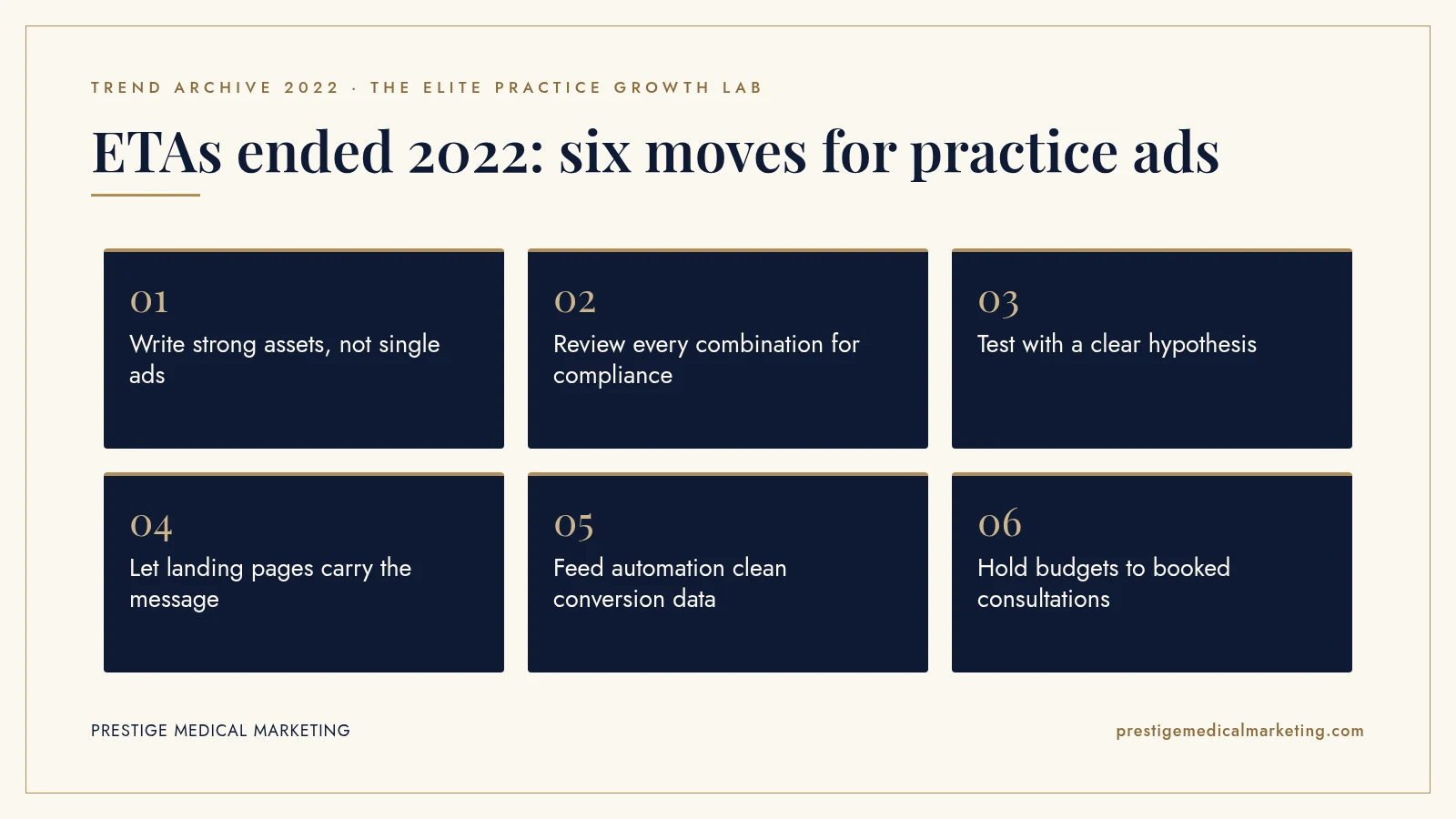
Responsive search ads remain the core search format, now alongside more automation. These steps keep them effective and compliant.
1. Write distinct headlines
Cover different angles: the service, the practice’s credentials, location, booking convenience and what makes the experience distinctive. Avoid near-duplicates.
2. Check every combination for compliance
Make sure each headline and description is accurate on its own and cannot combine into a misleading claim.
3. Pin only what must be fixed
Pin required disclosures or the practice name where necessary, and leave the rest flexible for testing.
4. Match ads to landing pages
Send each ad group to a page that delivers exactly what the ad promised, with clear booking and contact options.
5. Measure booked consultations
Track calls, form submissions and actual appointments, and judge ads by cost per new patient.
6. Review search terms regularly
Exclude irrelevant searches so the budget reaches people looking for what you offer.

Writing assets, not ads
The shift from expanded text ads to responsive search ads changed the craft of ad writing. Instead of composing one persuasive message, a practice writes a set of building blocks. Each headline has to work as a standalone statement and as part of a pair or trio. Descriptions have to complement any headline that might appear above them.
A useful structure groups headlines by purpose. A few describe the service plainly. A few establish credibility, such as board certification or years in practice, stated accurately. A few address convenience, such as online booking or evening hours. A few speak to the experience, such as private consultations or a dedicated care coordinator. Descriptions then expand on these themes and include a clear next step.
This structure gives Google meaningful variety to test and gives the practice confidence that any combination will read sensibly.
Compliance in a combinatorial world
Healthcare marketers should review responsive search ads differently from fixed ads. A good process lists every headline and description, marks any that contain claims needing substantiation, and checks that no combination could imply something untrue. Price statements need care: a starting price must be genuine, and any conditions must be clear on the landing page.
Outcome claims deserve the most caution. Phrases implying guaranteed results, superlatives that cannot be substantiated and before-and-after promises are risky in any format and riskier when combined automatically with other text. Platform policies may also disapprove ads or restrict them for certain health-related content.
Documentation helps. Keeping a short record of who approved each asset, and what substantiation supports any claim, makes reviews faster and gives the practice a clear answer if an ad is ever questioned. It also prevents a well-meaning team member from adding a headline months later that quietly undoes the original review.
Testing without losing the thread
Under expanded text ads, testing was simple to explain: version A against version B. Responsive search ads made testing less transparent, because Google mixes assets continuously. Google Ads does report how often combinations and individual assets are shown, which helps, but it is not the same as a clean head-to-head result.
A practical approach is to change one theme at a time. If a practice wants to know whether convenience messaging outperforms credential messaging, it can adjust that group of headlines, leave the rest stable and compare results over a meaningful period. Changing everything at once makes it impossible to learn which idea actually made the difference. Patience matters too: low-volume campaigns, which many practices run, need weeks rather than days to show a reliable pattern worth acting on.
The landing page carries the message
Because a practice cannot know exactly which headline a searcher saw, the landing page has to do more work. It should confirm the service clearly, restate the practice’s key credentials and differentiators, answer the obvious questions and offer an easy next step on any device. If an ad might mention online booking, the page must offer it. If an ad might mention a consultation, the page should explain what that consultation involves.
A strong landing page also protects against the risk of mismatched combinations. Whatever the ad said, the page presents the full, accurate picture, including any conditions on pricing or eligibility. That consistency builds trust with patients and keeps the advertising honest even when the exact ad text varies from one search to the next.
Automation needs good inputs
Responsive search ads were part of a broader move toward automation in Google Ads, including automated bidding, broader matching and AI-assisted campaigns in later years. Automation works best with good inputs: accurate conversion tracking, clear assets and well-structured landing pages. It works poorly when it optimizes toward the wrong signal, such as form submissions that include spam or calls that never become appointments.
For practices, the most important input is conversion data that reflects real patients. Tracking booked consultations, and feeding that information back where possible, helps automated systems pursue the inquiries that matter. Privacy rules must shape how that tracking works, especially for health information.
Budget discipline after the change
Responsive search ads made it easier for campaigns to reach more searches, because Google could match different combinations to a wider range of queries. That flexibility can be useful, but it also makes budget discipline more important. A practice should set clear limits on geography, schedule and services, and review where spending actually goes each month.
Smaller practices in particular benefit from focus. Concentrating budget on the services with the highest value and the clearest demand, in the area the practice genuinely serves, usually outperforms spreading a modest budget across every service and every nearby town. Responsive search ads work best inside a tightly defined campaign, not as a substitute for one.
Timing matters as well. Ad schedules can reflect when the practice can actually answer the phone. An ad that drives calls at nine in the evening to a line that goes to voicemail wastes budget and frustrates the very people the practice wants to reach.
What 2022 does not tell us
Google did not publish data comparing practice performance under expanded text ads and responsive search ads, and we have no public data on how medical advertisers were affected. Results depend heavily on account structure, assets and tracking. What 2022 does show is the direction Google has taken since: more automation, with advertiser inputs carrying more weight.
The premium practice advantage
A premium practice has clear differentiators worth advertising accurately: credentials, experience and a distinctive patient experience. The work is turning them into compliant, flexible assets and a booking path that converts. See our services, our booking engine, who we help and how we approach Google Maps and AI search visibility. Our team works from Austin with practices nationwide.
The bottom line
From June 30, 2022, Google Ads stopped allowing new or edited expanded text ads, making responsive search ads the standard. For private practices, it meant writing compliant, distinct assets, pinning sparingly and judging ads by booked consultations.
Check if your market is open. We take one practice per specialty per market. Request a market check or call (716) 400-0084.
Frequently asked questions
What changed on June 30, 2022?
Google Ads stopped allowing advertisers to create new expanded text ads or edit existing ones in standard search campaigns.
Did existing expanded text ads stop running?
No. Google said existing expanded text ads could continue to serve, and advertisers could still pause, resume or remove them and see their performance reports.
What replaced expanded text ads?
Responsive search ads, which let advertisers enter up to 15 headlines and 4 descriptions that Google Ads combines into different ad versions.
Can a practice control which headline appears first?
Yes, by pinning a headline or description to a position. Google notes that pinning reduces the number of combinations it can test.
Why does this matter for medical practices?
Healthcare ads are subject to Google's health policies and truth-in-advertising rules. With combined assets, every headline and description must be accurate and compliant on its own and in any combination.
How should a practice judge responsive search ads?
By outcomes such as calls, booked consultations and cost per new patient, not by ad strength ratings alone.