
On February 8, 2023, Google published guidance saying it rewards high-quality content however it is produced, and that using automation, including AI, mainly to manipulate search rankings violates its spam policies. It pointed creators to E-E-A-T and its Who, How and Why questions, and noted that health topics get extra weight on reliability. For functional medicine practices, the lesson was that AI can assist, but clinician expertise and accuracy have to drive the content.
By early 2023, AI writing tools had gone from niche to everywhere. Practices that had paid writers for years suddenly heard that a chatbot could produce a dozen articles in an afternoon. Some agencies began doing exactly that, filling sites with long, fluent articles on gut health, hormones, inflammation and nutrition that no clinician had read.
Functional medicine practices were an obvious target for that pitch. The specialty covers a wide range of health topics, patients research heavily before booking and content has long been central to how these practices attract new patients. If AI could produce content for almost nothing, why not produce a lot of it?
In February 2023, Google answered. This retrospective covers what Google said about AI-generated content, why it mattered for functional medicine and how a practice should use AI today. It is marketing guidance, not legal or medical advice. For related context, see our coverage of Washington’s My Health My Data Act in 2024.
What actually happened in 2023
February 8: Google’s statement. Google Search Central published guidance on AI-generated content, written by Danny Sullivan and Chris Nelson. Its core message was that Google rewards high-quality content however it is produced. Google said it had long focused on the quality of content rather than how it was made.
Automation for manipulation is spam. The guidance was equally clear on the other side. Using automation, including AI, to generate content with the primary purpose of manipulating ranking in search results violates Google’s spam policies. Google noted that its systems had long dealt with mass-produced, low-value content and would continue to. It also pointed out that automation had been used for years to generate helpful content such as sports scores and weather forecasts.
E-E-A-T as the standard. Google pointed creators to its concept of E-E-A-T: experience, expertise, authoritativeness and trustworthiness. It said content that demonstrates these qualities is what its ranking systems seek to reward, whatever the production method.
Extra weight on health. Google said its systems give even more weight to content that aligns with strong E-E-A-T on topics that could significantly affect people’s health, financial stability or safety. Health content, in other words, faces a higher bar.
Who, How and Why. The guidance encouraged creators to evaluate content by asking who created it, how it was created and why. Google suggested that where readers might reasonably ask how something was produced, it can help to disclose the use of automation. It also said accurate author bylines are useful where readers would expect them.
No AI bylines. Google added a pointed note: giving AI an author byline is probably not the best way to follow its recommendation to make clear who created the content.
Why it mattered for functional medicine practices
Functional medicine content frequently sits at the edge of evidence. Some topics are well supported, some are emerging and some are contested. Patients researching the specialty are often comparing claims from many sources, including sources with little clinical grounding. In that environment, accuracy and attribution are not nice-to-haves. They are what separate a trusted practice from the noise.
Google’s statement made clear that AI-generated health content would be judged by the same demanding standard as any health content. A fluent article on thyroid health or the microbiome written by an AI tool with no clinical review would not earn trust just because it was long or well formatted. If it contained inaccuracies or overstated claims, it could hurt both patients and the practice’s credibility.
It also meant the opportunity was real. Practices could use AI to work faster, as long as qualified clinicians stayed responsible for the substance. A practice that could publish one reviewed article a month might realistically publish several, without lowering its standards.
What typical agencies did
Many agencies took the February guidance as permission. “Google says AI content is fine” became the headline, and some agencies used it to justify publishing large volumes of unreviewed AI articles on health topics. Fewer read the rest of the guidance, which made the quality bar, the spam policy and the extra scrutiny for health topics clear.
The results were predictable. Sites full of interchangeable articles struggled through the helpful content and core updates later in 2023, while sites with genuine expert content held up better. Our September 2023 helpful content retrospective covers that update in detail.
What it means for a functional medicine practice today
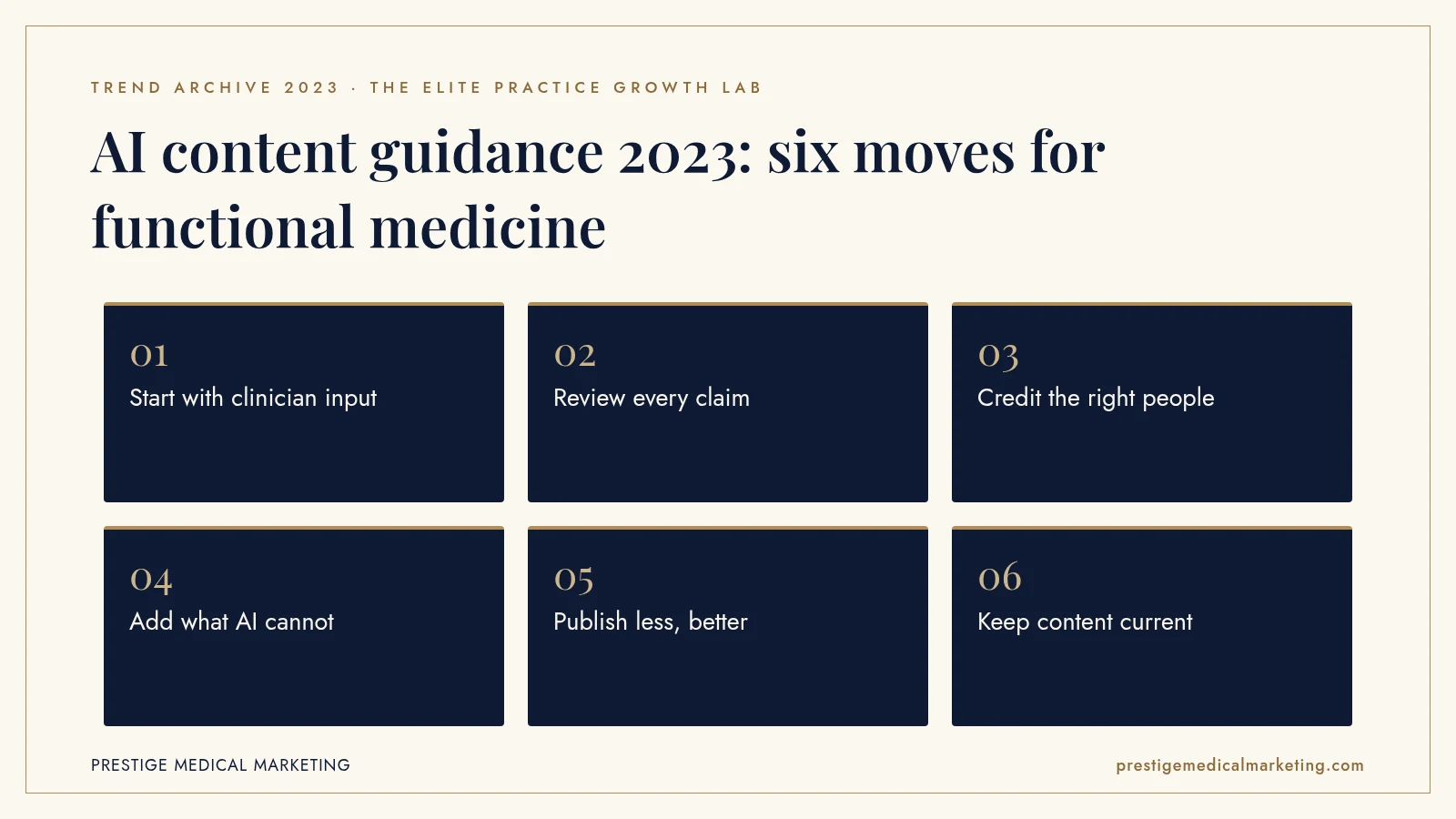
AI is now a standard writing tool. These steps help a functional medicine practice use it without losing trust.
1. Start with clinician input
Have a clinician outline the key points, nuances and cautions before any drafting begins. The substance should come from someone who treats patients, not from a prompt. AI is far more useful when it is shaping expert thinking than when it is inventing it.
2. Review every claim
Check each health claim against reliable sources and remove anything overstated or unsupported. Note clearly where evidence is limited or still developing. A single exaggerated sentence can undermine an otherwise excellent page.
3. Credit the right people
Byline the clinician who wrote or reviewed the page, with accurate credentials. Never byline an AI tool. Provider pages should explain each person’s training and focus so the byline means something.
4. Add what AI cannot
Include how your practice actually approaches the topic: your testing philosophy, how you build plans and when you refer out. That experience is the differentiator, and it cannot be generated.
5. Publish less, better
A smaller library of reviewed, genuinely useful pages beats a large library of generic articles. Quality compounds over time; volume decays, and thin pages can weigh on the strong ones. Consolidate overlapping pages so each topic has one strong home.
6. Keep content current
Revisit key health pages on a schedule and update them when guidance changes, noting the review date honestly. Outdated health information is a trust problem, not just an SEO problem.

Where AI helps and where it hurts
Used well, AI tools can make a functional medicine practice’s content operation more efficient. They can turn a clinician’s rough notes into a readable draft, suggest a clearer structure, tighten long paragraphs, generate FAQ ideas from real patient questions and help adapt a long article into shorter formats. These are editing and production tasks, and AI is often good at them.
Used poorly, AI creates risk. Language models can produce confident statements that are wrong, cite studies that do not exist or blur the line between established findings and speculation. In health content, those failures matter. A patient who reads an inaccurate claim on a practice website may make a poor decision, and the practice owns that claim regardless of who drafted it.
The dividing line is responsibility. AI can draft. A qualified human has to decide what is true, what is appropriate and what the practice is willing to stand behind.
Evidence-aware content wins trust
Functional medicine patients are often well read and skeptical. Many have already tried conventional approaches and are looking for a practice that will listen and explain. Content that acknowledges uncertainty tends to earn more trust with this audience, not less.
That means distinguishing clearly between what research supports, what is plausible but unproven and what the practice offers based on clinical experience. It means avoiding words like “cure,” “reverse” and “guaranteed.” It means explaining the reasoning behind a test or protocol rather than just asserting its value.
This approach also aligns with regulatory expectations. In April 2023, the FTC reminded hundreds of companies that health claims require competent and reliable scientific evidence. Our 2023 substantiation retrospective covers what that standard means in practice, and our functional medicine marketing guide covers how to market within it.
A practical review workflow
A workable process for a busy functional medicine practice looks something like this. A clinician records a short voice memo or bullet list covering the topic: what patients ask, how the practice approaches it and what to be careful about. A writer, with or without AI assistance, turns that into a draft. The clinician reviews the draft for accuracy and tone, flags anything overstated and approves it. Someone checks every external source and link before publishing.
That workflow keeps clinical expertise at the center while using AI where it saves time. It also creates a clear record of who reviewed what, which helps with accurate bylines and with future updates when guidance or evidence changes.
The same workflow applies to email, social posts and patient education materials. Anything that makes a health claim on behalf of the practice deserves clinician review. Social captions and promotional emails are where overstated language most often slips through, because they are written quickly and reviewed casually. A short checklist of words to avoid and claims that need a source keeps the whole team aligned, including any outside vendors who write for the practice.
What patients notice
Patients rarely think in terms of E-E-A-T, but they recognize its absence. A page that sounds like every other page on the topic, never mentions how the practice actually works and ends with a generic call to action reads as filler. A page that explains a clinician’s reasoning, uses the practice’s own voice and answers the question a patient actually asked reads as care.
That difference shows up in behavior. Patients who find substantive content tend to spend more time with it, return to it before booking and arrive at consultations better informed. Patients who find filler leave and keep looking, often landing on a competitor whose content feels more personal.
AI-assisted content can land on either side of that line. What decides it is whether the final page carries the practice’s real perspective, examples and judgment. That is why the clinician’s role in the process matters so much more than the tool.
What 2023 does not tell us
Google’s 2023 guidance explained its principles, not its methods. It did not say how its systems detect low-quality automated content or how heavily any signal is weighted. There is no reliable public data on how functional medicine sites using AI fared compared with others. What 2023 does show is Google’s stated position, which has been consistent since: quality and trust matter, production method does not.
The premium practice advantage
Premium functional medicine practices have the expertise and patient relationships that AI cannot replicate. Content that reflects that depth stands out. See our functional medicine services, our full services, who we help and our approach to Google Maps and AI search visibility. Our team works from Austin with practices nationwide.
The bottom line
Google’s 2023 guidance did not ban AI content. It made quality and trust the test, with a higher bar for health. For functional medicine practices, AI can help produce content faster, but clinicians have to own every claim.
Check if your market is open. We take one practice per specialty per market. Request a market check or call (716) 400-0084.
Frequently asked questions
Does Google penalize AI-generated content?
Google's February 2023 guidance said it focuses on the quality of content rather than how it is produced. Using automation mainly to manipulate rankings violates its spam policies, regardless of whether a person or AI produced it.
What is E-E-A-T?
E-E-A-T stands for experience, expertise, authoritativeness and trustworthiness. Google uses these concepts to describe what its systems aim to reward, and it says trust is the most important.
What are Google's Who, How and Why questions?
Google suggests creators consider who created the content, how it was created and why it was created. The why should be to help people, not mainly to attract search visits.
Should AI-written pages have an AI byline?
Google said giving AI an author byline is probably not the best way to follow its recommendation. Bylines should go to the people responsible, and disclosure of AI involvement can be useful where readers would reasonably expect it.
Why does this matter more for functional medicine?
Google said its systems give even more weight to reliability on topics that could affect health, finances or safety. Functional medicine content often covers health topics with varying levels of evidence, which raises the bar for accuracy.
Can a functional medicine practice use AI to draft content?
Yes, as a tool. The safest approach is for a qualified clinician to provide the substance, review every claim, check sources and approve the final page before it is published.