
Google announced passage ranking in October 2020, saying that understanding individual passages, not just whole pages, would improve 7 percent of search queries across all languages as it rolled out globally. The system went live for US English searches in February 2021. For functional medicine practices, it meant a well-organized section within a long page could rank for a specific question, rewarding clear structure and precise answers over keyword-stuffed pages.
Functional medicine practices tend to write long pages. A page about gut health might cover symptoms, testing approaches, nutrition, the role of stress and sleep, what a first consultation involves and how progress is followed over time. Each section might answer a question someone is searching for, but for years, a single specific question could struggle to surface a page that covered a broader topic.
In 2021, Google changed that with passage ranking. The idea was simple: if a page contained a passage that answered a precise question better than anything else, Google could recognize that passage and rank the page for that question. For practices that wrote detailed, thoughtful content, it was a chance for depth to be rewarded.
This retrospective covers what Google actually announced and launched, why it mattered for functional medicine practices and what it means for content today. For the later chapters, see our look at Experience joining E-E-A-T in 2022, Google’s 2023 guidance on AI-generated content and the 2023 GoodRx case.
What actually happened in 2021
October 15, 2020: the announcement. At its Search On event, Google described several AI advancements in a post on how AI is powering a more helpful Google. One was a breakthrough in ranking that let Google understand individual passages, not just whole pages. Google said that by understanding passages in addition to the relevance of the overall page, it could find needle-in-a-haystack information, and that the technology would improve 7 percent of search queries across all languages as it rolled out globally.
February 2021: live in US English. Google confirmed in February 2021 that passage ranking was live for US English queries, as reported in industry coverage at the time. Google said it would expand to other countries and languages later.
Clarifications. Google representatives explained that passage ranking was not a separate index of passages. Pages were still indexed as whole pages; the system helped Google consider the relevance of specific passages when ranking. Google’s current guide to its ranking systems describes passage ranking as an AI system used to identify individual sections of a web page to better understand how relevant a page is to a search.
No special markup. Google did not ask site owners to add code or tags. The system worked on the content itself, which meant clarity of writing and structure was what mattered.
Why it mattered for functional medicine practices
Functional medicine patients often search with specific, nuanced questions. They want to know whether a particular test is useful, how a nutrition approach relates to a symptom pattern or what to expect over the first few months of care. These are long-tail questions that a broad page might answer in one section.
Before passage ranking, a long page about digestive health might rank for broad terms but miss the specific question answered in a subsection. After passage ranking, that subsection had a better chance of being recognized, provided it was clearly written and focused. That rewarded practices that took the time to explain things well.
It also raised the stakes for accuracy. If Google could pull a specific passage into view for a specific question, that passage had to stand on its own and be correct. A vague or overstated paragraph had nowhere to hide.
What typical agencies did
Some agencies interpreted passage ranking as a reason to make every page much longer, padding content with loosely related sections in the hope that one would rank. That approach tended to make pages harder to read and did nothing to improve the quality of any individual answer.
Others ignored it, treating it as a technical change that did not require action. That was closer to correct, since Google asked for no special markup, but it missed the opportunity to improve how existing long pages were organized.
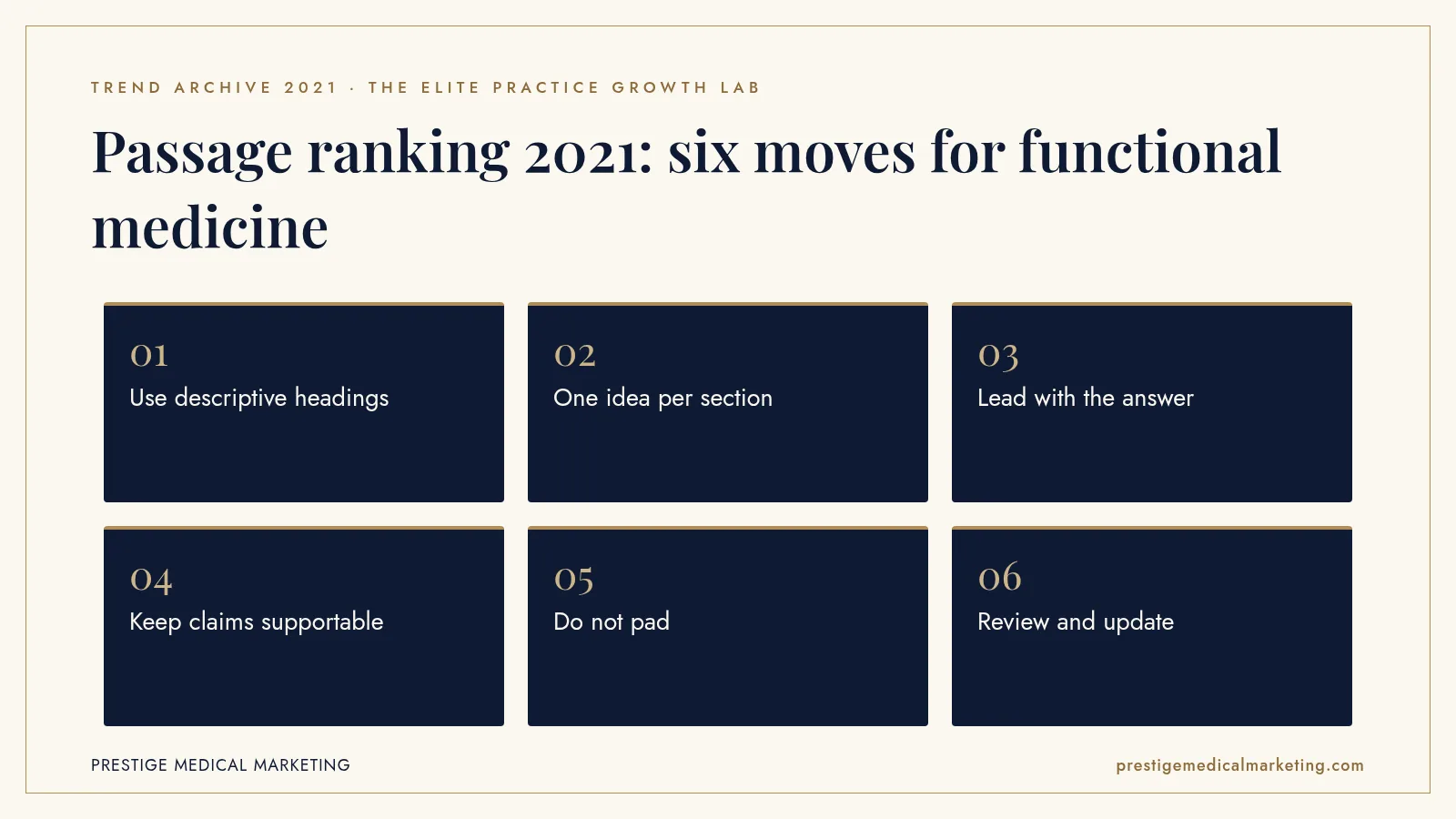
The better approach was to review key pages for structure: descriptive headings, sections that each answer one question, plain language and accurate, supportable claims.
What it means for a functional medicine practice today
Passage-level understanding is now part of how search and AI systems read pages. These habits matter.
1. Use descriptive headings
Headings that state the question or topic, such as what a comprehensive stool analysis can and cannot show, help readers and systems find the right section.
2. One idea per section
Each section should answer one question well. Mixing several topics in one block makes every answer weaker.
3. Lead with the answer
Start each section with a clear, direct answer, then add nuance and detail. Readers scanning for an answer find it quickly.
4. Keep claims supportable
Functional medicine content should distinguish established evidence from emerging research and avoid promising cures.
5. Do not pad
Write as long as the topic needs and no longer. A focused page often serves patients better than an exhaustive one.
6. Review and update
Assign clinical review to key pages, note the reviewer and update sections when guidance or the practice’s approach changes.

Rethinking the long condition page
Many functional medicine websites have a small number of pillar pages on major areas such as gut health, hormones, thyroid, metabolic health or fatigue. Passage ranking suggested a practical way to improve them without rewriting everything: audit each page section by section.
For each section, ask whether a patient could find it from the heading alone, whether the first sentence answers the implied question, whether the claims are accurate and appropriately cautious and whether the section links to a related page where a topic deserves more depth. Sections that fail those tests can be rewritten, split or removed.
This audit often reveals duplication. The same explanation of a test or approach may appear on several pages with slightly different wording. Consolidating it into one strong section, then linking to it, improves clarity for readers and avoids pages competing with each other in search.
Writing for patients who read carefully
Functional medicine patients are often unusually engaged. Many have tried several approaches before, and many read deeply before choosing a practitioner. They notice when content is vague, overpromising or clearly written for search engines rather than for them.
That audience is well served by the same qualities passage ranking rewards: precise answers, honest framing and clear structure. A section that explains what a functional medicine consultation involves, how long it takes, what information to bring and how follow-up works answers real questions that patients ask before booking.
Transparency about cost and process is part of that. Many functional medicine practices operate outside insurance or on a membership model. Clear explanations of how fees work, what is included and what is not help the right patients self-select and reduce misunderstandings later.
Compliance and careful language
Functional medicine marketing operates under the same rules as other health advertising. Claims about treating or curing conditions need appropriate support, testimonials must reflect typical experiences or be clearly qualified, and supplements or tests promoted on the site should be described accurately.
Because passage ranking can surface a single section on its own, every section should be able to stand alone without misleading a reader. A caveat placed three sections away does not help someone who only reads the passage that matched their question.
Structuring long pages so passages stand alone
If search systems can understand a single passage within a long page, each section should make sense on its own. That means clear subheadings that describe what follows, opening sentences that answer the question directly and paragraphs that stay on one idea. A patient who lands in the middle of a page should be able to understand where they are and what the section covers without reading everything above it. The same structure helps human readers scan, which is how most people read on a phone.
Answering the questions patients actually ask
Functional medicine patients often arrive with detailed, personal questions about symptoms, testing, timelines, cost and how care differs from what they have already tried. Front desk teams and clinicians hear those questions every day. Collecting them and answering the most common ones clearly, without making clinical promises, creates content that serves real people and gives search systems precise passages to surface. It also shortens consultations, because patients arrive better informed.
Keeping long content current
Long pages tend to age quietly. Prices change, services evolve, providers join or leave and guidance is updated. A page that was accurate when published can become misleading within a year. Assigning an owner to each major page, adding a review date to the editorial calendar and updating content when anything changes protects both patients and the practice’s credibility.
Internal links that guide the reader
A long condition page can connect naturally to related services, provider profiles and booking. Well-placed internal links help patients move from learning to acting and help search engines understand how the site fits together. Links should be descriptive and genuinely useful, not inserted for their own sake. Our work on functional medicine marketing builds those paths into every page, so each article leads somewhere genuinely useful for the reader next.
Measuring what long content does
The success of a long page is not measured only by rankings. Practices should look at whether readers move on to service pages, whether they book consultations and whether the questions coming into the front desk change. Those signals show whether a page is helping patients make decisions, which is the real goal. Reviewing these measures each quarter, alongside notes from the front desk about what patients mention when they call, gives a practice a grounded view of which pages earn their place and which need work. Small, steady improvements usually outperform occasional overhauls.
What 2021 does not tell us
Google did not publish how often passage ranking affected results in specific categories, and the 7 percent figure referred to queries across all languages once fully rolled out. We do not have public data showing how functional medicine websites were affected. What 2021 does show is that Google was reading pages more closely, section by section, and that clear structure and precise answers had become more valuable.
The premium practice advantage
A premium functional medicine practice has what passage-level search rewards: clinicians who explain things well and a careful, individualized approach. The work is organizing that expertise clearly. See our functional medicine services, our functional medicine marketing guide, our full services, who we help and how we approach Google Maps and AI search visibility. Our team works from Austin with practices nationwide.
The bottom line
Google’s passage ranking, announced in October 2020 and live for US English searches in February 2021, let specific sections of long pages rank for specific questions. For functional medicine practices, the lasting lesson was to structure detailed content clearly, answer each question precisely and keep every passage accurate on its own.
Check if your market is open. We take one practice per specialty per market. Request a market check or call (716) 400-0084.
Frequently asked questions
What is passage ranking?
Google describes passage ranking as an AI system it uses to identify individual sections, or passages, of a web page to better understand how relevant a page is to a search.
When did it launch?
Google announced it at its Search On event on October 15, 2020, and it went live for US English searches in February 2021.
How many queries did Google say it would affect?
Google said the technology would improve 7 percent of search queries across all languages as it rolled out globally.
Is passage ranking the same as indexing passages separately?
No. Google still indexes whole pages. Passage ranking helps it understand the relevance of specific sections within a page when ranking that page.
Why did it matter for functional medicine practices?
Functional medicine pages are often long and detailed. Passage ranking gave a specific, well-written section a better chance of matching a narrow question, even if the page as a whole covered a broader topic.
Should practices write longer pages because of it?
No. Length alone does not help. Clear headings, focused sections and accurate answers make it easier for both readers and search systems to find the relevant part.