
On December 15, 2022, Google announced an update to its search quality rater guidelines that added Experience to Expertise, Authoritativeness and Trustworthiness, creating E-E-A-T. Google said trust is the most important of the four. Raters do not directly change rankings, but their ratings help Google evaluate its systems. For functional medicine practices, it signaled that health content should show real clinical experience, accurate expertise and clear trust signals.
Functional medicine practices publish a lot of health content. Articles on gut health, hormones, inflammation, thyroid function, fatigue and nutrition fill practice websites, newsletters and social feeds. Some of it is excellent, written or reviewed by clinicians who see these concerns every day. Some of it is indistinguishable from what any wellness brand might post, with confident claims and little sign of who wrote it or why they should be believed.
In December 2022, Google made the distinction more explicit. Its updated search quality rater guidelines added a new letter to a familiar acronym, turning E-A-T into E-E-A-T, and placed trust at the center of the whole idea. It was a short announcement with long consequences for anyone publishing health information.
This retrospective covers what Google actually changed in 2022 and what it means for a functional medicine practice today. For how the same thinking shaped the next year, read our look at Google’s 2023 guidance on AI-generated content, and for a related privacy chapter, see Washington’s My Health My Data Act.
What actually happened in 2022
December 15: the update. Google Search Central published “Our latest update to the quality rater guidelines: E-A-T gets an extra E for Experience”. The post explained that the search quality rater guidelines had been updated.
Experience joined the family. Google said raters could now consider the extent to which the content creator has the necessary first-hand or life experience for the topic. Its examples were practical: content that shows someone actually used a product, visited a place or went through something can be valuable in ways that expertise alone does not capture.
Trust at the center. Google described trust as the most important member of the E-E-A-T family. Experience, expertise and authoritativeness support trust, but a page can show some of them and still be untrustworthy.
Raters do not rank pages. Google repeated that the quality raters it works with do not directly influence rankings. Their ratings help Google measure whether its systems are producing helpful results, much as a test panel helps evaluate a product.
Context: a year of helpfulness. The change followed the helpful content update of August 2022, whose self-assessment questions had already asked whether content demonstrated first-hand expertise. December’s update gave that idea a name inside the rater framework.
Why it mattered for functional medicine
Health is the clearest example of what Google calls Your Money or Your Life content, where inaccurate or misleading information can affect someone’s wellbeing. Raters are asked to apply higher standards to these topics. Functional medicine sits squarely inside that category, and often in its more debated corners: testing approaches, supplementation, dietary protocols and chronic conditions where evidence is still developing.
That makes trust signals unusually important. A reader evaluating a functional medicine article wants to know whether a qualified clinician wrote or reviewed it, whether claims are proportionate to the evidence, whether the practice is transparent about who it is and how it works, and whether the content is trying to inform or simply to sell a protocol.
The extra E also suited the specialty. Functional medicine clinicians often spend long appointments with patients and see patterns across many cases. That experience, described carefully and without breaching privacy, is exactly the kind of first-hand perspective Google said could add value.
What typical agencies did
Much of the industry reaction treated E-E-A-T as a checklist. Add an author box. Add a credentials line. Add an “about the author” page. Sprinkle the word “experience” into the copy. Some agencies sold “E-E-A-T optimization” packages that changed page furniture while leaving the underlying content as generic as before.
Others leaned into experience in a way that created new problems: invented patient stories, composite case studies presented as real, or testimonials that overstated results. For a health practice, that is the opposite of trust.
The better response was to treat E-E-A-T as a description of what genuinely credible health content looks like, then make the content meet it. Author boxes help only when the author is real, qualified and actually responsible for the page.
What it means for a functional medicine practice today
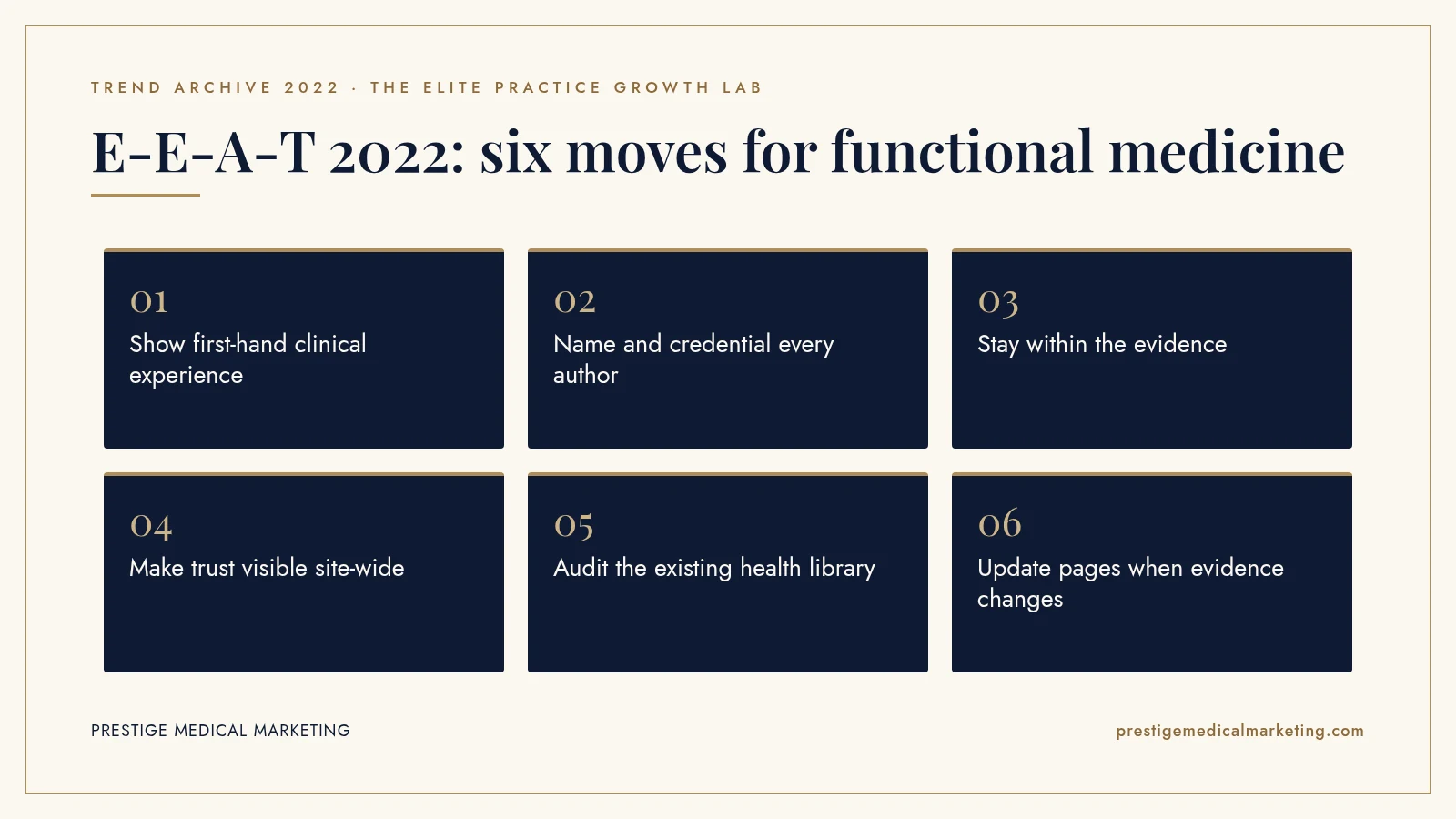
These steps translate the framework into a site patients can trust.
1. Put a clinician on every health page
Show who wrote or medically reviewed each article, with accurate credentials and a link to a real bio. Remove pages no clinician is willing to stand behind.
2. Write from clinical experience
Describe how your practice evaluates a concern, what a first visit involves and how you decide on testing or referral. That perspective is hard to copy.
3. Match claims to evidence
Say what is well established, what is promising and what is uncertain. Link to primary sources where they help readers check.
4. Be transparent about the practice
Make it easy to find who you are, where you practice, how to contact you and how pricing and memberships work.
5. Keep content current
Review health pages on a schedule and note real updates honestly. Outdated health information erodes trust quickly.
6. Use real stories only with consent
Share patient experiences only with documented permission and accurate representation, and never present composites as individual cases.

Experience without overreach
Experience is a powerful signal, but in health it comes with responsibilities. A clinician can describe patterns they commonly see, the questions patients ask most often, and how they think through a complex presentation. They can explain why they order certain tests and not others, and when they refer to a specialist. That is experience that informs.
What experience cannot do is substitute for evidence. “I have seen this work in my patients” is a description of a clinician’s impressions, not proof that an intervention works for a given reader. Strong content holds both: the clinician’s perspective, clearly framed as such, alongside an honest account of what research does and does not show.
This balance is also a regulatory matter. Health claims in marketing are subject to truth-in-advertising rules, and claims about treating disease require competent and reliable scientific evidence. Content that respects that boundary is better for patients and safer for the practice.
Trust is built across the whole site
Google’s emphasis on trust is a reminder that a single excellent article does not make a trustworthy site. Trust comes from consistency. Accurate contact details, clear policies, a privacy notice that matches what the site actually does, visible clinician bios, reasonable claims on every page and a booking flow that does what it says.
For functional medicine practices, pricing transparency deserves special mention. Many work on cash or membership models, with testing costs that can surprise patients. Explaining how fees, memberships and lab costs work, in plain language, is one of the most trust-building things a practice website can do.
Reviews matter too, as long as they are genuine. A steady flow of authentic reviews that mention specific clinicians and experiences reinforces what the website says. Gated or curated review collection does the opposite.
Authority in a crowded field
Authoritativeness is the hardest of the four to manufacture. It comes from being recognized by others: other clinicians who refer to you, local organizations that link to you, publications that cite your clinicians, and patients who mention you by name. A practice can encourage that by doing work worth citing, such as speaking at community events, contributing to professional discussions and publishing genuinely useful guides.
It cannot be shortcut. Paid links, fabricated press mentions and directory spam may look like authority to an unsophisticated tool, but they are the kind of signals Google’s spam policies target.
Auditing an existing health library
Most functional medicine practices already have years of content. Before writing anything new, it is worth reviewing what exists against the framework. A simple audit asks four questions of each health page. Who wrote it, and who reviewed it? Is every claim still accurate and proportionate to the evidence? Does the page reflect how this practice actually works, or could it sit on any wellness site? And does it help a reader take a sensible next step, whether that is booking, asking their own clinician or simply understanding their options?
Pages that pass become the foundation. Pages that fail on accuracy should be corrected or removed promptly, because inaccurate health information is the clearest trust problem a site can have. Pages that fail only on depth can often be merged into a stronger, clinician-reviewed guide on the same topic.
The audit also tends to reveal gaps: questions patients ask every week that the site never answers. Those gaps are usually the best place to invest new writing time, because the answers draw on experience the practice already has.
Where E-E-A-T fits now
Since December 2022, E-E-A-T has become one of the most cited ideas in search marketing, often more than Google intended. It is a framework raters use and a description of what Google’s systems try to reward, not a dial a site can turn. Google’s later guidance on AI-generated content, in 2023, applied the same lens: content is judged on whether it is helpful and trustworthy, however it is produced.
For a functional medicine practice, the practical meaning has stayed stable. Health content should come from people who know the subject, reflect real clinical experience, be honest about evidence and make it clear who is responsible for it.
That stability is useful. Search tactics change quickly, but the qualities raters are asked to look for describe good clinical communication in any era. A practice that builds its content around them is not chasing an algorithm. It is doing the work patients would want done anyway, and that work tends to survive whatever Google changes next.
What 2022 does not tell us
The rater guidelines describe how Google asks people to evaluate search results. They are not a list of ranking factors, and Google does not publish how individual signals are weighted. We do not have public data showing how functional medicine sites performed before and after December 2022, and Google does not explain how individual rater judgments translate into specific system changes. What the update does tell us is how Google describes good content in its own words, and that description has remained consistent since.
The premium practice advantage
A premium functional medicine practice has the raw material Google describes: experienced clinicians, thoughtful care and real patient relationships. The work is presenting it clearly and honestly. See our functional medicine services, our functional medicine marketing guide, our full services, who we help and how we approach Google Maps and AI search visibility. Our team works from Austin with practices nationwide.
The bottom line
In December 2022, Google added Experience to E-A-T and named trust the most important element. For functional medicine practices, it confirmed that credible health content comes from real clinicians, reflects real experience and is honest about evidence.
Check if your market is open. We take one practice per specialty per market. Request a market check or call (716) 400-0084.
Frequently asked questions
When did Google add the extra E?
Google announced the change on December 15, 2022, in a Search Central post about its updated search quality rater guidelines.
What does the extra E stand for?
Experience. Google said raters could consider the extent to which content creators have the necessary first-hand or life experience for the topic.
Which part of E-E-A-T matters most?
Google said trust is at the center of the concept and is the most important member of the E-E-A-T family.
Do quality raters change a site's rankings?
No. Google says raters' ratings do not directly influence ranking. They help Google evaluate whether its ranking systems are working well.
Why does this matter more for functional medicine?
Health topics are what Google calls Your Money or Your Life topics, where inaccurate information can cause harm. Functional medicine content often addresses complex or debated topics, so trust signals carry extra weight.
Is E-E-A-T a ranking factor I can optimize directly?
Google describes E-E-A-T as a concept raters use, not a single ranking factor. The practical work is making content accurate, experienced and transparent about who stands behind it.