
On April 29, 2024, the FDA announced a final rule, published May 6, 2024, making clear that laboratory developed tests are medical devices and phasing out its general enforcement discretion over four years. On March 31, 2025, a federal court in the Eastern District of Texas vacated the rule, and in September 2025 the FDA removed the rule's language. For functional medicine practices, the episode was a reminder to describe specialty tests accurately, explain what results can and cannot show and avoid overstating diagnostic claims. This is marketing guidance, not legal advice.
Testing sits at the center of many functional medicine practices. Patients often arrive after years of unexplained symptoms, hoping that detailed testing will reveal something their previous care missed. Practices use a range of tests, from standard blood panels to specialty assessments of hormones, nutrients, gut health and more.
Many specialty tests are laboratory developed tests, designed and run within a single laboratory rather than sold as kits. For decades, the FDA said it had authority over those tests but generally chose not to enforce device requirements. In 2024, the FDA moved to change that.
This retrospective covers what the FDA decided, what happened next and what it means for how functional medicine practices describe testing today. This is marketing guidance, not legal advice. For our specialty approach, see functional medicine marketing.
What actually happened in 2024
The proposal. In October 2023, the FDA proposed amending its regulations to make clear that in vitro diagnostic products, including those manufactured by laboratories, are medical devices.
The final rule. On April 29, 2024, the FDA announced the final rule, which was published in the Federal Register on May 6, 2024 as Medical Devices; Laboratory Developed Tests. It described a phaseout of general enforcement discretion over roughly four years, with requirements such as reporting, registration and, for some tests, premarket review coming in stages.
The legal challenge. Laboratory industry groups sued, arguing the FDA lacked authority to regulate LDTs as devices.
The reversal. On March 31, 2025, the U.S. District Court for the Eastern District of Texas vacated the rule. In September 2025, the FDA published a notice removing the rule’s language from its regulations. The FDA’s laboratory developed tests page tracks the status.
Why it mattered for functional medicine
Functional medicine practices rely on specialty labs more than many other fields. When the rule was finalized, practices faced questions about whether favored tests would remain available, whether costs would rise and whether some labs would stop offering certain tests rather than seek FDA review.
The rule also put a spotlight on test claims. The FDA’s concern centered on whether tests were accurate and whether their results supported the clinical decisions made with them. That concern applies to marketing as well. Practices that promoted tests as definitive answers to complex symptoms were making claims that regulators, and patients, could question.
Costs were another concern. If labs had to pay for FDA submissions and compliance, some feared those costs would be passed on to patients, many of whom already pay for specialty testing out of pocket.
Even after the rule was vacated, the debate highlighted something important: patients deserve accurate information about what a test can and cannot show.
What typical agencies did
Many agencies built functional medicine marketing around testing as the hook: find the root cause, uncover hidden imbalances, get answers other doctors missed. Some pages implied that a single panel could explain a patient’s symptoms.
Those messages could attract interest, but they set expectations that testing alone could not meet. When patients felt results did not deliver the promised answers, trust suffered. Aggressive test claims also increased exposure to complaints and scrutiny.
Few agencies paid attention to the LDT rule at all, which meant practices had little help thinking about how regulatory changes might affect their services or messaging.
What it means for a functional medicine practice today
Testing can remain a strength if it is described honestly. Here is how we approach it.
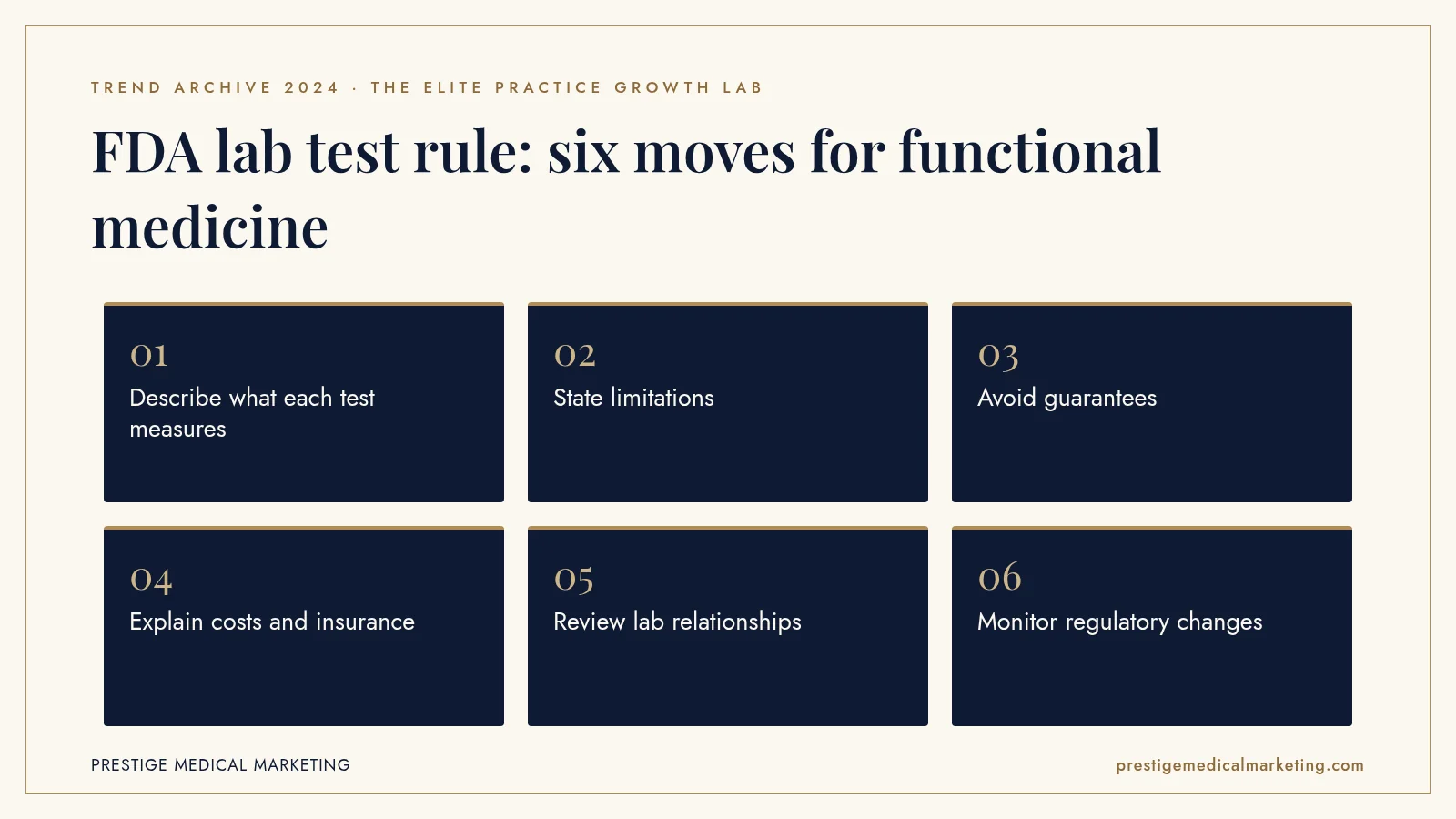
1. Describe what each test measures
Explain in plain language what a test looks at and how results are used alongside history, symptoms and examination.
2. State limitations
Be clear when tests are not diagnostic on their own, when evidence is evolving or when results need interpretation.
3. Avoid guarantees
Do not promise that testing will find a cause or lead to a specific outcome.
4. Explain costs and insurance
Specialty tests are often paid out of pocket. State costs or ranges clearly and explain what patients will receive.
5. Review lab relationships
Understand each lab’s certifications and how it validates tests, and review relationships with counsel for compliance.
6. Monitor regulatory changes
Track FDA, CLIA and state developments so service and marketing pages stay accurate.

Talking about testing with patients
Patients who come to functional medicine often feel unheard. They want a provider who takes their symptoms seriously and looks deeper. Testing is one way to do that, but the conversation matters as much as the lab report.
Good marketing reflects that conversation. It explains that care begins with a detailed history, that testing is chosen based on the patient’s situation and that results are one piece of a broader picture. It describes how the provider reviews results with the patient and builds a plan. That message is honest, and it positions the practice as thoughtful rather than test-driven.
Content can help patients understand common tests before they book. A short explainer on what a particular panel measures, when it may be useful and what it costs helps patients make informed decisions and reduces surprises. Our functional medicine work emphasizes that kind of education.
Why accuracy helps visibility
Search engines and AI assistants increasingly evaluate health content for trustworthiness. Pages that make extreme claims, lack sources or contradict mainstream evidence are less likely to be recommended. Pages that explain tests carefully, cite evidence where available and acknowledge limits are more likely to be referenced.
That gives functional medicine practices a reason to favor accuracy beyond compliance. Careful, well-sourced content builds the kind of authority that search and AI systems reward. Our guide to getting your practice recommended by AI explains how trustworthy content supports visibility.
Pricing and packages
Many functional medicine practices bundle testing into packages or memberships. That can make care more predictable for patients, but it also requires clear communication. Patients should understand which tests are included, what happens if additional testing is recommended and how results are reviewed.
Packages should be built around care, not around selling as many tests as possible. A package that includes testing the provider believes is appropriate, plus follow-up and support, is easier to explain and defend than one that leads with a long list of panels.
Transparent pricing also builds trust. Patients researching functional medicine often compare practices, and a clear explanation of costs can be a deciding factor.
What patients search for
Patients exploring functional medicine search for specific concerns: fatigue, digestive issues, hormone changes, inflammation and more. They also search for practical information: what a functional medicine visit involves, what tests are common, what it costs and whether insurance applies.
Practices that answer those questions directly attract patients who understand the model and are ready to engage. Service pages for common concerns, explainers for frequently used tests and clear information about the patient journey give patients and search engines what they need. Local visibility matters too, so a strong Google Business Profile and genuine reviews help nearby patients find the practice.
Working with labs
Practices depend on lab partners for accurate results, reliable turnaround and helpful support. The LDT debate was a reminder to understand those partners well. Practices should know where tests are performed, what certifications labs hold, how tests are validated and how results are reported.
Practices should also review any marketing materials labs provide. Lab-supplied content may contain claims that the practice would not make on its own. Since the practice is speaking to its patients, it should be comfortable standing behind every claim on its website, regardless of who wrote it first.
Financial relationships with labs deserve attention too. Arrangements involving referrals, discounts or payments can raise compliance questions, so practices should review them with counsel.
Building trust with referring providers
Many functional medicine practices receive referrals from conventional providers or work alongside them. Careful test claims help those relationships. A primary care physician is more likely to refer patients to a practice that describes testing responsibly and communicates results clearly than to one that promotes tests as answers other doctors missed.
Sharing clear summaries, respecting the role of other providers and avoiding marketing that disparages conventional care can open doors. Over time, those relationships can become an important source of patients who are well suited to the practice.
A review checklist for testing pages
Every page that describes testing should be checked against a few questions. Does it explain what the test measures in plain language? Does it say how results are used alongside history and examination? Does it avoid calling the test diagnostic when it is not? Does it avoid promising that testing will find a cause or lead to a cure? Does it list costs or explain how pricing works? Does it explain who performs the test and how results are reviewed with the patient?
Pages should also be reviewed when lab partners change, when tests are discontinued or when regulations shift. A simple list of every page, email and handout that mentions specific tests makes those updates quick. Many practices find outdated test descriptions on their websites from labs they no longer use, which confuses patients and creates avoidable risk.
Clinical leaders should sign off on testing content. Marketing teams can write clearly, but providers should confirm that descriptions match how tests are actually used in the practice. That review protects patients and makes the content more accurate and useful.
Measuring what matters
Testing-focused marketing should be measured by more than inquiries. Track how many consultations lead to care plans, how many patients complete recommended follow-up and how patients rate their experience. If many patients order tests but few continue care, the marketing may be setting expectations the practice cannot meet. Better alignment between message and experience improves retention and reviews.
What 2024 does not tell us
The vacated rule leaves open questions. Congress could legislate on diagnostic test regulation, and the FDA could pursue other approaches. We do not know how future rules will treat specialty tests or how they would affect availability and cost. We also lack reliable data on how the 2024 rule affected functional medicine practices during the months it was in effect. Practices should watch for developments and keep their claims careful in the meantime.
The premium practice advantage
A premium functional medicine practice is trusted because it is thoughtful. It chooses tests carefully, explains them honestly and builds care around the patient, not the lab menu.
That is how we market functional medicine practices: clear education, transparent pricing and visibility through Google Maps and AI search. See our services and who we help. Our team works from Austin with practices nationwide.
The bottom line
In 2024, the FDA finalized a rule to regulate laboratory developed tests as devices, and in 2025 a court vacated it. For functional medicine practices, the lasting lesson is that testing should be described accurately, with clear limits and honest expectations. This is marketing guidance, not legal advice.
Check if your market is open. We take one practice per specialty per market. Request a market check or call (716) 400-0084.
Frequently asked questions
What is a laboratory developed test?
A laboratory developed test, or LDT, is a diagnostic test designed, manufactured and used within a single laboratory. Many specialty tests used in functional medicine have been offered this way.
What did the FDA rule do?
The final rule, published May 6, 2024, amended FDA regulations to make clear that in vitro diagnostic products, including those made by laboratories, are devices, and set out a phased end to FDA's general enforcement discretion for LDTs.
What happened to the rule?
On March 31, 2025, the U.S. District Court for the Eastern District of Texas vacated the rule. In September 2025, the FDA published a notice removing the rule's language from its regulations.
Does that mean specialty tests are unregulated?
No. Laboratories remain subject to other rules, including CLIA requirements for clinical laboratories, and marketing claims are subject to advertising and consumer protection laws.
How should practices talk about specialty tests?
Explain what each test measures, how results are used in care and what limitations exist. Avoid presenting tests as definitive diagnoses when they are not.
Is this legal advice?
No. This is marketing guidance, not legal advice. Practices should consult qualified counsel about testing, lab relationships and claims.