Google previewed multisearch near me at Google I/O in May 2022 and said at Search On in September 2022 that it would start rolling out in English in the US later that fall. It let people take a picture or screenshot, add text and find related results at local businesses. Google also said Lens answered more than 8 billion questions a month. For private practices, it signaled that real, descriptive images and accurate local information would matter more in how people discover businesses.
For most of search history, finding something nearby meant typing words into a box. A service, a city, perhaps the words near me. In 2022, Google spent much of the year showing a different future: one where people point a camera at something, add a few words and get local results. It called the feature multisearch near me.
Google’s examples were about food and shopping, not healthcare. Snap a photo of a dish and find a restaurant nearby that serves it. Take a picture of an item and see whether a local shop carries it. But the direction mattered to every local business, including private medical practices. Search was becoming visual, and the images and information a business published would feed new ways of being found.
This retrospective covers what Google actually announced in 2022 and what it means for a practice today. For later chapters, see the Search Generative Experience in 2023, AI Overviews in 2024 and AI Mode in 2025.
What actually happened in 2022
Earlier in 2022: multisearch arrives. Before the near me announcement, Google introduced multisearch in the Google app, letting people take a picture or screenshot with Lens and then add text to it, similar to the way someone might point at something and ask a question about it.
May 11: Google I/O. In its I/O 2022 Search announcements, Google previewed multisearch near me, which would let people take a picture or screenshot of something like a dish or an item and find it nearby. Google also previewed scene exploration, a future capability for searching across a whole scene through the camera.
September 28: Search On. At Search On 2022, Google said multisearch was available in English globally and would come to more than 70 languages in the following months. It said multisearch near me would start rolling out in English in the US later that fall, helping people find and connect with local businesses.
Lens at scale. In the same announcement, Google said people used Lens to answer more than 8 billion questions every month.
More visual results. Google also described plans to show more visual content in results, including visual stories and short videos from creators on the open web for some topics, and new ways to explore related topics as people typed and scrolled.
Why it mattered for private practices
Multisearch near me was not built for healthcare, and it would be misleading to suggest patients were photographing symptoms to find a clinic through it. Google’s examples were dishes and products, and health searches carry their own sensitivities. The relevance for practices was broader and more structural.
First, it showed that Google was investing heavily in understanding images and connecting them to local businesses. The photos a practice publishes on its website and Google Business Profile are part of the information Google can use to understand what the practice is and offers.
Second, it showed that search results were becoming more visual overall. Images, short video and visual stories were taking more space. A practice whose online presence consisted of text and generic imagery had less to show in that environment than one with real, high-quality photography of its space, team and work.
Third, it reinforced the importance of accurate local data. Any feature that connects a query to a nearby business depends on that business’s location, hours, categories and offerings being correct.
What typical agencies did
Many agencies treated visual search as a headline rather than a priority. Some promised “Lens optimization” without being clear what that meant. Others ignored it, reasoning that patients do not photograph their way to a doctor.
Both missed the practical point. The work that supports visual and local discovery is mostly the same work that supports everything else: accurate business information, original photography, descriptive text and pages that clearly explain services. It did not require a new product, just better fundamentals.
Image quality became a differentiator. Practices still relying on generic imagery found that it said little about who they were. The practices that benefited most were those that treated photography as a lasting asset, commissioning a proper library of their spaces and people and then using it consistently across the website, the Google Business Profile and social channels.
What it means for a practice today
Search is more visual and more AI-driven than it was in 2022. These steps help a practice be understood and found.
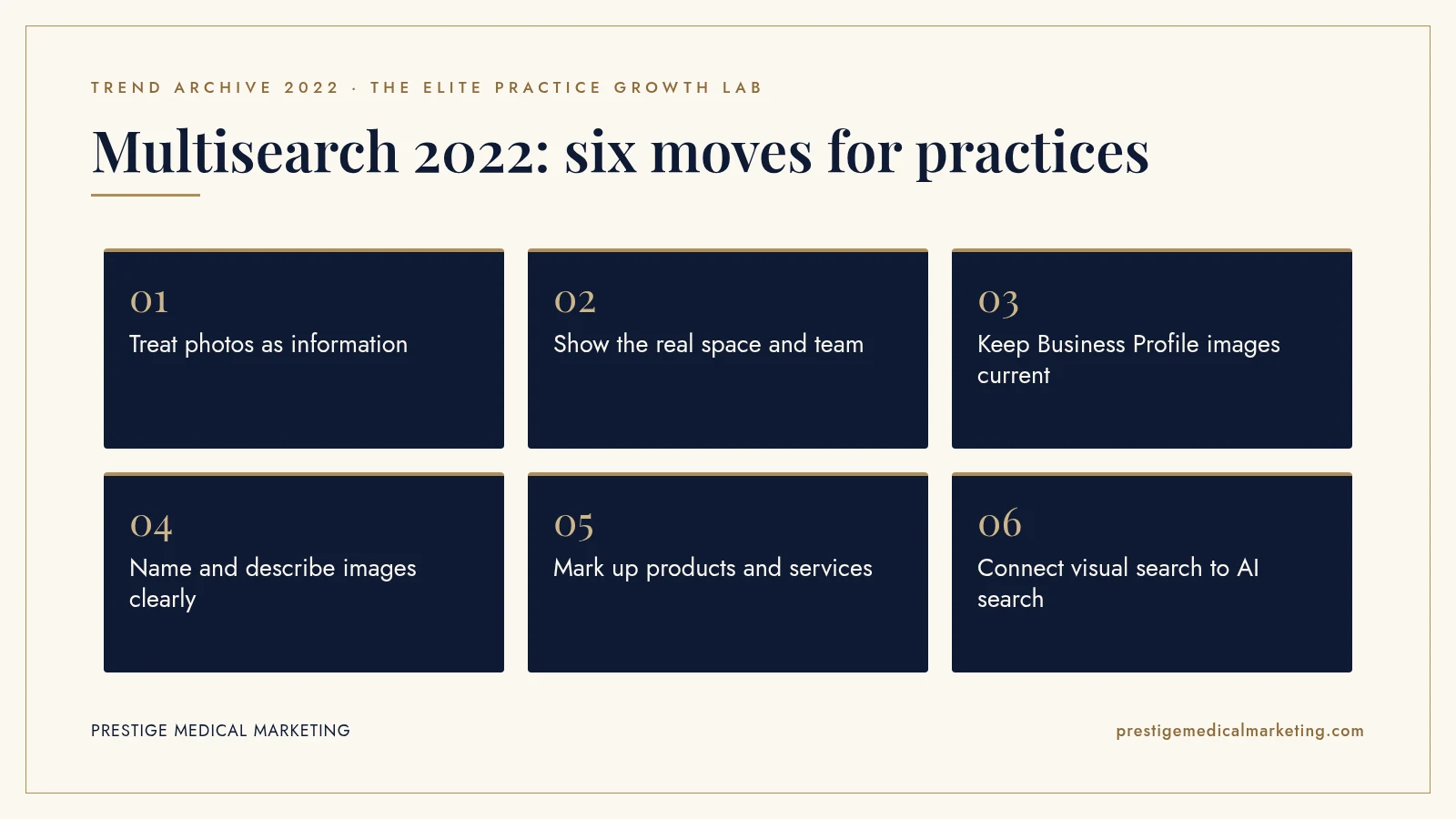
1. Invest in original photography
Photograph your actual practice, team and environment professionally. Real images communicate quality and help search systems understand what you are.
2. Describe images accurately
Use descriptive file names and alternative text that explain what each image shows. It helps accessibility and understanding.
3. Complete your Google Business Profile
Add categories, services, hours, attributes and current photos. Local features depend on accurate profile data.
4. Show products and treatments honestly
If you offer skincare or retail products, list them accurately. Represent treatments with consented, realistic imagery.
5. Keep information consistent
Make sure your name, address, phone and services match across the web, so any system connecting a query to you gets it right.
6. Protect patient privacy in images
Never publish identifiable patient images without documented consent, and check backgrounds for visible information.

Photography as information
For a premium practice, photography has always been about impression: a calm reception area, polished treatment rooms, a confident team. In a visual search environment, it is also information. Images tell search systems and patients what the practice looks like, what kind of care it offers and whether it matches what a person is looking for.
That raises the value of real photography over generic imagery. A generic image of a smiling person in a white room could belong to any business. A photograph of the practice’s actual consultation room, its signage and its team belongs to only one. When search systems and patients compare options, the specific beats the generic.
Photography should also stay current. Images of a renovated reception area, a new location or a changed team keep the visual story accurate, while outdated photos can create a mismatch when a patient arrives. A yearly photo session, planned around any changes to the space or team, is a modest investment that keeps every channel looking like the practice patients will actually visit.
Visual search and the patient journey
Patients do use visual search in ways adjacent to healthcare. Someone might photograph a skincare product to learn what it is, look up a building to confirm they are in the right place, or screenshot a social post about a treatment to find out more. Each of these touches a practice’s online presence. Accurate product listings, clear signage photos and consistent business information make those moments work in the practice’s favor.
The sensitive side deserves equal attention. People sometimes use image search for health questions, and results in that area should be treated with care. A practice’s role is not to chase those searches but to make its own information clear, accurate and trustworthy wherever someone encounters it, and to encourage anyone with a health concern to seek a proper consultation.
A practical image checklist
Most practices can improve their visual presence in a single focused project. Start with an inventory: every image on the website and Google Business Profile, where it came from and whether it still reflects the practice. Remove generic imagery that could belong to anyone, outdated photos of former team members or old interiors, and anything without clear rights to use.
Then plan a professional session that covers what patients want to see. The exterior and entrance, so people recognize the building. Reception and waiting areas. Consultation and treatment rooms, staged without patient information. Each clinician, photographed consistently. Details that express the practice’s standards, such as materials, lighting and finishes. Where appropriate and with consent, the team at work.
Finally, publish thoughtfully. Use compressed, correctly sized files so pages stay fast. Write file names and alternative text that describe what each image shows in plain language. Add a selection to the Google Business Profile and refresh it periodically. A strong image library supports the website, profiles, social channels and any visual search feature at once.
Practices that sell products
Some practices, particularly in dermatology, aesthetics and wellness, sell skincare or other products in their offices. For them, visual search has a more direct connection. A patient might photograph a product they were recommended, or a friend’s bottle on a bathroom shelf, and search to learn more or find where to buy it nearby.
Accurate product information on the practice website, with clear photos, correct names and honest descriptions, helps the practice appear in those moments. So does keeping the Google Business Profile current with products where that feature is available. Claims about products should stay within what the manufacturer and evidence support, especially for anything that sounds like a treatment benefit.
For practices that do not sell products, the lesson still applies to services: clear, specific, visually supported information about what the practice offers.
The thread to AI search
Multisearch was one step on a path that led to AI-powered search experiences. The underlying idea, understanding information across text, images and the physical world, became central to AI Overviews and AI Mode in later years. Those systems also rely on what businesses publish: their websites, profiles, images and reviews.
That continuity is the lasting lesson of 2022. The features change, but the inputs that help a practice be understood remain the same: accurate information, original content and a consistent presence across the places search systems read.
It also explains why investing in fundamentals is efficient. A practice that photographs its spaces well, describes services clearly and keeps its profiles accurate does not need to chase each new feature. The same assets serve text search, visual search, maps and AI answers, and they keep serving as new formats appear.
What 2022 does not tell us
Google did not publish usage data for multisearch near me, and we have no public data showing that patients used it to find medical practices. Its examples were food and retail. What 2022 does show is Google’s stated direction toward visual and multimodal search connected to local businesses, which has continued since.
The premium practice advantage
A premium practice already looks the part. The work is making sure that quality shows up in the images and information search systems read. See how we approach Google Maps and AI search visibility, our custom websites, our full services and who we help. Our team works from Austin with practices nationwide.
The bottom line
In 2022, Google previewed and began rolling out multisearch near me, combining images and text to find things locally. For private practices, it signaled that original photography and accurate local information would increasingly shape how people discover businesses.
Check if your market is open. We take one practice per specialty per market. Request a market check or call (716) 400-0084.
Frequently asked questions
What was multisearch?
Multisearch let people take a picture or screenshot with Google Lens, then add text to refine the search, much like pointing at something and asking a question about it.
What did multisearch near me add?
It let people search with an image plus text to find related results at local businesses near them. Google's examples focused on dishes and items in local shops.
When was it announced?
Google previewed multisearch near me at Google I/O in May 2022. At Search On on September 28, 2022, it said the feature would start rolling out in English in the US later that fall.
How widely used was Google Lens in 2022?
At Search On 2022, Google said people used Lens to answer more than 8 billion questions every month.
Does multisearch near me help medical practices directly?
Mostly indirectly. Google's examples were food and products, not healthcare. The broader lesson is that real images and accurate business information feed visual and local discovery.
What should a practice do about visual search?
Publish real, high-quality photos of your practice, team and services where appropriate, with descriptive text, and keep your Google Business Profile complete and accurate.