On December 5, 2022, Google brought continuous scrolling to desktop search results for English searches in the US, loading up to six pages of results as people scrolled before showing a More results button. Mobile had received the feature in October 2021. In June 2024, Google began returning to paginated results. For IV and wellness clinics, the episode showed that rankings beyond the top few spots could earn some extra visibility, but the top of the page still mattered most.
For years, page two of Google was a running joke in marketing: the best place to hide something, because nobody looked there. For an IV therapy or wellness clinic competing in a crowded local market, falling from the bottom of page one to the top of page two could mean a sharp drop in visibility, simply because people rarely clicked through to another page.
In December 2022, Google changed that boundary on desktop. Instead of a row of page numbers at the bottom of the results, desktop searchers in the US saw more results load automatically as they scrolled. Page two, in the old sense, partly disappeared. For a while, it seemed the familiar cliff between page one and page two might soften.
This retrospective covers what Google actually changed in 2022, what happened next and what it means for an IV or wellness clinic today. For related chapters, see iOS 17 link tracking protection in 2023, the TikTok divestment law in 2024 and the Texas IV therapy law in 2025.
What actually happened in 2022
December 5: continuous scroll on desktop. Google began rolling out continuous scrolling for desktop search results for English searches in the US. Engadget reported that as people reached the bottom of a results page, more results would load automatically.
Up to six pages. Google said results would continue loading for up to six pages, after which a More results button would appear. Search Engine Roundtable covered the rollout the same day.
Following mobile. Google had already brought continuous scroll to mobile search in the US in October 2021. The December 2022 change extended the same idea to desktop.
Google’s reasoning. Google presented the change as a way for people to see more results without clicking through to a new page, particularly when they wanted to compare several options.
Accessibility controls. Google’s accessibility help for Search describes links at the top of a desktop results page, including one that turns continuous scrolling on or off, so people using a keyboard or screen reader can control how results load.
What came later. In June 2024, Google began removing continuous scroll from desktop search results and restored paginated navigation, saying automatic loading had not significantly improved satisfaction. Mobile was expected to follow.
Why it mattered for IV and wellness clinics
IV therapy and wellness clinics often compete in dense local markets against other clinics, mobile IV services, med spas offering drips and national franchises. Many searches mix local results, ads and directory listings. For a smaller clinic, holding a top position on core searches can be hard, and many sat somewhere in positions eight to twenty.
Continuous scroll changed the economics of that middle ground slightly. When results loaded automatically, a listing in position twelve sat on the same scrolling page as position eight rather than behind a click. Some people scrolling for more options might see it. That did not make lower positions valuable in the way the top results were, but it reduced the hard cliff.
It also meant more ads and features could appear further down the page, because the results stream kept going. Clinics running search ads sometimes saw impressions from placements lower in the scroll that had not existed before.
What typical agencies did
Some agencies seized on continuous scroll as proof that “page two is dead” and reported improved impressions as if they reflected improved rankings. Others warned clients that the change would dilute clicks because people had more options to scroll through.
Few explained the key point: continuous scroll changed how results were displayed, not how they were ranked. Position still mattered. The first few organic results and the local map pack continued to capture most attention, and the behavior of people who scrolled deep was not the same as the behavior of people who clicked early.
The useful response was to keep focusing on what drives visibility in the results people actually see first. For most IV and wellness clinics, that meant the map pack, the Google Business Profile, reviews and a handful of strong service pages, none of which depended on how many results loaded below them.
What it means for an IV or wellness clinic today
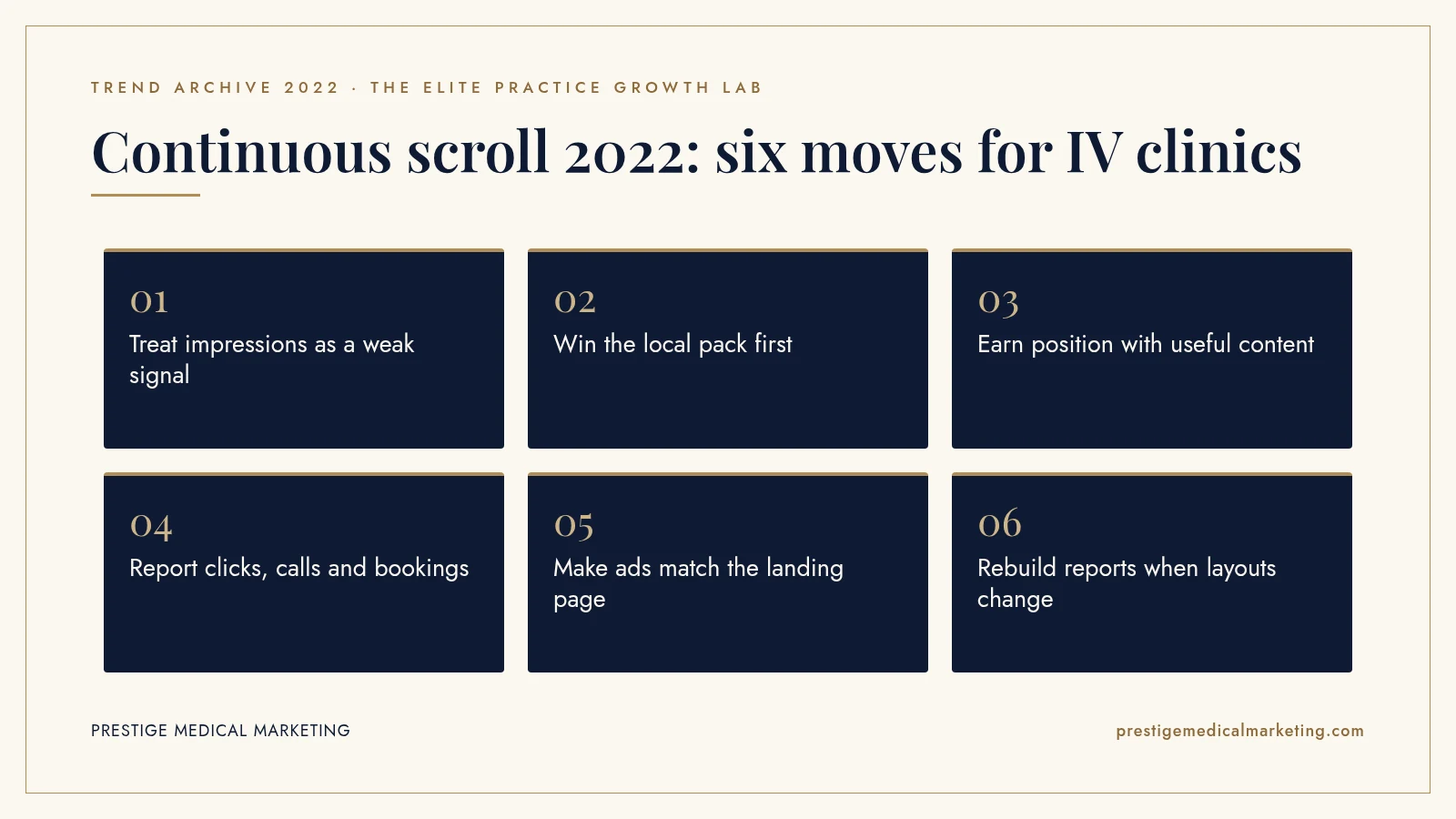
With pagination back, the old cliff between page one and the rest has returned. These steps focus effort where patients look.
1. Prioritize the local map results
For most IV searches with local intent, the map pack sits near the top. A complete, accurate Google Business Profile is the foundation.
2. Earn genuine reviews steadily
Ask every satisfied client for an honest review through a simple, consistent process. Never gate or incentivize reviews.
3. Build clear service pages
Explain each drip or service, who it may suit, how a visit works, safety screening and pricing structure, with clinician review.
4. Read impressions carefully
Interpret Search Console impressions alongside clicks and position. Display changes can move impressions without real change in visibility.
5. Keep claims compliant
Avoid health claims you cannot substantiate. Wellness marketing draws regulatory attention.
6. Strengthen branded demand
Reputation, referrals and repeat clients build searches for your name, where you rank first regardless of layout.

Impressions are not visibility
One practical consequence of continuous scroll was confusion in reporting. Google Search Console counts an impression when a result appears in the loaded results a person sees. With more results loading automatically, some sites saw impressions rise for queries where they ranked lower on the page, without any real change in their position or clicks.
That is a reminder to read search data in context. Impressions, clicks, average position and click-through rate tell a story together. A rise in impressions with flat clicks is often a display effect, not a visibility gain. For a clinic, the numbers that matter most remain calls, booking requests and new clients.
The same caution applies whenever Google changes how results are presented. AI Overviews, new ad formats and changes to local results all alter what people see before they reach the organic listings. A clinic that reports only impressions and average position may misread these changes; one that tracks the full path to a booked appointment sees the effect clearly.
The local pack still decides most bookings
For searches like IV therapy near me, hydration drip or vitamin infusion with a city name, the local map results usually appear near the top and draw a large share of attention. Appearing there depends on relevance, distance and prominence, which Google describes in its local ranking guidance. A clinic cannot change its distance from a searcher, but it can make its profile relevant and prominent.
That means choosing accurate categories, listing services, adding real photos of the clinic and team, keeping hours current, answering questions and building reviews that mention specific experiences. These signals influence the results at the very top of the page, which matter far more than any position deep in a scroll.
Mobile IV services face a particular challenge, because Google’s guidelines treat service-area businesses differently from businesses with a storefront. Setting up a profile correctly as a service-area business, with an accurate service area and no misleading address, keeps it eligible and avoids suspensions that can remove a listing entirely.
Content that earns position
Organic positions are earned by helpful, specific content and a credible site. For IV and wellness clinics, that means service pages that explain what is included in each drip, who should not receive it, how clinicians screen clients, what a visit is like and how pricing works. It also means being honest about evidence: many wellness claims are not well supported, and pages that overstate benefits can undermine credibility and draw regulatory attention.
A clinic that publishes a few well-researched, clinician-reviewed pages usually outperforms one with dozens of near-identical pages for every vitamin and every neighborhood.
Supporting content can extend that foundation. Clear answers to common questions, such as how long a visit takes, whether a consultation is required, what screening involves and how often clients typically return, address the practical concerns that stand between interest and a booking. Each answer is a reason for a cautious first-time client to choose the clinic that explained things best.
Reporting that survives layout changes
The continuous scroll episode is a useful case study in building reports that do not mislead. Google changes how results look several times a year, and each change can nudge impressions, average position and click-through rate in ways that have little to do with a clinic’s real performance. A report built only on those numbers invites false alarms and false celebrations.
A sturdier report starts with outcomes. How many new clients booked this month, and how did they find the clinic? How many calls came from the Google Business Profile, and how many booking requests came from organic search? From there, search metrics add explanation rather than serving as the headline. If bookings from search rose while impressions fell, the clinic is doing well. If impressions rose while bookings stayed flat, the change is probably cosmetic.
Annotating reports with known Google changes, such as the start of continuous scroll in December 2022 or its removal in 2024, also helps. Months later, nobody remembers why a chart jumped, and a single line of context prevents a wasted investigation.
Ads in a longer page
Continuous scroll gave Google more room to place ads further down the results, and clinics running search campaigns sometimes saw impressions from those lower placements. As with organic impressions, those numbers needed careful reading. Ads shown deep in a scroll tended to behave differently from ads at the top.
With pagination restored, the practical advice is unchanged: judge campaigns on cost per booked appointment, not impressions, and keep ad copy compliant with platform health policies and truth-in-advertising rules.
What 2022 does not tell us
Google did not publish data on how continuous scroll changed click behavior, and we do not have public data on how IV and wellness clinics were affected. Its own explanation for returning to pagination in 2024 suggests the feature did not significantly change satisfaction. What the episode does show is that display changes can shift reported metrics without changing real visibility.
The premium practice advantage
A premium IV or wellness clinic earns its place at the top with clinical standards, honest content and genuine client loyalty. See our IV and wellness services, our IV therapy marketing guide, our full services, who we help and how we approach Google Maps and AI search visibility. Our team works from Austin with practices nationwide.
The bottom line
Google brought continuous scroll to US desktop search on December 5, 2022, then began reversing it in June 2024. For IV and wellness clinics, the lasting lesson was to focus on the top of the page, read metrics in context and earn position through local strength and honest content.
Check if your market is open. We take one practice per specialty per market. Request a market check or call (716) 400-0084.
Frequently asked questions
When did continuous scroll come to desktop search?
Google announced it on December 5, 2022, for English-language searches in the US on desktop.
How did it work?
As people scrolled, Google loaded more results automatically, up to six pages' worth, after which a More results button appeared.
When did mobile get continuous scroll?
Google introduced continuous scroll on mobile search in the US in October 2021.
Is continuous scroll still in place?
No. In June 2024, Google began removing continuous scroll from desktop search and returning to paginated results, with mobile expected to follow.
Did it change rankings?
No. It changed how results were displayed, not how pages were ranked. It mainly affected how far down the results people might scroll.
What should an IV clinic focus on instead of page position?
Strong local visibility in Google Maps, a complete Google Business Profile, genuine reviews and clear service pages, which influence the results people actually see first.