
On October 10, 2023, the FDA warned patients and health care providers about potential risks of compounded ketamine products, including oral formulations, for psychiatric disorders. The FDA said ketamine is not approved for any psychiatric disorder, that use without monitoring for sedation, dissociation and vital sign changes may put patients at risk, and it cited a report of slowed breathing after at-home use. For behavioral health practices, the alert reinforced careful, accurate and supervised ketamine marketing.
By 2023, ketamine had become one of the most heavily marketed treatments in behavioral health. In-office infusion clinics multiplied, and online programs began shipping compounded oral and sublingual ketamine for use at home after a telehealth visit. Ads promised fast relief from depression, anxiety and trauma, often with little mention of screening, supervision or the limits of the evidence.
On October 10, 2023, the FDA issued a warning about compounded ketamine products, including oral formulations, marketed for psychiatric disorders. The alert was aimed at patients and providers, but its message reached directly into how practices advertise ketamine care. Every claim about approval, safety or convenience now had an official statement to be measured against.
This retrospective covers what happened and what it means today. It connects to our coverage of the FDA’s 2024 MDMA therapy decision, the 2025 Medicare telehealth lapse and the 2023 BetterHelp order.
What actually happened in 2023
October 10: the alert. The FDA’s compounding risk alerts list records an October 10, 2023 warning to patients and health care providers about potential risks associated with compounded ketamine products, including oral formulations, for the treatment of psychiatric disorders.
Not approved for psychiatric use. The FDA said ketamine is not approved for the treatment of any psychiatric disorder, although compounded products had been marketed for depression, anxiety, PTSD and obsessive-compulsive disorder.
Monitoring. The FDA said use of compounded ketamine without monitoring for sedation, dissociation and changes in vital signs may put patients at risk. Known concerns include abuse and misuse, psychiatric events, increased blood pressure, slowed breathing and bladder symptoms.
A reported case. As HealthDay reported, the FDA cited an April 2023 report of a patient who used compounded oral ketamine at home for PTSD and experienced slowed breathing, with a blood level reportedly about twice a typical anesthetic level.
Context. The FDA said it was not aware of evidence that compounded ketamine is safer, more effective or faster than approved medications for certain psychiatric disorders. It had issued a separate alert on compounded ketamine nasal spray in February 2022.
Why it mattered for behavioral health practices
Ketamine marketing had moved quickly ahead of the evidence and the rules. Practices offering supervised in-office treatment found themselves competing with online programs promising convenience and low prices. Patients often did not understand the difference between supervised infusion, the approved esketamine nasal spray given under a restricted program, and compounded oral products used at home. Marketing rarely helped them, because many ads described all three with the same words.
The FDA alert gave practices a clear, authoritative basis for explaining those differences. It also warned against marketing that implied ketamine was approved for psychiatric conditions or safe to use without monitoring.
For practices offering ketamine responsibly, the alert was an opportunity to differentiate on safety and clinical rigor rather than price. It gave them an official source to point to when patients asked why supervised care cost more than a mail-order program, and why the practice required an evaluation before the first session.
What typical agencies did
Many agencies wrote ketamine copy that promised rapid relief, used phrases like “breakthrough treatment” and featured dramatic testimonials. Some blurred the line between approved esketamine and off-label ketamine. Few explained screening, monitoring or the limits of the evidence, and fewer still mentioned that the treatment does not work for everyone.
The better approach treated ketamine marketing as high-stakes medical communication: accurate, balanced, supervised and clear about who is and is not a candidate. That meant fewer bold headlines and more plain explanations, reviewed by the medical director before anything went live.
What it means for a behavioral health practice today
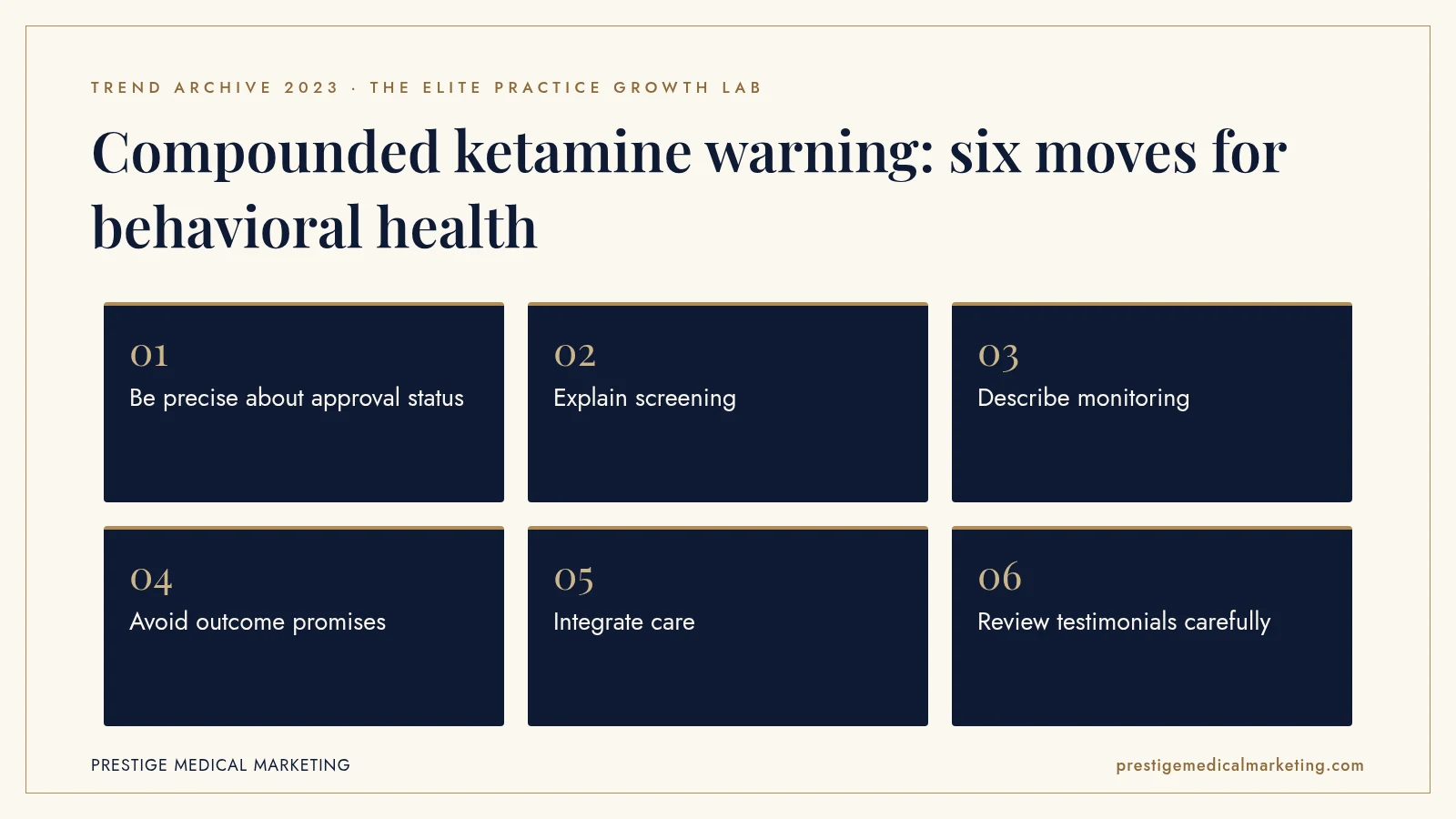
These steps help a practice describe ketamine care accurately.
1. Be precise about approval status
Distinguish approved esketamine from off-label ketamine and never imply approval that does not exist. Phrases like “FDA-approved ketamine therapy for depression” are inaccurate for ketamine itself.
2. Explain screening
Describe how the practice evaluates whether ketamine is appropriate, including medical and psychiatric history, current medications and blood pressure.
3. Describe monitoring
Explain how sessions are supervised, how vital signs are checked and how recovery is managed. Note that patients should not drive after treatment and describe how the practice handles transportation.
4. Avoid outcome promises
Do not promise rapid or lasting relief. Responses vary widely, and some people do not respond at all. Saying so builds credibility.
5. Integrate care
Explain how ketamine fits with therapy and ongoing psychiatric care rather than replacing them. Integration sessions and coordination with the patient’s existing clinicians are worth describing.
6. Review testimonials carefully
Avoid presenting dramatic individual results as typical, and get consent that reflects the sensitivity of mental health stories.

Supervised versus at-home care
The clearest marketing distinction after 2023 was supervision. In-office treatment allows clinicians to monitor sedation, dissociation and vital signs, the risks the FDA highlighted. Practices that offer supervised care should explain what that supervision includes, who provides it and how long patients stay after treatment.
That explanation is persuasive because it answers a real concern. Patients and families who read about the FDA warning want to know they will be safe. A practice that shows its monitoring process gives them that reassurance. Photos of a calm, private treatment room and a short description of a typical session can do more than any headline.
Platform advertising limits
Ad platforms restrict promotion of controlled substances and certain prescription treatments, and policies on ketamine-related ads have been strict. Practices should not rely on paid social ads to promote ketamine directly. Educational content, search visibility, referral relationships with psychiatrists and therapists, and strong reviews are more durable channels. Clear, sourced explanations of treatment options also tend to surface in AI-generated answers, which many patients now consult before calling. Our guide to getting recommended by AI explains how that works.
Privacy considerations
Ketamine care is mental health care, which carries heightened privacy expectations. The FTC’s 2023 actions against BetterHelp and GoodRx showed the risk of sharing health information with ad platforms. Practices should keep advertising pixels off ketamine pages and intake flows, and measure inquiries without sending details about a visitor’s mental health interests to ad platforms. We cover that in our tracking letters retrospective.
The first phone call matters
People calling about ketamine are often in distress, sometimes after months or years of trying other treatments. The way the front desk answers shapes whether they book and whether they feel safe. Staff should be trained to respond warmly, explain the evaluation process, avoid making clinical promises and know how to direct someone in crisis to immediate help. A practice that misses calls or responds slowly loses people who may not call again. Our guide to call handling and lead leakage covers the systems that prevent that.
Reviews and reputation
Reviews matter in behavioral health, but they require care. Practices should never confirm in a review response that someone is a patient or discuss their treatment. Thank reviewers in general terms and move specific concerns to a private conversation. Steady, authentic reviews that mention a respectful environment and attentive clinicians help prospective patients feel comfortable. We cover the approach in our reputation and premium pricing guide.
Explaining the treatment options clearly
Patients researching ketamine often meet a confusing mix of terms: infusion, injection, nasal spray, lozenge, troche, esketamine, Spravato and compounded ketamine. A practice website that explains these clearly does patients a service and sets the practice apart.
A good explanation covers what each option is, how it is given, whether it is FDA-approved and for what, where it is administered and how patients are monitored. HealthDay’s report on the 2023 alert noted that Spravato contains only one of ketamine’s two mirror-image molecules and is approved as a nasal spray for treatment-resistant depression in adults, used with an oral antidepressant. Clear, sourced explanations like that help patients ask better questions and arrive at consultations with realistic expectations.
Who is not a candidate
Responsible ketamine marketing says plainly that the treatment is not right for everyone. Certain medical conditions, psychiatric histories and substance use concerns can make ketamine inappropriate or require extra caution. Practices that state this openly attract better-fit patients and reduce wasted consultations.
It also signals clinical seriousness. A practice that is willing to turn some people away is more credible than one that seems willing to treat anyone who pays. Patients, families and referring clinicians all notice the difference quickly.
Working with referral partners
Many patients reach ketamine treatment through referrals from psychiatrists, therapists and primary care clinicians. Those referral partners read the same FDA warnings and want assurance that their patients will be screened, monitored and supported. Practices that share their protocols, communicate after treatment and coordinate with the referring clinician build strong referral relationships.
Referral partners also value accurate marketing. A practice whose website overpromises puts the referring clinician in an awkward position. One that describes care carefully is easier to recommend.
Measuring outcomes honestly
Some ketamine practices track patient-reported outcomes using standard questionnaires. That can support quality improvement and honest communication, but marketing should be careful with those numbers. Internal outcomes data is not the same as a controlled trial, and selecting favorable results for ads can mislead.
If a practice shares outcomes, it should describe the method, the limits and the fact that individual results vary, ideally with clinical and legal review. Many practices find it simpler to describe their process and let reviews and referrals speak to results. That approach is also easier to keep accurate as the practice grows and its patient mix changes over time.
Pricing and access
Ketamine treatment is often paid out of pocket, and costs vary widely by approach. Practices should explain pricing clearly, including what a treatment series typically includes, whether consultations and follow-up are separate and what insurance may cover, such as some esketamine treatment. Transparent pricing reduces anxiety and confusion for people who are already struggling and builds trust with families who help them decide.
What 2023 does not tell us
The FDA alert did not ban compounded ketamine or set rules for every setting. It does not tell us how often adverse events occurred in practice or how regulators would evaluate any particular program. What 2023 does show is the agency’s documented concerns and its statement on approval status, which should guide marketing language.
The premium practice advantage
Premium behavioral health practices market safety and clinical depth, not shortcuts. Visit our behavioral health marketing service, our services, who we help and our approach to Google Maps and AI search visibility. Our team works from Austin with practices nationwide.
The bottom line
The 2023 FDA ketamine warning drew a clear line around approval status and monitoring. Behavioral health practices that market supervised, integrated and accurately described care earn trust from patients and referral partners alike.
Check if your market is open. We take one practice per specialty per market. Request a market check or call (716) 400-0084.
Frequently asked questions
What did the FDA warn about in October 2023?
Potential risks associated with compounded ketamine products, including oral formulations, marketed for psychiatric disorders such as depression, anxiety, PTSD and obsessive-compulsive disorder.
Is ketamine FDA-approved for depression?
Ketamine itself is approved as an anesthetic, not for any psychiatric disorder. Esketamine, sold as Spravato, is a related nasal spray approved for treatment-resistant depression and certain depressive symptoms in adults.
Why did the FDA raise concerns about at-home use?
The FDA said using compounded ketamine without monitoring for sedation, dissociation and changes in vital signs may put patients at risk, and it cited a reported case of slowed breathing after at-home oral use.
Had the FDA warned about ketamine before?
Yes. In February 2022, the FDA alerted health care professionals to potential risks associated with compounded ketamine nasal spray.
Can a practice advertise ketamine therapy?
Practices should get legal advice, describe treatment accurately, avoid claims that ketamine is approved for conditions it is not, avoid promising outcomes and explain supervision and screening.
What should behavioral health practices emphasize instead?
Clinical evaluation, appropriate patient selection, in-office monitoring where applicable, integration with therapy and honest discussion of evidence and risks.