
OpenAI said in October 2025 that ChatGPT had reached 800 million weekly users, up from 700 million in August. Meta said Meta AI passed 1 billion monthly users in May 2025. AI assistants became a real starting point for research, including about health and local providers. For private practices, being described accurately and recommended in those answers now matters alongside ranking on Google.
A patient who wants a new provider used to open Google. Many still do. But in 2025, a large and growing number of people started somewhere else first: a chat window. They described what they wanted, asked for options, and asked follow-up questions about the answer.
That shift did not replace Google, and anyone telling you it did is selling something. But it was real, it was measurable, and it changed what it means for a private practice to be findable.
Here is what actually happened in 2025, what the public numbers say, and what a practice owner should do about it today.
What actually happened in 2025
ChatGPT’s growth. In August 2025, ChatGPT was at about 700 million weekly users. Two months later, at OpenAI’s DevDay on October 6, 2025, Sam Altman said the number had reached 800 million weekly active users. For context, that is a weekly figure, not monthly.
Meta AI’s scale. On May 28, 2025, Mark Zuckerberg told Meta’s shareholders that Meta AI had about 1 billion monthly active users across Meta’s apps. That assistant sits inside Facebook, Instagram, WhatsApp and Messenger, the same places many aesthetic and wellness practices already market.
Google’s AI search. Google’s own AI features grew too. Alphabet said in July 2025 that AI Overviews had more than 2 billion monthly users and AI Mode had passed 100 million monthly users in the U.S. and India.
A first crack in traditional search. In May 2025, Apple’s Eddy Cue testified in federal court that searches in Safari had declined in April 2025 for the first time in 22 years, which he attributed to people using AI tools. We cover that moment in more depth in a separate retrospective in this archive.
What the consumer data says
Usage numbers tell you people are in these tools. They do not tell you what people use them for. For that, the best public data comes from consumer surveys.
BrightLocal’s consumer search behavior research found that 40% of consumers are actively using generative AI within search, and 5% said they default to ChatGPT for general searches. On reviews specifically, BrightLocal’s 2025 Local Consumer Review Survey found 6% of consumers used ChatGPT or other AI tools to find local business reviews, down from 9% the year before.
Put those together and you get a nuanced picture. AI is becoming a normal part of how people search. But for the specific job of choosing a local business, Google and review platforms still did most of the work in 2025. AI assistants were a growing second front, not a replacement.
Retail gives a sense of trajectory. Adobe reported that during the 2025 holiday season, traffic to U.S. retail sites from generative AI sources rose 693.4% year over year. That is retail, not healthcare, and it started from a small base. But it shows how quickly AI referrals can grow once a habit forms.
Why this matters more for cash-pay and aesthetic practices
AI assistants are especially good at one kind of question: “help me understand my options.” That is exactly how patients approach elective and cash-pay care. Which treatment is right for this concern? What should I expect to pay? What questions should I ask a provider? What should I look for in a clinic?
Those conversations happen before the patient picks a practice. If an assistant explains the options and then names a few providers, the practices it names have a head start. If it gets your practice wrong, or does not know you exist, you lose the patient before you knew they were looking.
What typical agencies sold in 2025
As AI assistants grew, a new product appeared in agency price lists: “AI SEO,” “GEO,” “LLM optimization.” Some of it was sensible. A lot of it was the same old SEO with a new label, or worse, promises of guaranteed placement in ChatGPT answers. Nobody outside the AI companies controls those answers, and anyone guaranteeing placement is guessing.
We take a plainer view. AI assistants summarize what they can find and trust. So the job is to make the truth about your practice easy to find, consistent everywhere, and backed by evidence. That is not a trick. It is the foundation good marketing should have had all along.
What it means for a practice owner today
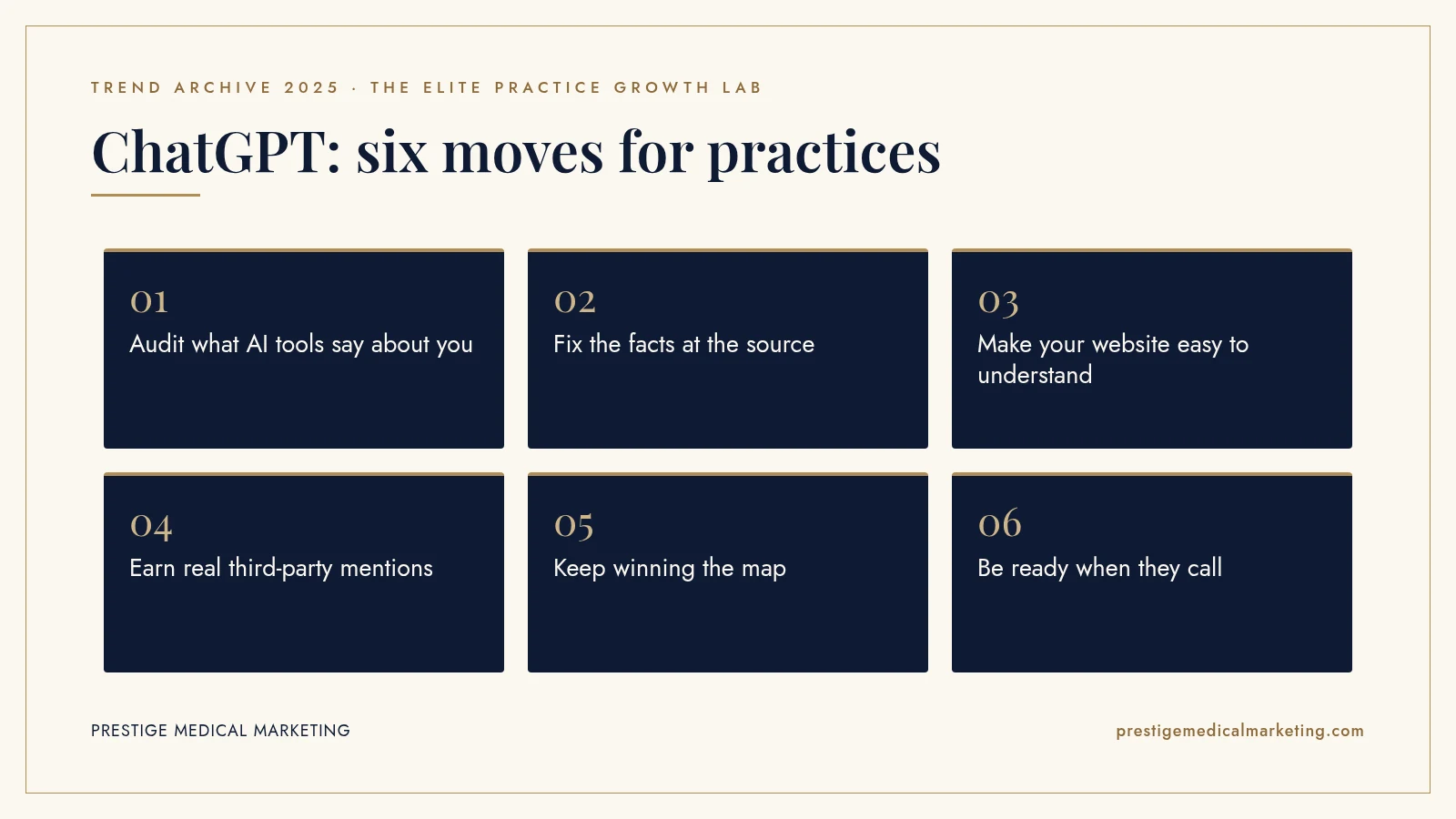
1. Audit what AI tools say about you
Open ChatGPT, Gemini, Meta AI and Google’s AI Mode. Ask what a patient would ask: who offers a treatment you provide near you, what a good clinic looks like, and questions about your practice by name. Write down what is right, what is wrong and who gets recommended instead. This is your baseline.
2. Fix the facts at the source
Your practice name, address, phone, hours, services and providers should match everywhere: your website, Google Business Profile, Apple Business Connect, Bing Places, Yelp, Healthgrades and specialty directories. Inconsistency confuses people and machines alike.
3. Make your website easy to understand
Clear service pages that say what you offer, who provides it, who it is for and how to book. Provider bios with real credentials. Structured data that labels your business, services and FAQs. A site that loads fast and is open to crawlers. Our guide on how to get your practice recommended by AI walks through each piece.
4. Earn real third-party mentions
AI tools pay attention to what others say about you, not just what you say about yourself. Local press, professional associations, community partnerships and patient reviews all count. A steady flow of honest reviews on Google matters here as much as anywhere. See our playbook on reputation and premium pricing.
5. Keep winning the map
Do not let AI distract you from Google Maps, where most local booking intent still lands. Our retrospective on how Google’s Ask Maps changed local search explains how AI is changing the map itself.
6. Be ready when they call
A patient who has already researched with an AI assistant is often ready to book. If they reach voicemail, they move on to the next name. Fast answers and same-day follow-up turn AI visibility into actual patients. That is why we pair visibility work with an AI receptionist for your practice and fast follow-up.

What a patient’s AI conversation looks like
To make this concrete, picture a typical research session. This is an illustration, not a transcript of any real user. A woman in her forties opens an AI assistant and writes that she has been losing weight with a doctor’s help and wants to know about skin tightening. The assistant explains the broad options, from energy-based devices to surgical lifts, with general pros and cons. She asks which is better for the abdomen after significant weight loss. It explains that loose skin often needs a surgical consult, and suggests what to ask. Then she asks who does this well near her.
At that last step, the assistant either names practices or suggests where to look, such as board certification directories and reviews. Whether your practice comes up depends on what the assistant can find and trust about you. If your website clearly describes the procedure, your surgeon’s credentials and your approach for patients after weight loss, you are a better candidate for that answer than a practice whose site just lists “body contouring.”
Notice what happened in that session. The patient’s understanding of the options was shaped before she ever saw your website. The questions she asks your coordinator on the phone will be sharper. And the practices that show up in the answer did not get there by gaming anything. They got there by being clear and credible about the exact situation she described.
Accuracy is now a marketing issue
One more lesson from 2025: AI assistants can get things wrong. They can list a provider who has left, an old address, a service you stopped offering or prices you never charged. When a patient trusts that answer and calls, the first impression starts with a correction.
You cannot edit an AI model directly. But you can reduce errors by keeping your own information current and consistent, removing outdated pages, updating listings whenever something changes, and making sure your provider pages reflect your current team. Treat it like reputation management. Check regularly, fix the source, and check again.
What not to overreact to
It is easy to read “800 million weekly users” and decide your whole marketing plan needs to change. It does not. ChatGPT’s users ask about everything: work, school, code, cooking. Only a slice of that is about finding a provider, and OpenAI has not published how large that slice is.
The right response is proportionate. Keep investing in Google, because that is where most booking intent still lives. Add a regular AI visibility check, fix what is wrong, and make sure your practice’s information is clean and credible. Most of that work also strengthens your Google presence, so very little is wasted.
It also helps to remember what an AI assistant cannot do. It cannot show a patient your space, introduce your injector or answer the phone. It can describe and recommend. The rest still depends on the experience your practice delivers, the reviews that experience earns, and how quickly your team responds when a patient reaches out.
A simple rhythm works well: check AI answers about your practice once a quarter, log what changed, and fix the source of any error the same week. Over a year, that small habit keeps your practice described the way you would describe it yourself.
Why premium practices have the edge here
AI assistants try to give people a good answer. When someone asks for a reputable provider, they look for signals of reputation: credentials, consistent information, strong reviews, real expertise on the website, mentions from credible sources. Those are exactly the things a premium practice already has, or should have.
The budget clinic with a thin website and a handful of reviews has less for an assistant to work with. The premium practice that documents its expertise clearly has more. In that sense, the AI shift rewards the same qualities that let you charge premium prices in the first place.
That is the thinking behind the Prestige System for medical practice marketing: visibility on Google, in Maps and in AI answers, built on real expertise and backed by fast follow-up. Our team works from Austin with practices nationwide.
The bottom line
In 2025, ChatGPT reached 800 million weekly users, Meta AI passed a billion monthly users, and Google pushed AI answers to the top of search. Patients did not abandon Google, but more of them started their research in a conversation.
The practices that benefit are the ones that are easy for both patients and AI tools to understand, verify and recommend. That work starts with your own facts, your own website and your own reputation, which is exactly where you have the most control.
Check if your market is open. We take one practice per specialty per market. Request a market check or call (716) 400-0084.
Put this playbook to work: see how it applies to Google Maps and AI search visibility and med spa marketing.
Frequently asked questions
How many people used ChatGPT in 2025?
OpenAI CEO Sam Altman said at OpenAI's DevDay on October 6, 2025 that ChatGPT had 800 million weekly active users. In August 2025, the figure had been 700 million.
Do patients really use ChatGPT to find doctors and clinics?
Some do, and the public data shows AI is becoming part of search behavior. BrightLocal found 40% of consumers are actively using generative AI within search, and 5% said they default to ChatGPT for general searches. Neither number is specific to healthcare, so treat them as direction rather than a measure of your market.
How does ChatGPT decide which practices to recommend?
OpenAI does not publish a ranking formula. In practice, AI assistants summarize what they can find and trust about a business across the web: its website, business listings, reviews and mentions. Clear, consistent, credible information gives them more to work with.
Can I pay to be recommended by ChatGPT?
Not as a practice owner in the way you buy Google Ads. Be wary of anyone promising guaranteed placement in AI answers. What you can do is make your practice easy to understand and verify, which is the work that tends to improve how AI tools describe you.
Is Google still more important than ChatGPT for a private practice?
For most practices, yes. Google Search and Maps still carry most local booking intent. AI assistants are a growing second front. The good news is that most of the work overlaps: strong pages, complete listings and real reviews help in both.
How do I check what AI tools say about my practice?
Ask them. Try questions a patient would ask, such as the best options for a treatment in your area, and questions about your practice by name. Note what they get right, what they get wrong and who they recommend instead. Repeat every few months.