
Physical therapy marketing works when a private practice stops relying on a few referral sources and builds direct demand. Win local search for the conditions you treat, explain direct access and cost plainly, strengthen physician and trainer referrals, make booking fast and track every patient from first call to completed plan of care.
Many private physical therapy practices grew on referrals from a handful of physicians. That still matters, but it is fragile. One physician retires, a health system hires its own therapists and the schedule thins out overnight. The practices that grow steadily build direct demand: patients who search, find you and book without waiting for a referral slip.
Why private PT practices need direct demand
- Direct access is real. The APTA’s direct access advocacy page explains how patients in every state can see a physical therapist without a physician referral in some form, with rules that vary by state.
- Patients search first. Knee pain, a shoulder injury or post-surgery rehab all start with a search for options nearby.
- Referral sources shift. Health systems increasingly keep referrals in-house.
- Patients compare. Reviews, specialties, hours, location and cost decide who gets the call, often within a few minutes of searching.
Where PT marketing goes wrong, and how we do it instead
They market “PT.” We market outcomes patients care about.
Nobody searches for “therapeutic exercise.” They search for help getting back to running, golf, tennis or picking up their kids. We write pages around those goals and the conditions behind them.
They hide the cost. We explain it.
Patients worry about copays, deductibles and visit limits. We explain insurance, cash-pay options and what a typical plan costs, so patients book with confidence.
They ignore direct access. We lead with it.
Many patients do not know they can book without a referral. We explain your state’s rules and your insurance policies in plain language.
They count leads. We count completed plans.
Our monthly ROI reporting tracks evaluations, show rate, visits per plan and revenue by source. One physical therapy practice per market, month-to-month terms.
They guess. We cite.
We never invent statistics or patient stories. Every number we use links to a credible source, and every claim stays within what your clinicians can support.

Check if your market is open. We partner with one physical therapy practice per market. Request a market check or call (716) 400-0084.
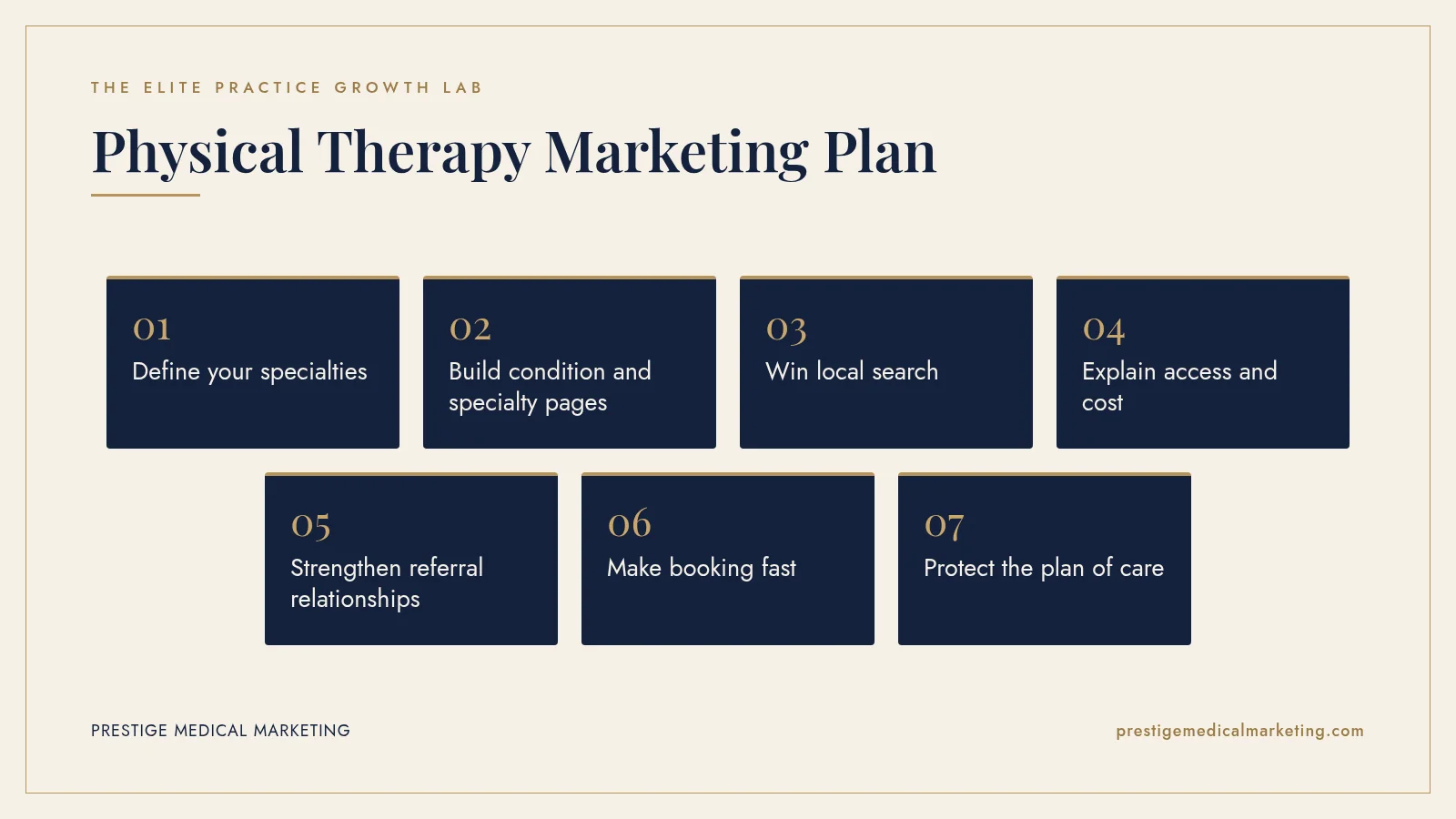
The physical therapy marketing plan, step by step
Step 1: Define your specialties
Sports and orthopedic rehab, post-surgical recovery, vestibular care, pelvic health, performance training: name what your therapists do best. Specialties make you the obvious choice for patients who need them. A practice that claims to treat everything looks like every other practice on the map. Pick the three or four areas where your team has the deepest training and the strongest results, and build your marketing around them first.
Step 2: Build condition and specialty pages
A page for each major condition and specialty, explaining symptoms, the evaluation, what treatment involves, typical plan length and how to book. Include therapist bios with credentials and real photos.
Step 3: Win local search
A complete Google Business Profile with the right categories, services, hours and real photos of your clinic and team. Consistent listings everywhere. A steady flow of honest reviews from every patient, requested at a natural milestone.
Step 4: Explain access and cost
A clear page on direct access in your state, the insurance plans you accept, typical out-of-pocket costs and cash-pay options. Answer the questions that keep patients from calling, before they have to ask.
Step 5: Strengthen referral relationships
Make referring simple, send progress updates promptly with consent and visit key offices regularly. Track referrals by source so you know which relationships to invest in.
Step 6: Make booking fast
Online booking for evaluations, a click-to-call button that reaches a trained person and a fast reply to every form. Our guide to call handling and lead leakage shows where practices lose patients they already paid to attract.
Step 7: Protect the plan of care
Most revenue in physical therapy is won or lost after the first visit, so treat retention as marketing. Set expectations at the evaluation, book visits ahead, send reminders, call after misses and show progress at checkpoints. Then track it all monthly and move budget to what fills the schedule with patients who finish their care.
Mistakes we fix first
- A site that reads like an insurance brochure. Lead with goals and specialties instead.
- No therapist bios. Patients choose people. Show them.
- No mention of direct access. Patients assume they need a referral and wait.
- Slow form replies. A patient with a sore shoulder books wherever answers first.
- Dropping off after discharge. Past patients are your best source of referrals and repeat visits.
- Only tracking new evaluations. Visits per plan and completion rate show where revenue is really won or lost.
Cash-pay services that grow a private practice
Many private practices add services outside insurance to stabilize revenue and serve active patients longer. Examples include performance and return-to-sport programs, wellness and maintenance visits, golf and running assessments and post-discharge strength programs. Give each its own page with a clear price, who it is for and how to book. Market them to past patients first; they already trust your team. A discharged patient who just finished knee rehab is the ideal candidate for a strength program that keeps them on the court. Invite them before they leave, not months later.
Physician and professional referrals, done right
Direct demand does not replace referrals. It makes them less risky. Build a short list of physicians, surgeons, athletic trainers, personal trainers and chiropractors who see your ideal patients. Give each a simple one-page overview of your specialties and how referrals work. Send prompt progress notes with the patient’s consent. Thank partners consistently and track every referral in the same system as your marketing leads, so you can see which relationships produce patients who complete care.
Reviews that reflect real care
Physical therapy patients spend weeks with your team, which gives you more chances to earn a detailed review than almost any other kind of practice. Use them well:
- Ask at a milestone the patient cares about, such as returning to a sport or finishing a plan, not on the first visit.
- Send a direct review link by text, with a short personal note from the therapist.
- Ask every patient, not just the happy ones. The FTC’s rule on fake reviews bans incentivized reviews and review suppression.
- Reply to every review calmly, without confirming that the reviewer is a patient or sharing any health details.
Reviews that mention specific goals, like getting back on the tennis court, help future patients picture their own recovery.
Tracking that shows what actually works
Most PT practices track new evaluations and stop there. That hides the real story. A channel that brings ten evaluations who average four visits is worth less than one that brings six who complete twelve. Track these numbers by source every month:
- Calls, forms and online bookings
- Booked evaluations and show rate
- Average visits per plan of care
- Plan completion rate
- Revenue per new patient
With this view, budget decisions get simple. Spend more where patients complete care and less where they drop off after two visits.
Content that brings in direct-access patients
- “Do I need a referral for physical therapy in [state]?”
- “How much does physical therapy cost without insurance?”
- “Physical therapy vs. chiropractic: which do you need?”
- “How long does physical therapy take after knee surgery?”
- Condition guides for each specialty you offer
Each article should link to the matching specialty page and end with a booking option. Clear, well-sourced answers also help you show up when patients ask AI assistants for help; read our guide to getting your practice recommended by AI.
Website essentials for a private PT practice
- A fast, mobile-first homepage that names your specialties
- Condition and specialty pages for every core service
- A direct access and insurance page written in plain language
- Therapist bios with credentials and real photos
- Online booking for evaluations on every page
- Hours, parking and directions that are easy to find
Questions to ask a physical therapy marketing agency
- What will you report? Evaluations, show rate, visits per plan and revenue by source.
- Who owns my website, profiles and data? You should.
- How do you handle reviews? Every patient, no incentives, no screening.
- Do you work with other PT practices near me? One practice per market protects your strategy.
- What are the terms? Month-to-month keeps the agency accountable.
What good looks like
In ninety days: clear specialties, condition pages under way, a complete map listing, a direct access page, fast booking and full tracking in place. By month six: more evaluations from search, a healthier mix of direct and referred patients and better plan completion. For the bigger picture on steady growth, read predictability and scaling, or see our physical therapy practice page and services overview.
Ready to build direct demand? Check if your market is open or call (716) 400-0084. We’re based in Austin, Texas, and work with practices nationwide.
Put this playbook to work: see how it applies to physical therapy marketing and med spa marketing.
Frequently asked questions
How do private physical therapy practices get more patients?
By combining three sources: direct-access patients from local search, steady referrals from physicians and other professionals, and past patients who return or refer friends. Practices that depend on one source are exposed when it slows down.
Can patients see a physical therapist without a referral?
In every U.S. state patients have some form of direct access to physical therapy, though the rules and limits vary by state and by insurer. The APTA tracks state-by-state details. Explain your state's rules and your insurance policies plainly on your website.
What keywords should a physical therapy practice target?
Local practice searches like "physical therapy near me," condition searches such as "physical therapy for knee pain [city]" or "sports physical therapy [city]," and cost questions such as "how much is physical therapy without insurance."
How do you improve physical therapy plan-of-care completion?
Explain the plan and expected milestones at the evaluation, book visits in advance, send reminders, call after missed visits and show patients their progress at regular checkpoints.
Should a physical therapy practice offer cash-pay services?
Many private practices add cash-pay options such as performance training, wellness visits or out-of-network care. Market them on their own pages with clear pricing, separate from insurance-based care.
How do physical therapy practices get more physician referrals?
Make referring easy, communicate progress promptly with the patient's consent and show up consistently. Physicians refer to practices that make their patients happy and keep them informed.
Is Google Ads worth it for physical therapy?
It can be for high-intent local searches, especially in competitive areas or for new locations. Keep campaigns local, send clicks to matching condition pages with online booking and judge results by booked evaluations.