
Functional medicine marketing works when you make a complex, cash-pay model easy to understand and easy to start. Define who you help and how, publish clear education on the conditions you treat, explain pricing and programs plainly, win local search, offer a low-friction first step such as a discovery call, and track every lead to an enrolled patient.
Functional medicine patients are some of the most motivated people in healthcare. Many have spent years with symptoms that never got a clear answer, and they are ready to invest in care that takes time to listen. They are also careful buyers. They read everything, compare practitioners and look hard at price before they book. Marketing that respects that process wins. Marketing that rushes it, or overpromises, loses.
What makes functional medicine marketing different
- Long research cycles. Patients often read for weeks or months before they reach out.
- Cash pay and memberships. Price is a real decision, so clarity matters more than in insurance-based care.
- Complex care. Testing, protocols and follow-up are hard to explain in a headline.
- High trust stakes. Patients have often been let down before. Overpromising confirms their worst fear.
Good marketing makes the complicated simple and the expensive feel justified.
Where functional medicine marketing goes wrong, and how we do it instead
They talk about root causes. We talk about the patient.
“We find the root cause” appears on almost every functional medicine site. It says nothing specific. We write about the conditions you treat, the patients you help and what working with you looks like week by week.
They hide pricing. We explain it.
Hiding cost does not make it smaller; it makes it scarier. We publish program tiers or ranges and explain what is included, so patients arrive at the consult ready to commit.
They promise to reverse disease. We stay honest.
The FTC’s health products compliance guidance requires health claims to be supported by competent and reliable scientific evidence. We describe your approach, testing and what patients commonly experience, and we cite sources for any numbers.
They post generic wellness content. We build condition authority.
Generic posts about “inflammation” compete with every health site on the internet. Specific, practitioner-reviewed pages about the conditions you actually treat, written for your patients, earn rankings and trust. Google’s guidance on helpful, people-first content rewards exactly that.
They report traffic. We report enrolled patients.
Our monthly ROI reporting tracks discovery calls, consults, enrollments and revenue by source. One functional medicine practice per market, month-to-month terms.

Check if your market is open. We partner with one functional medicine practice per market. Request a market check or call (716) 400-0084.
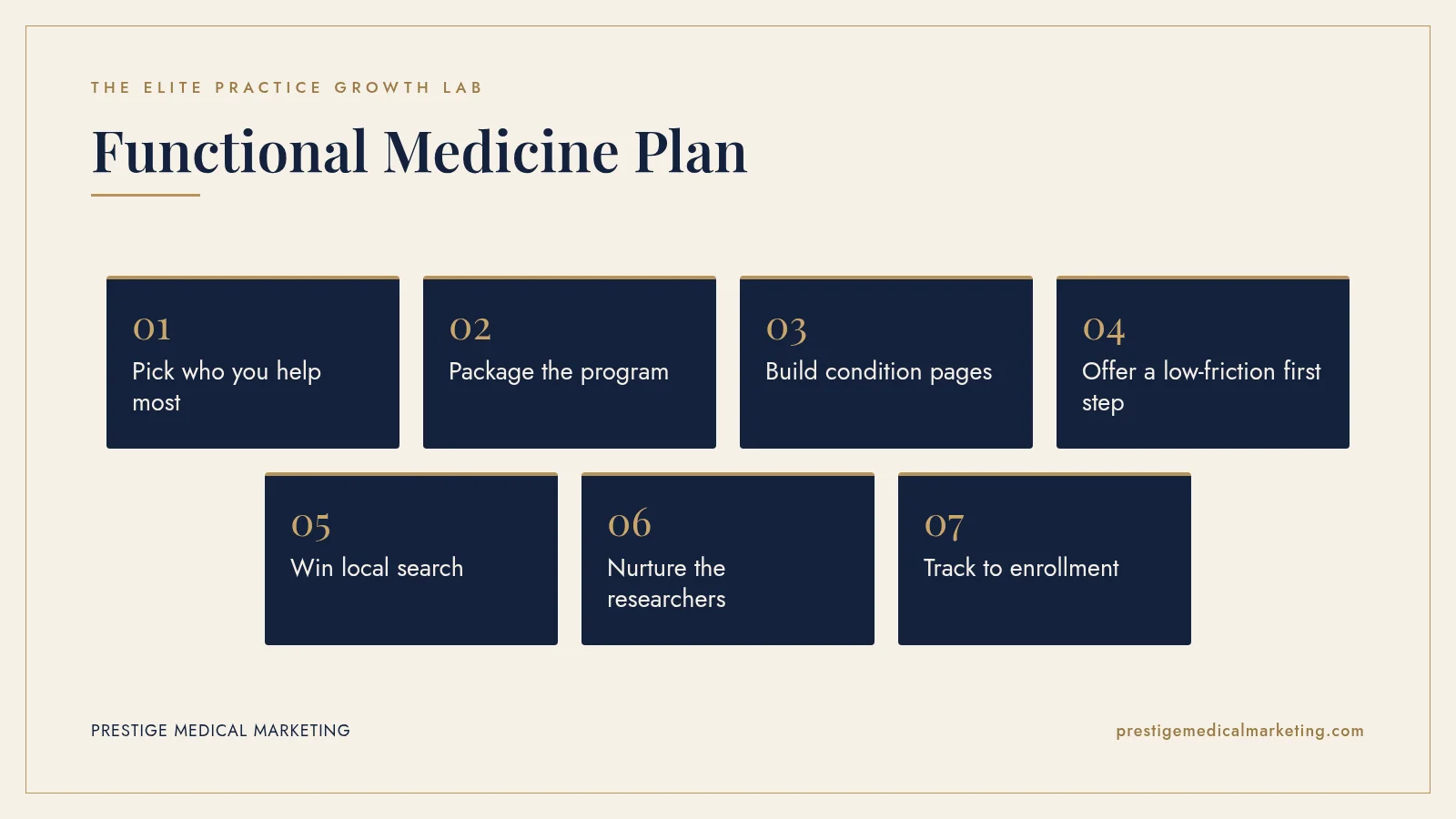
The functional medicine marketing plan, step by step
Step 1: Pick who you help most
Name the three to five patient groups or conditions where your practice does its best work. Gut health, hormone balance, fatigue, metabolic health, autoimmune support: whatever your practitioners know best. Focus beats a list of thirty conditions every time.
Step 2: Package the program
Describe the path: intake, testing, the first plan, follow-ups, coaching and what membership includes. Give each tier a name, a price or range and a clear list of what is included.
Step 3: Build condition pages
For each focus area, a page that explains common symptoms, how your practice evaluates them, the testing you may use and why, what a plan typically involves and how long patients usually work with you. Practitioner-reviewed, with a byline and sources.
Step 4: Offer a low-friction first step
A fifteen-minute discovery call, a short consult or a fixed-price intake. Make it bookable online, explain exactly what happens on the call and keep the script consistent.
Step 5: Win local search
A complete Google Business Profile with accurate categories, services and photos of your real practice and team. Consistent listings everywhere. Reviews requested from every patient at a natural milestone, never screened by sentiment.
Step 6: Nurture the researchers
Many visitors are not ready this month. Offer a useful guide or short email series for each focus area, then invite readers to a discovery call. Keep emails practical and short.
Step 7: Track to enrollment
Connect calls, forms and bookings to your practice software. Measure discovery calls, consults, enrollments, retention and revenue by channel, so budget follows patients, not clicks.
Mistakes we fix first
- A homepage full of philosophy. Patients want to know whether you help people like them. Say it in the first line.
- No pricing anywhere. Calls that end at the price waste your team’s day.
- Practitioner bios buried three clicks deep. Patients choose a person. Show them early.
- A discovery call that turns into a free consult. Keep it short, scripted and focused on fit.
- Slow replies. A motivated patient who waits two days for a callback finds someone else. Our guide to call handling and lead leakage shows where those patients go.
- No follow-up for non-buyers. Most patients who do not book today could book in three months. Stay in touch.
Content that earns trust with careful buyers
Functional medicine content works when it reads like a thoughtful practitioner explaining things to one patient. Topics that pull their weight:
- “What happens at a functional medicine first visit”
- “How much does functional medicine cost, and what is included”
- “Functional vs. conventional care: how they work together”
- Condition explainers for each focus area
- “Which lab tests we use and why”
Each piece links to the right program page and ends with an invitation to a discovery call. This is also the content AI assistants cite when patients ask which practitioners to trust. Our guide to getting recommended by AI explains how to earn those mentions.
Pricing and the consult conversation
For cash-pay practices, the consult is where marketing turns into revenue. Help your team win it:
- Send the program overview and pricing before the consult, so no one is surprised.
- Open with the patient’s goals, then show how the program addresses them.
- Offer two or three clear options, not a custom quote every time.
- Make enrollment simple: one link, one payment plan, one start date.
- Follow up within a day with a short summary and the enrollment link.
Track consult-to-enrollment rate by practitioner and by lead source. If patients from one channel enroll at half the rate of another, the problem is usually the message that brought them in, not the consult itself. Fix the message, and the consult gets easier for everyone.
Website essentials for a functional medicine practice
- A homepage that names who you help and how, in plain language
- Condition pages for each focus area
- A programs and pricing page
- Practitioner bios with credentials, training and photos
- A discovery call or consult booking button on every page
- Patient education resources and a short email series
Referrals and partnerships
Functional medicine practices often grow through trusted professionals as much as through search. Personal trainers, nutrition coaches, chiropractors, physical therapists and primary care physicians all see patients who want a deeper look. Build those relationships on purpose:
- Create a one-page overview for referring professionals: who you help, how referrals work and how you communicate back.
- Send a short update to the referring professional after the first visit, with the patient’s consent.
- Track referrals by source in the same system as your marketing leads, so you see which partners send patients who enroll.
- Thank partners consistently. A handwritten note goes further than a gift card.
Retention is part of marketing
A patient who completes a full program and renews is worth several who stop after the first month. Plan for it: set expectations at enrollment, schedule follow-ups before the patient leaves the office, check in between visits and offer a maintenance membership when the active phase ends. Ask for a review when a patient reaches a goal they care about. Retention by source shows which channels bring patients who stay, and that is where the budget belongs.
Questions to ask a functional medicine marketing agency
- How do you handle health claims? They should talk about evidence, sources and practitioner review.
- What do you report? Discovery calls, consults and enrollments by source.
- Who owns the website, accounts and data? You should.
- Do you work with competitors in my area? One practice per market is the only arrangement that protects your strategy.
- What are the terms? Month-to-month keeps an agency focused on results.
What good looks like
In ninety days: clear focus areas, a packaged program with pricing, condition pages under way, a bookable first step, a complete map listing and tracking to enrollment. By month six: consistent discovery calls, a higher share of patients who arrive ready to enroll and a clear view of which channels bring patients who stay. Visit our functional medicine practice page or our services overview.
Ready to grow with patients who stay? Check if your market is open or call (716) 400-0084. We’re based in Austin, Texas, and work with practices nationwide.
Put this playbook to work: see how it applies to functional medicine marketing and med spa marketing.
Frequently asked questions
How do functional medicine practices get new patients?
Most come from search, referrals and education. Patients look up symptoms and conditions, find practitioners who explain them clearly, and then check reviews and pricing. A site with strong condition pages, a clear program, visible pricing guidance and an easy first step converts that research into consults.
Should a functional medicine practice show its prices?
Yes, at least as ranges or program tiers. Cash-pay patients expect to see what care costs. Clear pricing filters out poor-fit leads and saves your team hours of calls that end at the price.
What is a discovery call, and does it work?
A short, free call where a team member or practitioner explains the program and answers questions. It lowers the barrier for patients who are not ready to pay for a full intake. It works best with a clear script, a fixed length and a direct invitation to book at the end.
Do webinars and workshops work for functional medicine marketing?
They can, for practices whose patients like to learn before they commit. Keep them focused on one topic, invite attendees to a specific next step and track how many become patients. Drop the format if it fills seats but not schedules.
Which keywords should a functional medicine practice target?
Local practice searches like "functional medicine doctor near me" and "functional medicine [city]," plus condition and symptom searches tied to the conditions you treat, and cost and process questions such as "how much does functional medicine cost."
How do you market functional medicine without overpromising?
Explain your approach, the testing you use and why, and what patients commonly experience, without promising to cure or reverse conditions. Support any health claim with credible evidence and link to sources. Plain honesty builds more trust than bold promises.
How long does it take to see results from functional medicine SEO?
Local map rankings and long-tail condition pages often move within three months. Broader condition topics take six to twelve months of consistent, well-researched content.