
On April 28, 2021, HHS practice guidelines took effect that exempted eligible physicians, physician assistants, nurse practitioners, clinical nurse specialists, certified registered nurse anesthetists and certified nurse midwives from certain certification requirements related to training, counseling and other ancillary services when treating up to 30 patients with buprenorphine for opioid use disorder. A Notice of Intent was still required. In December 2022, the Consolidated Appropriations Act, 2023 removed the federal waiver requirement altogether.
For many people living with opioid use disorder, the hardest part of treatment is the first step: finding a clinician who can help and feeling safe enough to ask. For years, federal rules shaped how many clinicians could offer one of the most studied medications for that condition. In 2021, those rules began to loosen.
On April 28, 2021, the Department of Health and Human Services published practice guidelines for the administration of buprenorphine for treating opioid use disorder. The guidelines removed a training certification that many clinicians had described as a barrier, and they set the stage for bigger changes that followed at the end of 2022.
This retrospective explains what happened in 2021, why behavioral health practices paid attention, what changed afterward and what it means for how a practice communicates today. For related chapters, see our pieces on the 2022 launch of the 988 Lifeline and the 2025 Medicare telehealth lapse.
What actually happened in 2021
Under the Drug Addiction Treatment Act of 2000, often called DATA 2000, practitioners who wanted to prescribe buprenorphine for opioid use disorder outside a specialized opioid treatment program needed a waiver. To get it, they submitted a Notice of Intent to the Substance Abuse and Mental Health Services Administration, known as SAMHSA, with certifications about training and about their capacity to refer patients for counseling and other services.
The practice guidelines published in the Federal Register changed part of that process. They exempted eligible physicians, physician assistants, nurse practitioners, clinical nurse specialists, certified registered nurse anesthetists and certified nurse midwives who were state licensed and registered with the DEA from the certification requirements related to training, counseling and other ancillary services.
The exemption came with limits. It allowed these practitioners to treat up to 30 patients with buprenorphine for opioid use disorder without making the training-related certifications. Practitioners were still required to submit a Notice of Intent. The guidance took effect the day it was published.
The Federal Register notice described the purpose plainly: addressing perceived barriers to prescribing buprenorphine, especially the training requirement. It also noted that medication-based treatment, as part of a comprehensive treatment plan that may include counseling and behavioral therapies, is an effective approach that can sustain recovery and prevent overdose.
Why it mattered for behavioral health practices
Behavioral health practices sit at the center of this work. Some already offered medication treatment. Others offered therapy and psychiatric care and referred patients elsewhere for medication. The 2021 guidelines made it easier for more clinicians, including nurse practitioners and physician assistants who often staff outpatient behavioral health practices, to begin offering buprenorphine to a limited number of patients.
That had practical consequences. A practice that added medication treatment needed to tell people about it accurately. It needed intake processes that could handle sensitive first conversations. It needed to explain what treatment involved, without promising outcomes, and to make clear what was and was not offered.
It also mattered for trust. People seeking help for substance use often fear judgment. How a practice talks about treatment online, from the words on its website to the tone of its intake call, can determine whether someone follows through.
What typical agencies did
Many generic agencies treated the change as a keyword opportunity. They pushed pages targeting broad treatment terms, wrote copy that promised quick results and used urgent, pressured language that could feel exploitative to someone in a vulnerable moment.
Others ignored the regulatory detail entirely. They wrote as though any clinician could prescribe without limits, or they failed to mention that the waiver still existed in 2021. For a field where accuracy and trust are central, those shortcuts created real risk.
A more careful approach treated the change as a reason to improve clarity, privacy and the human experience of reaching out, not as a chance to chase volume.
What it means for a behavioral health practice today
The 2021 guidelines are no longer the current rule, but the lessons apply directly to how a practice presents medication treatment and other sensitive services today.
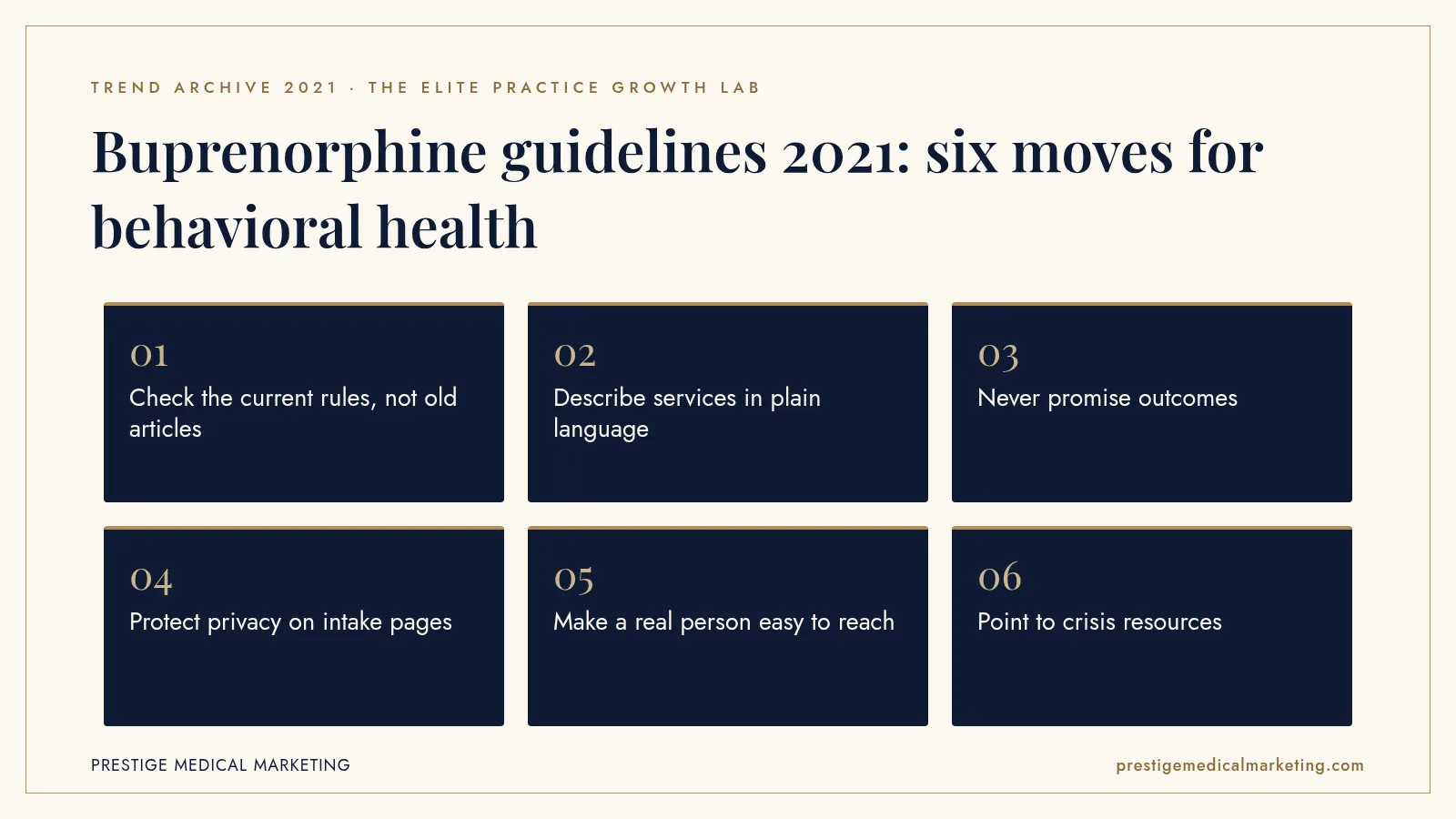
1. Check the current rules, not old articles
The rules changed again after 2021. Before publishing anything about who can prescribe or how treatment works, confirm current federal and state requirements with qualified advisors.
2. Describe services in plain language
Explain what the practice offers, who it is for and what a first appointment looks like. Avoid jargon and avoid language that shames or frightens.
3. Never promise outcomes
Recovery is personal and varies. Describe the approach and the care team, not guaranteed results or timelines.
4. Protect privacy on intake pages
Pages about substance use treatment are among the most sensitive a practice owns. Keep third-party tracking off them and keep forms minimal.
5. Make a real person easy to reach
Many people need to talk before they book. A warm, prompt phone response often matters more than any page.
6. Point to crisis resources
Make it clear that people in immediate danger should call 911 or contact the 988 Suicide and Crisis Lifeline, and that the practice is not an emergency service.

What changed after 2021
The 2021 guidelines were not the end of the story. According to SAMHSA, Section 1262 of the Consolidated Appropriations Act, 2023 removed the federal requirement for practitioners to submit a Notice of Intent to prescribe medications such as buprenorphine for opioid use disorder. SAMHSA stopped accepting waiver applications, and says practitioners who have a current DEA registration that includes Schedule III authority may now prescribe buprenorphine for opioid use disorder in their practice if permitted by applicable state law.
SAMHSA describes the waiver requirement as removed in December 2022. The 30-patient framework of the 2021 guidelines, and the waiver it modified, became history. State law still matters, and SAMHSA also points practitioners to separate training requirements that took effect in 2023. That is another reason any practice should verify the current rules before describing them publicly.
Why the language of treatment matters
Words shape whether people seek care. Terms that label people rather than describe a condition can feel judgmental, while clear, respectful language can make reaching out feel possible. Behavioral health practices have an opportunity to set the tone across their website, emails, social posts and phone scripts.
That does not mean avoiding plain words. People search using the terms they know, and a page should use language they recognize. The goal is to pair findable language with warmth and dignity, so the page both reaches people and respects them once they arrive.
Families are often the first visitors
In many cases, the first person to visit a treatment page is not the patient but a worried parent, partner or friend. Their questions are different. They want to know how to talk to someone they love, what treatment involves and what support exists for them too. A practice that offers family guidance, or that clearly explains how families can be involved with the patient’s permission, meets a real need and earns trust from people who influence the decision to seek care.
Integrating medication with counseling and therapy
The 2021 Federal Register notice framed medication-based treatment as part of a comprehensive plan that may also include counseling and behavioral therapies. Behavioral health practices are well placed to offer that combination. Explaining how therapy, psychiatric care and medication fit together, and how the care team coordinates, helps people understand that they are choosing a whole approach rather than a single prescription.
It also gives the practice a clear and honest way to differentiate itself. Rather than competing on speed or price, it can explain the depth of its care and the people who provide it.
Telehealth and access
Telehealth has become central to behavioral health, but the rules for prescribing controlled substances via telehealth have shifted several times and remain subject to federal and state requirements. A practice offering virtual care should describe it accurately, state where it can serve patients and avoid implying services that are not available in a given state. Our piece on the 2025 Medicare telehealth lapse shows how quickly those rules can move.
Measuring growth without exposing people
Practices need to know whether their outreach works, but measurement must not come at the expense of privacy. Use aggregate, privacy-respecting analytics, avoid sending identifiable or sensitive information to advertising platforms and measure what matters most: completed intake conversations and booked first appointments. Our piece on the 2022 HHS tracking technology bulletin covers the privacy side in more depth.
Advertising sensitive services carefully
Advertising platforms apply special rules to addiction-related services, and those rules can change. Before running paid campaigns, a practice should review the current policies of each platform and confirm whether any certification or approval is needed. Ad copy should be calm, factual and free of pressure, and landing pages should match what the ad promises.
A short checklist for leadership
Leaders can ask a few practical questions. Is everything we say about prescribing accurate under current federal and state rules? Are our treatment pages free of third-party tracking? Can a nervous caller reach a trained, kind person quickly? Do we clearly state what we offer, where and to whom? Do we point people to emergency resources? Answering those questions honestly does more for growth than any new campaign.
Consistency across every channel
A person may first see a practice in a map listing, then visit its website, then call. If the listing, the site and the phone conversation describe services differently, confidence drops. Keeping service descriptions, hours, locations and accepted insurance consistent everywhere is simple, unglamorous work, but it removes doubt at the exact moment someone is deciding whether to reach out for help. Small details, handled well, signal that the whole practice is careful.
What 2021 does not tell us
The 2021 guidelines show the direction federal policy was moving, but they do not tell any single practice how to structure its clinical services, which state rules apply or how a given community will respond. Those answers depend on local law, clinical judgment and the needs of the people a practice serves. Treat this history as context, not as legal or clinical advice.
The premium practice advantage
A premium behavioral health practice earns trust through clinical depth, accurate communication and real respect for privacy. Our work is helping people find care and start it without fear or friction. See our behavioral health services, our custom websites, our call handling, our booking engine, our full services and who we help. Our team works from Austin with practices nationwide.
The bottom line
In April 2021, federal practice guidelines removed a training certification for buprenorphine prescribing, and by the end of 2022 the waiver itself was gone. For behavioral health practices, the lasting lesson is about communication: describe treatment accurately, speak with dignity, protect privacy and make the first conversation easy.
Check if your market is open. We take one practice per specialty per market. Request a market check or call (716) 400-0084.
Frequently asked questions
What did the 2021 buprenorphine practice guidelines do?
They exempted eligible, state-licensed, DEA-registered practitioners from certain certification requirements related to training, counseling and other ancillary services, allowing them to treat up to 30 patients with opioid use disorder using buprenorphine.
When did the guidelines take effect?
The guidance took effect on April 28, 2021, when it was published in the Federal Register.
Did the 2021 guidelines remove the waiver?
No. Practitioners still had to submit a Notice of Intent to prescribe buprenorphine for opioid use disorder. The waiver requirement itself was removed later.
What changed in December 2022?
Section 1262 of the Consolidated Appropriations Act, 2023 removed the federal requirement to submit a Notice of Intent. SAMHSA says practitioners with a current DEA registration that includes Schedule III authority may prescribe buprenorphine for opioid use disorder if permitted by applicable state law.
Why does this matter for behavioral health marketing?
As more clinicians became able to offer medication treatment, practices needed to explain their services clearly, accurately and with care, so people seeking help could understand their options and take the first step.
What should a behavioral health practice do today?
Confirm current federal and state rules with qualified advisors, describe services honestly, protect privacy on intake pages and make it simple and respectful for people to reach a real person.