
TikTok announced on September 27, 2021 that more than 1 billion people around the world were coming to the app every month. For med spas, the milestone confirmed that short, vertical video had become a major way people learned about aesthetic treatments. The lasting lesson was to use short video to educate and build trust in the practice's own experts, while keeping claims accurate and owning the client relationship rather than depending on any single platform.
By 2021, aesthetic treatments had found a new kind of showroom. People were watching injectors explain lip filler technique, skin specialists walk through a chemical peel and clients describe what a treatment actually felt like, all in short vertical videos scrolling past on a phone. TikTok was at the center of that shift.
On September 27, 2021, the company announced that more than a billion people were coming to TikTok every month. For med spas, the number did not create the trend, but it confirmed something many owners had already noticed at the front desk: new clients were arriving having already watched videos about the treatment they wanted.
This retrospective covers what TikTok announced in 2021, why it mattered to med spas, how agencies responded and what still holds today. For later chapters, see our pieces on Instagram’s 2022 rollback of TikTok-style changes, TikTok and Instagram as search engines in 2022 and the day TikTok went dark in 2025.
What actually happened in 2021
September 27: the milestone. In a newsroom post, TikTok said more than 1 billion people around the world were coming to the app every month. The company framed the milestone around its community of creators and the variety of content on the platform.
A year of rapid growth. The announcement capped a period in which short-form vertical video spread across platforms. Instagram had launched Reels in 2020, YouTube was rolling out Shorts, and in mid-2021 Instagram’s leadership said the app was shifting toward video and entertainment.
Aesthetics finds an audience. Through 2021, aesthetic and skin care content became one of the most visible categories on short video platforms. Injectors, skin specialists and clients posted explanations, treatment walk-throughs and results, and viewers used those videos to research treatments before contacting a practice.
Why it mattered for med spas
Med spa treatments are personal and visual. A client considering lip filler, neuromodulators or a laser treatment wants to know what it looks like, who performs it, how it feels and what recovery involves. Short video answers those questions faster and more vividly than text, which is why it became such a powerful research tool.
The shift also changed the starting point of the client journey. Instead of searching for a med spa near me, many people first encountered a treatment through a video, then looked for a provider who seemed trustworthy. The practices that benefited were the ones whose own experts were visible, credible and easy to find.
There was a downside. The same format that made education easy also made exaggeration easy. Heavy filters, dramatic results without context and undisclosed paid promotions became common, and aesthetic practices had to decide whether to compete on spectacle or on trust.
What typical agencies did
Many agencies chased reach. They pushed trends, sounds and challenges that had little to do with the practice, measured success in views and followers and treated a viral video as a win even when it attracted people who would never book.
Some went further and encouraged before-and-after content without clear consent or context, or paid creators without making the relationship clear. Those choices could create problems with platform rules, professional standards and the FTC’s guidance on endorsements.
The more effective agencies used short video as education. They put the practice’s real injectors and clinicians on camera, answered common questions honestly and connected video to a simple path to book.
What it means for a med spa today
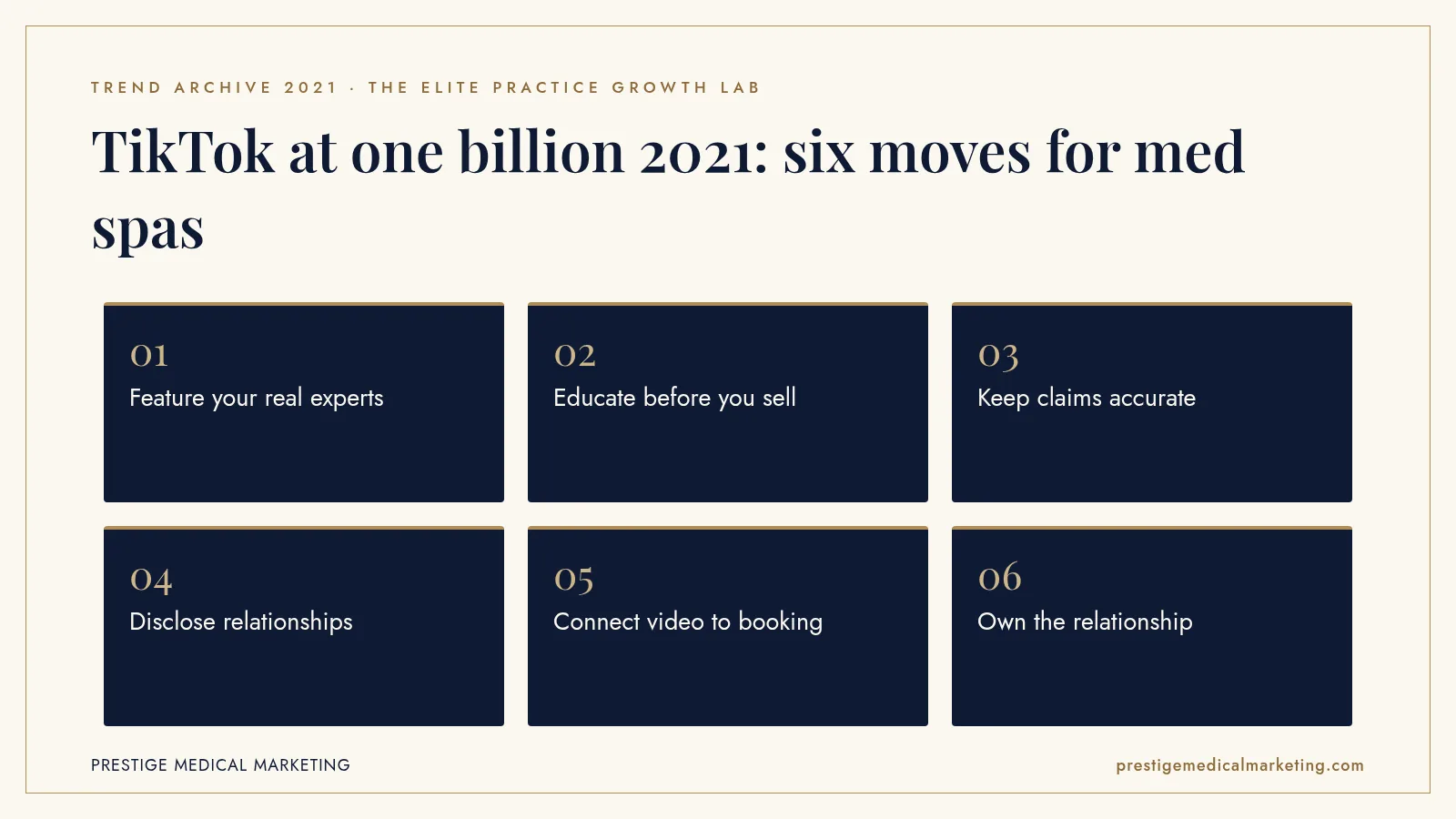
Short video is now a permanent part of aesthetic marketing. These habits make it work for a premium practice.
1. Feature your real experts
Clients book with people they trust. Let your injectors and clinicians explain treatments in their own words, with their credentials visible.
2. Educate before you sell
Videos that explain what a treatment does, who it suits and what recovery looks like attract better-fit clients than promotional clips.
3. Keep claims accurate
Show realistic results with consent and context, avoid promising outcomes and remember that results vary from person to person.
4. Disclose relationships
If a creator or client is paid or receives free treatment in exchange for content, that relationship should be clearly disclosed.
5. Connect video to booking
A video that inspires interest should lead to a clear, fast way to book a consultation, with a website that is easy to use on a phone.
6. Own the relationship
Followers belong to the platform. Email lists, client records and a strong website belong to the practice.

Views are not clients
One of the most important lessons of the short video era is that attention and bookings are different things. A video can reach many thousands of people and produce very few consultations if it attracts viewers who are curious rather than ready, or who live far from the practice. A modest video that answers a real question for local clients can be worth more.
The way to know is to measure. Every inquiry should be logged with its source, and every new client should be asked how they found the practice. Over a few months, patterns appear: which kinds of videos lead to bookings, which treatments generate serious interest and which content draws only passive viewers.
Brand and tone for a premium practice
Short video rewards personality, but personality does not have to mean noise. A premium med spa can be warm, clear and confident without chasing every trend. Well-lit footage, calm explanations and a consistent visual style communicate quality. The goal is for a viewer to think this is a place where I would feel safe and well cared for.
That tone carries through to the website and the consultation. When a client who first saw a calm, expert video arrives at a website and a front desk that feel the same way, the practice’s brand becomes consistent and memorable.
Consent and privacy in aesthetic video
Clients who appear in videos should give clear, written consent that covers how and where the content will be used. Faces and bodies are personal, and a client who agreed to a photo for a chart may not have agreed to appear in a video seen by thousands. A respectful consent process protects both the client and the practice.
The same care applies to messages and comments. A med spa should avoid discussing a specific client’s treatment in public replies and should move sensitive questions to private, secure channels.
Platform risk is real
A billion monthly users can make a platform feel permanent, but no platform is guaranteed. Algorithms change, features appear and disappear and legal pressure can disrupt access. In the United States, TikTok faced a federal divestment law in 2024 and briefly went dark in January 2025. Med spas that had built their entire client pipeline on one app learned how fragile that was.
The safer approach is to use short video for discovery while building assets the practice controls: a fast website, a strong Google Business Profile, an email list and a reputation that clients carry by word of mouth.
Repurposing video across channels
A good educational video does not have to live on one platform. The same explanation of a treatment can appear on the practice’s website, in an email to existing clients, on YouTube and in a consultation follow-up. Each use extends the value of the work and reduces dependence on any single app’s algorithm.
Repurposing also makes the practice’s content library more useful over time. A collection of clear, accurate videos about each core treatment becomes an asset that helps clients prepare for consultations and helps staff answer common questions consistently.
How a med spa can plan its video calendar
A sustainable plan is usually modest. A practice might commit to a small number of short videos each month, built around the questions clients ask most often at consultations. Each video is reviewed for accuracy and consent before posting, published on the platforms the practice uses and added to the relevant treatment page on the website.
That rhythm is easier to maintain than a daily posting schedule and tends to produce content with lasting value. Over a year, the practice builds a library of trustworthy explanations rather than a feed of forgotten trends.
Training the team to appear on camera
Many injectors and clinicians are excellent with clients and uncomfortable in front of a camera. That is normal, and it is solvable. Short practice sessions, simple talking points drawn from real consultation questions and permission to keep things natural usually produce better results than scripted performances. Clients respond to clarity and warmth far more than to polish.
It also helps to agree on boundaries in advance. Team members should know which topics they are comfortable discussing, which claims they should never make and who reviews content before it goes live. A clear process protects the people on camera as much as it protects the practice.
Answering comments and messages well
Short video creates conversation. Viewers ask about price, pain, downtime and whether a treatment would suit them. Thoughtful public replies that answer general questions, and an easy invitation to continue privately, turn curiosity into consultations. Replies should stay general and avoid diagnosing or recommending treatment for a specific person in public.
Response time matters here as much as it does on the phone. A question answered the same day is far more likely to become a booking than one that sits for a week, so someone on the team should own the inbox and the comments. Consistency matters more than any single viral post.
What 2021 does not tell us
TikTok’s milestone was a global figure and did not describe how many users were in any one country, how many were interested in aesthetics or how often viewers went on to book treatments. There is no reliable public data on how much of med spa demand in 2021 originated on short video. What the milestone does show is that short vertical video had become a mainstream way people explored treatments, and that practices with credible, visible experts were well placed to benefit.
The premium practice advantage
A premium med spa has what short video rewards over time: real expertise, honest results and a client experience worth talking about. The work is presenting it clearly and measuring what actually books. See our med spa services, our booking engine, our reputation and premium pricing work, our full services and who we help. Our team works from Austin with practices nationwide.
The bottom line
When TikTok announced more than a billion monthly users in September 2021, it confirmed that short video had become a main way people researched aesthetic treatments. For med spas, the lasting lesson was to feature real experts, keep claims honest, connect video to booking and own the client relationship rather than depending on any one platform.
Check if your market is open. We take one practice per specialty per market. Request a market check or call (716) 400-0084.
Frequently asked questions
When did TikTok reach one billion users?
TikTok announced on September 27, 2021 that more than 1 billion people around the world were coming to TikTok every month.
Why did the milestone matter to med spas?
It confirmed that short vertical video had become a mainstream place where people discovered and researched aesthetic treatments such as injectables, skin treatments and body contouring.
Did med spas need to post trends and dances?
No. Educational, honest video featuring the practice's own injectors and clinicians generally builds more trust with premium clients than chasing trends.
What are the risks of short video for aesthetic practices?
Exaggerated claims, unconsented or misleading before-and-after content, and undisclosed paid endorsements can create regulatory and reputational risk.
Should a med spa rely on TikTok for growth?
No single platform should carry a practice's growth. Platforms change rules and can even face legal disruption, as TikTok did in the United States in 2025.
How should a med spa measure short video?
Track inquiries and booked consultations by source in the practice's own systems, and ask new clients how they found the practice, rather than relying only on views.