
On November 10, 2025, HHS and FDA announced they were initiating removal of broad boxed warnings from menopausal hormone therapy products, removing references to risks of cardiovascular disease, breast cancer and probable dementia, while keeping the endometrial cancer boxed warning for systemic estrogen-alone products. FDA approved the first six updated labels in February 2026. For functional medicine and hormone practices, it opened a larger, more informed conversation about menopause care, and raised the bar for accurate marketing.
Few labels have shaped a whole area of medicine the way the menopause hormone therapy boxed warning did. For more than twenty years, it sat at the top of the prescribing information, warning about heart disease, breast cancer and dementia. Many women never asked about hormone therapy. Many doctors did not offer it.
On November 10, 2025, HHS and FDA announced they were starting to take most of that warning off.
For functional medicine, integrative and hormone-focused practices that care for women in midlife, it was one of the most consequential health policy events of the year. It also created a marketing risk: the temptation to overstate what changed. This retrospective covers the facts and what a practice owner should do today.
What actually happened in 2025
In its November 10, 2025 announcement, FDA said it was initiating the removal of broad “black box” warnings from hormone replacement therapy products for menopause. Key points from the announcement:
- FDA said the action followed a comprehensive review of the scientific literature, an expert panel in July 2025 and a public comment period.
- It was working with companies to update labeling to remove references to risks of cardiovascular disease, breast cancer and probable dementia from the boxed warning.
- It was not seeking to remove the boxed warning for endometrial cancer for systemic estrogen-alone products.
- It said hormone therapy use plummeted in the early 2000s after boxed warnings were applied following the Women’s Health Initiative study, and noted the average age of women in that study was 63.
FDA’s accompanying drug safety statement described the labeling changes it requested to clarify benefit and risk considerations. HHS also published a fact sheet summarizing the action.
The process continued into the new year. On February 12, 2026, FDA said it had approved labeling changes for six menopausal hormone therapy products, the first batch, and that 29 drug companies had submitted proposed labeling changes at its request.
Why this matters for functional medicine and hormone practices
Menopause care has been underserved for years. Many women in their forties and fifties describe hot flashes, night sweats, poor sleep, mood changes and other symptoms, and feel they were not given clear options. Functional medicine, integrative and hormone-focused practices have built a lot of their patient base by filling that gap with longer visits, more listening and a whole-person approach.
The November announcement put menopause in the national news. Women who had never considered hormone therapy started asking about it. Women who had stopped it years ago wondered whether to revisit it. Primary care physicians fielded new questions. That is a surge of interest, and practices that already offer thoughtful menopause care are well positioned to meet it.
It also changes the tone of the conversation. For two decades, practices that offered hormone therapy had to start with a defense. Now they can start with an explanation of what the evidence review found, what changed on the label and what still requires care.
What typical agencies did with the news
Predictably, some marketers jumped straight to headlines like “HRT is safe now” or “FDA says hormones prevent disease.” Neither is what FDA announced. The boxed warning for endometrial cancer for systemic estrogen-alone products remained, and hormone therapy is still a prescription treatment with risks and benefits that depend on the individual.
Others blurred the line between FDA-approved hormone products and compounded hormone preparations, implying the label changes applied to everything a practice prescribes. The announcement concerned labeling for approved products. Compounded preparations are not FDA-approved, and marketing them as if they carry FDA’s conclusions is a mistake.
The average agency sees a news hook. A good partner sees a trust opportunity, and protects it.
What it means for a practice today
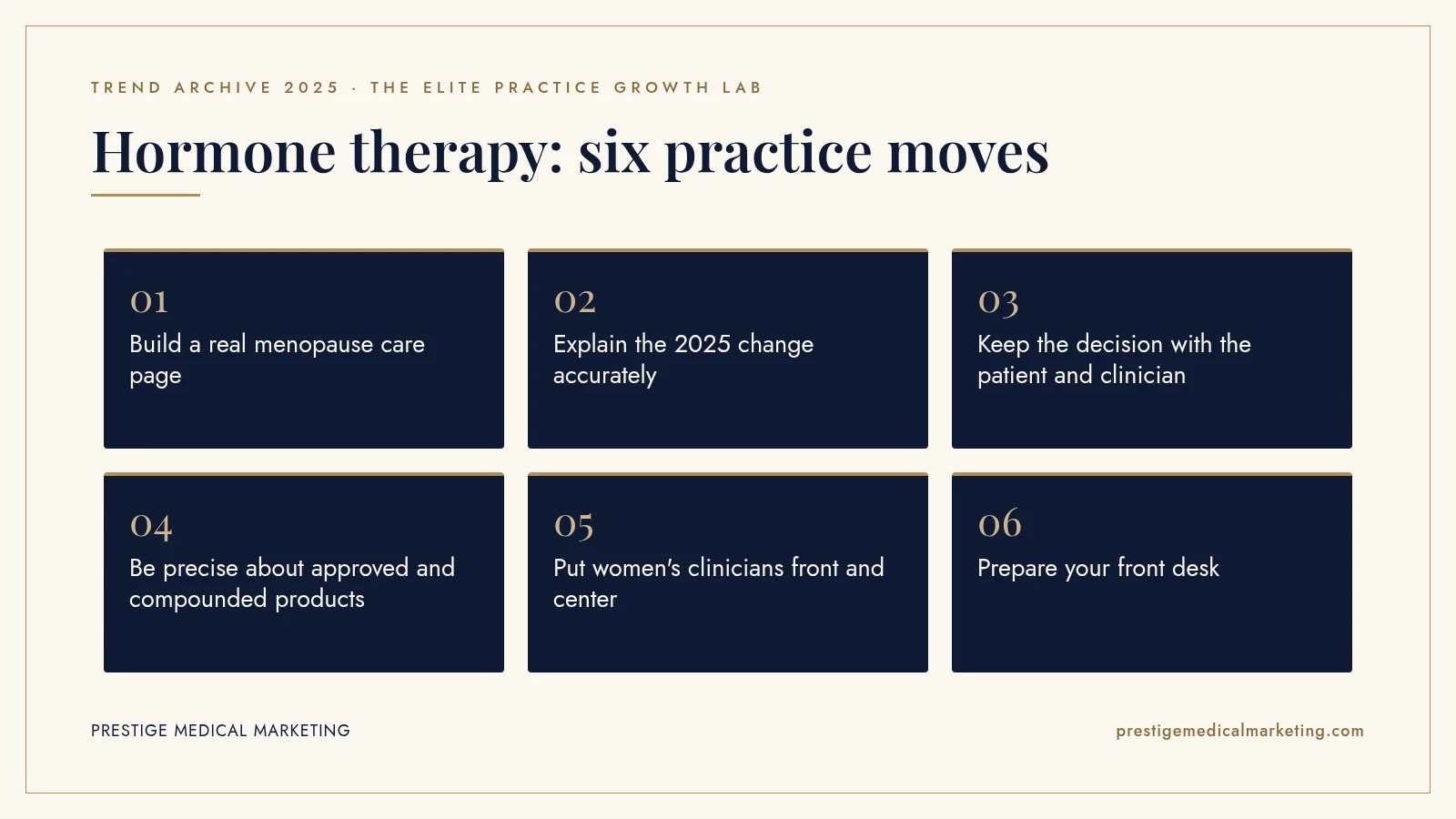
1. Build a real menopause care page
Create a dedicated page for menopause and perimenopause care. Explain who it is for, the symptoms that bring women in, how your evaluation works, the options you offer, how you monitor treatment and who provides care. Our functional medicine marketing guide covers the structure we use for service pages like this.
2. Explain the 2025 change accurately
Add a short section, reviewed by your clinicians, on what FDA announced: removal of boxed warning language on cardiovascular disease, breast cancer and probable dementia, with the endometrial cancer warning retained for systemic estrogen-alone products. Link to FDA’s announcement. Date the section and update it as more labels are approved.
3. Keep the decision with the patient and clinician
Make it clear that hormone therapy is not right for everyone and that your clinicians evaluate each woman individually, including history and risk factors. Offer non-hormonal options where appropriate. This is both honest and reassuring.
4. Be precise about approved and compounded products
If your practice uses compounded hormones, describe them accurately, never imply they are FDA-approved, and do not apply the label changes to them in your marketing. Have counsel review any page that discusses specific products.
5. Put women’s clinicians front and center
Women researching menopause care want to know who they will see. Name your clinicians, describe their training and experience in midlife women’s health, and show a warm, professional environment. Trust is the product. A short video introduction from each clinician can help, too.
6. Prepare your front desk
Interest spikes bring calls. Make sure your team can explain your menopause care process, consultation fees, lab testing and timelines clearly, and can book quickly. Missed calls during a news cycle are lost patients.

Questions women are asking, and how to answer them
Here are questions a menopause care practice should be ready to answer on its website and by phone, in language its clinicians review.
“I heard the warnings were removed. Does that mean hormones are safe for me?” The best answer explains that FDA removed some broad warnings after reviewing the evidence, that risks still depend on age, timing and health history, and that the practice will evaluate her individually.
“I stopped hormones years ago because of the warning. Should I restart?” The best answer invites her for an evaluation rather than giving a yes or no online.
“What if I do not want hormones?” The best answer describes non-hormonal options your practice offers and makes clear she will not be pushed toward any treatment.
“Will insurance cover this?” The best answer is specific about what your practice bills, what is cash-pay and what to expect at the first visit.
Answering these questions clearly does two things. It earns trust with the patient reading your page today, and it gives search engines and AI assistants credible, specific material when women ask them the same questions.
A whole-person model is the right fit
The renewed attention on menopause is an opening for practices that do more than prescribe. Midlife women’s health touches sleep, weight, bone health, metabolic health, mood, sexual health, strength and long-term heart health. Functional medicine and integrative practices that already take a whole-person view can show how hormone therapy, when appropriate, fits into a broader plan.
That is a better story than any single treatment. It also builds longer relationships, which matters for practices that rely on memberships or ongoing care. For a practice that also offers longevity services, it connects naturally to the themes in our longevity clinic marketing guide.
It is also worth building referral relationships with gynecologists and primary care physicians who may not have time for longer menopause visits. A practice that becomes the trusted local place for thorough midlife care can earn steady referrals, not just search traffic.
A marketing checklist for menopause care
Before any menopause-related page, ad, email or social post goes live, run it through a short checklist. It takes minutes and prevents most problems.
Accuracy. Does it describe the 2025 change correctly, including the warning that was kept? Does it link to FDA’s announcement rather than a secondhand summary?
Product precision. Does it distinguish FDA-approved products from compounded preparations? Does it avoid applying FDA’s labeling conclusions to products FDA does not approve?
Balance. Does it mention that hormone therapy has risks and is not right for everyone? Does it describe non-hormonal options where your practice offers them?
No promises. Does it avoid promising specific outcomes, such as weight loss, disease prevention or a return to how she felt at thirty? Those claims attract scrutiny and the wrong expectations.
Clinician review. Has a treating clinician read it and agreed it reflects how the practice actually cares for patients?
Privacy. Does the page avoid sending sensitive health information to ad platforms through tracking pixels or form integrations? Women researching menopause deserve the same privacy care as any other patient, and health data rules tightened in several states.
Make it easy to find
A well-built menopause page will not help if women cannot find it. Make sure your Google Business Profile lists menopause or hormone services where categories and services allow, that your page title and headings use the words women actually search, such as menopause, perimenopause and hormone therapy, and that your page answers questions directly near the top. Add FAQ content that mirrors real patient questions. These are the same signals that help AI search tools understand and recommend your practice.
What the 2025 record does not tell us
FDA’s announcement was a labeling action, not a guarantee of outcomes for any individual. Medical societies and researchers continued to discuss how to apply the evidence, and practices should follow that conversation through their own clinicians. We are not aware of reliable public data yet on how much patient demand for menopause care changed after November 2025. If a vendor quotes a specific surge, ask for the source.
What is clear is that the topic moved into the mainstream, the regulatory language changed, and women have more reason than ever to look for a knowledgeable practice.
The premium practice advantage
When a health topic hits the news, the noise gets loud. The practice that explains it calmly, accurately and in plain language, with named clinicians and a clear process, stands out from the noise. Women in midlife are often busy, discerning and tired of being dismissed. They will pay for a practice that listens.
That is how we build functional medicine practice marketing: clinician-led content, accurate claims, a premium patient experience and visibility on Google, Maps and AI search through Google Maps and AI search visibility. Our team works from Austin with practices nationwide, one per specialty per market.
The bottom line
On November 10, 2025, FDA began removing boxed warning language on cardiovascular disease, breast cancer and probable dementia from menopausal hormone therapy, kept the endometrial cancer warning for systemic estrogen-alone products and approved the first updated labels in February 2026. For practices that care for women in midlife, it was a chance to lead a better-informed conversation. Lead it accurately, and it becomes a lasting source of trust.
Check if your market is open. We take one practice per specialty per market. Request a market check or call (716) 400-0084.
Put this playbook to work: see how it applies to the Prestige System for medical practice marketing and med spa marketing.
Frequently asked questions
What did FDA announce about hormone therapy in November 2025?
On November 10, 2025, HHS and FDA said FDA was initiating removal of broad boxed warnings from hormone therapy products for menopause. FDA said it was working with companies to remove references to risks of cardiovascular disease, breast cancer and probable dementia from the boxed warning, while keeping the endometrial cancer boxed warning for systemic estrogen-alone products.
Have the labels actually changed?
The process takes time because each manufacturer updates its labeling. In February 2026, FDA announced it had approved labeling changes for the first six menopausal hormone therapy products, and said 29 companies had submitted proposed changes at its request.
Why were the boxed warnings added in the first place?
FDA said use of hormone therapy dropped sharply in the early 2000s after boxed warnings were applied following the Women's Health Initiative study. In its 2025 announcement, FDA noted the average age of women in that study was 63, more than a decade past the average age of menopause.
Does this mean hormone therapy is right for every woman?
No. Hormone therapy is still a prescription treatment with risks and benefits that depend on each woman's age, health history and symptoms. FDA kept the endometrial cancer boxed warning for systemic estrogen-alone products. The decision belongs to a woman and her clinician after a proper evaluation.
Can functional medicine practices market hormone therapy?
Practices that offer menopause care can describe their evaluation and treatment, but must follow FTC truth-in-advertising rules, state medical board rules and platform policies. Avoid promising results, avoid implying compounded products are FDA-approved, and present risks fairly.
What should a menopause care page include?
Who the care is for, how evaluation works, the treatment options you offer and when each is appropriate, how you monitor patients, what the 2025 label changes do and do not mean, and the clinicians who provide care. Plain language, named providers and honest risk discussion build the most trust.