
In 2025, Oregon enacted SB 951, signed June 9, which restricts management services organizations from owning or controlling the medical practices they manage and voids many noncompete, nondisclosure and nondisparagement agreements. California enacted SB 351, signed October 6 and effective January 1, 2026, which bars private equity groups and hedge funds from interfering with clinical decisions and certain practice operations. AmSpa's 2024 report found only 3% of med spas were private equity owned and 81% were single-location, so most med spas remain independent.
Over the past several years, private equity firms and their management companies have become familiar names in aesthetic medicine. Every independent med spa owner has felt the pressure: a new chain opens nearby with a bigger ad budget, a slick brand and a membership offer that seems impossible to match. Some owners receive acquisition offers. Others wonder whether independence can last.
In 2025, lawmakers in two states weighed in. Their laws did not ban private equity from health care, but they drew new lines around who controls medical decisions. This retrospective covers what happened, what it means for independent owners and how to compete with confidence today.
What actually happened in 2025
Oregon SB 951. On June 9, 2025, Oregon’s governor signed Senate Bill 951. The Oregon Legislature’s measure summary says it prohibits a management services organization and its shareholders, directors, officers and employees from owning or controlling a professional medical entity it manages, and voids certain noncompetition, nondisclosure and nondisparagement agreements between business entities and medical professionals, with exceptions.
The law firm Kirkland & Ellis described it as the nation’s toughest limits on private equity in physician practices. According to its summary, the law applies to physicians, nurse practitioners, physician associates and naturopathic practitioners and their practices. New arrangements formed after June 9, 2025 must comply by January 1, 2026, and existing structures have until January 1, 2029. Kirkland’s summary lists activities management companies may not control, including hiring and compensation decisions for licensed providers, clinical schedules and patient loads, and treatment protocols.
California SB 351. On October 6, 2025, California’s governor signed SB 351, effective January 1, 2026. According to Foley & Lardner’s summary, it prevents private equity groups and hedge funds from interfering with a provider’s professional judgment, and reserves decisions about medical records, employment of health care providers, payer contracts, billing and coding, and equipment and supplies for licensed practitioners. It also bars management contracts involving private equity groups or hedge funds from including certain noncompete and nondisparagement clauses. The bill text is public.
The context. AmSpa’s 2024 Medical Spa State of the Industry executive summary found the number of medical spas grew from 8,899 in 2022 to 10,488 in 2023, that 81% of med spas were single-location and that only 3% were owned by private equity firms, the same share as in its 2022 report. AmSpa’s industry report page describes an industry that has eclipsed $17 billion in revenue and is growing by more than $1 billion per year.
Why this mattered for med spa owners
The laws are about structure and control, not marketing. But they send a clear message: in at least two large markets, lawmakers want licensed providers, not investors, making clinical decisions. That message lines up with what patients already want from a med spa. They want to know who is treating them, that the person is skilled and that decisions are made with their results in mind rather than quarterly targets.
The AmSpa figures also correct a common misperception. Chains get the headlines, but the typical med spa is a single-location, independently owned business. If you own one, you are not an endangered exception. You are the industry.
That does not make competition from well-funded groups any less real. A multi-location brand can outspend most independents on ads and software. The question is where an independent owner can win.
What patients actually see
Most patients never read a management agreement. What they see is the experience: how quickly someone answers, whether the same provider treats them each visit, whether the practice feels personal or processed, and whether results match what was promised. Ownership shows up indirectly, through staff turnover, pricing pressure and how much time providers have with each patient. Independent owners who protect those details give patients a reason to stay that no advertising budget can easily replace.
Where independent med spas win
1. The provider is the brand
Patients choose injectors, not logos. An independent practice can put its providers front and center: real names, real faces, real training and a clear point of view on results. A chain can try to do this, but turnover and standardized branding make it harder. Our med spa marketing guide covers how to build a provider-led brand.
2. Reputation in your own market
Local reviews, referrals and community relationships compound over time. An owner who has served a market for years has an asset a newcomer cannot buy quickly. Make it visible with a strong review program and a well-built Google Business Profile.
3. Speed
Independent owners can add a treatment, adjust pricing or launch a campaign this week. That agility matters when search behavior and platforms change as quickly as they did in 2025.
4. Personal service
Patients notice when the person who answers the phone knows the providers and the treatments. They notice when follow-up feels personal. That experience is hard to scale and easy to lose, which is exactly why it is an advantage for owners who protect it. Our guide on call handling and lead leakage shows where most practices lose patients before the first visit.
5. Premium positioning
Chains often compete on price and memberships. Independents can compete on expertise, results and experience, and charge accordingly. Our guide on reputation and premium pricing explains how.

What typical agencies get wrong
Many marketing agencies try to make an independent med spa look and sound like a chain: generic templates, discount-led ads, the same promotions every competitor runs. That plays to the chain’s strengths, not yours.
We take the opposite approach. We build marketing around what makes your practice different: your providers, your results, your reputation and the experience patients have with you. We pair it with the systems that make an independent practice as responsive as any group: fast follow-up, smart booking and strong visibility in search, maps and AI recommendations. And we work with one practice per specialty per market, so we are never building the same playbook for the competitor down the street.
What it means for a practice today
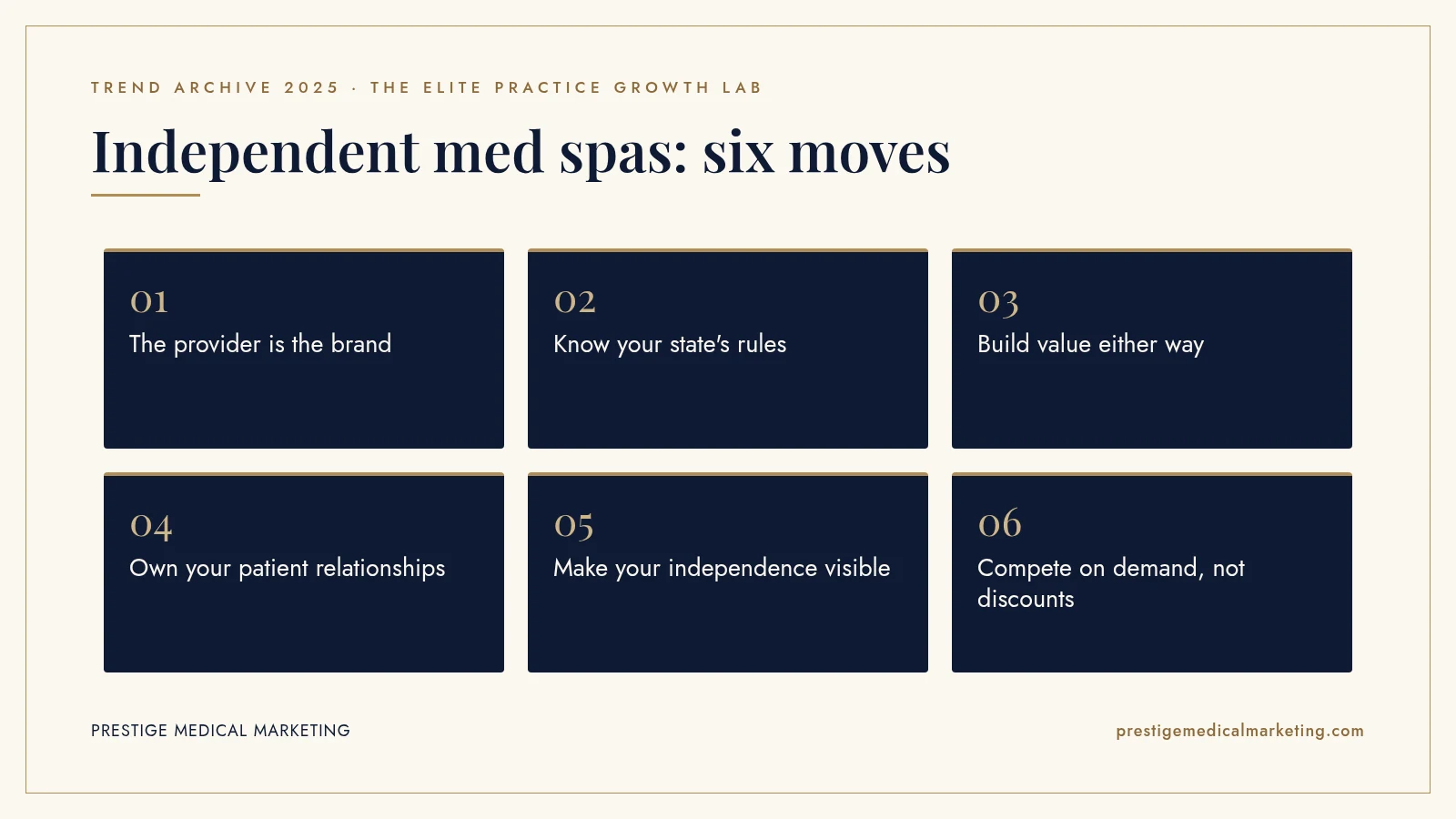
Know your state’s rules
Whether you are considering investment, a management company or growth through new locations, ask a healthcare attorney how your state’s laws apply. Oregon and California were two of the most prominent 2025 examples, and Kirkland noted that other states, including Massachusetts and Connecticut, have also taken steps to regulate private equity in health care.
Build value either way
Whether you plan to stay independent or sell one day, the same things make a practice valuable: predictable new patient demand, strong retention, a recognizable brand and clean data. Our predictability and scaling guide covers how to build them.
Own your patient relationships
Keep your website, Google Business Profile, review profiles, ad accounts and patient communication tools in the practice’s name. Practices that do not control these assets have less flexibility, whatever their ownership plans.
Make your independence visible
Patients often cannot tell the difference between an independent practice and a chain location. Tell them. Introduce the owner and providers on your website, explain how decisions are made and show the care behind your results. Do it honestly and without attacking competitors.
Compete on demand, not discounts
If a chain opens nearby with a cheaper membership, resist the urge to match it. Strengthen your visibility for high-value treatments, make booking easy and follow up fast. Our booking engine and AI agents help independents respond like a larger group.
When a chain opens nearby
A new multi-location competitor usually arrives with visible signals: a grand opening promotion, heavy social and search advertising, introductory pricing on popular treatments and a membership offer. The first few months can feel unsettling as some patients try the new option.
The worst response is to panic and discount. A better response starts with your existing patients. Reach out personally, remind them of their provider and their results, and make rebooking easy. Then look at your visibility. When someone in your area searches for the treatments you are known for, do they see you, with strong reviews and clear information? When they call, does someone answer quickly and helpfully? When they ask an AI assistant for a recommendation, are you mentioned?
Most patient decisions in aesthetics are relationship decisions. Patients who trust their provider tend to stay. New patients who see clear proof of expertise, a strong reputation and an easy path to booking will choose an independent practice over a newer, larger brand more often than many owners expect.
Questions to ask before you take an investment offer
If you receive an offer, take time to understand it. Ask who will control clinical decisions, hiring, scheduling and pricing after the deal. Ask what happens to your providers’ agreements, including any noncompete terms, and how your state’s rules apply. Ask what marketing and brand changes are planned, and whether your practice name and reputation will remain front and center. Ask how performance will be measured and what happens if targets are missed. Bring in your own attorney and financial adviser before signing anything. An offer that looks generous on paper can look very different once control and obligations are clear.
A 90-day plan for independent owners
Days 1 to 30. Audit your visibility in search, maps and AI recommendations for your top five treatments. Check how quickly calls and web inquiries are answered. Review your Google Business Profile and review volume.
Days 31 to 60. Rebuild your highest-value treatment pages around your providers and real expertise. Fix response times with better call handling and booking. Start a steady review request process.
Days 61 to 90. Measure non-branded search growth, booked consultations and rebooking rates. Double down on what is working. The med spa SEO guide covers the search side in more detail.
What 2025 does not tell us
The 2025 laws apply in specific states, to specific structures, and their effect on med spas specifically is still developing. Courts, regulators and later amendments may change how they work. AmSpa’s ownership figures come from its 2024 report, and newer data may differ. We do not have reliable public data showing that independent med spas outperform chains, or the reverse. This article is not legal advice.
The premium practice advantage
Well-funded chains will keep growing in some markets. That is fine. Premium independent practices do not need to outspend them. They need to be the obvious choice for the patients who value expertise and personal care, and to be easy to find and easy to book.
That is the work we do for med spas and practices across every specialty we serve, from Austin for practices nationwide.
The bottom line
In 2025, Oregon’s SB 951 and California’s SB 351 limited how private equity firms and management companies can control medical practices. Meanwhile, AmSpa’s data shows most med spas are independent, single-location businesses. For owners, the lesson is to understand your state’s rules and compete where independents win: providers, reputation, service and speed.
Check if your market is open. We take one practice per specialty per market. Request a market check or call (716) 400-0084.
Frequently asked questions
What did Oregon SB 951 do?
Signed on June 9, 2025, it bars management services organizations and their affiliates from owning or controlling the medical practices they manage, codifies limits on interference with clinical decisions and voids many noncompete, nondisclosure and nondisparagement agreements, with exceptions. Existing structures have until January 1, 2029 to comply.
What did California SB 351 do?
Signed on October 6, 2025 and effective January 1, 2026, it prevents private equity groups and hedge funds from interfering with providers' professional judgment and reserves decisions such as medical records, hiring of providers, payer contracts, coding and billing, and equipment approvals for licensed practitioners.
Do these laws apply to med spas?
They apply to medical practices within their scope. Whether a particular med spa is covered depends on its structure, the licensed providers involved and state law. Speak with a healthcare attorney about your situation; this article is not legal advice.
How many med spas are owned by private equity?
AmSpa's 2024 Medical Spa State of the Industry report found that only 3% of medical spas were owned by private equity firms, the same share as its 2022 report, and that 81% were single-location businesses.
Can an independent med spa compete with a well-funded chain?
Yes, on the things patients care about most: the provider they trust, consistent results, personal service and local reputation. Independent owners can make decisions faster and build a brand around real people rather than a corporate name.
Should I sell my med spa to a private equity firm?
That is a personal and financial decision that depends on your goals, your state's laws and the terms offered. Get independent legal and financial advice. Whatever you decide, a practice with strong, predictable patient demand is worth more.