
The information blocking regulations implementing the 21st Century Cures Act became applicable on April 5, 2021, after an interim final rule moved the date from November 2, 2020. Health care providers are among the actors covered. Until October 6, 2022, the electronic health information in scope was limited to the data elements in the USCDI standard. For functional medicine practices, the change meant patients could expect timely electronic access to results and notes, and that clear communication around that access became part of the patient experience.
Functional medicine runs on data. Comprehensive lab panels, detailed histories, nutrition notes and long care plans are central to how these practices work. For years, much of that information lived inside the practice, shared with patients at the clinician’s pace during scheduled visits.
In 2021, that changed in a meaningful way. On April 5, 2021, the federal information blocking regulations under the 21st Century Cures Act became applicable to health care providers and other actors. Patients gained a stronger expectation of timely electronic access to their health information, and practices had to rethink how results and notes reached patients.
This retrospective explains what took effect in 2021, why it mattered for functional medicine and what it means for patient experience today. It is an educational overview, not legal advice. For related privacy and data chapters, see our pieces on the FTC’s 2023 GoodRx action and the 2023 tracking technology warning letters.
What actually happened in 2021
The rule. ONC’s Cures Act Final Rule implemented interoperability provisions of the 21st Century Cures Act and was designed to give patients and their providers secure access to electronic health information. Part of that rule addressed information blocking.
The definition. As ONC explains on its information blocking page, information blocking is a practice by an actor that is likely to interfere with the access, exchange or use of electronic health information, except as required by law or covered by an exception. Health care providers are one of the types of actors.
April 5, 2021. According to ONC’s applicability and enforcement FAQ, an interim final rule moved the applicability date from November 2, 2020 to April 5, 2021.
A defined first scope. Before October 6, 2022, electronic health information for information blocking purposes was limited to the data elements represented in the United States Core Data for Interoperability standard, known as USCDI. That included common clinical data such as laboratory results and clinical notes.
Exceptions. ONC notes that exceptions are identified in 45 CFR Part 171, and that when an actor’s practice meets an exception it is not considered information blocking.
Why it mattered for functional medicine practices
Functional medicine patients often receive extensive lab work. Under the new expectations, many practices found that results could reach patients through the portal before the clinician had a chance to review them together. A patient might see dozens of values, some flagged as outside the reference range, without the context the practice usually provided.
That created both a risk and an opportunity. The risk was confusion and anxiety, followed by a flood of messages. The opportunity was to show patients that the practice respected their access to their own information and had a clear plan for explaining it.
The rules also reinforced something functional medicine practices already valued: patients as active partners in their care. Timely access to records supports that partnership when it is paired with good communication.
What typical agencies did
Most marketing agencies paid no attention to the information blocking rules. They saw them as an IT or compliance matter with nothing to do with patient acquisition or reputation.
That missed an important point. Patient experience after the first visit drives reviews, referrals and retention. A practice whose patients felt confused or ignored after seeing results online was at risk of losing trust, regardless of how good its marketing was.
The better approach connected operations and communication: clear expectations on the website and in onboarding, a portal experience that worked well and a reliable process for explaining results.
What it means for a functional medicine practice today
Information access rules have continued to evolve since 2021. These habits support both compliance and patient trust.
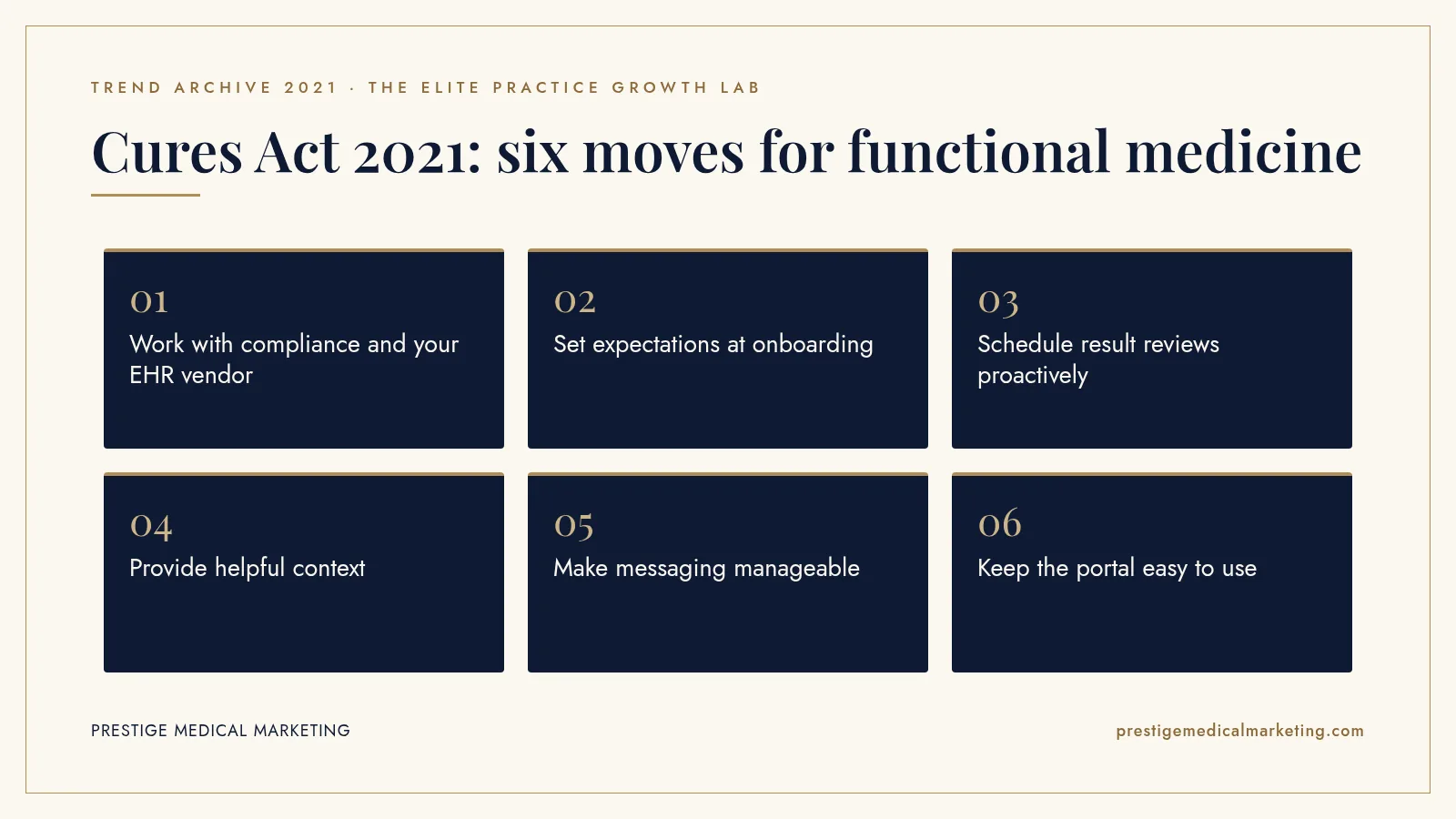
1. Work with compliance and your EHR vendor
Policies on releasing information should be set with qualified advisers and configured correctly in the practice’s systems.
2. Set expectations at onboarding
Tell new patients that results may appear in the portal before their review visit, and explain how the clinician will go over them.
3. Schedule result reviews proactively
Book follow-up visits or calls when labs are ordered so patients know when they will get context.
4. Provide helpful context
General educational resources about common tests can help patients understand what they are seeing without replacing clinician interpretation.
5. Make messaging manageable
Set clear response times for portal messages and route questions to the right team member.
6. Keep the portal easy to use
A portal that is hard to access frustrates patients. Clear instructions and support make access a positive experience.

The patient experience of seeing results first
Imagine a patient who has invested in a comprehensive panel and receives a notification late on a Friday evening. They log in and see a long list of values, some marked high or low. Without context, it is easy to worry. Practices that anticipated this moment, by explaining in advance that results would arrive before the review and that flagged values are common and often not concerning on their own, helped patients feel prepared rather than alarmed.
That preparation can be as simple as a short paragraph in the welcome materials and a message when labs are drawn. It costs little and prevents a great deal of anxiety.
Communication as part of the brand
Functional medicine practices often position themselves around time, attention and partnership. The way they handle records and results is a direct test of that promise. A practice that responds to portal messages promptly, explains results clearly and treats patient questions with respect lives up to its brand. A practice that leaves patients waiting weeks for answers undermines it.
That experience shows up in reviews. Patients often mention communication when they describe a practice to others, both positively and negatively.
Records requests and new patients
Information access works in both directions. New patients often arrive with records from previous providers, and they may need their records sent elsewhere later. A smooth, clearly explained process for requests reduces friction and reflects well on the practice. The website should explain how to request records and who to contact with questions.
Data from outside sources
Functional medicine patients sometimes bring data from wearables, home testing or other sources. How the practice incorporates that information is a clinical decision, but explaining the practice’s approach on the website helps set expectations. Patients appreciate knowing whether and how outside data will be considered in their care.
Privacy alongside access
Greater access did not reduce privacy obligations. Practices still need to protect health information, verify identity before releasing records and use secure channels. Marketing systems, such as website forms and email tools, should be reviewed so that health information is not shared inappropriately. Access and privacy work together: patients should be able to get their information easily and trust that it is protected.
Explaining lab philosophy on the website
Many functional medicine practices use testing differently from conventional practices, ordering broader panels or interpreting results against different goals. That is a clinical matter, but it shapes what patients see in their portal. A short, carefully written page that explains how the practice approaches testing, why certain tests may be ordered and how results are discussed helps patients understand what they are looking at. It should avoid exaggerated claims about what testing can reveal and should be reviewed by the practice’s clinicians.
That kind of page also helps prospective patients decide whether the practice fits them. People who value a detailed, data-informed approach will appreciate the explanation, and people who prefer a simpler approach can self-select before booking.
Training the team for the new rhythm
When results reach patients faster, the front desk and clinical support staff feel it first. Calls and messages increase, often with anxious tone. A short training on how to respond, what staff can and cannot say about results and when to escalate to a clinician helps the whole team handle the volume calmly. Scripts should be reviewed by clinicians and compliance advisers so they remain accurate.
Practices that prepared their teams in 2021 found the transition far smoother than those that waited for the messages to pile up.
Reference ranges and optimal ranges
Functional medicine clinicians sometimes discuss lab values in terms that differ from the standard reference ranges printed on a lab report. When a patient sees a portal result marked normal and later hears the clinician describe it as an area to work on, or sees a value flagged as abnormal that the clinician considers unremarkable, confusion follows. The solution is not to hide information but to explain the difference in advance.
A brief, clinician-approved note in onboarding materials can explain that lab reports show standard reference ranges, that the clinician will interpret results in the context of the full history and goals, and that a single value rarely tells the whole story. That framing helps patients read their results calmly and arrive at the review visit with good questions instead of fears.
Turning access into engagement
Patients who can see their own information often become more engaged in their care. They notice trends, ask better questions and follow plans more closely. Functional medicine practices are well placed to encourage that engagement, because their model already depends on patient participation. Simple tools help: a summary of key goals after each visit, a reminder of when the next labs are due and clear instructions for how to send questions.
Engaged patients also tend to stay longer and refer others. Seen that way, the shift toward access in 2021 was not only a compliance matter but a chance to deepen the relationships that sustain a practice over many years.
What 2021 does not tell us
The April 2021 applicability date did not tell us how enforcement would work for health care providers, how quickly practices would adapt or how patients would respond to faster access across different specialties. Enforcement frameworks for different types of actors developed later. There is no reliable public data on how functional medicine practices specifically were affected. What 2021 does show is that patient access to electronic health information became a firm expectation, and that clear communication is the best way to make that access a positive experience.
The premium practice advantage
A premium functional medicine practice offers time, attention and partnership. Handling records and results with clarity and care is part of that promise. See our functional medicine services, our functional medicine marketing guide, our custom websites, our reputation and premium pricing work and our full services. Our team works from Austin with practices nationwide.
The bottom line
When the information blocking regulations became applicable on April 5, 2021, patients gained a firmer expectation of timely electronic access to their health information. For functional medicine practices, the lasting lesson was to pair that access with clear expectations, proactive result reviews and responsive communication, so that openness strengthened trust instead of creating confusion.
Check if your market is open. We take one practice per specialty per market. Request a market check or call (716) 400-0084.
Put this playbook to work: see how it applies to med spa marketing.
Frequently asked questions
When did the information blocking regulations take effect?
ONC says an interim final rule moved the applicability date from November 2, 2020 to April 5, 2021.
What is information blocking?
ONC defines it as a practice by an actor that is likely to interfere with the access, exchange or use of electronic health information, except as required by law or covered by an exception.
Are medical practices covered?
Yes. Health care providers are one of the types of actors covered by the information blocking regulations.
What was the USCDI limit?
Before October 6, 2022, electronic health information for information blocking purposes was limited to the data elements represented in the United States Core Data for Interoperability standard.
Are there exceptions?
Yes. Information blocking exceptions are set out in 45 CFR Part 171. ONC notes that if a practice meets an exception, it is not considered information blocking.
How should a functional medicine practice respond today?
Work with compliance advisers and the EHR vendor on policies, and prepare patients for receiving results quickly through the portal, including how and when the clinician will explain them.