
On June 13, 2022, the FDA approved a new indication for Olumiant (baricitinib), a once-daily oral JAK inhibitor, for adults with severe alopecia areata. Lilly and Incyte called it the first and only systemic medicine for the condition. The approval rested on two trials, BRAVE-AA1 and BRAVE-AA2, with 1,200 adults, and the label carries a boxed warning for serious infections, mortality, malignancy, cardiovascular events and thrombosis. For dermatology practices, it meant explaining a real new option accurately and carefully.
Alopecia areata is an autoimmune condition in which the immune system attacks hair follicles, causing hair loss that can range from small patches to the entire scalp and body. For many patients, it is not a cosmetic concern but a profound change in how they see themselves and how others see them. For years, those with severe disease often heard that treatment options were limited.
In June 2022, that changed. The FDA approved Olumiant, an oral medication already used for rheumatoid arthritis, for adults with severe alopecia areata. Its manufacturers described it as the first systemic treatment for the condition. For dermatology practices, it opened a new conversation with patients and a new responsibility to explain the option clearly.
This retrospective covers what the FDA approved in 2022 and what it means for a dermatology practice today. For related dermatology chapters, see Instagram’s 2022 rollback and the Google and Reddit partnership in 2024.
What actually happened in 2022
June 13: approval. The FDA’s approval letter, signed June 13, 2022, added an indication for Olumiant (baricitinib) tablets for the treatment of adult patients with severe alopecia areata.
A first for the condition. Lilly and Incyte announced the approval of a once-daily pill as the first and only systemic medicine for adults with severe alopecia areata.
The trials. According to the prescribing information, two randomized, double-blind, placebo-controlled trials enrolled 1,200 adults who had at least 50% scalp hair loss for more than six months. The primary endpoint was at least 80% scalp hair coverage at week 36.
Reported results. Lilly reported that at 36 weeks, 17% to 22% of patients on 2 mg a day and 32% to 35% on 4 mg a day reached 80% or more scalp coverage, compared with 3% to 5% on placebo.
Safety. The label carries a boxed warning for serious infections, mortality, malignancy, major adverse cardiovascular events and thrombosis, and lists testing and monitoring requirements.
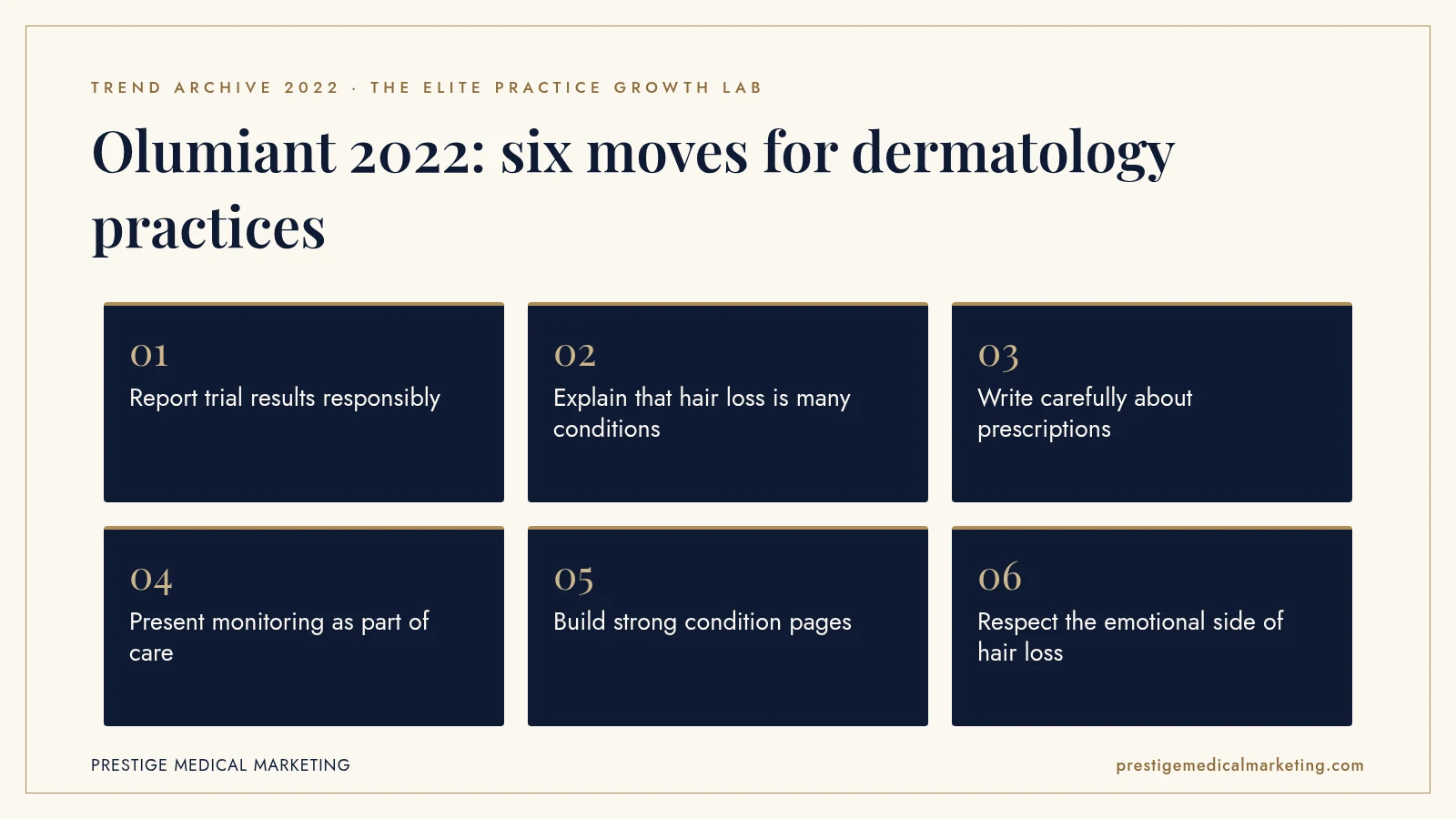
Why it mattered for dermatology practices
Patients with alopecia areata are often well informed and deeply motivated. Many had searched for years, tried treatments with limited success and joined online communities to share information. When a new option was approved, many of them quickly looked for dermatologists who could discuss it.
That created a clear opportunity for dermatology practices with expertise in hair disorders. It also created risk. A prescription medication with a boxed warning is not something to promote with hype. Patients needed accurate information about who it was approved for, what results looked like in trials and what monitoring treatment required.
The approval also highlighted the importance of diagnosis. Hair loss has many causes, and alopecia areata is only one of them. A practice that helps patients understand the differences, and why evaluation matters, serves them far better than one that markets a pill.
What typical agencies did
Some agencies saw the approval as a chance to run broad hair loss campaigns, blurring the line between severe alopecia areata and common hair thinning. Ads implied that a new pill could restore hair for anyone, ignoring the specific indication and the safety profile.
Other agencies ignored the approval entirely, leaving dermatology practices with outdated hair loss pages that said little about current options. Patients who had followed the news closely noticed, and some concluded the practice was not current in the field.
The careful approach updated educational content, explained the condition and its treatments accurately, and invited patients to schedule an evaluation with a dermatologist experienced in hair disorders.
What it means for a dermatology practice today
Treatment options for alopecia areata have expanded since 2022. These principles still apply.
1. Explain the condition first
Help patients understand alopecia areata, how it differs from other hair loss and why diagnosis matters.
2. Be precise about indications
Describe who a medication is approved for. Do not imply it treats other types of hair loss.
3. Present results honestly
If citing trial results, include the comparison and the time frame. Avoid implying guaranteed outcomes.
4. Include safety information
Mention boxed warnings and monitoring requirements in balanced language reviewed by a dermatologist.
5. Show expertise in hair disorders
Highlight the dermatologist’s experience diagnosing and managing hair loss conditions.
6. Respect patient sensitivity
Use imagery and language that treat alopecia areata as a medical condition, not a cosmetic flaw.

Reading trial results responsibly
The trial results behind the 2022 approval are useful, and they are easy to misuse. The primary endpoint was the proportion of patients who reached at least 80% scalp hair coverage after 36 weeks. Lilly reported that a meaningful share of patients on the higher dose reached that goal, compared with a small share on placebo. That is a real benefit for a condition with few options. It also means many patients in the trials did not reach the endpoint in that time frame.
Marketing that shows only the best responders, or implies that most patients regrow a full head of hair, misrepresents those findings. A more honest presentation explains what the endpoint measured, how long it took and that response varied. Patients with severe, long-standing disease deserve that clarity, because their expectations shape how they experience treatment.
Trial populations also matter. The trials enrolled adults within specific age ranges with at least 50% scalp hair loss for more than six months. Content should not imply results for groups the trials did not study.
Hair loss is many conditions
Patients often search for hair loss treatment without knowing which type of hair loss they have. Pattern hair loss, telogen effluvium, scarring alopecias, traction alopecia and alopecia areata each have different causes and treatments. A dermatology website that groups them all under one generic page misses the chance to help patients understand their own situation.
Separate, clearly written pages for major hair loss conditions help patients and search engines alike. Each page can explain symptoms, how the condition is diagnosed and what treatment options exist in general terms, with a clear invitation to book an evaluation. This structure also makes it easier to update content when new treatments are approved.
Writing about prescription treatments
Dermatology practices increasingly discuss prescription medications on their websites. Doing this well requires balance. Patients benefit from knowing that options exist. They also need to understand that a prescription medication is chosen by a clinician after evaluation, that it carries risks and that results vary.
A practical approach is to describe categories of treatment, explain how the dermatologist decides between them and mention specific medications in an educational context with their approved indications and key safety considerations. Content should be reviewed by a dermatologist and updated as labels change.
It also helps to date the content and note when it was last reviewed. Patients researching a fast-moving area want to know whether the information reflects current options, and visible review dates signal that the practice keeps its guidance up to date.
Monitoring is part of the offer
A JAK inhibitor is not a medication a patient simply starts and forgets. The Olumiant label describes testing before treatment, such as screening for tuberculosis and checking blood counts, and ongoing monitoring during therapy. It also lists situations in which treatment should not be started or should be interrupted.
For a dermatology practice, that monitoring is part of the value it provides. Explaining it openly helps patients understand why a specialist’s care matters and why a medication like this is not something to obtain through a quick online visit with no follow-up. It also sets realistic expectations about appointments, lab work and the time commitment involved.
Practices can describe their monitoring approach on the relevant condition page in plain language: what happens at the first visit, what tests may be needed, how often follow-up occurs and how the team handles side effects or questions between visits.
Search, AI answers and condition pages
When patients ask search engines or AI assistants about alopecia areata treatment, the answers draw on pages that explain the condition clearly and accurately. A dermatology practice with a well-structured, current, clinician-reviewed page on alopecia areata is more likely to be useful to those systems and to the patients who follow their links.
Useful elements include a plain-language definition, how diagnosis works, an overview of treatment categories, what to expect at a consultation and who on the team specializes in hair disorders. A short FAQ addressing common questions, written without hype, helps both readers and the systems summarizing them.
The emotional dimension
Alopecia areata can affect self-esteem, social life and mental health. Patients and families often describe feeling dismissed by earlier providers. A dermatology practice that acknowledges this, in its content and in the consultation, builds trust before treatment begins.
That acknowledgment should be genuine and careful. It is not a marketing hook. It is recognition that the patient’s experience matters, and that the practice will listen. Imagery should reflect real people with dignity and respect, not dramatic transformations, staged reveals or exaggerated claims.
Connecting patients with reputable support organizations and patient communities can also help. A practice that points patients toward trustworthy resources beyond its own services shows that its interest is the patient’s wellbeing, not only the next appointment.
Referral partners and second opinions
Many patients with alopecia areata first see a primary care physician, a hair stylist or a general dermatologist who notices the problem. Relationships with those referral sources matter. A dermatology practice known for expertise in hair disorders can share clear, professional information with local physicians about when to refer, what the practice offers and how it communicates back after a consultation.
Second opinions are common in this condition, especially among patients who were told earlier that nothing could be done. A practice that welcomes those patients, reviews their history carefully and explains current options without overpromising often becomes their long-term dermatology home.
What 2022 does not tell us
The 2022 approval established a new option for severe alopecia areata; it did not tell us how many patients would be eligible, how they would respond outside trials or how long-term use would compare with other options. Other treatments followed after 2022. We do not have public data on how dermatology practices marketed the approval. What 2022 does show is that a meaningful new treatment demands precise, balanced communication.
The premium practice advantage
A premium dermatology practice earns trust with expertise and honesty about every treatment. See our dermatology services, our custom websites, our approach to reputation and premium pricing, our full services, who we help and how we approach Google Maps and AI search visibility. Our team works from Austin with practices nationwide.
The bottom line
In June 2022, the FDA approved Olumiant for adults with severe alopecia areata. For dermatology practices, it meant updating hair loss content, explaining the condition and its options precisely and leading with the dermatologist’s evaluation.
Check if your market is open. We take one practice per specialty per market. Request a market check or call (716) 400-0084.
Frequently asked questions
What did the FDA approve in June 2022?
A new indication for Olumiant (baricitinib) tablets for adult patients with severe alopecia areata. FDA's approval letter is dated June 13, 2022.
Why was the approval described as a first?
Lilly and Incyte described Olumiant as the first and only systemic medicine approved for adults with severe alopecia areata at the time.
What trials supported the approval?
Two randomized, placebo-controlled trials, called AA-1 and AA-2 in the label and BRAVE-AA1 and BRAVE-AA2 by Lilly, enrolled a total of 1,200 adults with at least 50% scalp hair loss.
Does Olumiant carry safety warnings?
Yes. Its label includes a boxed warning for serious infections, mortality, malignancy, major adverse cardiovascular events and thrombosis.
Is Olumiant a treatment for common hair thinning?
No. The 2022 indication was for severe alopecia areata, an autoimmune condition. It is not approved for pattern hair loss.
How should a dermatology practice talk about it?
Accurately and with balance: who it is approved for, what the evidence shows, what risks apply and why a dermatologist's evaluation comes first.