
Google began rolling out the page experience update for desktop on February 22, 2022, applying the same signals it already used on mobile, including Core Web Vitals, HTTPS and the absence of intrusive interstitials, but not mobile-friendliness. Google described page experience as one of many factors, with relevance still paramount. For private practices, it reinforced that a fast, stable, uncluttered website helps patients and supports visibility on desktop as well as mobile.
Most conversations about practice websites in the early 2020s focused on mobile, and for good reason. Patients search on phones, tap to call and book between appointments. But a large share of serious research still happened on larger screens. Someone comparing clinics before a significant decision, a family member arranging care, or a patient filling out a long intake form often sat at a laptop or desktop to do it.
In 2022, Google extended its page experience signals to that desktop experience. Signals that had applied to mobile ranking since 2021, including Core Web Vitals, began applying to desktop too. For practices whose desktop sites had been allowed to grow heavy, with large sliders, autoplay video, chat widgets and pop-ups stacked on top of each other, it was a prompt to look at the visit through a patient’s eyes.
This retrospective covers what Google actually changed in 2022 and what it means for a practice website today. For the next chapters, see our look at Interaction to Next Paint replacing FID in 2024 and the Google Optimize sunset in 2023.
What actually happened in 2022
The announcement. In November 2021, Google Search Central published “Timing for bringing page experience ranking to desktop”, saying the rollout would begin in February 2022 and be complete by the end of March 2022.
February 22: the rollout. Google’s Search Status Dashboard lists the page experience update for desktop starting on February 22, 2022.
The same signals, minus one. Google said desktop ranking would use the same page experience factors as mobile: the three Core Web Vitals, HTTPS security and the absence of intrusive interstitials. The mobile-friendliness signal did not apply, since it is specific to phones.
The three Core Web Vitals. At the time, the vitals were Largest Contentful Paint, measuring how quickly the main content loads; First Input Delay, measuring how quickly a page responds to a first interaction; and Cumulative Layout Shift, measuring how much the layout jumps around while loading.
Reporting. Google said Search Console would help site owners understand desktop page experience, with its Page Experience and Core Web Vitals reports showing desktop data alongside mobile.
One factor among many. Google repeated that page experience was one of many factors in ranking. It said great, relevant content could still rank well even if page experience was not ideal, while page experience could make a difference when many pages were similarly relevant.
Why it mattered for private practices
Practice websites are often built by assembling parts: a theme, a page builder, a booking widget, a review widget, a chat tool, a tracking script or three, an accessibility overlay, a video header and a promotional pop-up. Each addition may be reasonable on its own. Together, they can make a page slow to load, slow to respond and prone to shifting as elements appear.
Those problems are not only ranking concerns. A patient who taps a button that moves as a banner loads, or waits for a heavy page before seeing a phone number, has a worse experience. Intrusive interstitials that cover content on arrival frustrate people who came for information. For practices competing in local markets, where several sites may be similarly relevant, the quality of the visit can be a tiebreaker in rankings and in a patient’s decision.
Desktop mattered specifically because many practices had optimized mobile and neglected desktop, or vice versa. The 2022 rollout meant both experiences counted.
What typical agencies did
Page experience generated a wave of score-chasing. Agencies ran PageSpeed Insights, screenshotted lab scores and promised to raise them. Some installed plugins that deferred scripts aggressively, which raised lab scores but broke booking widgets or forms. Others focused on the number rather than the field data Google actually used from real visitors.
Another common reaction was to ignore it, on the basis that Google called page experience a modest factor. That missed the larger point: the same problems that hurt page experience scores also hurt conversions.
The better approach looked at real-user field data in Search Console, identified the templates and elements causing problems, and fixed them without breaking anything patients relied on.
What it means for a practice website today
Core Web Vitals still matter, now with Interaction to Next Paint in place of First Input Delay. These steps keep a site fast and stable.
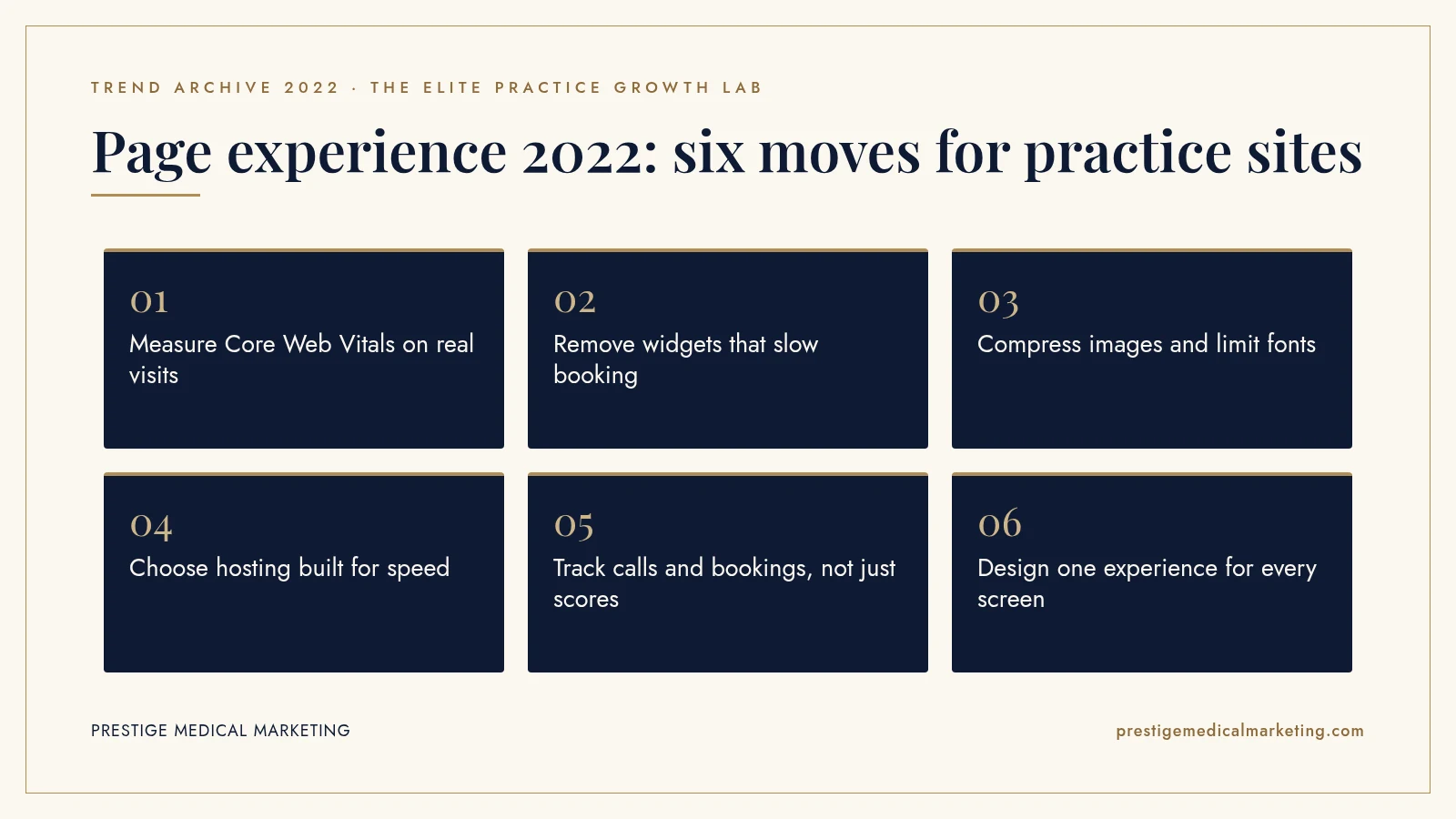
1. Use field data, not just lab scores
Check the Core Web Vitals report in Search Console for mobile and desktop. It reflects real visitors, which is what Google uses.
2. Audit third-party scripts
List every widget and tag. Remove what no one uses and load the rest efficiently. Each script has a cost.
3. Lighten the hero
Large sliders and autoplay video often slow the main content. A single optimized image with a clear headline usually performs better.
4. Reserve space for elements
Set dimensions for images, embeds and banners so the layout does not jump as they load.
5. Drop intrusive pop-ups
Avoid interstitials that cover content on arrival. Offer promotions within the page instead.
6. Test the booking path
After any speed change, book a test appointment on desktop and mobile to confirm nothing broke.

Speed, stability and trust
A premium practice signals quality in every detail of the patient experience, from the reception area to the follow-up call. The website is often the first of those details a patient encounters. A site that loads quickly, stays stable and presents information clearly communicates competence before a word is read. A site that stutters, shifts and interrupts communicates the opposite.
This is particularly true on desktop, where patients often spend more time and read more carefully. A long procedure page or a detailed program description should be comfortable to read on a large screen, with sensible line lengths, clear headings and images that support rather than delay the content.
Accessibility belongs in the same conversation. Readable type sizes, sufficient contrast, descriptive image text and forms that work with a keyboard help patients with different needs and usually make a site faster and cleaner for everyone. Practices often treat accessibility and performance as separate projects, but the same disciplined build tends to serve both.
The hidden cost of widgets
Many practice sites carry scripts that were added for a campaign years ago and never removed. Old tracking pixels, abandoned chat tools, retired review widgets and duplicate analytics tags all consume loading time and can create privacy questions as well. A script audit often reveals that a site is loading code from many different companies on every page.
Removing unnecessary scripts is one of the most effective ways to improve both performance and privacy. It also simplifies future decisions: when every remaining script has a clear owner and purpose, adding or replacing tools becomes deliberate rather than haphazard.
Booking engines deserve special attention. They are essential, but many embed heavy code on every page rather than only where booking happens. Loading them only on booking pages, or opening them on demand, can improve performance across the rest of the site.
Images, fonts and hosting
Three unglamorous areas account for a large share of slow practice websites. The first is images. Photography matters in medical marketing, especially for aesthetic and wellness practices, but uncompressed images exported straight from a camera or design tool can be many times larger than they need to be. Modern formats such as WebP, correctly sized versions for different screens and lazy loading for images below the fold keep a site visually rich without making it heavy.
The second is fonts. Many sites load several font families and weights from external services, which can delay text from appearing or cause it to shift when the final font arrives. Limiting fonts to what the design genuinely needs, and loading them efficiently, improves both loading and stability.
The third is hosting. Inexpensive shared hosting can respond slowly before a page even begins to load, especially at busy times. A well-configured host with caching and a content delivery network gives every other optimization a stronger foundation. None of these choices is visible to a patient as a feature, but all of them shape whether the first impression feels effortless.
What to measure beyond the vitals
Core Web Vitals describe part of a visit, not all of it. A practice should also watch the measures that connect directly to patients: how many visitors call, request an appointment or complete a form, and where they abandon the process. A page can pass every vital and still lose patients if the phone number is hard to find or the form asks for too much too soon.
Pairing speed data with conversion data shows which improvements matter. If a faster booking page coincides with more completed requests, that is the result worth reporting, far more than a higher lab score.
Desktop and mobile are one experience
Patients move between devices. Someone may find a practice on a phone in the evening, read in depth on a laptop the next morning and book from a phone at lunch. The 2022 change was a reminder that each step counts. A practice should review both experiences regularly, using real devices, and make sure key actions such as calling, booking and finding directions work smoothly on each.
Forms are a common weak point. Intake and contact forms that work on mobile may be awkward on desktop, or the reverse. Testing them end to end, including confirmation messages and emails, catches problems that quietly cost appointments.
Maintenance matters as much as the initial build. Plugins update, vendors change their embed code and new campaigns add scripts. A short monthly check of the Core Web Vitals report and a quarterly review of every third-party script keeps a fast site from slowly becoming a slow one again.
What 2022 does not tell us
Google did not publish how much weight page experience carried, and it consistently described it as one factor among many. We do not have public data on how practice websites as a group were affected by the desktop rollout. What 2022 does show is that Google measures real-user experience on every device type and continues to refine those measurements, as the 2024 switch to Interaction to Next Paint confirmed.
The premium practice advantage
A premium practice deserves a website that feels as considered as its care: fast, stable and clear on every screen. See our approach to custom websites and booking engines, our full services, who we help and how we approach Google Maps and AI search visibility. Our team works from Austin with practices nationwide.
The bottom line
In February 2022, Google began applying page experience signals, including Core Web Vitals, to desktop search. For private practices, it confirmed that a fast, stable, uncluttered website matters on every device, for patients first and rankings second.
Check if your market is open. We take one practice per specialty per market. Request a market check or call (716) 400-0084.
Frequently asked questions
When did page experience reach desktop ranking?
Google said the rollout would begin in February 2022 and finish by the end of March 2022. Its Search Status Dashboard lists the desktop update starting on February 22, 2022.
Which signals applied on desktop?
Google said desktop used the same page experience factors as mobile, including Core Web Vitals, HTTPS security and no intrusive interstitials, but not the mobile-friendliness signal.
What were Core Web Vitals in 2022?
Largest Contentful Paint for loading, First Input Delay for interactivity and Cumulative Layout Shift for visual stability. Interaction to Next Paint replaced First Input Delay in March 2024.
Was page experience a major ranking factor?
Google said page experience was one of many factors and that great relevant content could still rank well even when page experience was average.
How can a practice check its scores?
Google Search Console reports Core Web Vitals for mobile and desktop using field data from real visitors, and PageSpeed Insights shows individual page results.
Why does desktop matter for medical practices?
Many patients research providers and complete forms at a desk or on a laptop, and referral coordinators and family members often book on desktop too.