
Google Optimize and Optimize 360 stopped working on September 30, 2023, and any experiments still running ended that day. Google said Optimize lacked many features customers needed and pointed to third-party testing tools that integrate with Google Analytics, naming AB Tasty, Optimizely and VWO. For private practices, the lesson was that most websites lack the traffic for reliable A/B tests, and that conversion improvements usually come from clear offers, fast pages, strong proof and easy booking.
Google Optimize was the free experiment tool that let website owners test one version of a page against another. It was popular with agencies because it was free, connected to Google Analytics and made testing feel accessible. On September 30, 2023, it stopped working, and every active experiment ended with it.
For private practices, the shutdown raised a reasonable question: if the free testing tool is gone, how should a practice improve its website? The honest answer is that most practice websites were never good candidates for formal A/B testing in the first place, and that the biggest conversion wins usually come from fixing obvious problems rather than testing button colors.
This retrospective covers what happened in 2023 and what it means for practice websites today. It pairs with our coverage of the 2023 Universal Analytics shutdown and the INP Core Web Vital in 2024.
What actually happened in 2023
The sunset. Google’s Optimize sunset page states that Google Optimize and Optimize 360 were no longer available as of September 30, 2023, and that any experiments and personalizations still active on that date ended.
Google’s reasoning. Google said Optimize, though a longstanding product, did not have many of the features and services customers requested for experimentation testing, and that it would invest in solutions it considered more effective.
The alternatives. Google said it was collaborating on Google Analytics 4 integrations with third-party A/B testing providers, listing AB Tasty, Optimizely and VWO.
The timing. The shutdown came three months after standard Universal Analytics properties stopped processing data on July 1, 2023. Many websites lost their analytics setup and their testing tool within the same year.
Why it mattered for private practices
Optimize had made testing feel easy, and many agencies used it to show activity. Some ran tests on headlines, buttons or form layouts and reported winners in monthly reports. The problem was that most practice websites did not have enough conversions for those results to mean much.
A practice that receives forty consultation requests a month cannot reliably detect whether a new headline improved conversion by ten percent. The natural variation from week to week is larger than the effect being measured. Tests declared winners after a few weeks often reflected noise, seasonality or a change in ad spend rather than the page itself.
The shutdown forced a more honest conversation about what actually moves practice website conversion. It also raised a fair question about the reports practices had received for years: if many test results were noise, what decisions had been based on them, and were those decisions still serving the practice?
What typical agencies did
Some agencies migrated clients to paid testing platforms without asking whether the traffic justified it. Others simply stopped testing and kept reporting traffic as before. A few used the change to rethink how they improved websites, focusing on the issues visible in session recordings, call logs and patient feedback.
The best response was to treat the shutdown as permission to focus on fundamentals: fix what is clearly broken, improve what patients clearly need and measure the results over meaningful periods.
What it means for a practice website today
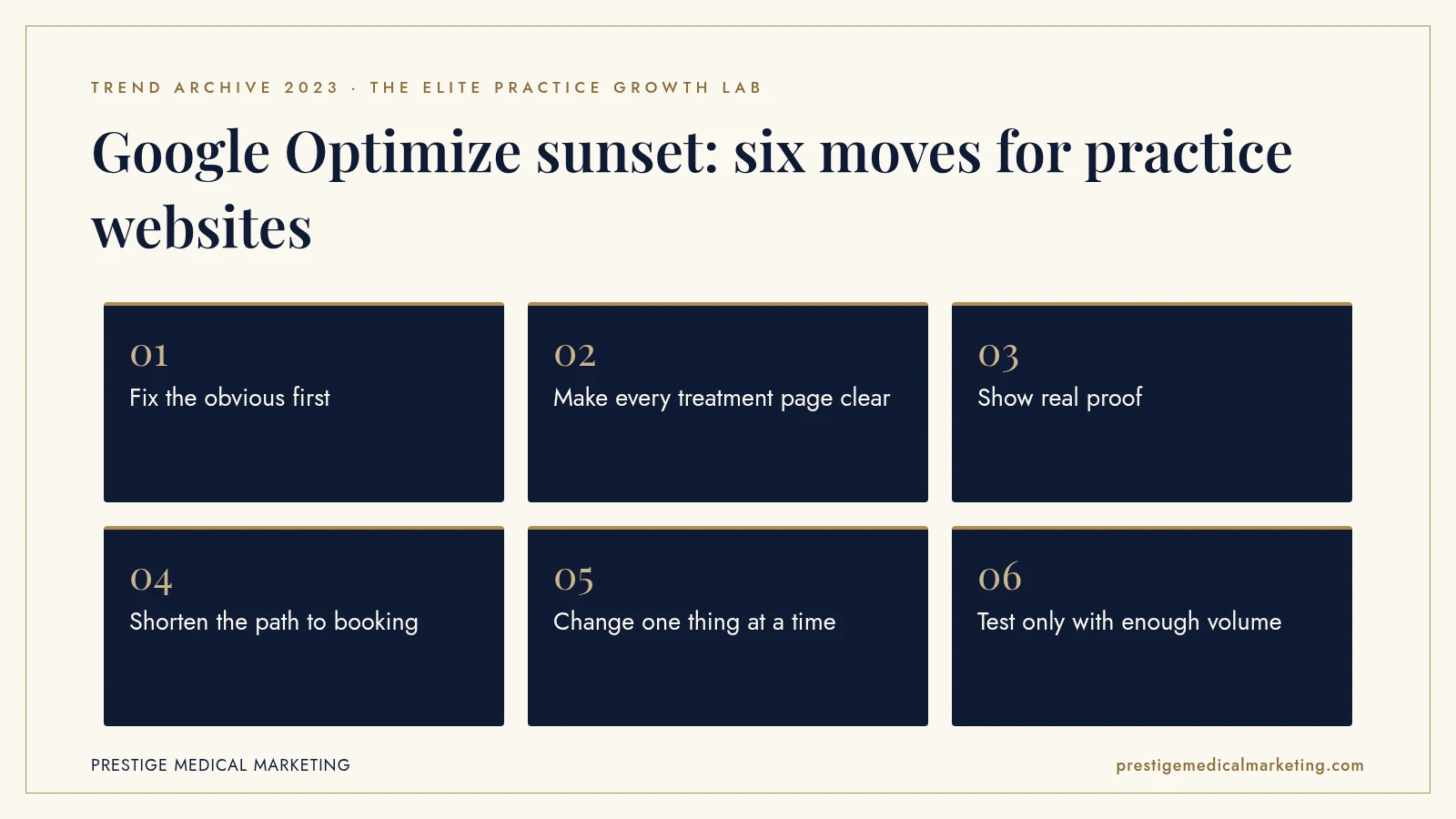
Conversion improvement does not require a free testing tool. These steps produce real gains for most practices.
1. Fix the obvious first
Slow mobile pages, broken forms, buried phone numbers and confusing navigation cost more than any headline. Review the site on a phone as a new patient would, and fix what gets in the way. Ask someone outside the practice to try booking and watch where they hesitate.
2. Make every treatment page clear
Each key treatment or procedure page should explain who it is for, what to expect, who performs it and how to book. Clarity converts better than cleverness, and it answers the questions patients would otherwise call to ask.
3. Show real proof
Display genuine reviews, provider credentials, compliant before-and-after photos where appropriate and the practice’s real environment. Prospective patients look for evidence of trust, and they look for it quickly, often in the first few seconds on a page.
4. Shorten the path to booking
Offer click-to-call, a short consultation form and online booking where appropriate. Every extra step loses some patients. Make sure the booking path works smoothly on a phone, since that is where most first visits begin.
5. Change one thing at a time
When making a meaningful change, record the date and compare conversion over several weeks before and after, accounting for seasonality and ad changes. Keep a simple change log so results can be traced back to specific decisions.
6. Test only with enough volume
Reserve formal A/B tests for high-traffic pages or paid campaigns where conversion volume is high enough for reliable results. Everywhere else, rely on clear improvements and honest before-and-after comparison.

Why most practices lack the volume for clean tests
A/B testing depends on statistics. To detect a modest improvement with confidence, a test needs a meaningful number of conversions in each variation. For a high-traffic online store, that can happen in days. For a private practice with a few dozen consultation requests a month, it can take many months, during which seasons change, campaigns shift and competitors move.
That does not mean practices should never experiment. It means they should be realistic about what experiments can show. Large changes, such as a redesigned consultation page or a new booking flow, are more likely to produce visible effects than small tweaks. And qualitative evidence, such as watching how real visitors use the site or listening to what callers ask, often reveals more than a statistically weak test.
Where practice websites usually lose patients
In our experience, the same problems appear on many practice websites. Pages load slowly on mobile. Phone numbers are hard to tap. Forms ask for too much information. Treatment pages describe the procedure but do not explain who performs it or how to start. Pricing signals, such as starting prices or financing options, are absent, so patients do not know whether the practice fits their expectations. Reviews and credentials are hidden on a separate page.
Fixing those issues rarely requires a testing platform. It requires looking at the site the way a prospective patient does and removing friction. Our custom website service is built around exactly that, and our booking engine addresses the final step.
What a premium website signals
Conversion is not only about mechanics. Patients considering premium treatments are also judging whether the practice feels right. Photography of the real practice, a calm and confident design, clear provider bios and consistent branding all signal quality before a patient ever calls.
That matters most for elective and cash-pay practices, where patients compare several options and often choose based on perceived quality and trust. A website that looks generic suggests a generic experience. A website that reflects the practice’s actual standard of care supports the price point and the patient’s decision.
Measuring improvement without Optimize
A practical measurement approach for most practices is simple. Track consultation requests, calls and bookings from the website each month, segmented by key pages. When a meaningful change is made, note the date. Compare the following months with the preceding period and the same period a year earlier where data allows.
Combine that with qualitative signals. Ask the front desk what new patients mention when they first call. Review call recordings, where lawful and appropriate, to see what questions come up repeatedly. Those questions often point directly to information the website should provide.
When formal testing does make sense
Some practices do have the volume for meaningful experiments. A multi-location med spa group with substantial paid traffic, a weight loss program running large campaigns or a plastic surgery practice with heavy organic traffic to a few key procedure pages may generate enough conversions to test landing page variations with confidence.
In those cases, the testing should be disciplined. Decide in advance what is being tested and why. Define the conversion that counts, usually a consultation request or booking rather than a click. Estimate how long the test needs to run before starting, and do not stop it early because one variation looks ahead. Avoid running tests during major promotions or seasonal swings that could distort the results.
Paid testing tools, including the ones Google named, can support that work. They are worth the cost only when the traffic and the stakes justify it.
Using patient language to improve pages
One of the most reliable ways to improve a practice website does not involve testing tools at all. It involves listening. The questions prospective patients ask on the phone, in consultation and in reviews reveal what they need to know before booking.
If callers repeatedly ask about downtime, the treatment page should address downtime clearly. If patients ask who will perform the procedure, provider information should be prominent. If people ask whether financing is available, that answer belongs near the booking button. Each of those improvements reduces uncertainty, and uncertainty is the main reason a prospective patient leaves without contacting the practice.
Front desk staff and patient coordinators are a valuable source here. A short monthly conversation about common questions can produce a list of website improvements that no testing platform would find.
Speed and stability still matter
Many practice websites in 2023 carried heavy themes, page builders, chat widgets, tracking scripts and testing snippets that slowed them down. Optimize itself added a script that some sites loaded in ways that briefly hid page content to prevent flicker. Removing it was, for some sites, a small speed gain.
Google’s Core Web Vitals, including Interaction to Next Paint, which replaced First Input Delay in 2024, reward pages that load quickly and respond promptly. For a patient on a phone, those qualities are simply the difference between a page that feels professional and one that feels broken.
What 2023 does not tell us
Google did not publish how many sites used Optimize or how many practices had active experiments when it ended. We also have no reliable data on whether practice websites that switched to paid testing tools improved conversion more than those that did not. What 2023 does show is the documented end date, Google’s stated reasoning and the alternatives it named.
The premium practice advantage
Premium practices convert best when their websites feel as considered as their care. See our services, who we help, our approach to Google Maps and AI search visibility and our guide to call handling and lead leakage. Our team works from Austin with practices nationwide.
The bottom line
Google Optimize ended on September 30, 2023. For most practices, the loss mattered less than the lesson: real conversion gains come from clarity, speed, proof and an easy path to booking, measured honestly over time.
Check if your market is open. We take one practice per specialty per market. Request a market check or call (716) 400-0084.
Frequently asked questions
When did Google Optimize shut down?
Google says Optimize and Optimize 360 were no longer available as of September 30, 2023, and any experiments and personalizations still active on that date ended.
Why did Google end Optimize?
Google said Optimize did not have many of the features and services customers requested for experimentation, and that it would invest in third-party A/B testing integrations with Google Analytics.
What did Google recommend instead?
Google said it was collaborating on GA4 integrations with A/B testing providers AB Tasty, Optimizely and VWO.
Do private practices need A/B testing?
Sometimes. Clean A/B tests need enough traffic and conversions to reach reliable conclusions. Many practice websites do not have that volume, so careful before-and-after changes are often more practical.
What improves practice website conversion most?
Usually the basics: a clear offer for each treatment, fast mobile pages, visible proof such as reviews and credentials, and an easy path to call or book.
Can a practice still run experiments without Optimize?
Yes, through third-party testing tools or by making one deliberate change at a time and comparing results over a meaningful period while watching for seasonal effects.