
Standard Universal Analytics properties stopped processing new data starting July 1, 2023, and Google later removed access to Universal Analytics data starting the week of July 1, 2024. Practices had to move to Google Analytics 4, which uses a different event-based data model. Starting March 2023, Google automatically created GA4 properties for many sites that had not migrated. For private practices, the shift was a chance to rebuild measurement around booked consultations and patient value, with careful attention to health privacy.
For more than a decade, Universal Analytics was the default way practices understood their websites. Owners and office managers knew where to find sessions, bounce rate and the goals their agency had set up years ago. On July 1, 2023, that stopped. Standard Universal Analytics properties stopped processing new data, and practices had to move to Google Analytics 4.
The change was announced well in advance, yet many practices reached mid-2023 with GA4 barely configured. Some had properties Google created automatically. Others had nothing collecting conversions at all, and did not realize it until months of data were missing and impossible to recover. And the reports they had relied on for years did not exist in the same form in GA4.
This retrospective covers what happened in 2023, why it mattered for private practices and how to measure growth well today. It connects to our coverage of the 2023 FTC and HHS tracking warning letters and Chrome cookies and health tracking in 2025.
What actually happened in 2023
March 2023: automatic GA4 properties. Google’s Universal Analytics help page says that starting March 2023, if a site owner had not migrated an active standard UA property and had not opted out, Google created a GA4 property on their behalf, reusing existing site tags where possible.
July 1, 2023: processing stopped. Google says standard Universal Analytics properties stopped processing hits starting July 1, 2023, with some properties continuing briefly while the shutdown was staged.
Google Ads impact. Google says that for UA properties linked to Google Ads, UA data stopped flowing to Ads beginning July 1, 2023. Campaigns bidding on imported UA goals or using UA audiences could be affected.
July 2024: data removed. The same page says that starting the week of July 1, 2024, users no longer have access to current or historical Universal Analytics data, and most lose access to the interface and API. Google recommended exporting data before then.
A different data model. GA4 replaced the session-and-pageview model with an event-based model. Familiar UA metrics and reports either changed definition or disappeared, which made year-over-year comparisons across the switch unreliable.
Why it mattered for private practices
Most practices never needed sophisticated analytics. They needed to know a few things: how many people found the website, which marketing brought them, and how many became consultation requests and booked patients. Universal Analytics, configured well, could answer some of that. GA4, configured badly, answered almost none of it.
Automatic GA4 properties were the core problem. They reused existing tags, but they did not know that a practice’s most important event was a consultation form submission, a click-to-call or a completed online booking. Many practices ended 2023 with GA4 reporting traffic accurately while missing the conversions that mattered.
There was also the privacy dimension. 2023 was the year the FTC and HHS warned about tracking technologies on health websites. Rebuilding analytics was the right moment to ask what data the practice was collecting, and on which pages.
What typical agencies did
Many agencies accepted the automatic migration or ran a quick setup wizard and moved on. Reporting continued, but the numbers often looked different, and clients were told the change was “just GA4.” Conversion tracking, call tracking integration and booking system events were frequently left incomplete.
Some agencies used the change to switch reports to traffic metrics that looked healthy in GA4 while quietly dropping conversion reporting. The better response was to treat the migration as a measurement rebuild centered on patient acquisition.
What it means for a private practice today
Universal Analytics is gone, but the measurement questions remain. These steps build analytics that actually inform decisions.
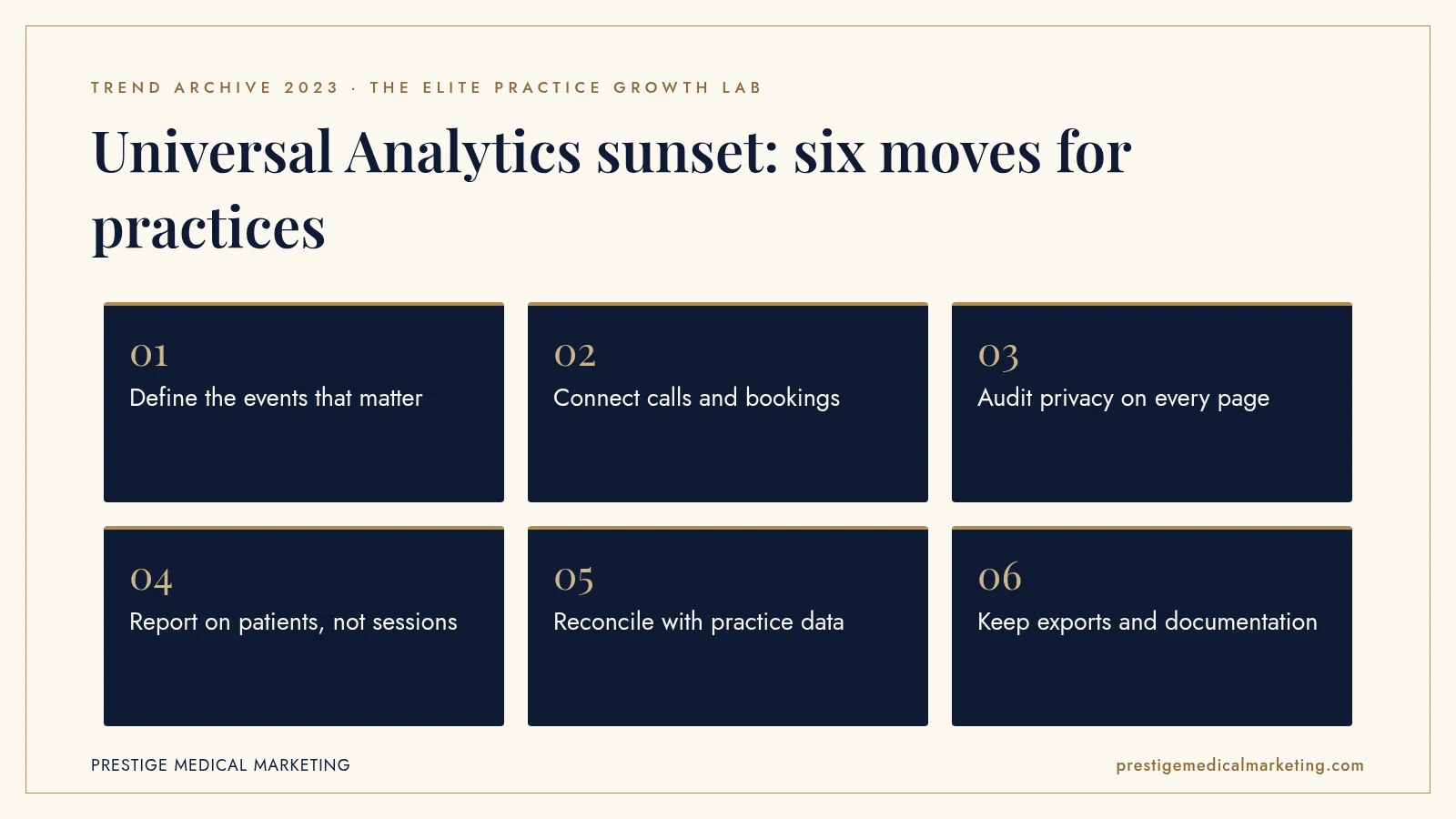
1. Define the events that matter
List the actions that signal a prospective patient: consultation requests, calls from the website, booking starts and completed bookings. Configure each as a key event in GA4 and confirm it fires correctly with real tests on desktop and mobile.
2. Connect calls and bookings
Many patients, especially for higher-value treatments, call rather than fill out forms. Connect call tracking and your booking engine so phone and online bookings are measured, not just web forms.
3. Audit privacy on every page
Review which tags run on condition, treatment and appointment pages. Avoid sending health-related details or identifiers to analytics or ad platforms, and get qualified privacy advice for your situation. Repeat the audit whenever new tags are added.
4. Report on patients, not sessions
Build a simple monthly report: website consultation requests, calls, booked consultations and the channels behind them. Traffic is context, not the goal. Keep the report short enough that the practice owner actually reads it.
5. Reconcile with practice data
Compare analytics with your practice management or CRM records. If analytics shows forty consultation requests and the front desk logged twenty, find out why. Duplicate submissions, spam or broken follow-up are common causes, and each one points to a different fix.
6. Keep exports and documentation
Document how events are defined and export key data periodically. The UA shutdown showed that platform data is not permanent, and that a practice should own a record of its own history.

Rebuilding measurement around the patient journey
The most useful way to think about practice analytics is as a funnel with a few clear stages. A prospective patient discovers the practice through search, maps, social or a referral. They visit the website and look at treatments, providers and pricing signals. They contact the practice by calling, submitting a form or starting an online booking. Then they book, attend and, ideally, return.
GA4 can measure the middle of that funnel well when configured correctly. It cannot see what happens after a phone call or inside the practice management system without integration. That is why the strongest practices pair GA4 with call tracking and a booking engine that reports completed appointments. Our booking engine service and our guide to call handling and lead leakage explain how those pieces fit together.
Once the funnel is measured end to end, the questions get sharper. Which channels bring patients who actually book? Which treatment pages lead to consultations? Where do calls go unanswered? Those are decisions a practice can act on.
The privacy question that came with GA4
The UA shutdown happened in the same month that the FTC and HHS sent roughly 130 warning letters to hospital systems and telehealth providers about online tracking. HHS’s position on tracking technologies on unauthenticated web pages was later partly vacated in court in 2024, as we covered in our piece on AHA v. Becerra, but the FTC’s interest in health data sharing continued.
For a practice rebuilding analytics, the practical approach is cautious. Minimize what is collected on sensitive pages. Avoid passing form contents, condition names or identifiers to analytics. Configure data retention, Google signals and sharing settings deliberately rather than accepting defaults. And document the decisions so they can be reviewed when guidance changes.
What to do about the lost history
Many practices lost years of trend data when UA access ended in 2024. If yours did, the first step is accepting that direct year-over-year comparisons across the switch were never reliable anyway, because the data models differed.
The second step is building a new baseline. Twelve months of well-configured GA4 data, reconciled with practice records, is more valuable than a decade of UA data that measured sessions but not patients. Some practices kept exported summaries of key UA metrics, which can be useful context as long as they are labeled clearly as a different system.
How specialty practices should configure events
The right events differ by practice type. A med spa might track consultation requests, online bookings for specific treatments, gift card purchases and membership sign-ups. A plastic surgery practice usually cares most about consultation requests by procedure, virtual consultation submissions and calls to the patient coordinator. A functional medicine or longevity clinic might track discovery call bookings, program inquiries and lab panel interest.
Physical therapy and chiropractic practices often see a high share of phone bookings, so call tracking matters more than form tracking. Behavioral health practices need to be especially careful about what is measured, because even the fact that a visitor viewed a particular service page can be sensitive.
Whatever the specialty, the principle is the same. Measure the few actions that represent real patient intent, name them clearly and keep the configuration documented so anyone reviewing it later understands what each number means.
Connecting analytics to advertising responsibly
The UA shutdown also changed how practices connected analytics to Google Ads. Campaigns that bid on imported UA goals lost that data on July 1, 2023, and many had to be rebuilt around GA4 key events or native Google Ads conversion tracking.
For health practices, that rebuild should be deliberate. Conversion data sent to ad platforms should describe the action, such as a consultation request, without revealing health conditions or personal details. Audience lists built from visitors to sensitive pages deserve particular caution, and Google’s own personalized advertising policies restrict targeting based on health conditions.
Analytics is a tool, not a strategy
The 2023 shutdown also exposed how much practices had relied on analytics dashboards as a stand-in for strategy. A report full of charts can look impressive while answering none of the questions that matter. The goal of measurement is to make better decisions: where to invest, which treatments to promote, how to improve conversion and how to stop losing leads.
Practices that understand that use analytics sparingly and well. They watch a short list of numbers, review them every month with the team and act on what they show. That discipline matters more than any specific platform. GA4 will change too, as every analytics product does. A practice that knows which few numbers drive its growth can adapt to the next change without losing its footing, because its questions stay the same even when the tools do not.
What 2023 does not tell us
We do not have reliable data on how many private practices lost conversion tracking during the migration or how long it took them to notice. Google did not publish practice-level statistics. What 2023 does show is the documented timeline, the automatic migration behavior and the platform integrations that stopped receiving UA data.
The premium practice advantage
Premium practices win on patient value, which makes accurate measurement of booked consultations essential. See our services, who we help, our custom websites, our approach to Google Maps and AI search visibility and our approach to predictability and scaling. Our team works from Austin with practices nationwide.
The bottom line
Universal Analytics stopped processing data on July 1, 2023, forcing practices onto GA4. The practices that used the moment to measure booked patients carefully, with privacy in mind, came out with better information than they had before.
Check if your market is open. We take one practice per specialty per market. Request a market check or call (716) 400-0084.
Frequently asked questions
When did Universal Analytics stop working?
Google says standard Universal Analytics properties stopped processing hits starting July 1, 2023. Access to Universal Analytics data and the interface ended starting the week of July 1, 2024.
What replaced Universal Analytics?
Google Analytics 4, which uses an event-based model rather than the session and pageview model that Universal Analytics used.
Did Google migrate practices automatically?
Starting March 2023, Google created GA4 properties on behalf of many sites that had not migrated or opted out. Those automatic setups were rarely configured for a practice's real conversion goals.
Can historical Universal Analytics data still be accessed?
No. Google says that starting the week of July 1, 2024, users no longer have access to current or historical Universal Analytics data.
Did the shutdown affect Google Ads?
If Universal Analytics was linked to Google Ads, Google says UA data stopped flowing to Ads starting July 1, 2023, which could affect campaigns bidding on imported UA goals.
Is GA4 safe to use on a medical practice website?
It depends on configuration. HHS and the FTC warned in 2023 about tracking technologies on health websites. Practices should review what data analytics tools collect, especially on pages related to conditions or appointments.