
In June 2024, an FDA advisory committee voted against MDMA-assisted therapy for PTSD, and on August 9, 2024, Lykos Therapeutics announced that the FDA had issued a complete response letter declining approval and requesting an additional Phase 3 trial. For behavioral health practices, it meant MDMA-assisted therapy remained unapproved, so marketing had to avoid implying availability and instead focus on evidence-based care patients could actually receive. This is marketing guidance, not legal advice.
Interest in psychedelic-assisted therapy grew rapidly in the years before 2024. Research results, news coverage and advocacy raised hopes that treatments like MDMA-assisted therapy could help people with post-traumatic stress disorder who had not responded to other care. Many patients began asking their therapists and psychiatrists when these treatments would be available.
In 2024, the FDA considered the first application for MDMA-assisted therapy for PTSD. Many expected an approval. Instead, the FDA asked for more evidence.
This retrospective covers what happened, why it mattered for behavioral health practices and how to talk about emerging treatments responsibly. This is marketing guidance, not legal advice. For our specialty approach, see behavioral health marketing.
What actually happened in 2024
The application. Lykos Therapeutics submitted a new drug application for midomafetamine, or MDMA, capsules used in combination with psychological intervention for adults with PTSD.
The advisory committee. On June 4, 2024, an FDA advisory committee met to review the application. A majority voted that the data did not show the treatment was effective and that its benefits did not outweigh its risks. Members raised concerns about study design, expectation effects and safety reporting.
The decision. On August 9, 2024, Lykos announced a complete response letter from the FDA. The FDA did not approve the application and requested an additional Phase 3 trial.
The reaction. News coverage, including AP’s report, described the decision as a major setback for the psychedelic therapy field.
Why it mattered for behavioral health
Behavioral health practices were caught between patient hope and regulatory reality. Patients with PTSD and other conditions had read about MDMA-assisted therapy and wanted access. Some practices had prepared to offer it if approved, and some marketing had already started to build excitement.
The decision meant MDMA-assisted therapy remained unapproved. Practices that had implied it was coming soon, or that positioned themselves as psychedelic therapy providers, had to recalibrate. Patients who had pinned hopes on a new treatment needed support and honest information.
The episode also showed how quickly expectations can outrun evidence. For practices, that is a reminder to keep marketing grounded in what is approved and available.
What typical agencies did
Some agencies leaned heavily into psychedelic trends before approval, creating content and ads that implied treatments were imminent or available. Those messages attracted interest but risked misleading vulnerable patients and drawing scrutiny from regulators and advertising platforms.
Other agencies ignored the topic entirely, leaving practices without a way to answer patient questions online. Patients searching for information found news articles and advocacy sites instead of a trusted local provider.
The better path was balanced education: acknowledge the research, explain the status honestly and describe evidence-based care available now.
What it means for a behavioral health practice today
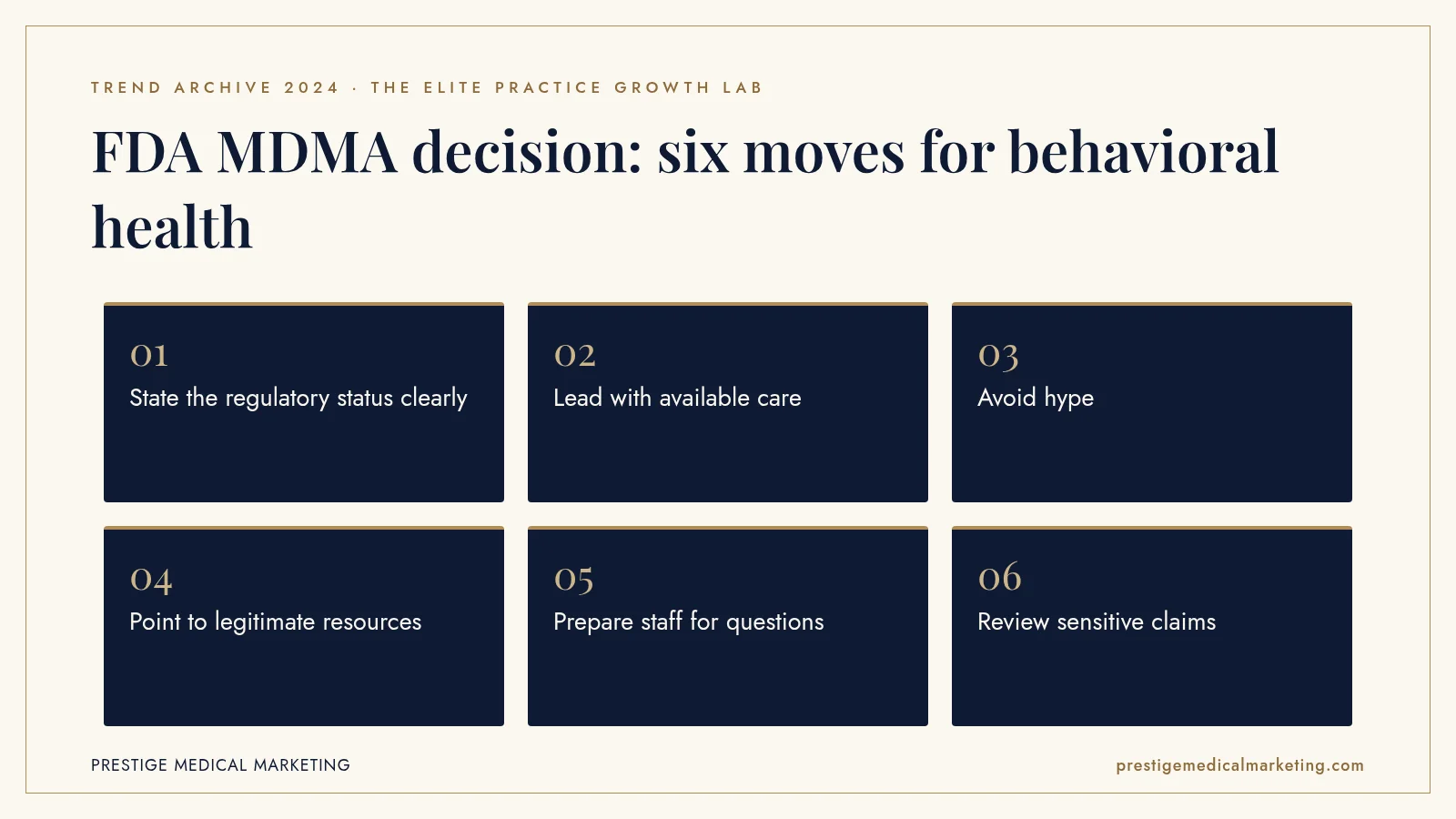
Patients deserve honesty about emerging treatments. Here is how we approach it.
1. State the regulatory status clearly
When writing about investigational treatments, say plainly that they are not approved and are available only in research settings where applicable.
2. Lead with available care
Describe the evidence-based treatments the practice offers now and who they help.
3. Avoid hype
Do not imply breakthroughs, guarantees or timelines that are not supported.
4. Point to legitimate resources
Where appropriate, explain how patients can learn about clinical trials through official registries.
5. Prepare staff for questions
Give intake staff and clinicians consistent, compassionate language for patients asking about new treatments.
6. Review sensitive claims
Have clinical leaders and counsel review content about controlled or investigational treatments.

Writing about emerging treatments responsibly
Educational content about psychedelic research can serve patients well if it is careful. A good article explains what researchers studied, what regulators decided and why, what remains unknown and what patients can do now. It avoids sensational headlines and makes clear that investigational treatments are not available outside approved settings.
That kind of content can also help visibility. Patients searching for information about MDMA therapy or psychedelic treatment may find a practice’s balanced article, learn about available options and contact the practice for care. Search engines and AI assistants increasingly favor trustworthy health content, so accuracy supports reach. Our guide to getting your practice recommended by AI explains why.
Supporting patients who feel let down
For some patients, the 2024 decision was personally disappointing. They may have struggled with PTSD for years and hoped a new option was close. Behavioral health practices can respond with empathy: acknowledge the disappointment, explain what the decision means and discuss available treatments that may help.
Clinicians can also help patients separate the decision from their own prospects. A regulatory setback for one treatment does not mean recovery is out of reach, and many people with PTSD improve with therapies available today.
Marketing can reflect that empathy. Content that speaks to people who have tried treatments without success, explains different approaches and invites them to talk with a clinician is more helpful than content that simply promotes services.
Other treatments patients ask about
Patients asking about MDMA often ask about other options too, including ketamine-based treatments and newer therapies. Practices should describe what they offer accurately, including regulatory status, how treatment works, who may be a candidate and what risks exist. Some treatments are FDA-approved for specific uses, while others may be used off-label, and the distinction matters for how they are described.
Advertising platforms have specific policies for mental health services, controlled substances and addiction treatment. Some require certification. Practices should check current platform rules before running ads related to these topics.
Privacy and sensitivity
Behavioral health marketing requires particular care with privacy. Patients searching for PTSD treatment are sharing sensitive information through their behavior. Websites should avoid tracking technologies that could expose that information to third parties without appropriate safeguards. Our retrospective on the 2024 tracking ruling for behavioral health covers the tracking questions in more detail.
Forms and intake processes should collect only what is needed and protect what is collected. Patients who feel their privacy is respected are more likely to reach out.
Building a referral network
Behavioral health practices often depend on referrals from primary care providers, other therapists and community organizations. Balanced communication about emerging treatments helps those relationships. A practice known for careful, evidence-based care is easier to refer to than one associated with hype.
Sharing clear information with referral partners about what the practice offers, how patients are evaluated and how care is coordinated builds trust over time.
Answering questions at intake
Intake is often where patients first ask about new treatments. A caller may say they read about MDMA therapy and want to know whether the practice offers it. Staff should have a clear, compassionate answer ready: the treatment is not FDA-approved, it is not offered outside research settings, and the practice can talk with them about evidence-based options that are available.
That answer should not feel like a dismissal. Staff can acknowledge the patient’s interest, explain that many people have been following the research and invite them to schedule an evaluation. A short written explainer, linked from the website, can give patients more detail after the call.
Tracking these questions is useful too. If many callers ask about a particular treatment, the practice may want to publish an educational article on it or update its frequently asked questions.
What patients search for
Patients looking for help with PTSD and trauma search for specific services, such as trauma-focused therapy, PTSD treatment near me and help after a traumatic event. They also search for information about new treatments they have heard about. Practices that publish clear pages on the conditions they treat, the approaches they use and how to get started meet patients where they are.
Local visibility matters as well. A complete Google Business Profile, accurate service descriptions, clear insurance information and privacy-conscious contact options help patients find and contact the practice.
A content review checklist
Before publishing anything about emerging or investigational treatments, behavioral health practices can use a short checklist. Does the content state the current regulatory status clearly, near the top? Does it avoid implying that the practice offers a treatment it does not offer? Does it avoid predicting approval dates or outcomes? Does it explain what is known and what remains uncertain? Does it describe the evidence-based options available now and how to start? Has a licensed clinician reviewed it for accuracy?
The same checklist applies to ads, social posts, emails and video scripts. A cautious website paired with an overexcited social post still sends a mixed message. Keeping a list of every place a treatment is mentioned makes it easy to update content when the status changes, whether that means a new approval, a new trial or a new safety concern.
Content should also be dated or reviewed on a schedule. Regulatory status can change, and an article that was accurate in 2024 may need updating later. A note showing when the content was last reviewed helps patients and search engines judge its reliability.
Measuring what matters
For behavioral health practices, marketing success is not only about inquiry volume. Practices should track how many inquiries lead to evaluations, how many patients start care, how many remain engaged and how patients rate their experience. Those measures show whether the marketing attracts people the practice can help and whether the patient journey works.
Content performance matters too. Educational articles about emerging treatments may attract visitors who are researching rather than ready to book. That is fine if the content guides them toward available care. Practices can measure how many readers continue to service pages, contact forms or calls. If an article attracts traffic but few next steps, a clearer path to available care may help.
Careful measurement should respect privacy. Behavioral health practices should use analytics approaches that do not share sensitive information with third parties and should review tracking with privacy counsel.
What 2024 does not tell us
The FDA’s decision did not end research on psychedelic-assisted therapies. It requested more evidence for one application. We do not know when or whether MDMA-assisted therapy or other psychedelic treatments will be approved, or what conditions might apply. Practices should follow developments and keep their content accurate as the status changes.
The premium practice advantage
A premium behavioral health practice is trusted because it is honest. It explains what treatments can and cannot do, supports patients through disappointment and offers care grounded in evidence.
That is how we market behavioral health practices: balanced education, privacy-conscious websites and visibility through Google Maps and AI search. See our services and who we help. Our team works from Austin with practices nationwide.
The bottom line
In 2024, the FDA declined to approve MDMA-assisted therapy for PTSD and requested more research. For behavioral health practices, the lesson was to keep marketing grounded in available, evidence-based care and to discuss emerging treatments honestly. This is marketing guidance, not legal advice.
Check if your market is open. We take one practice per specialty per market. Request a market check or call (716) 400-0084.
Frequently asked questions
What did the FDA decide about MDMA in 2024?
On August 9, 2024, Lykos Therapeutics announced that the FDA had issued a complete response letter for its application for MDMA capsules used with therapy for PTSD, meaning the FDA did not approve it and requested an additional Phase 3 trial.
What did the advisory committee say?
In June 2024, an FDA advisory committee voted that the available data did not show the treatment was effective and that its benefits did not outweigh its risks.
Is MDMA-assisted therapy available at clinics?
It was not approved by the FDA as of the 2024 decision. Practices should not market it as an available treatment outside authorized research settings.
Can practices write about psychedelic research?
Yes, educational content about research can be appropriate if it is accurate, balanced and clearly states that treatments are investigational and not approved.
How should practices respond to patient questions about new treatments?
Explain the current status honestly, describe evidence-based options available now and refer patients to clinical trial resources where appropriate.
Is this legal advice?
No. This is marketing guidance, not legal advice. Practices should consult qualified counsel about claims involving investigational or controlled treatments.