
In November 2024, the DEA and HHS issued a third temporary extension of COVID-19 telemedicine flexibilities for prescribing controlled medications, keeping them in place through December 31, 2025. A fourth extension later carried them through December 31, 2026. For men's health clinics, where testosterone is a Schedule III controlled substance, it meant virtual prescribing could continue under the flexibilities, but marketing and operations had to plan for rules that remained temporary. This is marketing guidance, not legal advice.
Virtual care changed men’s health. Patients who might never have walked into a clinic could schedule a video consultation, complete labs nearby and receive ongoing care from home. For testosterone therapy and related treatments, that convenience became a major part of how many clinics attracted and kept patients.
Underneath that convenience sat a regulatory question. Testosterone is a Schedule III controlled substance, and federal law generally required an in-person evaluation before prescribing controlled substances through telemedicine. During the COVID-19 public health emergency, temporary flexibilities waived that requirement. Throughout 2024, clinics waited to see whether those flexibilities would continue.
This retrospective covers what the DEA decided in 2024, why it mattered for men’s health clinics and how to market virtual care responsibly. This is marketing guidance, not legal advice. For our specialty approach, see men’s health clinic marketing.
What actually happened in 2024
The background. The Ryan Haight Act generally requires an in-person medical evaluation before controlled substances are prescribed via the internet, with limited exceptions. During the public health emergency, the DEA and HHS allowed telemedicine prescribing without that prior in-person visit.
Earlier extensions. After the public health emergency ended in 2023, the DEA and HHS extended the flexibilities temporarily rather than letting them lapse, while working on permanent rules.
The third extension. In November 2024, the DEA and HHS issued a third temporary extension, published November 19, 2024, keeping the flexibilities in place through December 31, 2025.
What it allowed. The extension let DEA-registered practitioners continue prescribing controlled medications via telemedicine without a prior in-person evaluation, subject to the conditions in the rule.
What came next. At the end of 2025, a fourth temporary extension carried the flexibilities through December 31, 2026.
Why it mattered for men’s health clinics
For men’s health clinics offering testosterone therapy, the flexibilities were central to virtual care. Without them, clinics would generally need an in-person evaluation before prescribing, which would change the patient journey, staffing and geography of care.
The uncertainty mattered as much as the outcome. Each time an expiration approached, clinics faced questions about whether to keep promoting fully virtual starts, whether to build in-person options and how to explain the situation to patients. Marketing that promised fully online care without caveats carried risk if the rules changed.
The extension gave clinics more time, but it also reinforced that the rules were temporary. Clinics that treated the flexibilities as permanent were building on uncertain ground.
What typical agencies did
Many agencies marketed virtual testosterone care with aggressive promises: fast online prescriptions, no office visits and guaranteed results. Those messages attracted clicks but ignored the clinical and regulatory reality, and they made clinics vulnerable to scrutiny from advertising platforms and regulators.
Other agencies did not track regulatory changes at all. When rules shifted, clinics had to rewrite landing pages and pause campaigns in a hurry.
Few agencies helped clinics build marketing that would hold up under different regulatory outcomes, such as messaging that emphasized evaluation and care rather than prescriptions.
What it means for a men’s health clinic today
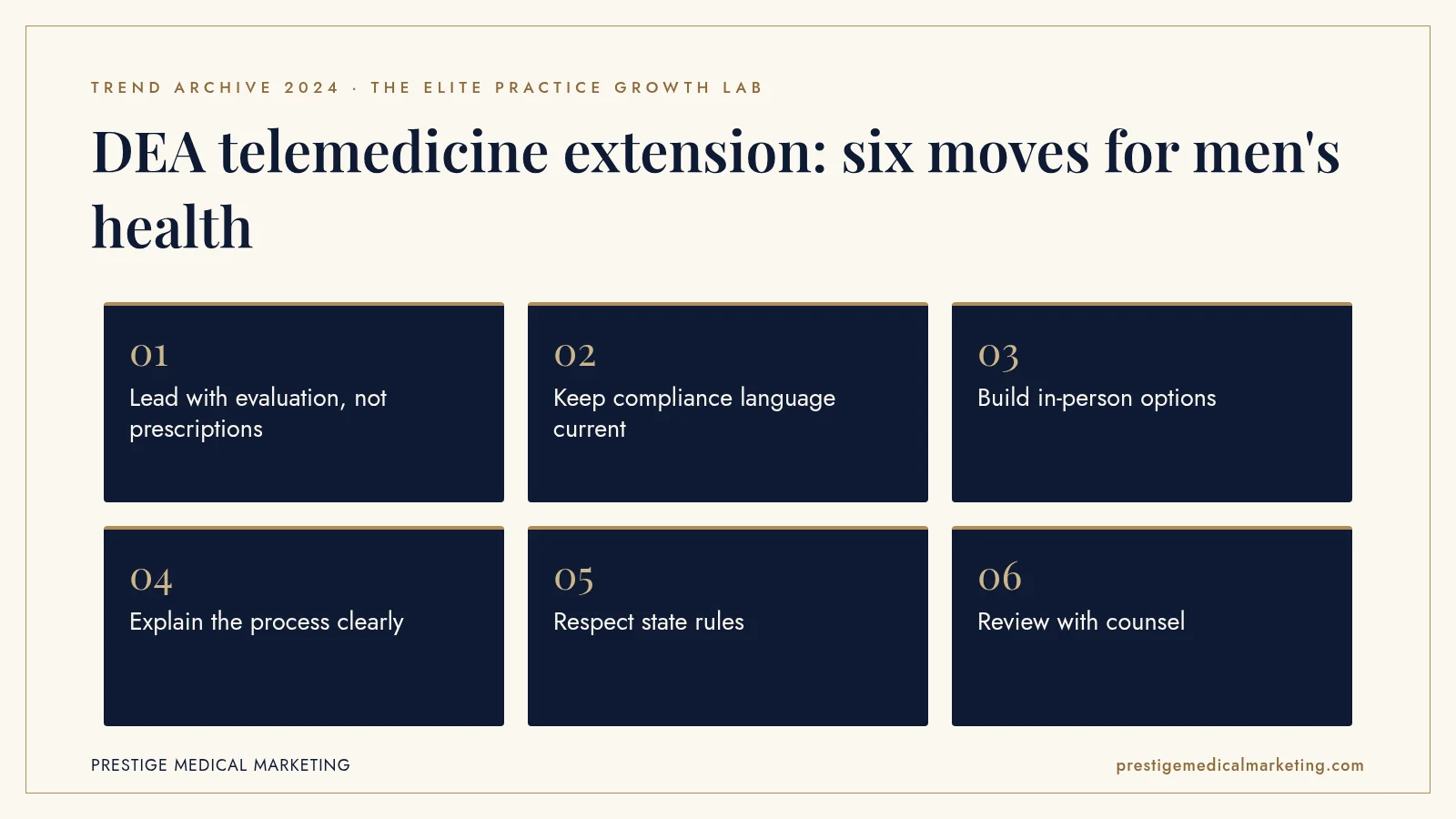
Virtual care can still be a strength, as long as marketing reflects the rules and the care. Here is how we approach it.
1. Lead with evaluation, not prescriptions
Describe consultations, lab work and provider review. Avoid language that promises a prescription before evaluation.
2. Keep compliance language current
Assign someone to monitor DEA and HHS updates and adjust pages, ads and intake when rules change.
3. Build in-person options
Offer or partner for in-person visits where practical so the clinic can adapt if flexibilities change.
4. Explain the process clearly
Show patients each step, from intake to labs, consultation, follow-up and monitoring, so expectations are realistic.
5. Respect state rules
Telemedicine and prescribing rules also vary by state. Market only where providers are licensed and care can be delivered properly.
6. Review with counsel
Have health care counsel review the virtual care model and marketing claims at least annually.

Marketing virtual care responsibly
Men considering testosterone therapy often have real concerns: low energy, changes in mood or performance, or questions after reading online. Good marketing meets those concerns with clear information, not hype. Explain what testosterone therapy is, who may be a candidate, what testing involves and what monitoring looks like. Our men’s health work focuses on that kind of clarity.
Advertising platforms and regulators pay attention to claims about prescription drugs. Clinics should avoid promising outcomes, implying that prescriptions are guaranteed or using before-and-after claims that cannot be supported. Educational content, provider credentials and clear process descriptions build trust and hold up better over time.
Virtual care marketing should also be honest about limits. Some patients will need in-person exams, some will not be candidates and treatment requires ongoing monitoring. Saying so builds credibility.
Operations that support the message
A clinic’s operations need to match its marketing. If the website promises a smooth virtual start, the intake process, lab coordination and follow-up need to deliver it. Patients who encounter delays or confusing steps after booking are less likely to continue care.
That means clear intake forms, easy lab scheduling, timely provider review and reliable follow-up. It also means documenting each step so the clinic can show how evaluations are conducted. Strong operations protect both patient experience and compliance. Our booking engine work connects scheduling, intake and follow-up.
Planning for regulatory change
The DEA has said it intends to create permanent rules for telemedicine prescribing of controlled substances. Until those rules are final, clinics face continued uncertainty. Planning for that uncertainty is part of running a resilient clinic.
Clinics can prepare by mapping which services depend on the flexibilities, identifying in-person options, preparing alternative patient journeys and keeping marketing flexible. When an expiration date approaches, a clinic with a plan can adjust calmly instead of scrambling.
Patients appreciate clear communication too. If rules change, tell existing patients what it means for their care and what steps they need to take.
Building patient trust in a crowded market
Men’s health became a crowded market in 2024, with national telehealth brands, local clinics and online advertisers all competing for attention. Trust became a key differentiator. Patients want to know who their provider is, what credentials they hold and how their care will be monitored.
Clinics can build trust by featuring real provider bios, explaining monitoring and safety, publishing clear pricing where possible and sharing genuine patient reviews within platform and legal rules. A local or regional clinic that combines virtual convenience with accessible in-person care has a real advantage over a faceless national brand.
What patients search for
Men researching testosterone therapy and related care ask practical questions. Is this right for me? What tests are involved? How much does it cost? Can I do this online? How often will I need follow-up? What are the risks? Clinics that answer those questions clearly on their websites tend to attract better-informed patients who are more likely to start and stay in care.
Those questions are also what AI assistants and search engines try to answer. Pages that explain the evaluation process, describe monitoring, state who is and is not a candidate and list costs or pricing ranges give search engines and AI tools useful material to reference. Pages full of hype give them little. Our guide to getting your practice recommended by AI explains how clear content supports visibility.
Local signals matter too. Many men prefer a clinic they can visit if needed, even if most care happens virtually. A strong Google Business Profile, accurate service descriptions and genuine reviews help a clinic appear when patients search nearby.
A checklist for virtual care pages
Every virtual care page should be reviewed against a short checklist. Does it explain the evaluation process, including labs and provider review? Does it avoid promising a prescription or guaranteed results? Does it state where the clinic can provide care and which providers are licensed? Does it explain follow-up and monitoring? Does it include clear contact options for questions? Does it link to privacy information and explain how patient data is handled?
Pages should also be reviewed whenever regulations change. If an extension expires or new rules take effect, the clinic should know exactly which pages, ads, emails and intake forms need updating. Keeping a simple list of every place virtual care is described makes those updates fast.
Advertising deserves its own review. Platforms have specific policies for prescription drugs and telehealth, and some require certification. Ads that violate those policies can be rejected or lead to account restrictions, so clinics should confirm current platform rules before launching campaigns.
Staff and provider alignment
Marketing promises are kept or broken by the people delivering care. Front desk staff, care coordinators and providers should all understand how the clinic describes its services and why. If marketing says every patient receives a thorough evaluation, providers need the time and process to do that. If marketing says patients can reach the clinic easily between visits, someone needs to answer those messages promptly.
Regular conversations between marketing and clinical leaders keep the message accurate. Providers can flag claims that overstate outcomes, and staff can share the questions patients actually ask, which become useful content for the website and frequently asked questions.
When regulations shift, those conversations become even more important. Everyone in the clinic should be able to explain the change to patients in simple, consistent language.
Measuring virtual care marketing
Clinics should measure more than leads. Track how many inquiries become completed evaluations, how many evaluated patients start care and how many remain in care after several months. Those numbers show whether marketing attracts the right patients and whether the patient journey works. A campaign that generates many inquiries but few completed evaluations may be promising something the clinic does not deliver.
What 2024 does not tell us
The 2024 extension did not settle the long-term rules. It extended temporary flexibilities while the DEA worked on permanent regulations. We do not know what final rules will require, how they will treat Schedule III medications or how enforcement will develop. Clinics should treat each extension as time to prepare, not as a permanent solution.
The premium practice advantage
A premium men’s health clinic is trusted because it is careful. It explains care clearly, evaluates patients properly, monitors treatment and adapts calmly when rules change.
That is how we market men’s health clinics: honest messaging, strong intake systems and visibility through Google Maps and AI search. See our services and who we help. Our team works from Austin with practices nationwide.
The bottom line
In November 2024, the DEA and HHS extended telemedicine flexibilities for controlled medications through 2025, and a later extension carried them through 2026. For men’s health clinics, the lesson was to market virtual care responsibly, lead with evaluation and plan for rules that remain temporary. This is marketing guidance, not legal advice.
Check if your market is open. We take one practice per specialty per market. Request a market check or call (716) 400-0084.
Frequently asked questions
What did the DEA do in November 2024?
The DEA, together with HHS, issued a third temporary extension of telemedicine flexibilities for prescribing controlled medications, through December 31, 2025, published in the Federal Register on November 19, 2024.
Why does this matter for men's health clinics?
Testosterone is a Schedule III controlled substance. The flexibilities allow prescribing controlled medications via telemedicine without a prior in-person visit, subject to conditions, which matters for clinics offering virtual care.
Were the flexibilities extended again?
Yes. A fourth temporary extension, published December 31, 2025, extended the flexibilities through December 31, 2026.
Are the rules permanent?
No. The flexibilities have been extended temporarily several times. Clinics should monitor DEA and HHS updates and plan for possible changes.
How should clinics market virtual care?
Describe the process accurately, emphasize clinical evaluation and lab work, avoid promising prescriptions and keep compliance language current with the rules.
Is this legal advice?
No. This is marketing guidance, not legal advice. Clinics should consult qualified health care counsel about prescribing rules, state laws and DEA registration.