
On April 23, 2024, the FTC announced a final rule banning most new noncompete agreements nationwide, set to take effect September 4, 2024. On August 20, 2024, Judge Ada Brown of the Northern District of Texas set the rule aside in Ryan LLC v. FTC, so it never took effect. In September 2025 the FTC dropped its appeals and shifted to case-by-case enforcement, including warning letters to healthcare employers. Dermatology practices should build patient loyalty to the practice, not rely on contracts alone.
Every dermatology practice owner knows the scenario. A well-liked provider, perhaps a physician assistant with a loyal cosmetic following or an associate dermatologist with a full schedule, decides to leave. They open a practice a few miles away. Over the next months, a portion of their patients follow them.
For decades, the answer to that risk was the noncompete agreement. In 2024, the federal government tried to ban most of them. Then a court stopped it. The legal story is still evolving, but the marketing lesson is already clear.
This retrospective covers what happened to the noncompete rule in 2024 and after, and what it means for how a dermatology practice builds loyalty. It is marketing guidance, not legal advice.
What actually happened in 2024
April 23: the rule. The FTC announced a final rule banning most new noncompete agreements nationwide. The FTC estimated that about 30 million workers, roughly one in five Americans, were bound by noncompetes. Existing noncompetes for senior executives could remain in force, but most others would become unenforceable. The rule was scheduled to take effect on September 4, 2024.
The lawsuits. Several challenges followed immediately. One was brought in Texas by Ryan LLC, a tax services firm, and was later joined by the U.S. Chamber of Commerce and other business groups.
August 20: the rule is set aside. Judge Ada Brown of the Northern District of Texas ruled in Ryan LLC v. FTC that the FTC lacked substantive rulemaking authority over unfair methods of competition and that the rule was arbitrary and capricious. She set the rule aside nationwide, so it could not take effect on September 4.
What followed. The FTC initially appealed. In September 2025, it voted to dismiss its appeals and moved to case-by-case enforcement. On September 10, 2025, FTC Chairman Andrew Ferguson sent warning letters to several large healthcare employers and staffing firms, urging them to review their noncompete agreements and end any that are unjustified or overbroad.
States kept moving. State legislatures continued to limit clinician noncompetes. Texas, for example, passed SB 1318, effective September 1, 2025. For physician agreements made or renewed after that date, it caps the restriction at one year, a five-mile radius and a buyout no higher than the physician’s annual salary and wages.
Why dermatology practices felt it
Dermatology combines two kinds of patient relationships. Medical dermatology patients often return for ongoing care and value continuity with a specific provider. Cosmetic patients may build a strong personal relationship with the injector or provider who knows their face and preferences. Both create loyalty to individuals.
Many dermatology practices also grew quickly through acquisitions and expansion, adding physician assistants, nurse practitioners and associate physicians. Noncompetes were a standard part of that model. The 2024 rule, even though it never took effect, made many owners realize how much of their growth plan depended on contracts rather than on patient loyalty to the practice itself.
The September 2025 warning letters sharpened the point. The FTC singled out healthcare as an area of focus. Whatever happens in court, the direction of public policy has been toward fewer and narrower noncompetes for clinicians, not more.
What typical agencies did
Most marketing agencies ignored the noncompete story entirely. It seemed like an HR and legal issue. But many of those same agencies had built their clients’ marketing around individual providers in a way that increased the risk.
Common examples: a social media presence that featured one injector almost exclusively, with their personal handle more prominent than the practice’s. A website where one provider’s bio dominated every service page. Review requests that asked patients to mention a specific clinician by name. Ads built around a personal brand that the practice did not own.
None of those choices is wrong on its own. Patients do respond to real people. The issue is balance. When every marketing asset points to one person, the practice’s reputation walks out the door with them.
What it means for a dermatology practice today
The goal is to make patients loyal to the practice: its standards, its team, its experience and its results. Here is how we approach it.
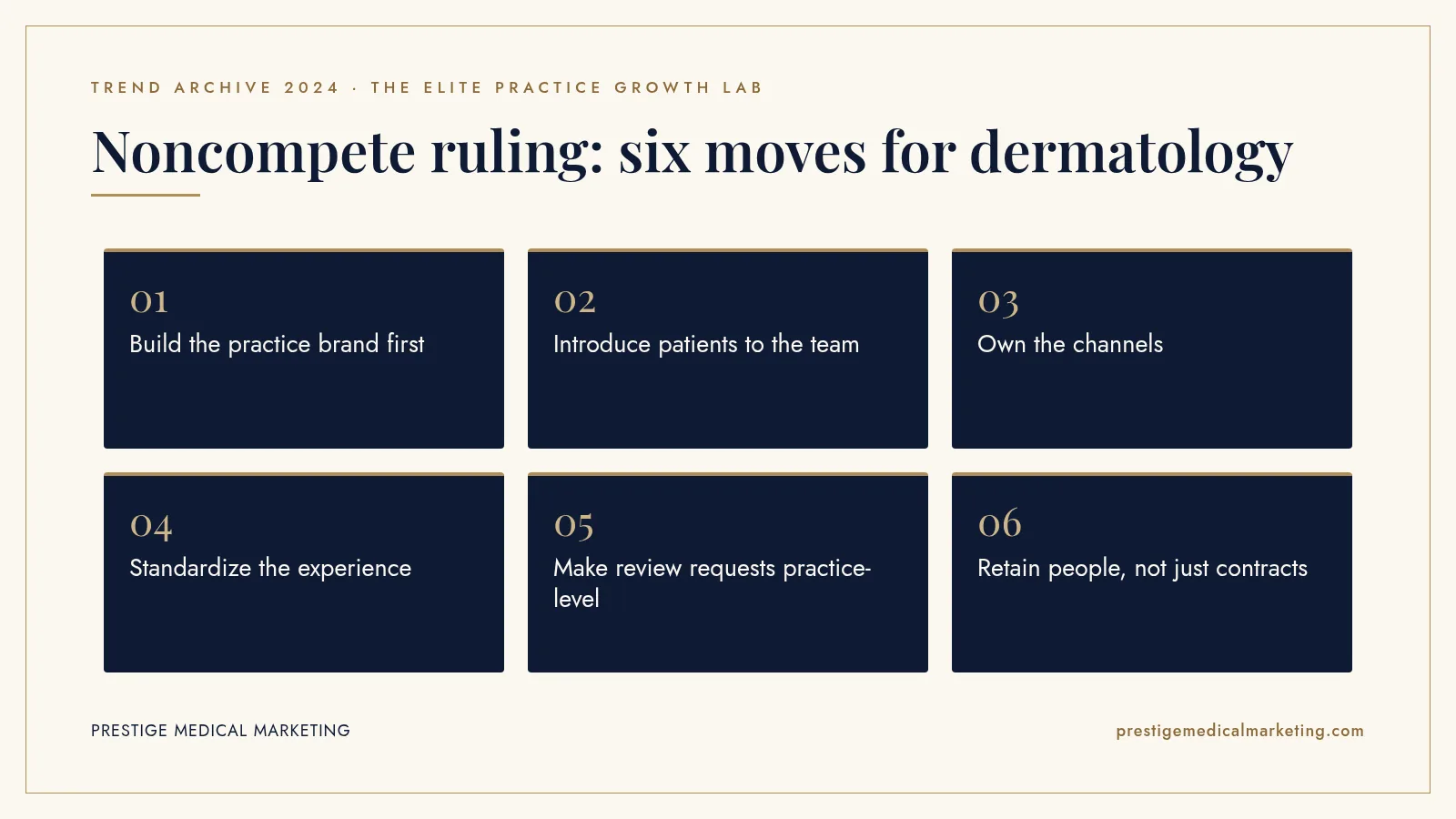
1. Build the practice brand first
Your name, your standards and your patient experience should be the center of your website, profile and social channels. Individual providers are featured as part of that brand, not instead of it.
2. Introduce patients to the team
Give every provider a strong bio and feature several team members across content. Patients who know more than one face at your practice are more likely to stay when one leaves.
3. Own the channels
Social accounts, review profiles, email lists and websites should belong to the practice, with practice-controlled logins. Content featuring a provider should live on practice channels.
4. Standardize the experience
Consistent consult structure, treatment protocols and follow-up make the experience about your practice. A patient who loves how your practice runs is harder to lure away.
5. Make review requests practice-level
Ask patients to review the practice. Reviews will still mention providers naturally, but the reputation accrues to the business.
6. Retain people, not just contracts
Competitive pay, a good culture and clear growth paths keep providers better than restrictions do. That is a business decision, but it has marketing consequences.

Balancing personal and practice brands
None of this means hiding your providers. Patients choose people, especially in cosmetic dermatology, and authentic content featuring real clinicians performs well. The goal is balance and ownership, not anonymity.
A good structure is a strong practice brand with several featured providers, each presented as part of a team with shared standards. Before-and-after galleries can credit the treating provider while living on practice channels with documented consent. Educational videos can feature different clinicians. The practice’s medical director or founder can set the tone without carrying the whole brand alone.
This also helps search visibility. A practice website with deep pages for each service and multiple clinicians gives Google and AI systems a fuller picture of the practice’s expertise. Our dermatology practice marketing guide covers how to structure those pages.
When a provider leaves anyway
Even the best-run practices lose people. When it happens, communication is a marketing moment. Patients scheduled with the departing provider deserve a prompt, professional message that introduces their new provider and reassures them about continuity of care, within whatever rules apply to patient notification in your state.
Update the website and profiles quickly so patients are not booking with someone who is gone. Keep content that featured the provider only if you have the rights to it and it remains accurate. Above all, avoid negative messaging about the departing clinician. Patients notice, and it rarely helps.
A practice that handles departures gracefully protects its reputation with the patients who stay, and those patients are the foundation of every review and referral that follows.
What patients actually stay loyal to
Ask long-time patients why they keep coming back to a dermatology practice and the answers are rarely about a contract or even a single name. They talk about being seen on time, about a front desk that remembers them, about a provider who explained things clearly, about results they trust and about never feeling pressured.
Those are practice-level qualities. They can be designed, trained and repeated across every provider on the team. When a practice markets those qualities consistently, it gives patients a reason to stay that does not depend on any one person’s schedule or career plans.
A note on hiring and recruitment
The policy shift also affects recruiting. If clinicians in your market face fewer restrictions, they also have more options, and your practice can recruit from a wider pool. That makes your reputation as an employer part of your marketing.
The same signals that attract patients attract providers: a strong brand, a full schedule, good reviews and a modern patient experience. A practice with a steady flow of new patients and a clear identity is an easier place to recruit to than one that depends on a single star provider. Marketing and recruitment reinforce each other.
An audit of where your brand actually lives
Most owners have never mapped how much of their marketing depends on one person. It takes an afternoon, and the results often surprise them.
Social accounts. Who created each account, whose email is attached, and who holds the password? If an account was started by a provider on their personal email, it may be harder to keep than you think.
Content. Count how many recent posts, videos and ads feature each provider. If one person appears in most of them, your content library has a single point of failure.
Website. Check whether service pages describe the practice’s approach or one provider’s personal approach. Both can work, but a page that only makes sense with one name on it will need rewriting the day that person leaves.
Reviews. Read your last fifty reviews. If most mention one clinician, the practice’s reputation is concentrated. That is a signal to introduce patients to more of the team.
Booking. Look at how patients book. If many request a single provider by name and wait weeks rather than seeing someone else, loyalty is attached to the person, not the practice.
Email and text lists. Confirm the patient communication lists live in practice-owned systems, with the practice’s name on every message.
None of these findings is a crisis. They are a map. Each one points to a small, steady change that shifts loyalty toward the practice over the next year, which is a far more durable protection than any agreement a court might later narrow.
What 2024 does not tell us
The 2024 rule never took effect, so there is no data on how a nationwide ban would have changed dermatology practices. The FTC did not name the recipients of its 2025 warning letters, and we do not know whether any were dermatology groups. State laws differ widely and continue to change. Whether any particular agreement is enforceable depends on your state and its terms, so rely on employment counsel rather than general articles, including this one.
The premium practice advantage
A premium dermatology practice is more than its individual providers. It is a standard of care, a patient experience and a reputation built over years. Practices that market that identity are protected in a way that contracts alone cannot provide.
That is how we approach dermatology marketing: a practice brand with featured clinicians, practice-owned channels and reviews, and Google Maps and AI search visibility built around the business. See our services and who we help. Our team works from Austin with practices nationwide.
The bottom line
The FTC’s 2024 noncompete ban was stopped in court, but the policy direction has kept moving toward fewer clinician restrictions. Dermatology practices that build loyalty to the practice, not just to one provider, are better prepared for whatever the law says next.
Check if your market is open. We take one practice per specialty per market. Request a market check or call (716) 400-0084.
Frequently asked questions
What did the FTC's 2024 noncompete rule do?
Announced on April 23, 2024, the rule would have banned most new noncompete agreements for workers nationwide and made most existing ones unenforceable, with a narrow exception for existing agreements with senior executives. It was scheduled to take effect on September 4, 2024.
Why did the rule never take effect?
On August 20, 2024, Judge Ada Brown of the U.S. District Court for the Northern District of Texas ruled in Ryan LLC v. FTC that the FTC lacked authority to issue the rule and that it was arbitrary and capricious. She set the rule aside nationwide.
What happened after 2024?
On September 5, 2025, the FTC voted to dismiss its appeals defending the rule. On September 10, 2025, FTC Chairman Andrew Ferguson sent warning letters to several large healthcare employers and staffing firms urging them to review their noncompete agreements, signaling case-by-case enforcement.
Are physician noncompetes still enforceable?
It depends on the state. Many states regulate or limit noncompetes for physicians and other clinicians. For example, Texas SB 1318, effective September 1, 2025, limits physician noncompetes to one year, a five-mile radius and a buyout capped at annual salary for agreements made or renewed after that date. Ask employment counsel about your state.
Why should a dermatology practice care about this for marketing?
When a provider leaves, some patients follow the provider. A practice whose patients only know one clinician's name has more at stake. Building recognition for the practice, its team and its standards reduces that risk regardless of what contracts allow.
Is this legal advice?
No. This is marketing guidance. Noncompete law varies by state and changes often. Consult qualified employment counsel before drafting or enforcing any agreement.