
Google rolled AI Mode out to all U.S. users on May 20, 2025, and by July it had more than 100 million monthly active users in the U.S. and India. AI Mode answers long, conversational questions by running many searches at once and summarizing the results. For dermatology practices, that rewards pages that answer specific, real patient situations clearly, from a named board-certified dermatologist, and penalizes vague service lists.
Think about how a patient used to search for a dermatologist. Two or three words. “Dermatologist near me.” “Acne treatment.” “Mole check.” Google returned a map and some links, and whichever practice ranked best got the call.
Now think about how people actually talk about their skin. “I’m 38, I’ve had adult acne along my jaw for two years, prescription creams haven’t worked, and I’m wondering if it’s hormonal and whether there are options besides antibiotics.” That is a real question. In 2025, Google built a search experience that welcomes it.
This retrospective covers what Google launched, what the public data says, and what a dermatology practice owner should do about it now.
What actually happened in 2025
Google first tested AI Mode in its Labs program in early 2025. Then, at Google I/O on May 20, 2025, it rolled AI Mode out to everyone in the U.S. Google described it as its most powerful AI search, with more advanced reasoning and the ability to handle follow-up questions.
The key technical idea is what Google calls query fan-out. Instead of running one search for your question, AI Mode breaks it into subtopics and runs many searches at once, then pulls the results together into a single answer with links. Google also brought its Gemini 2.5 model into Search that year, as listed in its I/O 2025 announcements.
Adoption followed quickly. In its July 2025 earnings remarks, Alphabet said AI Mode had passed 100 million monthly active users in the U.S. and India, while AI Overviews had more than 2 billion monthly users.
And in June 2025, Google began counting AI Mode clicks and impressions in Search Console, rolled into the same Performance report as regular web search. That made AI Mode part of every practice’s numbers, whether they knew it or not.
Why dermatology is built for conversational search
Dermatology has two businesses living under one roof. Medical dermatology: acne, eczema, psoriasis, rosacea, skin cancer screening, hair loss. Cosmetic dermatology: neuromodulators, fillers, lasers, peels, skin quality. Both are full of questions that do not fit in three words.
Patients describe their skin type, their history, what they have tried and what worried them. They ask about side effects, downtime, whether a treatment works on darker skin tones, how many sessions they will need, whether insurance covers it. Then they ask a follow-up.
That kind of searching is exactly what AI Mode was designed for. And because AI Mode fans a question out into many sub-searches, it can pull from many different pages to build one answer. A practice with a single “Services” page that lists twenty treatments in bullet points gives it almost nothing to use. A practice with a clear, specific page on hormonal acne in adults, written by a named dermatologist, gives it a lot.
What changed for patients, and for the practices that win them
Patients arrive more informed. Someone who has spent fifteen minutes in a conversational search thread before calling already understands the basic options. They want to know whether your practice is the right place, not what a retinoid is.
The shortlist forms earlier. In a traditional results page, the patient chose which links to open. In AI Mode, the answer itself shapes the shortlist, with links to the sources it used. Being one of those sources is the new page one.
Specific beats broad. Fan-out searches tend to be specific: a condition plus a patient group, a treatment plus a concern. Pages that address specific situations have more chances to be pulled in.
Credentials are visible signals. Skin health is a health topic. Google says it gives extra weight to trust for topics that can affect health. A board-certified dermatologist named on the page, with a real bio, is a signal that generic copy cannot fake.
What typical agencies did
Most agencies treated AI Mode as a headline, not a change in how patients behave. Some ignored it because it did not show up as its own line in reports. Others sold “AI optimization” packages that amounted to adding a few FAQ blocks to existing pages and calling it done.
A few went the other way and mass-produced hundreds of AI-written condition pages, hoping volume would get them cited. That runs straight into Google’s spam policy on scaled content abuse, and it tends to produce the exact thin, repetitive material conversational search has no reason to cite.
The average SEO firm optimizes for whatever the dashboard shows. AI Mode rewards what the patient actually needs. Those are not the same thing.
What it means for a dermatology practice today
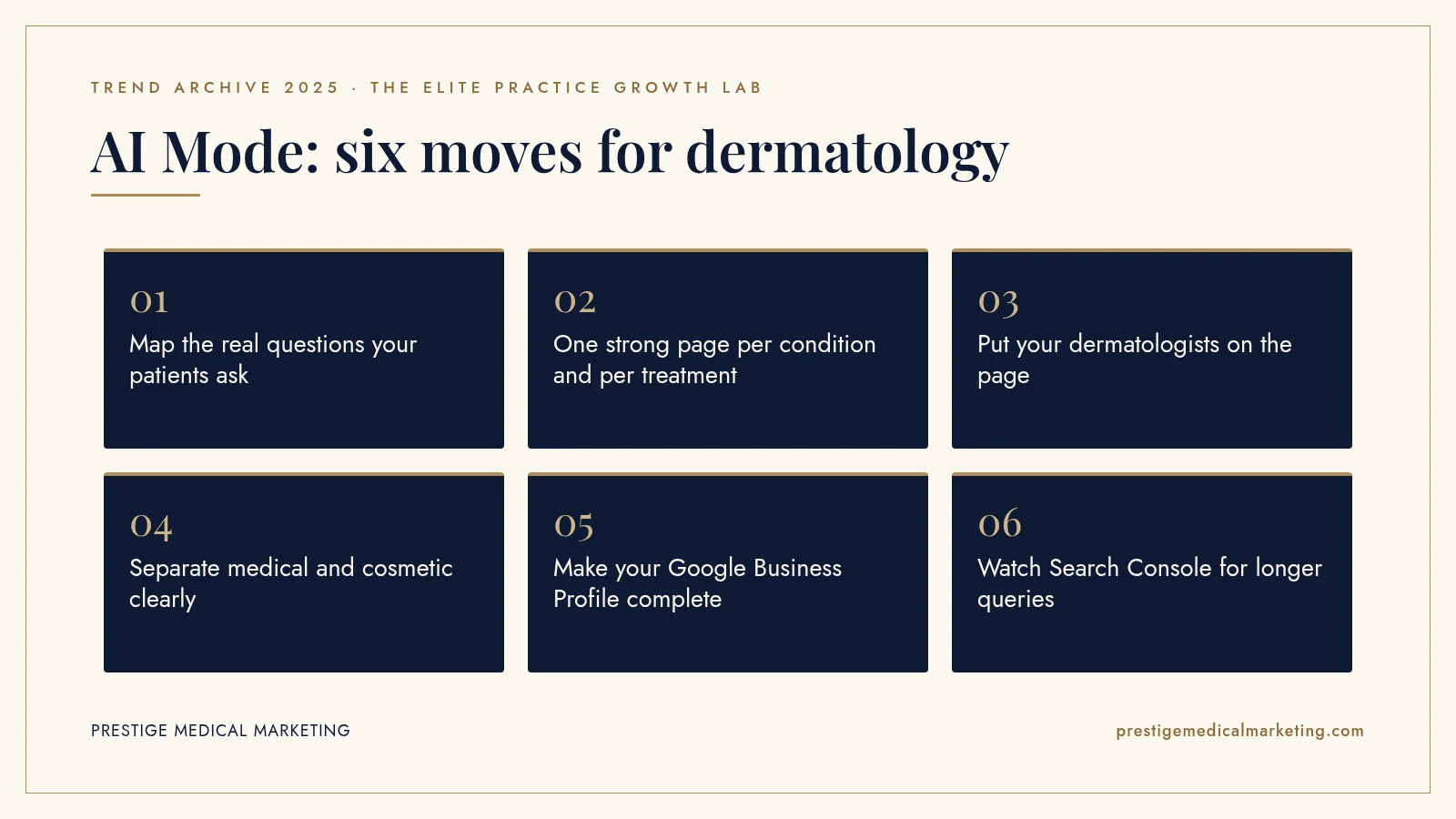
Here is how we would build a dermatology practice’s presence for conversational search, starting now.
1. Map the real questions your patients ask
Your front desk and providers already know them. Gather the ten questions patients ask most for each major condition and each cosmetic treatment. Those questions, in patients’ words, become the structure of your pages.
2. One strong page per condition and per treatment
Each page should open with a direct answer, then cover who it affects, how your dermatologists evaluate it, the treatment options you offer, realistic timelines, side effects, and when to book. Our dermatology practice marketing guide covers the full structure.
3. Put your dermatologists on the page
Name the provider who reviewed the content. Link to a real bio with board certification, training and focus areas. If your practice has a physician who focuses on skin of color, hair loss or Mohs surgery, say so clearly. Specific expertise is what conversational search is looking for.
4. Separate medical and cosmetic clearly
Patients asking about eczema and patients asking about laser resurfacing are on different journeys. Give each its own path through your site, with the right calls to action: insurance and referral details for medical, consult and pricing details for cosmetic.
5. Make your Google Business Profile complete
AI answers still lean on local listings when the question turns to where to go. Categories, services, hours, photos of your real office and team, and steady reviews all matter. For the AI side of local discovery, see our guide to getting your practice recommended by AI.
6. Watch Search Console for longer queries
Since AI Mode data is blended into Search Console, look for growth in long, question-style queries. They are a sign conversational search is sending people your way, and a guide to which pages to expand next.

A content map built for fan-out
Query fan-out changes how you should plan a dermatology website. If AI Mode breaks one patient question into several sub-searches, each strong page on your site is a separate chance to be pulled into the answer. So plan content in clusters, not one-offs.
Take adult acne. A single page called “Acne Treatment” covers it in name only. A cluster covers it the way patients actually think: adult acne along the jaw and whether it is hormonal, acne in teenagers and what parents should know, prescription options and how long they take to work, in-office treatments like peels and lasers, acne scarring once breakouts are under control, and what to expect at a first visit. Each page links to the others, and each answers one situation completely.
Do the same for your highest-value cosmetic services. For laser resurfacing, that might mean separate sections or pages on candidacy, skin tone considerations, downtime by laser type, how many sessions are typical in your practice, and how you combine treatments. For skin cancer screening, it might mean what a full-body exam involves, how often different patients should come in, and what happens if something suspicious is found.
This is not about volume. A dozen excellent pages that cover your core conditions and treatments in depth will do more than two hundred thin ones. The test for each page is simple: would one of your dermatologists be comfortable handing it to a patient?
Where the medical side meets the marketing side
Dermatology marketing has to respect the line between education and diagnosis. Content should help patients understand conditions and options, and then direct them to an exam. It should never suggest a page can replace one. That restraint is not just good ethics. It is the tone that earns trust, from patients and from search systems that weigh health content carefully.
Keep claims within what your providers would say in the room. Avoid promising results, avoid absolute language about cures, and be clear about when insurance applies. Pages written that way read as authoritative, and they hold up when someone at the practice reviews them a year later.
What the 2025 data does and does not tell you
A word of caution. Google has not published how many people use AI Mode for health or skin questions specifically. The 100 million figure covers all topics, in two countries. And because Search Console mixes AI Mode data with regular search, you cannot cleanly separate it in your own reports.
What the data does show is direction. Google put conversational search in front of every U.S. user, adoption grew quickly, and Google kept investing in it. A dermatology practice does not need exact AI Mode numbers to act on that. Better pages help in every version of search.
The real advantage: you already have the expertise
Here is the good news for a strong dermatology practice. Conversational search is hard to win with content tricks and easy to win with genuine expertise, clearly explained. You already have the expertise. Your dermatologists answer these questions every day in the exam room.
The work is getting that expertise onto your website in a form patients and search systems can use. That is a content and structure problem, not a technology problem. It is also where most of your competitors are weakest, because their websites were built by people who have never treated a patient.
One more practical point. The patient who arrives through a long conversational search has already done their homework, so the first call matters more. If your front desk cannot answer basic questions about your providers, wait times and pricing approach, that informed patient will try the next name on the list. Make sure the conversation on the phone matches the quality of the answer that brought them to you.
This is how we build dermatology practice marketing at Prestige: condition and treatment pages built around your physicians, local and AI visibility through Google Maps and AI search visibility, and fast follow-up on every inquiry. From Austin, for practices nationwide.
The bottom line
2025 was the year Google invited patients to describe their skin in full sentences. AI Mode reached every U.S. user, picked up more than 100 million monthly users across two countries within months, and started showing up in every practice’s Search Console data.
The dermatology practices that benefit are the ones whose websites answer real patient situations clearly, with real dermatologists attached. That was always good marketing. In conversational search, it is the price of entry.
Check if your market is open. We take one practice per specialty per market. Request a market check or call (716) 400-0084.
Put this playbook to work: see how it applies to the Prestige System for medical practice marketing and med spa marketing.
Frequently asked questions
What is Google AI Mode?
AI Mode is a conversational search experience inside Google Search. Instead of a list of links, it gives a written answer and lets people ask follow-up questions. Google rolled it out to all U.S. users on May 20, 2025, and said it uses a technique called query fan-out, breaking a question into subtopics and searching them at the same time.
How many people used AI Mode in 2025?
Alphabet said in its July 2025 earnings remarks that AI Mode had more than 100 million monthly active users in the U.S. and India. That is far smaller than regular Google Search, but it grew quickly from a standing start in May.
Does AI Mode traffic show up in Google Search Console?
Yes. From around June 2025, Google began including AI Mode clicks, impressions and positions in the Search Console Performance report, combined with regular web search data rather than reported separately.
Why does AI Mode matter for dermatology specifically?
Skin questions are naturally conversational. People describe symptoms, history and goals, then ask follow-ups. AI Mode handles that kind of question well, so it tends to pull from pages that answer specific situations clearly and credibly, which favors practices with detailed condition and treatment pages written or reviewed by dermatologists.
Can AI Mode diagnose skin conditions instead of a dermatologist?
No, and Google does not present it that way. Patients still need an exam. What AI Mode changes is how patients research before they book, and which practices they hear about while they research. That is the marketing opportunity.
Should my dermatology practice write content for AI Mode separately?
No. Write for patients. Clear condition and treatment pages, honest answers, named providers and real proof work for regular search, AI Overviews and AI Mode at the same time. Separate "AI content" usually ends up thin.