
Dermatology practice marketing works when it grows the cash-pay side of the schedule without diluting medical credibility. That means separate, detailed pages for cosmetic treatments, board-certified provider authority on every page, a complete Google Business Profile, steady real reviews and tracking that shows revenue by treatment and source.
Most dermatology practices do not have a demand problem. The phones ring with rashes, moles and acne. What they have is a mix problem. The schedule fills with insurance-reimbursed visits while the laser sits idle on Tuesday afternoons. Good dermatology marketing fixes the mix. It brings in the cash-pay patients you want, at the times you have open, without making the practice look like a discount spa.
What dermatology marketing is really for
Skin health is a large and growing need. The American Academy of Dermatology reports that skin cancer is the most common cancer in the United States. Medical demand will stay strong. The marketing job is to shape demand on the cosmetic and elective side, where margins are higher and patients pay at the time of service.
That usually means three goals:
- Grow specific cosmetic services. Laser resurfacing, neurotoxin, filler, microneedling, body contouring, hair restoration. Pick the ones with capacity and margin.
- Convert existing patients. Your medical patients already trust you. Many do not know you offer cosmetic care.
- Own local cosmetic searches. “Dermatologist for Botox near me” is a higher-trust search than “Botox near me.” Win it.
Cosmetic demand is large. The American Society of Plastic Surgeons counted more than 28.5 million minimally invasive cosmetic procedures in 2024, including nearly 9.9 million neuromodulator injections. Dermatologists are among the most trusted providers of those treatments. The marketing should say so.
Where dermatology marketing goes wrong, and how we do it instead
They market you like a med spa. We market you like a physician practice.
Discount banners and “$9 a unit” headlines erode the authority that makes a dermatologist worth more. We lead with board certification, training and clinical judgment, then show the cosmetic work that judgment produces.
They lump cosmetic into one page. We build one page per treatment.
“Cosmetic Services” with a bulleted list ranks for nothing. Each treatment gets a full page with candidacy, results, downtime, sessions, price guidance and the provider who performs it.
They report traffic. We report revenue by service line.
Our monthly ROI reporting separates medical from cosmetic and shows booked appointments and revenue by treatment and source. You see which dollars produced which patients.
They ignore existing patients. We start there.
The cheapest new cosmetic patient is the medical patient already in your chair. We build the in-office prompts, email education and follow-up that make cosmetic care easy to ask about.
They work for your competitor. We don’t.
One dermatology practice per market, month-to-month terms. If we stop earning it, you can leave.

Check if your market is open. We partner with one dermatology practice per market. Request a market check or call (716) 400-0084.
The dermatology growth plan, step by step
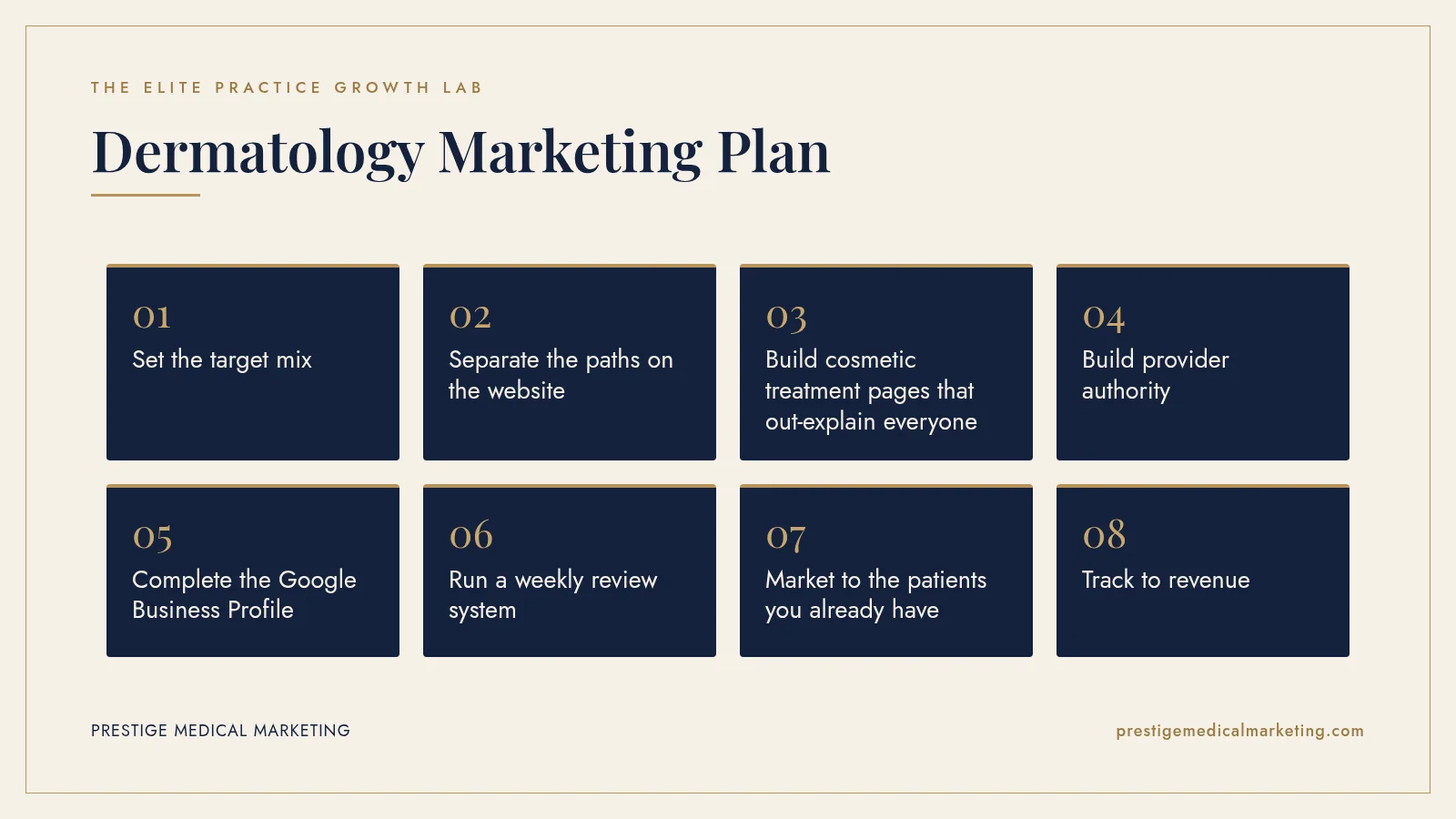
Step 1: Set the target mix
Decide which services you want more of and when. Pull provider capacity by day and room, average ticket and margin by treatment. Marketing should aim at the open hours, not at whatever is easiest to sell.
Step 2: Separate the paths on the website
Clear navigation for medical and cosmetic. Distinct booking paths, because a cosmetic patient should not have to fill out an insurance intake to ask about laser. Every page shows the provider and a direct way to book.
Step 3: Build cosmetic treatment pages that out-explain everyone
A dermatologist can explain skin better than anyone in the market. Use that. Each page covers how the treatment works on skin, who it suits by skin type and concern, number of sessions, downtime, results timeline, risks and starting price.
Step 4: Build provider authority
Full bios with board certification, fellowship training, memberships and publications. Short videos answering real questions. Google’s helpful content guidance rewards first-hand expertise, and patients do too.
Step 5: Complete the Google Business Profile
Dermatologist as the primary category, every cosmetic service listed with a description, real photos, accurate hours and a booking link. If each provider has a listing, keep them consistent with the practice listing and Google’s profile guidelines.
Step 6: Run a weekly review system
Ask every satisfied patient by text, reply personally, and keep health details out of every reply. Volume and recency matter. BrightLocal’s 2026 survey found 74% of consumers only care about reviews from the past three months.
Step 7: Market to the patients you already have
Treatment menus in rooms, a short cosmetic question on the intake form, a monthly email with one treatment explained, and staff trained to mention options when a patient asks. Simple, consistent, and never pushy.
Step 8: Track to revenue
Call tracking, form and booking tracking, connected to your practice management data so cosmetic revenue traces back to its source.
Content that dermatology patients actually read
Skip generic skincare listicles. Patients read the content that helps them make a decision:
- “Laser resurfacing vs. microneedling for acne scars”
- “How many sessions does laser hair removal take on darker skin tones”
- “Melasma treatment options and what to expect”
- “When to see a dermatologist instead of a med spa”
- “What a cosmetic consult with a dermatologist includes”
Each one links to the matching treatment page and ends with a clear next step. Write in plain language and back every health claim. The FTC’s health products guidance expects claims to be supported by competent and reliable scientific evidence, and dermatologists already know how to do that better than most.
Turning medical patients into cosmetic patients, without the hard sell
Your medical patients already trust your diagnosis. That trust is the most valuable marketing asset in the practice, and most dermatology offices never use it. The fix is not a sales script. It is making cosmetic care visible and easy to ask about.
- Ask on intake. One optional line on the new patient form: “Is there anything about your skin’s appearance you’d like to discuss?” It opens the door without pressure.
- Show the menu. A short, well-designed treatment card in every exam room. Patients read it while they wait.
- Hand off warmly. When a patient asks, the provider makes a brief recommendation and the coordinator books the cosmetic consult before checkout.
- Follow up by email. One useful, plain-language email a month about a single treatment, with a booking link. No coupon blasts.
- Track it. Count how many medical patients book a cosmetic visit each month. That number should rise steadily.
Pricing and positioning
Dermatologists should not compete on unit price with the cheapest injector in town. You compete on judgment, safety and results. Position the practice that way in every channel. Show starting prices so patients are not surprised, explain what is included, and let the provider’s credentials carry the difference. Patients who choose on price alone will leave for the next discount. Patients who choose on trust rebook for years.
Memberships and treatment plans can smooth revenue, but keep the offer simple: one or two tiers, clear benefits, easy to cancel. Complexity kills sign-ups, and a membership nobody understands does not build loyalty.
Paid campaigns that respect medical credibility
Paid search is the fastest way to fill open cosmetic hours while SEO builds. Keep the ads in your voice: provider names, credentials, real outcomes described honestly. Point each ad group at its matching treatment page, not the homepage. Measure booked appointments, not clicks. Social campaigns work well for showing the provider and the practice. Keep before-and-after imagery within each platform’s rules, and keep the tone clinical-confident rather than promotional.
Website essentials for a dermatology practice
- Fast mobile pages, with booking reachable in two taps
- Separate medical and cosmetic navigation
- One page per treatment and per major condition
- Provider pages with credentials and photos
- Insurance information for medical services, price guidance for cosmetic
- Patient forms that work on a phone
- Consistent name, address and phone everywhere
Our website efficiency playbook covers how a site should save your front desk time, not create work for it. And when calls come in faster than staff can answer, our call handling guide shows how to stop the leak.
What results should look like
In the first ninety days, expect a cleaner website, live treatment pages, a complete map listing and a steady review rhythm. Map visibility and long-tail treatment terms often move first. By month six, cosmetic bookings from search should be visible and growing in your reports, and you should be able to see which treatments respond best to marketing spend. That clarity is the point: every budget decision after that is based on booked revenue, not on guesses.
See how we structure the program on our dermatology marketing page.
Ready to fill the cosmetic schedule? Check if your market is open or call (716) 400-0084. We’re headquartered in Austin, Texas, and work with practices nationwide.
Put this playbook to work: see how it applies to the Prestige System for medical practice marketing, med spa marketing and plastic surgery marketing.
Frequently asked questions
Should a dermatology practice market medical and cosmetic services separately?
Market them on one site with clearly separate sections and pages. Medical credibility is your strongest selling point for cosmetic patients, so keep them connected, but give each cosmetic treatment its own page, its own booking path and its own reporting.
Is SEO worth it for a dermatology practice with a long waitlist?
Yes, if you point it at the right services. A full medical schedule does not mean a full cosmetic schedule. SEO lets you choose which appointments you want more of, such as laser, neurotoxin or body contouring, instead of taking whatever calls in.
How do dermatologists get more cosmetic patients?
Convert existing medical patients first with clear in-office and email education, then win new cosmetic searches with dedicated treatment pages, consented galleries, provider-focused content and a Google Business Profile that lists every cosmetic service.
Can a dermatology practice use patient reviews in marketing?
Yes, with care. Ask every satisfied patient for a review, respond personally without confirming any health details, and never offer incentives tied to positive reviews. The FTC's 2024 rule bans fake and sentiment-conditioned reviews.
What should a dermatology practice track?
New patient requests by service line, booked and kept appointments, cosmetic revenue by treatment and source, and conversion from medical to cosmetic patients. Traffic and rankings sit underneath those numbers.
How long does dermatology SEO take?
Map listing and long-tail treatment terms often move within two to three months. Competitive cosmetic terms in larger markets usually take six months or more of consistent work.
Should each dermatologist have a separate Google Business Profile?
Google allows individual practitioner profiles for providers who see patients directly. They can help patients searching by name, but they must stay consistent with the practice listing and follow Google's guidelines. For small practices, one strong practice profile with every provider named and pictured is often enough.